
A sign can be more than just a well-recognized object. It can represent a historic moment, epitomize a place, or even herald a landmark idea. When it comes to iconic signs, the USA is full of them.

Especially in the United States, many people collect antique and vintage advertising, street signs, and placards to decorate their garages, bars, and kitchens. American spots like Times Square in New York City have become one giant melange of signs. An entire state promotes its slogan, “Virginia is for Lovers,” through 300 LOVEworks signs positioned across communities, welcome centers, and photo spots. Signs, especially roadside place markers and mid-century advertisements, are part of the American psyche. They appear in movies, from animated hits like Cars to classic films like Pulp Fiction.
There are museums dedicated to signs. The Neon Museum in Las Vegas includes the neon boneyard made up of 250 unrestored signs. The American Sign Museum in Cincinnati, Ohio covers 100 years of history in 20,000 sq ft Work has begun on the newest sign attraction, the St Robert Route 66 Neon Park in Pulaski County, Missouri, which when complete in 2026 will be a free, open-air museum.
We have amassed a list of some of the best known and most visitor-luring signs from the continental United States. The list is not comprehensive since restoration efforts continually enhance famous signs and artists create new works around the country. Below is our list of the 20 most iconic signs in the United States worth traveling to see.

Hollywood
Welcome to Hollywood! There may be no sign more recognizable than the white letters fastened to Mount Lee overlooking Los Angeles. The all-caps letters were originally constructed by Crescent Sign Company in 1923 as part of a real estate advertisement for developers Woodruff and Shoults. The Hollywood Chamber of Commerce saved the sign from demolition after it had deteriorated by the late 1940s, even losing the H completely. The sign again wore hard and in the 1970s needed help. Celebrities like Alice Cooper, Hugh Hefner, and Gene Autry donated approximately $27,000 each for the repairs. HOLLYWOOD, with letters 45 ft tall, is now part of the 138-acre Griffith Park. Multiple hiking trails start behind the Griffith Observatory parking lot, and a 3-mile loop is accessed from Vermont Canyon Road.

Las Vegas
There is a neon wonderland in the Nevada desert, and one of America’s most familiar signs welcomes visitors to Las Vegas. The mid-century retro sign reading “Welcome to Fabulous Las Vegas Nevada” was created by artist Betty Willis. Constructed in 1959, the sign stands at the southern entrance to the famous Las Vegas Strip. Today, the sign is owned by Clark County, has been updated to run on solar power, and is found on every type of Vegas souvenir. The sign’s obverse reads “Drive Carefully Come Back Soon.” And while Vegas is rich with iconic signs, honorable mention must also be given to Vegas Vic who welcomes guests to Freemont Street. The Downtown cowboy, located four miles from the heart of the Strip, is a once-moving but still beloved testament to “Old Vegas.”

Roanoke Star
In 1949, the Roanoke Merchants Association (now the Chamber of Commerce) commissioned Kinsey Sign Co. to construct a decoration for the holiday season to shine above the city. Set upon Mill Mountain, this popular Virginia symbol, made with 2,000 ft of neon tubing, still shines. The world’s largest freestanding, illuminated, man-made star is 88 ft tall and weighs 60,000 lbs. On a clear evening, the star can be seen 60 miles away. Its position atop Roanoke’s highest elevation is accessed via Mill Mountain Park, which is also home to a zoo and a discovery center. The star is usually white, but occasionally, to mark remembrance and display patriotism, the star has been all red, or red, white, and blue.

Citgo
There are welcoming messages for visitors in Boston, but the most recognizable sign of the city’s skyline is an advertisement of a prominent filling station. Citgo stations dot the east coast and part of the midwest. Installed in 1940, the Boston Citgo sign overlooks Kenmore Square and was made famous by making its appearance in the background of Red Sox games, Boston’s Major League Baseball team—legend has it a few Red Sox sluggers have hit the sign with homerun balls. In 1982 the 60×60 ft sign faced removal, but the Boston public demanded it stay. Instead, the sign was given new lighting and remains part of the Beantown persona.
Coca Cola
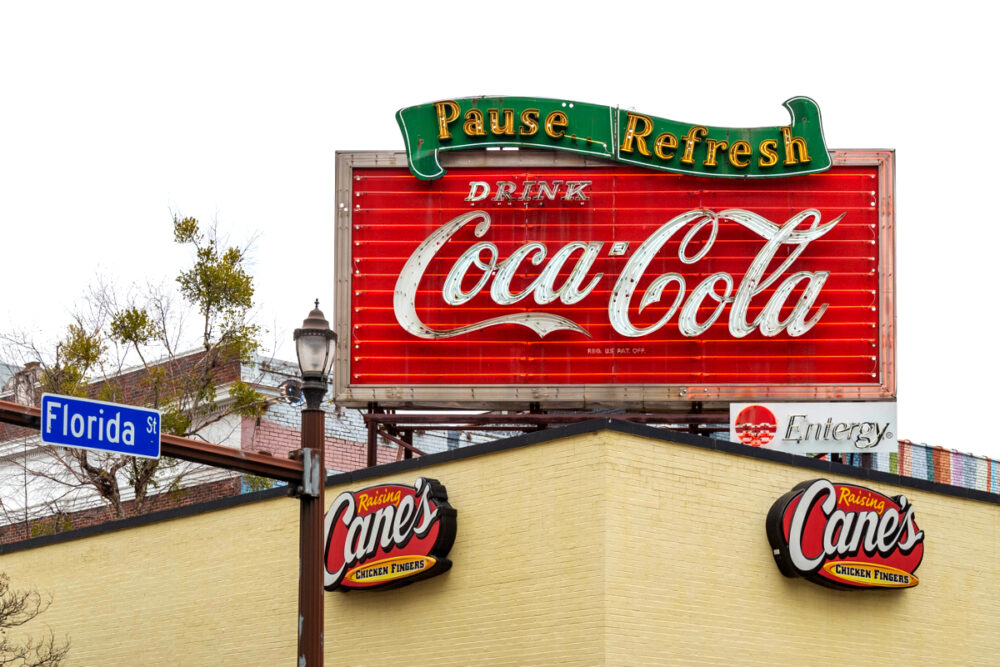
The iconic soda brand was not born in Baton Rouge (that honor belongs to Atlanta, GA), but the beloved rooftop Coca Cola sign in Baton Rouge has lived on the corner of Third Street and Florida Boulevard for more than 60 years. Coca Cola is one of the most collected brands in the world; some of the early Coca Cola collectibles, including advertising signs, can sell for tens of thousands of dollars. Many Coca Cola aficionados recognize the sign as the last surviving sign of its style, with a neon lit red background and classic white script. Atop the sign reads the former company slogan “Pause … Refresh.” Many residents call the sign an emblem of the downtown district, more than just a soda ad.

Universal Studios Orlando
Founded in 1912, Universal Films debuted with a logo depicting the company name over a black and white globe. Now known collectively as Universal Studios, the logo has morphed throughout the years but has remained an iconic symbol to movie buffs. The logo, seen at the opening of films like Schindler’s List, Jurassic Park, and E.T. the Extra-Terrestrial, has come to life at the company’s theme park in Orlando, Florida. The first incarnation of the spinning globe sign was installed for the park’s opening in 1990. This piece eventually found its way to California when Universal Studios Florida expanded and created Universal CityWalk. The location has become a popular photo destination as visitors wait for the perfect background as the new globe spins to read Universal.

Bristol
Walking down State Street in Bristol can be an experience in both Virginia and Tennessee. Visitors can easily recognize which state they are in because, standing near the intersection of Washington St. (Virginia) and Second St. (Tennessee), a 60-by-35 ft sign distinguishes the divide. Small brass markers denote the state line as it runs through the yellow stripes in the middle of the road. Lit by 1,322 bulbs, maintained by the twin cities, the sign stands 25 ft above the street and was erected in 1910. The slogan “A Good Place to Live” was added in 1921. The sign was restored and added to the National Register of Historic Places in the 1980s.
Ebenezer Baptist Church
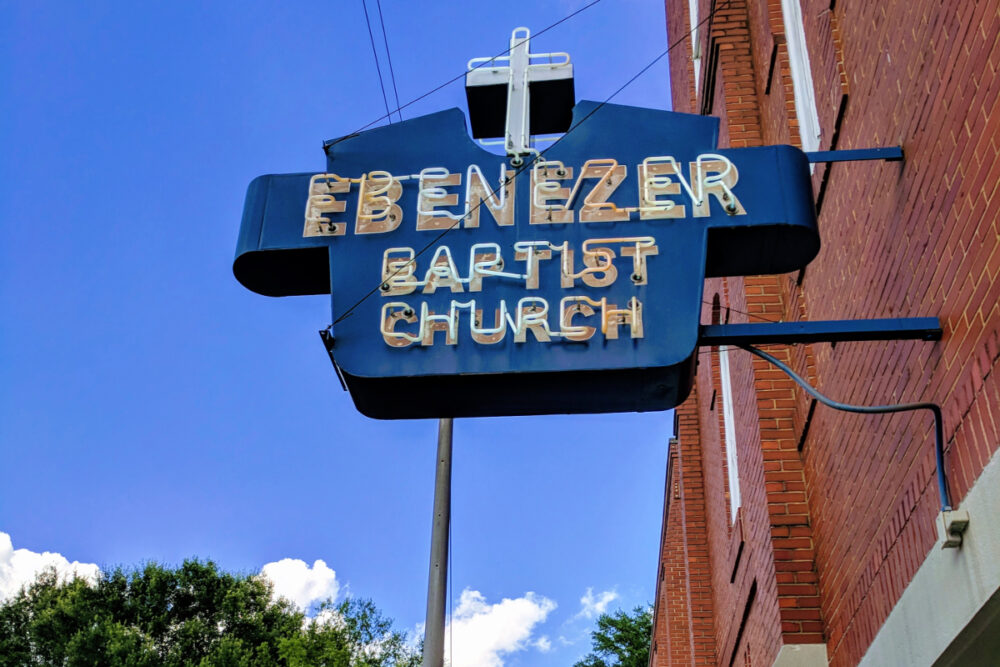
Both an iconic sign and an historic landmark, the neon sign on the side of 413 Auburn Ave NE in Atlanta, GA shines an important light. It is here, at the Ebenezer Baptist Church, that Martin Luther King Jr. was co-pastor from 1960 until his assassination in 1968. King was also baptized, and his father served as pastor at the church. Since the building was designated as part of The Martin Luther King Jr. National Historical Park in 2018, the congregation now holds services in a new sanctuary across the street. The National Park covers 35 acres in Atlanta and includes several sites related to the civil rights leader’s life, including King’s boyhood home. King’s grave site is also located in the park.

Wrigley Field
Wrigley Field, home of the Major League Baseball Chicago Cubs, is known for its iconic marquee at the main entrance. Standing on the corner of Clark and Addison streets, the beloved symbol of the ballpark originally served as an advertisement for Cubs games, promoting day-of-game ticket sales. Installed in 1934, it is as iconic as the stadium itself, which is a draw for any baseball enthusiasts. Visitors flock to the marquee for photos, recognizing it as one of the most memorable landmarks in American sports. The sign in the Friendly Confines was built by Federated Sign Company of Chicago. The marquee received its signature red paint in the 1960s and was given an electronic message board in the 1980s.

Bourbon Street
Bourbon Street is both famous and infamous as revelers party late into the night in New Orleans. The black and white signs on the street corners along Bourbon also display the area’s French heritage by declaring Rue Bourbon. Today, the likeness of this sign—and other rues of the French Quarter—is seen throughout pop culture, on plastic souvenirs, and on tourist shirts, magnets, and stickers. The French Quarter, home of Bourbon Street and also known as Vieux Carré, is one of the most iconic settings in the United States. Some streets in this historic core of New Orleans are also marked with tile signs attached to the masonry of buildings, dating from the post-French era, from 1762 to 1803, when this was Spanish Luisiana.
Pike Place Market
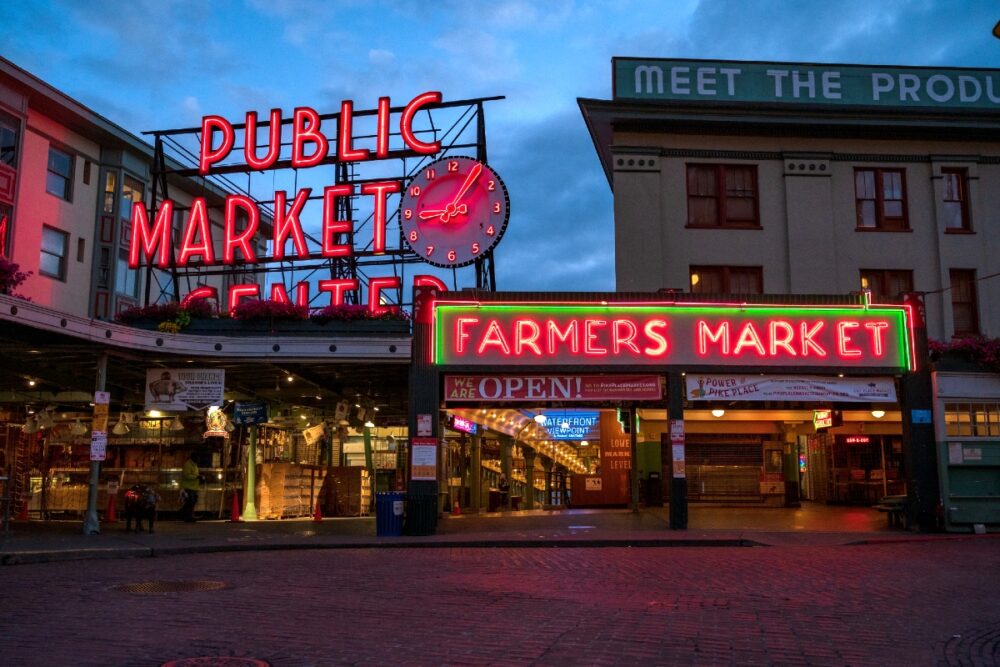
Seattle’s public market, Pike Place Market, overlooks Elliott Bay Waterfront and opened in 1907. This is where the prank of tossing a fish has turned into a sightseers bucket list item for over 30 years. Installed in 1937, the Public Market Center Clock & Sign directs visitors and shoppers to the local sales area with bold, neon red letters and a glowing analog clock. The sign’s artist is unknown. It stands on the Outlook Plaza Roof, directly between the Outlook Hotel and the Leland Building. The sign has been restored and maintained several times over the years, most extensively in 1971 and 2022. The 3-story testament to one of the nation’s oldest farmer’s markets is poised to stand for many more years.

TWA Hotel
Trans World Airlines existed from 1930 until 2001. At one point, TWA was synonymous with flying in the United States. The airline’s main transatlantic hub was the TWA Flight Center at JFK International Airport. Designed by famed architect Eero Saarinen in 1962, the building epitomizes Jet Age design. Today the center is a 512-room hotel marked by its original TWA sign. The TWA Hotel includes jet noise-canceling windows from floor to ceiling, a restored TWA Lockheed Constellation L-1649A aircraft transformed into a cocktail lounge, and a sign equally iconic as the one outside—a split-flap display board by Italian maker Solari di Udine. The building was designated an NYC Landmark in 1994 and listed on the National Register of Historic Places in 2005.

Nathan’s Famous
In 1916, Polish immigrant Nathan Handwerker opened a stand on Coney Island selling hot dogs for a nickel. He immediately outsold his competitors and Nathan’s Famous, the hot dog empire seen in 4th of July eating contests and in the coolers of almost every grocery store, was born. Soon the humble stand on the corner of Stillwell and Surf avenues grew and so did the sign marking its location. Today, the eatery encompasses almost an entire city block. The original, iconic green logo sits on a sign as tall as the building and there is a metal sausage donning a chef’s hat. Culinary items are spelled out in green and pink-orange neon letters. Hot dogs are now more than $5, but the sign remains the same, mostly.

Randy’s Doughnuts
“Our fans come for the photo ops but stay for the best donuts they’ve ever tasted,” say the folks at Randy’s Donuts in the LA neighbor-city of Inglewood. Opened as part of the Big Donut chain in 1952, the shop features a giant-sized doughnut bearing the name of the eatery. The baked good replica is at least 32 ft tall. Architect Henry Goodwin designed the programmatic style building. Structural engineer Richard Bradshaw created the doughnut with rolled steel bars covered with gunite concrete. This architectural institution has been spotted throughout pop culture, most notably in the Iron Man 2 movie when Tony Stark (Robert Downey Jr) enjoys a treat while sitting inside the hole of the rooftop doughnut.

Route 66
Stretching 2,400 miles from the shores of Lake Michigan to the Pacific Ocean, Route 66 remains an important page in US history. Part of the National Park Service’s Share Our Heritage Travel Itinerary, Route 66 meanders past historic buildings, through diverse cultural planes, and touches small town America. The route’s signage, the shield, can be spotted in eight states. No longer a federal road, as originally constructed, sections of the roadway are promoted by regional groups to maintain tourist traffic to many attractions. The Route 66 Legends Neon Sign Park is in Springfield, Illinois. On the stretch of the Mother Road in Kingman, Arizona there is a Route 66 shield large enough to drive a vehicle through. Route 66 celebrates its centennial in 2026.

Scranton Electric City
Scranton earned its nickname as the Electric City due to its early adoption of the power source. In 1886, the nation’s first streetcars powered only by electricity began operating in the Pennsylvania city. The first electric sign atop what is now the Scranton Electric Building lit the night in the early 1900s. Changes through the years have replaced the 1,200 incandescent bulbs creating circles of red and green; a red flame; and white rays, sconces, and letters reading Scranton the Electric City. Because of high operation costs, the sign remained dark from the 1970s until 2004. In 2014, leaders of the cultural organization La Fiesta Italiana spearheaded a drive to replace the bulbs with one-watt LED bulbs. The sign shines with these bulbs today.
Mall of America
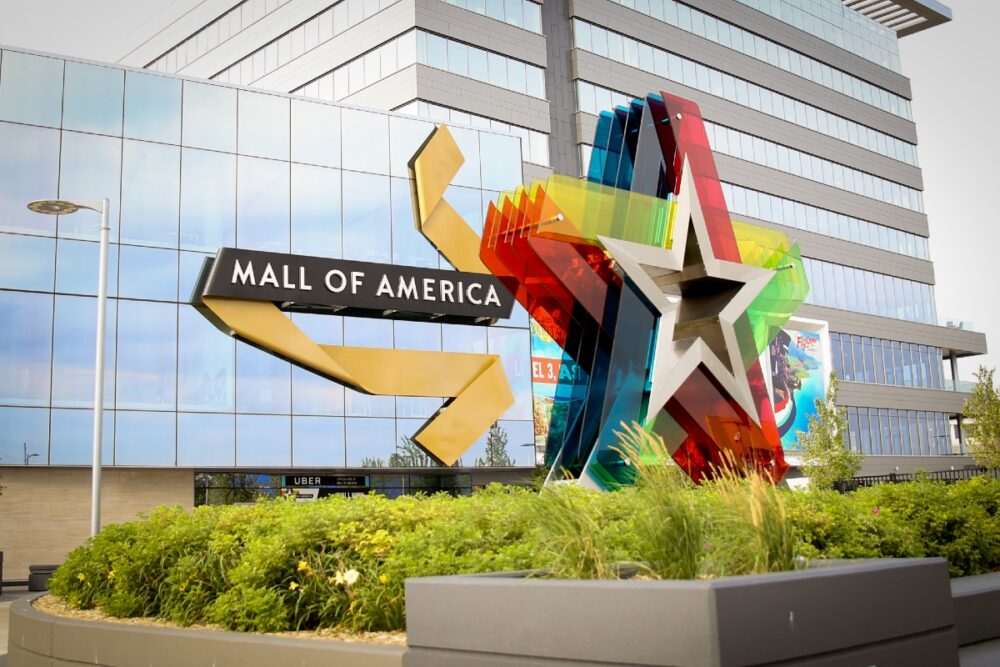
The Mall of America opened in 1992 at the height of shopping mall culture. Located in Bloomington, Minnesota, the facility is the largest mall in the United States and attracts 40 million people annually. A large rainbow-colored star is the welcoming sign to these visitors; it has served as a photo op since its recent installation. Mall operators removed the original Mall of America signs in 2014 when the mall underwent expansion. The sign has been seen in many wedding photo albums, because the mall has hosted over 9,000 ceremonies over the years. The 5.6-million-sq-ft mall doubles as an entertainment complex, which includes Nickelodeon Universe, Crayola Experience, and SEA LIFE aquarium. There are two hotels attached to the mall, the 14-story Marriott and the 500-room Radisson Blu.

Iwo Jima Theatre
The city of Jacksonville, North Carolina is rich with American patriotism. Marine Corps Base Camp Lejeune occupies 246 sq miles around the city in Onslow County. With the base opening in 1941, a military presence has made a significant impact on Jacksonville over the years. In 1953 Stewart & Everett Theatres opened a movie house downtown and named it The Iwo Jima Theatre. A point of pride for American Marines, the Battle of Iwo Jima was a turning point in World War II. The movie house, and many of the other iconic buildings and businesses of the 1950s, have disappeared with downtown reinvestment. But the forward-thinking folks at Onslow County Museum have preserved the theatre’s neon sign and display it with prominence as a symbol of Jacksonville’s history.

Chicago Theatre
In 1921, the doors opened for the first time at the Chicago Theatre, which was built as a movie palace inspired by French landmarks and architecture. Designed by Cornelius and George Rapp, the building was the flagship of the B&K Theatre Corporation. Reading vertically above the marquee, its illuminated letters spell out CHICAGO. The sign is one of only a few exposed-lamp electric signs still in operation in the US. At one point the letters were constructed of porcelain enamel-coated sheet metal and featured chaser lights cascading in a swirl pattern. This iconic image has featured in television and film for years, although the marquee has changed. In 2004, the original marquee was donated to the Smithsonian.
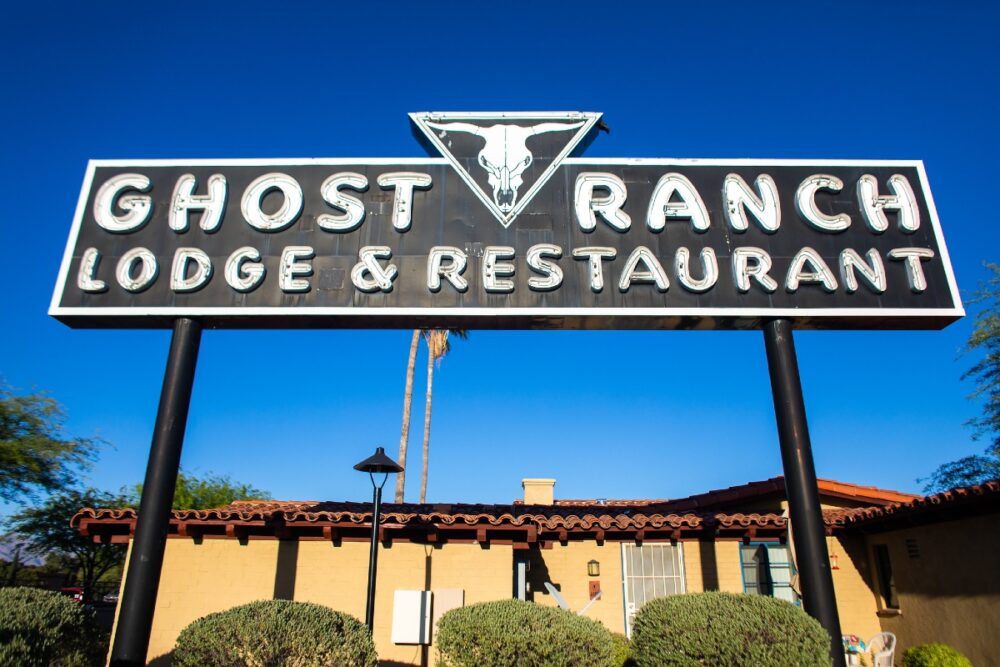
Ghost Ranch Lodge & Restaurant
Tucson’s Miracle Mile is steeped in history, some of it glamorous and some of it seedy. The 1.4-mile section of road lies north of Downtown Tucson. On December 11, 2017, the strip was listed on the National Register of Historic Places. The road is dotted with a collection of early- and mid-20th century automotive culture relics, including historic motels, service stations, and neon signs. Although not neon, the Ghost Ranch Lodge sign still welcomes visitors to the roadway today. The business has changed and is now a senior living facility, but the sign remains an iconic symbol of the heyday of cross-country American motor travel. Swiss-American architect Josias Joesler designed the building in 1941.