There are many Ways to Santiago, and the Camino Primitivo, which follows the path of the very first pilgrimage to the relics of Saint James, is among the most rewarding. Traversing the mountains of Asturias, the walking is tough, but the trail is quiet and stunningly beautiful: a place where revelations abound.
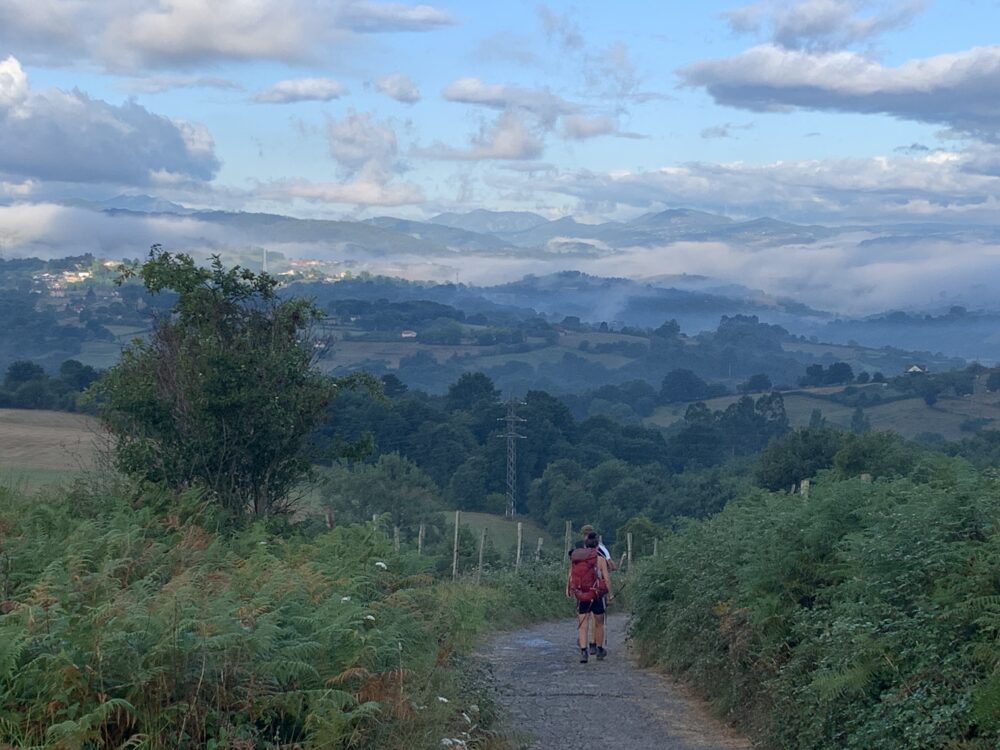
Pilgrims in the hills outside Oviedo (Photo: Chris Newens)
After just four days on the Camino Primitivo, I was tempted to stop. Not because I was having a bad time, nor because the trail was proving beyond my fitness. It was another reason: something unexpected, a truth about travel that until then I’d never quite grasped, and which ended up in exactly the kind of epiphany that people who set off toward Santiago hope to acquire. Typical.
When I’d mentioned my plans of switching up to the Primitivo route from the vastly more popular Camino Frances, which I’d already been trekking for two weeks, I had encountered much sucking of teeth. The more experienced pilgrims said the Primitivo was hard. One, an old German hiker with legs like band saws, even used the term ‘unbelievably’; the Primitivo was unbelievably hard.
King Alfonso II, the first person ever to make a pilgrimage to the bones of Saint James, and whose footsteps the Camino Primitivo follows, had not had modern have-a-go hikers in mind. His path was dictated by necessity. These days there is a whole network of Caminos to Santiago, but this was in 841 AD. The rest of Spain was occupied by the Umayyad Caliphate; if you wanted to get to the relics of the Christian saint, there was no taking the plains.
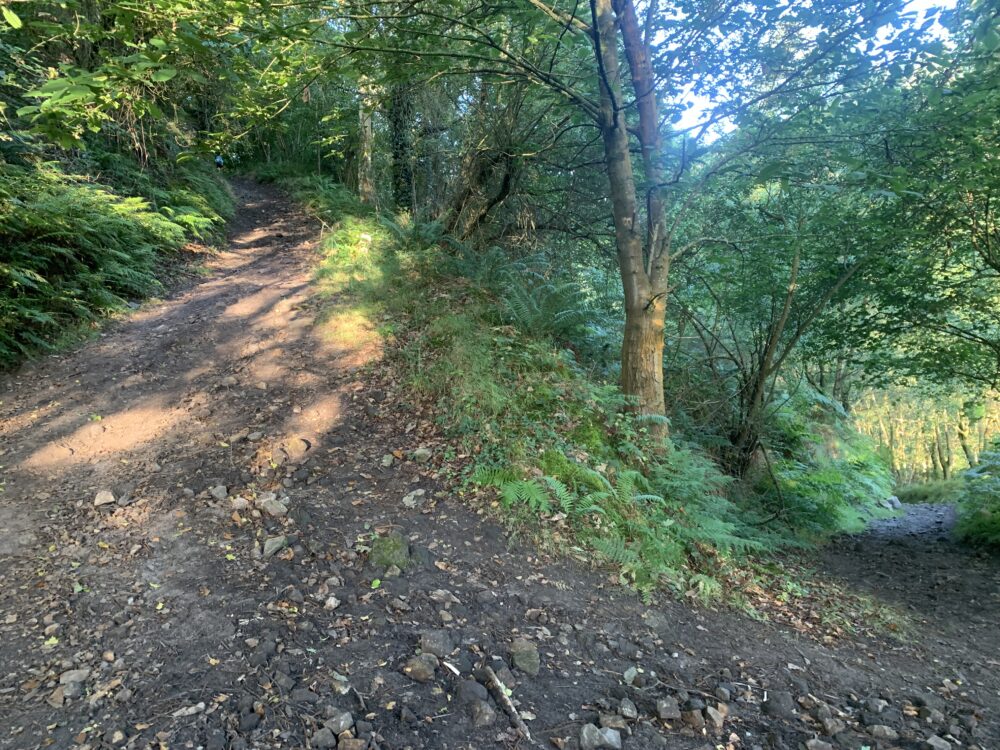
Hard walking (Photo: Chris Newens)
“You probably won’t meet anyone else who speaks English, either,” the warnings had continued. “The Primitvo is nowhere near as popular as the Frances, and the only people who do walk it are Spanish. Maybe some Italians.”
This had sounded appealing. For in coming to Spain to take part in this ostensibly spiritual endeavour, I had not counted on the main Camino route revealing itself as in effect the longest pub crawl in Europe. My two weeks on the trail, across the Pyrenees from Saint Jean Pied de Port to the vineyards of Burgos had been some of the most social of my life. The first cervezas were poured before 12 most days, and rest stops resonated long into the evenings with the sound of trail gossip and fat being chewed. I’m not saying it wasn’t fun, but I had figured I could do with some time alone.
So I had taken a bus from Burgos up to Oviedo, the Primitivo’s trailhead: a chilly, clean mountain town where they pour their cider from high and that once, long ago, had been the capital of all Christian Spain.
The route was well marked with the same yellow arrows as characterise all Caminos, and even if I did wander off I could soon find my way back with the GPS of the excellent Buen Camino app. But the warnings had proved right enough; walking the Primitivo was hard. Each of those first four days boasted ascents of at least 800 metres, mostly on uneven, rutted tracks. And it was lonely. There were other hikers – more than I had been led to expect – but they seemed interested in keeping to themselves; focussed on the trail rather than its inhabitants. Soon, though, I had remembered that “hard”, when it comes to walking, also means beautiful.
Straight out of Oviedo, the Primitivo entered a landscape of ancient hollow-ways and fantastic, shadow-strafed hills. Dawns were of luminous fingered rose, distant clouds draped silver rain curtains across jagged horizons, and isolated villages stood quiet vigil over valleys that looked old as creation. And as to lonely, isn’t that just another way of saying peaceful? All this beauty I was walking through, and for the most part, I had it to myself. In my ears, there was only the sound of my own footsteps, the Asturian wind, and the occasional chime of the twin bells that have soundscaped European hillsides for centuries: cow and church. It was bliss. Exhausting, foot-sore bliss, but bliss nonetheless.
So why now was I thinking of quitting?
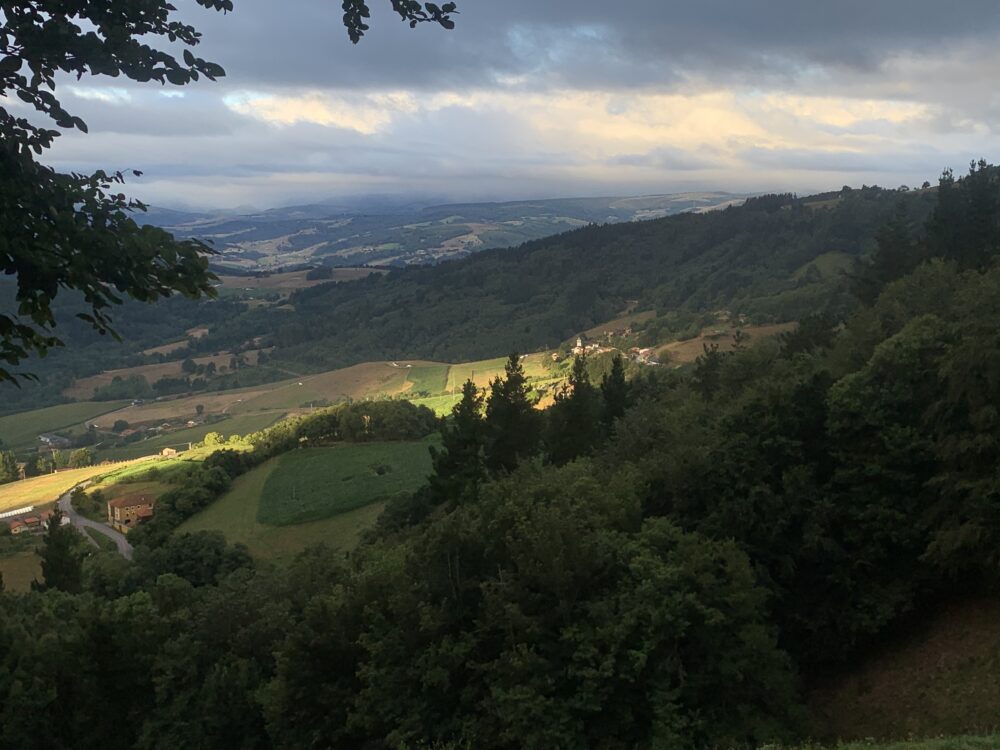
The beauty of the Primitivo (Photo: Chris Newens)
The start of my answer was the village where my fourth day on the Primitivo ended. Pola de Allande sits on a river at the base of a valley. I arrived under stunning blue skies, down white dusted paths and past crumbling farm houses from another age. It had been my longest day walking so far. I was tired, but exultant, and in the mid-afternoon sun, the village was a kind of paradise with its large turn of the century houses, shadowy streets, and views back to the green hills through which I had just walked. In a local bar that straddled the river, I sat down to one of the best beers I have ever tasted.
All this, however, was not so unusual on the Camino, where the exhaustion of long days has the tendency of elevating even the most average of destinations and transubstantiating any beaded glass of Estrella Galicia into a nectar of the gods. True, Pola de Allande was a nicer village than most, but its real seduction was where I stayed.
Just like on the Camino Frances, accommodation on the Primitivo is plentiful, if rudimentary and cheap. Pilgrim hostels offering dormitory bunks with paper sheets and costing between 8 and 18 euros are the norm in almost every village or town you walk through. There are usually private rooms available too, but when you’re away for as long as I was, now almost three weeks into an assumed five week odyssey, budgets must be stretched. This relentless communal living – its perpetual offer of only semi-comfort – is one of the hardest deprivations of the Way.
Nevertheless, I had been pushing the lifestyle as far as I could. Seeking out the cheapest of the cheap hostels, the donativos, where payment is by donation alone. This was not just about saving pennies, but also because I had discovered that it is in these establishments where, for want of a better word, the spirit of the Camino most resides. Yes, likely as not a night in a donativo means sleeping on the floor, crammed shoulder to shoulder with other pilgrims. But they also provide home-cooked meals, usually followed by short religious services which, despite my lack of faith, drew me closer to the people I shared them with, and to whatever it is – a sense of story, I guess – that lifts a pilgrimage beyond the status of a mere walk.
When I read then on the Buen Camino app that Pola de Allande had a donativo, it was to there that I headed. And discovered that it was like no donativo I had stayed in before.
Situated in an old riverfront property, the moment I stepped through the door of the Albergue Polagrino I was met by comfort. The entrance gave way into a large communal area cradled cool by thick stone walls. There were two large sofas and a wooden dining table –the empty stage of a thousand travellers’ tales. The walls were hung by the dusted souvenirs of foreign journeys and through the tall windows spilled beautifully moted light.
And it was quiet. The space had a calm unlike any interior I had been in for weeks, and which was as refreshing to me as a pull of water from a deep well. I was the only guest.
The man who ran the donativo was Dutch, though perhaps it would be better to call him a citizen of the world. He was slight and as tranquil as his house, which he told me he had bought during Covid, after many years of travelling the globe. He had spent two years restoring the Albergue Polagrino and now had opened its doors to let the globe travel to him. It was not always so quiet, he said. Most days he had four, maybe five guests, plus volunteers. Though today his volunteers had taken a trip to the beach. “Anyway,” he concluded. “Dinner’s at 8.”
My bed, in an empty wood-panelled dorm, was antique and soft. After showering, I siesta-ed in it for hours, feeling the privacy like a hot bath. The river gurgled outside and the ache of the Camino left my bones.
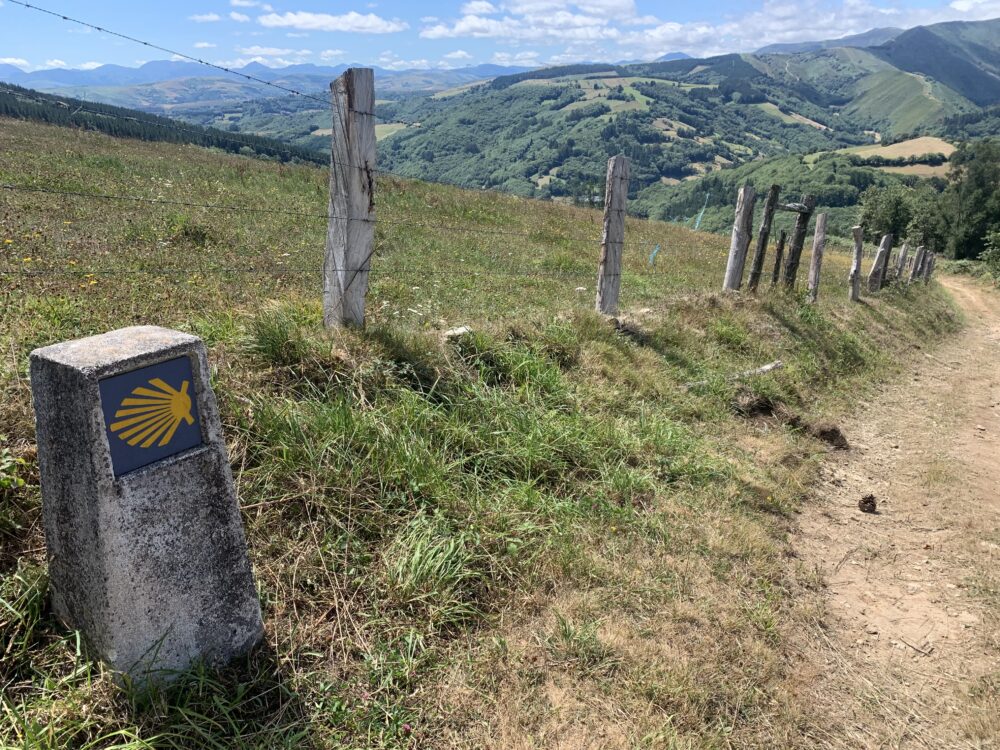
The road down into Pola de Allande (Photo: Chris Newens)
Dinner was vegetable curry. Hardly spectacular but after weeks of nothing but shades of Spanish yellow – tortilla, cheese, mayonnaise, fries – it tasted so good and healthy, I swear I could feel it adding years to my life. I ate with the donativo owner, and we spoke in low voices about the Camino and travel and about Pola de Allande in winter, when snow on the passes could cut it off entirely from the outside world.
Then, just as I was cleaning away the plates, the volunteers returned. Two young women from Zimbabwe, one from Spain, and an older man from the Midwest with grey eyes and tattooed slogans on his arms that had once been about the glories of being young, but that he’d had visibly amended to celebrate the pleasures of growing old.
We all got to talking. A bottle of wine was uncorked. In a way, it was much like so many other conversations with strangers-becoming-friends I’d had already on the Camino, but in another it was not. It was gentler, more rooted. These were not people who could walk away from each other if they chose. It felt closer to real life.
I went to bed with words ringing from everyone that if I wanted I could stay. Perhaps just for one more day, perhaps for more. They were going swimming in the river tomorrow, they said, and I was welcome to join. But I’d said no, said that I had to be out very early. Because tomorrow was the hardest day of the whole trek. Tomorrow, I added with bravado, I had a mountain to climb.
Except now I was staring into the murky blue of my lovely room’s ceiling, listening to the river outside as it continued its uninterrupted flow, and I did not feel that bravado any more. I felt like, yes, I wanted to stay.
People walk the Camino for all sorts of reasons. And they talk about their reasons for walking it. To get over a break up, to resist the sense of their own aging, some are even looking for God. Regardless of motives, however, most agree that it’s not about the destination, far more about the journey. But what now, I wondered, if I had found a destination after all? And it wasn’t Santiago, but a small patch of paradise in an Asturian valley I’d never heard of before but that after fewer than eight hours had started to feel like home.
I left before sunrise.
The pilgrimage path ran just a couple of kilometres along the valley floor before it started to curve up. And up. And then up some more. The sun rose greyly, and sweating cold, I ascended into the clouds. And I was still going. The world shrank to a bubble of clammy white, the blood rushed in my ears, my boots looked for purchase on the scree. Then, at last I was at the summit and in a loud-roaring wind. And in my chest came a quickening of adrenaline, as my mind recognised the danger of where I was – alone on the top of mountain, in a gathering storm. I wished more than anything I’d stayed in Pola de Allande, where in my head the sky was still blue. I pushed on.
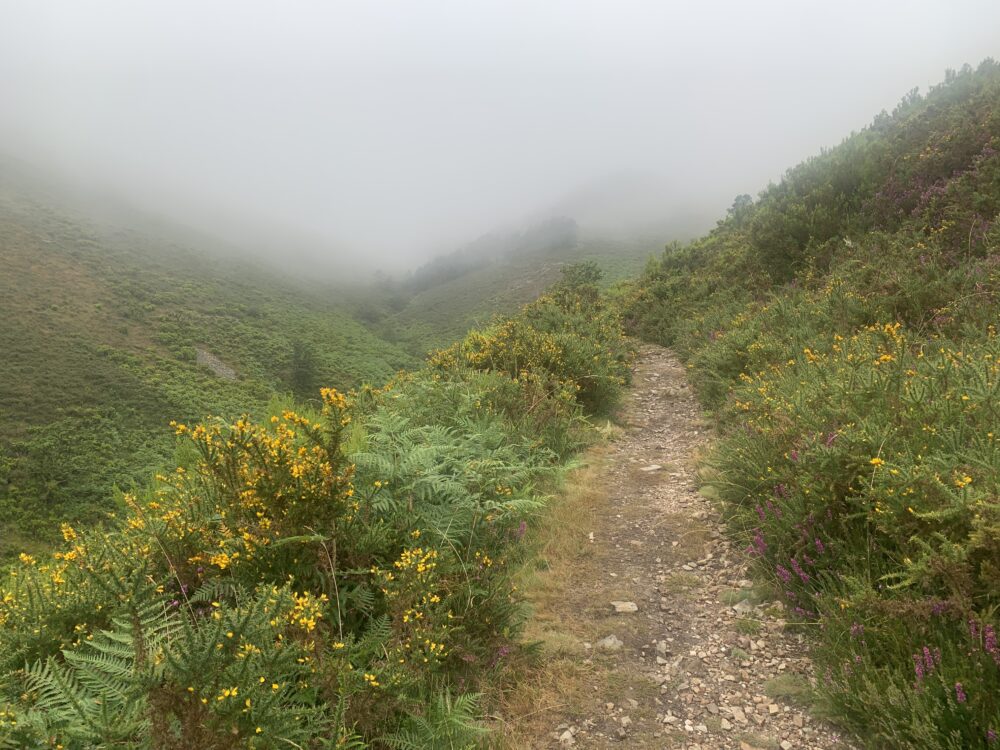
The route up toward the mountain pass (Photo: Chris Newens)
Soon, I was out of the worst of the wind, descending gorse-covered slopes. And not so long after that – four hours perhaps – I had reached another village and another hostel. Neither were anything like as beautiful as what I had found in Pola de Allande, but with 25 kilometres behind me, I would not be going back.
This hostel soon began to fill with other pilgrims. There had been another route it turned out, one that bypassed the valley, and which had taken them along a mountain ridge, where they’d fought with that loud-roaring wind for hours instead of the minutes I had suffered. And suddenly, whatever their native language, everyone wanted to talk; to share their hardships, or, even though they had only just met me, to tease me for choosing paradise over hell.
It marked the beginning of a new kind of Primitvo, almost as sociable as the Frances, though considerably more Spanish – less alien to the countryside through which it was passing. The walking only got tougher; the scenery more spectacular.
There were days when clouds pooled like lakes in the valleys and made the landscape into an archipelago of peaks. There were moments of magic: a Gallaecian bagpiper playing alone at sunset, wind turbines looming like Martian Tripods from mountain mist. There were card games and shared meals of polpo and pig’s head. There were new friendships and confidences and finally goodbyes. And eventually, inevitably there was Santiago.
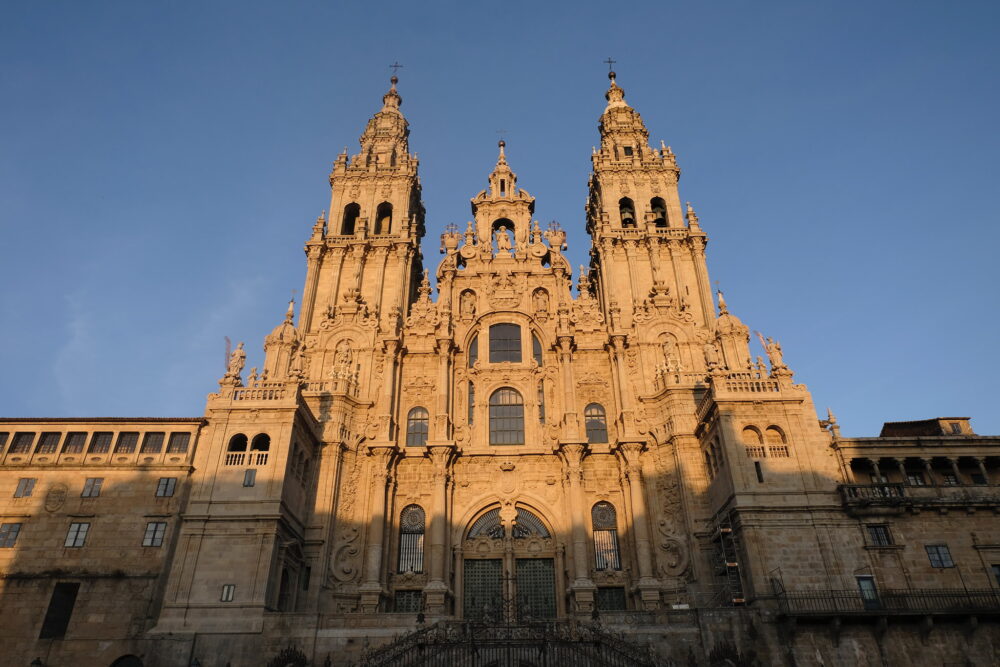
The cathedral at Santiago, one of the great arrivals gates of the world (Photo: Person-with-No Name via Flickr/ CC BY 2.0)
It was only lying on the hot stone of the Plaza del Obradoiro, surrounded by other pilgrims in one of the great arrivals gates of the world, staring up the baroque façade of Santiago Cathedral, that I realised where I’d found the motivation to make it here, and the real importance of a pilgrimage’s destination. Because, the thing was, that destination was no more this square than it had been Pola de Allande. For no matter how long it has taken to reach Santiago, and whatever route you walked, you will at a certain point need to again pick up your bags, and return to where you started out.
Home, I realised, is the inverse of travel, but it is also what gives travel its meaning. This is not something I consider on most journeys, but something that the length and difficulties of the Camino, not to mention its tendency to inspire pop-philosophising, had pushed into my mind. My desire to stop in Pola de Allande had been a kind of homesickness, though it was a sickness that the village would ultimately have only distracted from, rather than cured.
During my final few days on the Primitivo, just as it merged back with all the other Camino routes of Spain, I had downloaded onto my Kindle the story of another European journey even older than that of Alfonso II. The one Odysseus, that man of many ways, took on his return from Troy. And I had reminded myself how even that most famous of voyages, though ten years long, was in the great majority not spent going anywhere at all.
Calypso, Circe, lotus eating of any kind – a donation based hostel deep in the Asturian mountains: these are among the seductions of travel, but not things, ultimately, that we travel towards. The Camino is not to Santiago, but to whichever Ithaca you call your own.