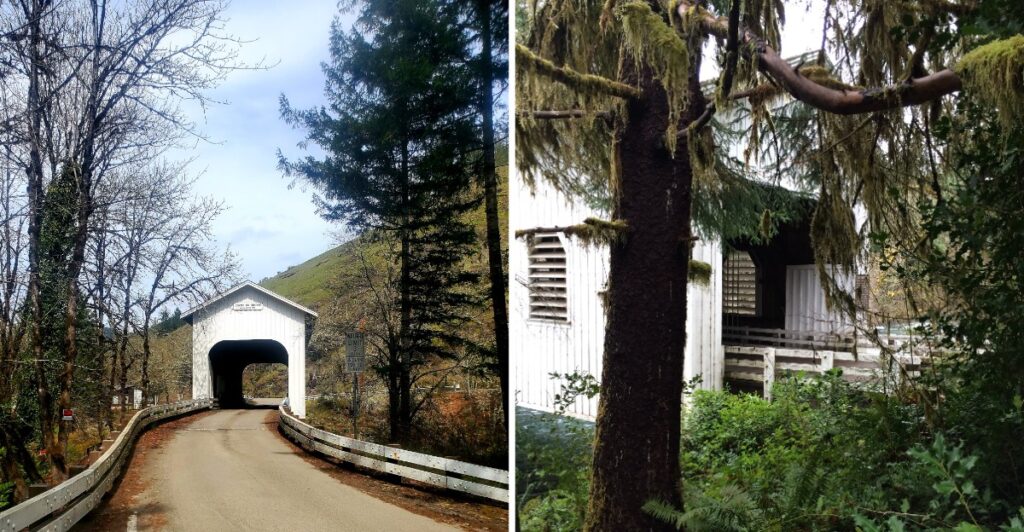
Neighbors once guarded a covered bridge overnight to stop it from being burned. That happened in the late 1950s, after a nearby covered bridge had already met that fate.
Another Oregon bridge was swept off its supports by a 1942 flood. Crews put it back, and it later made it through the 2020 Holiday Farm Fire.
Then there’s the state’s longest covered bridge, stretching 180 feet. It even has its own separate walkway for people on foot, the only covered bridge west of the Mississippi River built that way.
Honestly, I’d trust a stubborn wooden bridge over most modern parking garages. Roll your windows down and take your time crossing.
Oregon built these crossings to outlast rain and storms, and many are still doing the job.
1. Historic Goodpasture Covered Bridge, Vida, OR
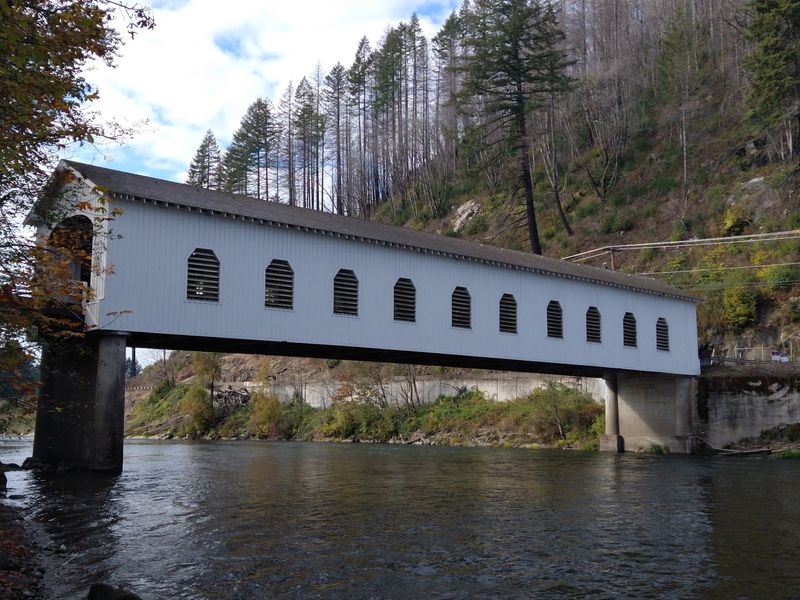
Some bridges get a ribbon-cutting, but this one got featured on commemorative coins in 2005.
Those coins helped fund upkeep for Lane County’s covered bridges, which is a pretty classy way to pass the hat.
Lane County built the span in 1938 and named it for Benjamin Franklin Goodpasture, an early pioneer farmer.
At 165 feet long, it ranks as the second-longest covered bridge in Oregon.
The design is the real show-off move. You get a Howe truss, semi-elliptical portals, and ten Gothic-style louvered windows on each side.
Those windows let daylight into the deck as you roll through. Take it slow, because the bridge handles one car at a time.
History has tested this crossing hard. A December 1942 flood knocked it off its abutments, yet crews restored it.
It also made it through the 2020 Holiday Farm Fire. Big renovations in 1987 and 2012 keep it sturdy enough for vehicles up to 44 tons.
Below, the McKenzie River rolls past, and fishing is close by. Bring a rod or a camera, since this ranks among the most photographed bridges in the state.
Visiting around the holidays? The bridge gets dressed up in customizable LED lighting, so evening drives turn festive fast.
It joined the National Register of Historic Places in 1979, and it wears its age well. Few road trips let you drive straight through a postcard.
The bridge stays open around the clock. Sunday mornings and Saturday afternoons tend to draw more company, while weeknight evenings feel calmer.
Address: 45200 Goodpasture Rd, Vida, OR 97488.
2. Historic Office Covered Bridge
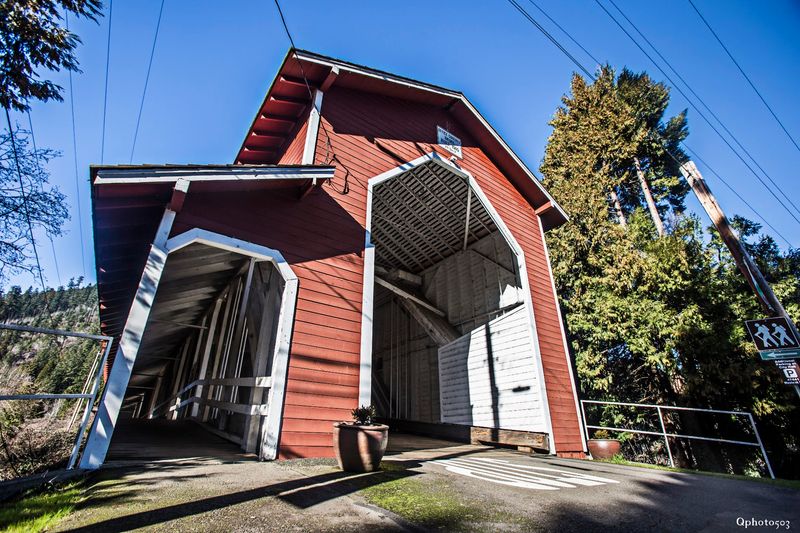
Lumber companies usually build for function, but the Westfir Lumber Company built a record holder in 1944. At 180 feet, this red beauty is the longest covered bridge in Oregon.
The company needed to link its mill site to its office, hence the name. It was built tough enough to carry heavy logging trucks.
Two earlier bridges, from 1924 and 1941, lost their fights with floods. The third time was clearly the charm.
Now for the quirky part. A separate pedestrian walkway runs alongside, making it the only covered bridge west of the Mississippi with that feature.
It’s also one of just two Oregon bridges built with triple Howe truss construction. Windows along the sides frame the North Fork Middle Fork Willamette River below.
The original wooden floor is still part of the crossing. Passenger cars and bikes can use the roadway, while pedestrians have a separate walkway, and the bridge has a posted 14-ton vehicle weight limit.
After the Westfir lumber mill burned in 1979, the privately owned bridge closed to public traffic.
Lane County took ownership in 1992, made repairs, reopened it, and added a new roof in 2002.
Plan to linger. Portal Park at the north end has restrooms, a playground, a picnic area, and a trailhead for the North Fork Trail.
Disc golf fans will find a course nearby too. The bridge also marks the southern entrance to the Aufderheide National Scenic Byway, so your slow drive can keep going.
Holiday visitors can catch the annual Bridge Lighting Festival. The bridge sometimes closes for special events, like Mountain Bike Oregon in late June 2026.
Address: Westfir, OR 97492.
3. Rochester Covered Bridge, Oakland, OR
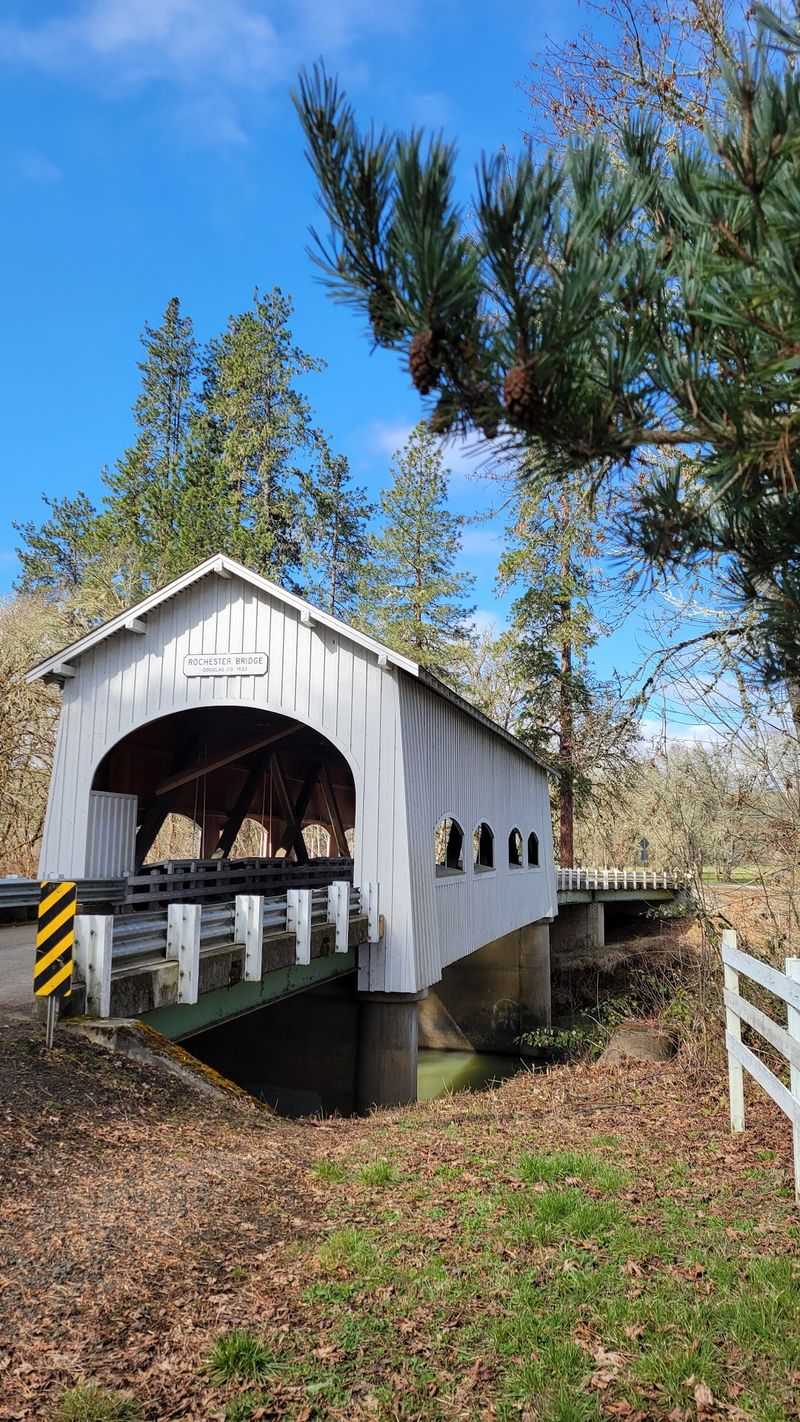
Talk about community spirit. In the late 1950s, armed residents reportedly guarded this bridge overnight so county workers couldn’t burn it down.
Another nearby covered bridge had already gone up in flames, so neighbors weren’t taking chances.
Their stubborn streak paid off, and you can still drive across today.
Floyd Frear built the current bridge in 1933. It replaced an older structure that may have dated back to 1862.
The bridge stretches 80 feet over Calapooya Creek and carries Rochester Road. You may also see it called the Calapooya Creek Bridge.
Look closely at the sides. Four curved-top windows line each wall, a detail that sets it apart from boxier bridges.
Faux decorative beams also dress up each gable end. It’s a Howe truss underneath, but the trim adds extra charm.
Speed is not the goal here. A recommended limit of 15 mph keeps things relaxed, which suits a bridge that’s been through so much.
It sits about three miles northwest of Sutherlin, off Old Highway 99. That makes it an easy add-on if you’re cruising the back roads of southern Oregon.
The bridge got remodeled in 1969 and stays open around the clock. Thursday and Friday afternoons tend to be quieter if you want photos without traffic.
Give a silent thank-you to those overnight guardians as you roll across. Without them, this spot would just be a creek with a road ending at it.
Address: 198-134 Rochester Bridge Rd, Oakland, OR 97462.
4. Yaquina River Chitwood Covered Bridge
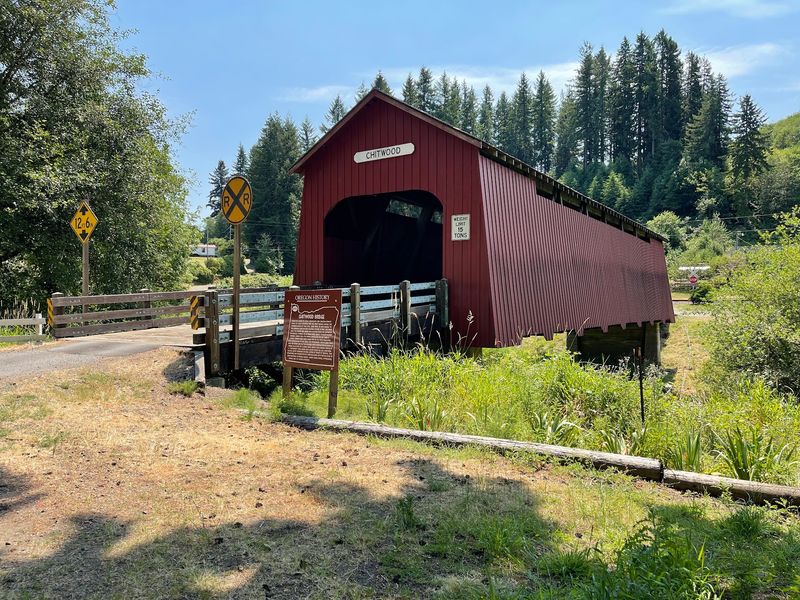
Not many covered bridges come with a sidekick, but this one has a giant tree standing nearby like a leafy bouncer.
Between the two, you’ll want your camera ready before you even park.
The bridge crosses the Yaquina River in quiet countryside near Toledo. A railroad runs through the scene too, adding another layer of history to the view.
Best of all, you can still drive through it. Plenty of Oregon covered bridges now serve walkers only, so rolling across one feels like a small treat.
Keep it slow and steady. Rural roads like this reward patience, and the bridge deserves more than a blur through the windshield.
Limited roadside parking is available near the bridge, so pull over only where it’s safe.
Kids tend to enjoy this stop. A wooden bridge, a huge tree, and a river make a fun break from staring at the back of a car seat.
Coming from the coast? Toledo sits a short drive inland from the central Oregon coast, so this works nicely as a detour on the way home.
The bridge is kept in excellent shape. That upkeep makes it a pleasure to photograph from almost any angle.
Want the full experience? Drive across once, then park and walk back to admire that tree up close.
Respect the neighbors, since this is a rural spot. Keep voices low and leave the quiet the way you found it.
Address: 51 Chitwood Rd, Toledo, OR 97391.
5. Cavitt Creek Covered Bridge
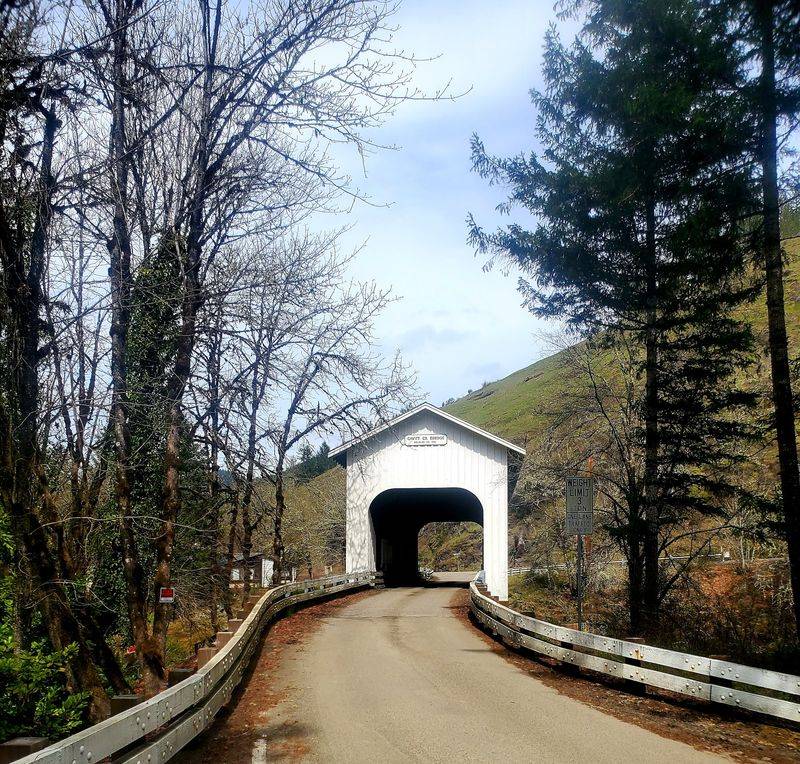
Here’s a fun naming puzzle for your road trip. The Cavitt Creek Covered Bridge doesn’t actually cross Cavitt Creek.
It spans the Little River, carrying Cavitt Creek County Road over the water. That’s why you’ll sometimes see it called the Little River Covered Bridge.
Builders finished it in 1943, right in the middle of World War II. It uses a Howe truss design, housed inside a wooden shell.
That roof isn’t just for looks. Covering a bridge shields the structural wood from Oregon rain, which explains why these old spans stick around so long.
The bridge sits near Glide, a small community east of Roseburg. It still carries road traffic, so you can roll right through.
Slow down on the approach and give it a proper look. Rural bridges like this are easy to miss if you’re rushing.
The setting is the real bonus. The Little River makes a scenic backdrop, so a quick photo stop pays off.
Pull over only where it’s safe. The road is still in use, so other drivers may be heading through.
Pair it with the Rochester bridge for a double feature. Both sit in Douglas County, so they make an easy day of bridge hopping.
The bridge stays open around the clock. Morning light can make for softer pictures if you’re picky about photos.
Bring snacks and a full tank. Back roads out here reward the prepared traveler.
Address: Glide, OR 97443.
6. Historic Mosby Creek Covered Bridge
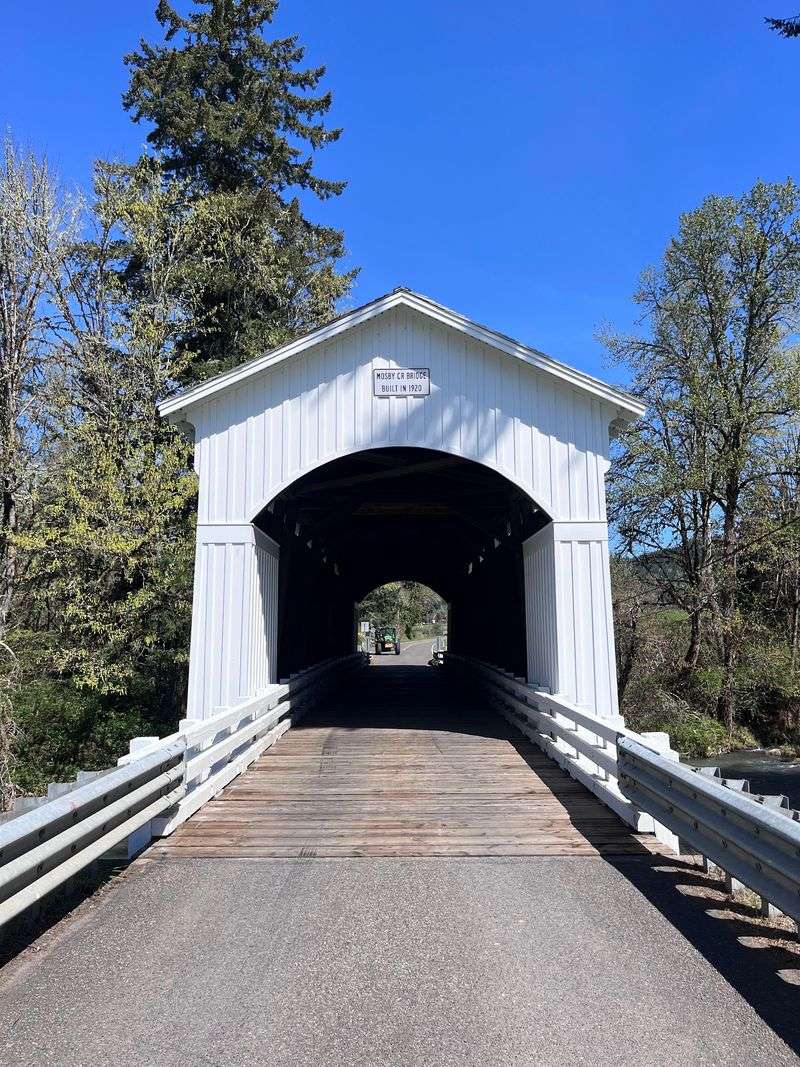
Retirement clearly isn’t on the schedule for this 1920 workhorse.
It’s the oldest covered bridge in Lane County, and it still carries traffic outside Cottage Grove.
Walter and Miller Sorensen built it, and it takes its name from pioneer David Mosby. He claimed 1,600 acres nearby back in 1853.
The looks are classic. Graceful semi-circular portal arches greet you at each end, framing board-and-batten siding.
Narrow ribbon openings near the roofline let in light and air. It’s a small detail that makes the inside feel less like a tunnel.
Mind the numbers before crossing. It’s one lane, with an 8-ton weight limit and a height cap of 11 feet 7 inches.
There are no sidewalks, so this one is for driving, not strolling across. Parking is tight too, with just two small pull-offs.
Want to stretch your legs anyway? The main trailhead for the Row River Trail sits right next to the bridge, great for a walk or bike ride toward Dorena Lake.
Movie fans, take note. The orange railroad bridge from the 1985 film Stand by Me is nearby.
The bridge joined the National Register of Historic Places in 1979. Restorations in 1990 and 2002 helped keep this senior citizen in good working shape.
Roll through gently and enjoy more than a century of history overhead. Few commutes come with this much character.
Address: 77935 Layng Rd, Cottage Grove, OR 97424.
7. Historic Hoffman Covered Bridge, Scio, OR
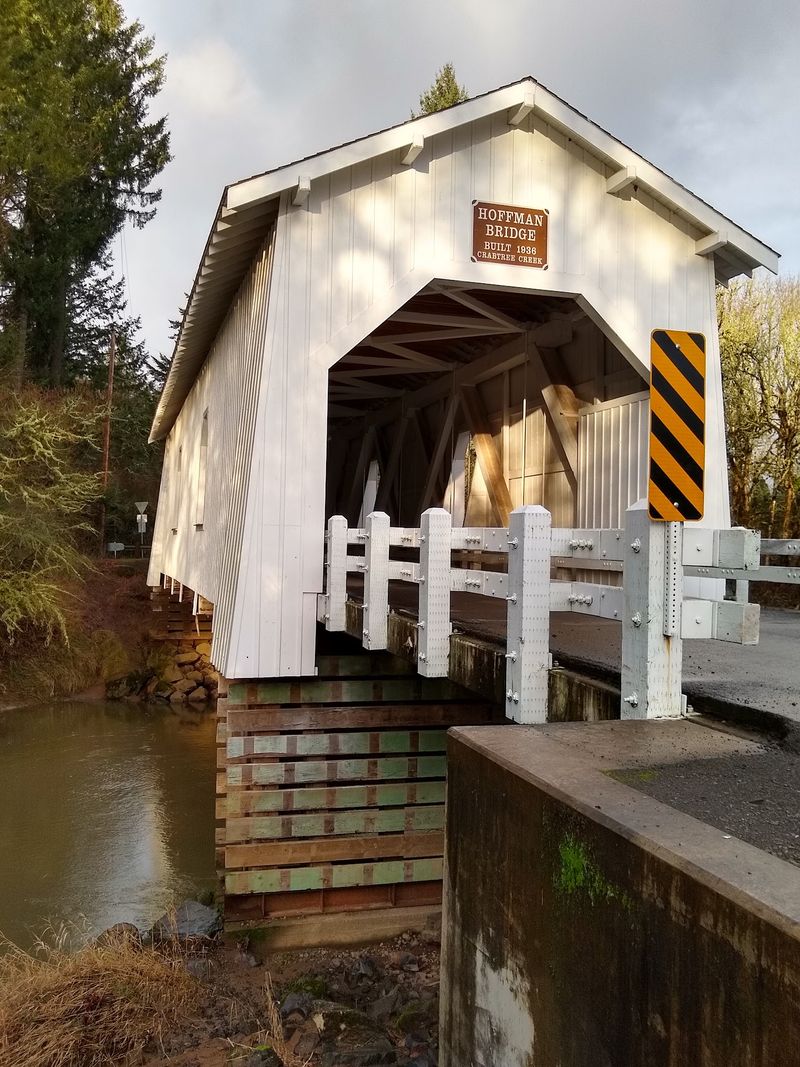
Hungry Hill Road sounds like a snack stop, but it actually leads to one of the prettiest short spans around Scio.
This bridge wears white paint and Gothic-style windows like it’s dressed for Sunday best.
Look for its four unique windows too. They give this restored bridge a personality all its own.
The span is short, so the crossing goes quickly. That’s your cue to slow way down and make it last.
A scenic swimming area sits near the bridge. On hot days, it’s a tempting place to cool off.
Anglers like it here as well. Watching someone cast a line from the bank is about as peaceful as an afternoon gets.
Free street parking keeps things simple. Pull over, grab your camera, and soak up the calm.
Kids usually get a kick out of it. A white bridge, water below, and room to explore make for an easy family stop.
Scio sits in Linn County, where several covered bridges dot the countryside. Plan a loop, and you can visit a handful in one afternoon, turning this into a fun Sunday drive.
Load directions before you leave, since the bridges are spread across farm country. Half the fun is the scenery between stops.
Timing helps if you want it to yourself. Tuesday and Wednesday evenings tend to be the quietest times to visit.
Address: Hungry Hill Rd, Scio, OR 97374.
8. Belknap Covered Bridge
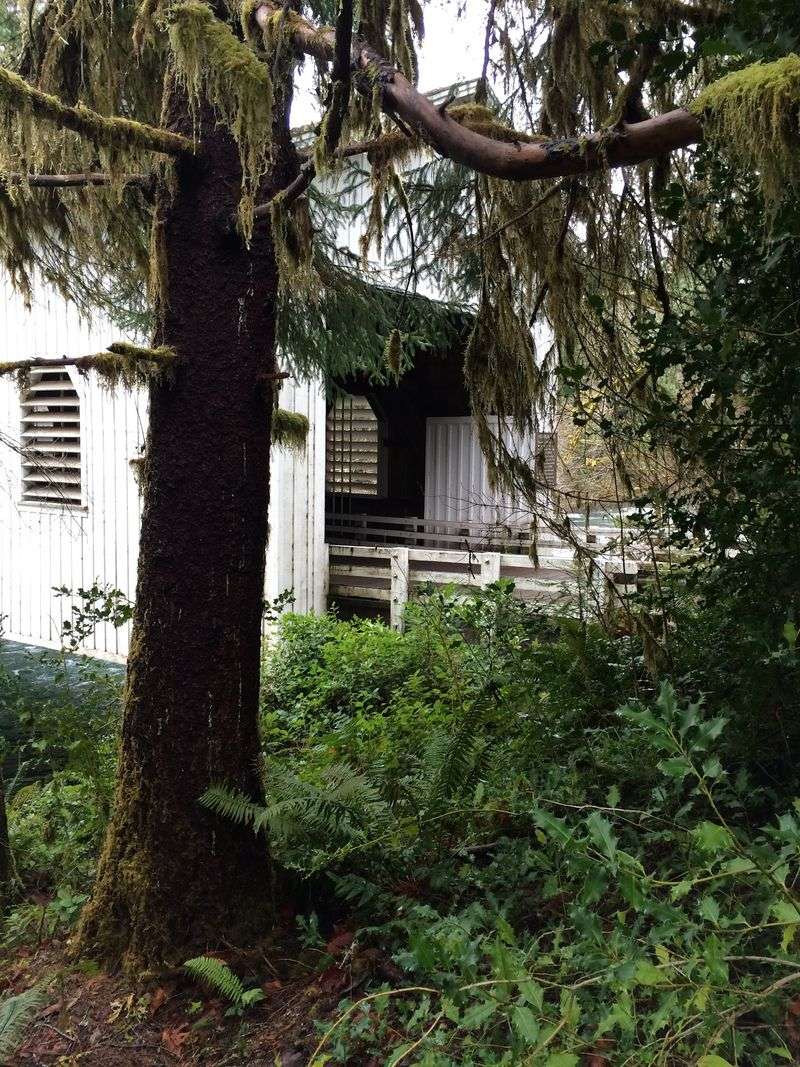
Way up the McKenzie River, where the crowds thin out, sits a bridge that seems happy to keep to itself.
Belknap Covered Bridge occupies a remote, quiet corner near Blue River.
It’s a lovely little crossing, and yes, you can drive right over it. Wooden bridges with real traffic are getting rarer, so enjoy the privilege.
The McKenzie flows underneath. That’s the same river that passes Goodpasture Bridge downstream, so you can pair them on one scenic drive.
Trail access is a big perk here. Lace up your shoes and stretch your legs after the drive.
Lane County looks after this historic span along with its other covered bridges. It’s an impressive bit of woodwork for such an out-of-the-way spot.
Give yourself time. The road along the McKenzie is half the reason to come, with river views that make slowing down easy.
Families will find room to roam. Kids can explore the trails while grownups admire the timber work.
The bridge is open around the clock. Monday mornings and Wednesday afternoons tend to be the calmest times.
Pack layers and snacks before heading out. Services can be limited in remote areas, so plan ahead.
This makes a fitting last stop on any Oregon covered bridge tour. Quiet, sturdy, and far from the rush, it shows exactly why a slow drive beats a fast one.
Address: McKenzie River Bridge, Blue River, OR 97413.