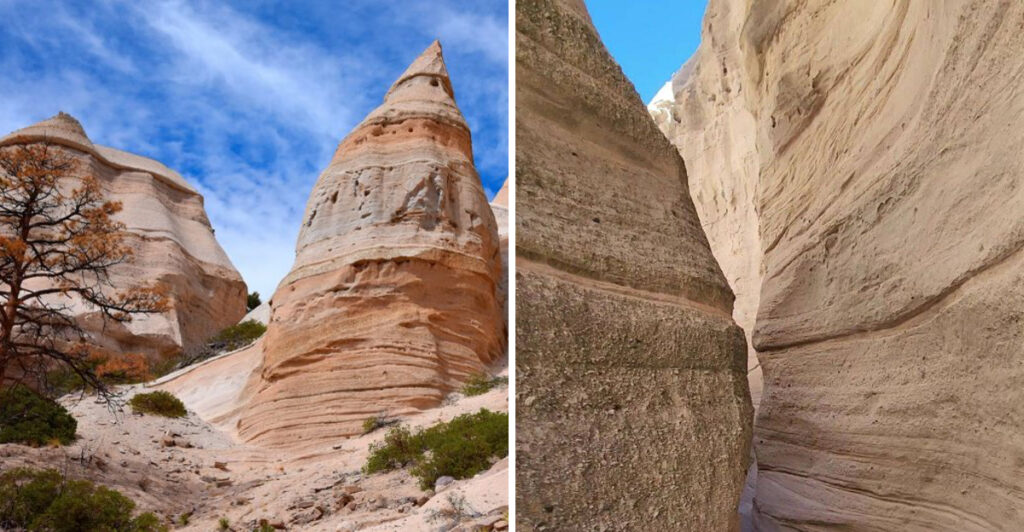
This is not the kind of hike where you just follow a path and check it off. Somewhere in New Mexico, pale canyon walls squeeze the trail into a narrow passage, and suddenly the whole day feels more interesting.
The silence feels different there, like the rock is holding the sound close. Then the route opens into a field of tent-shaped formations created by ancient volcanic eruptions and shaped by time.
Some towers are small enough to study up close, while others rise as high as 90 feet with boulder caps sitting above the softer stone below. The trail keeps changing, which makes the whole experience feel alive.
One bend brings sculpted walls before the path starts climbing toward the mesa. By the time the view opens wide above the canyon, the hike feels earned in the best way.
It is the sort of place your mind keeps replaying later.
A Canyon Walk Between Sculpted Walls
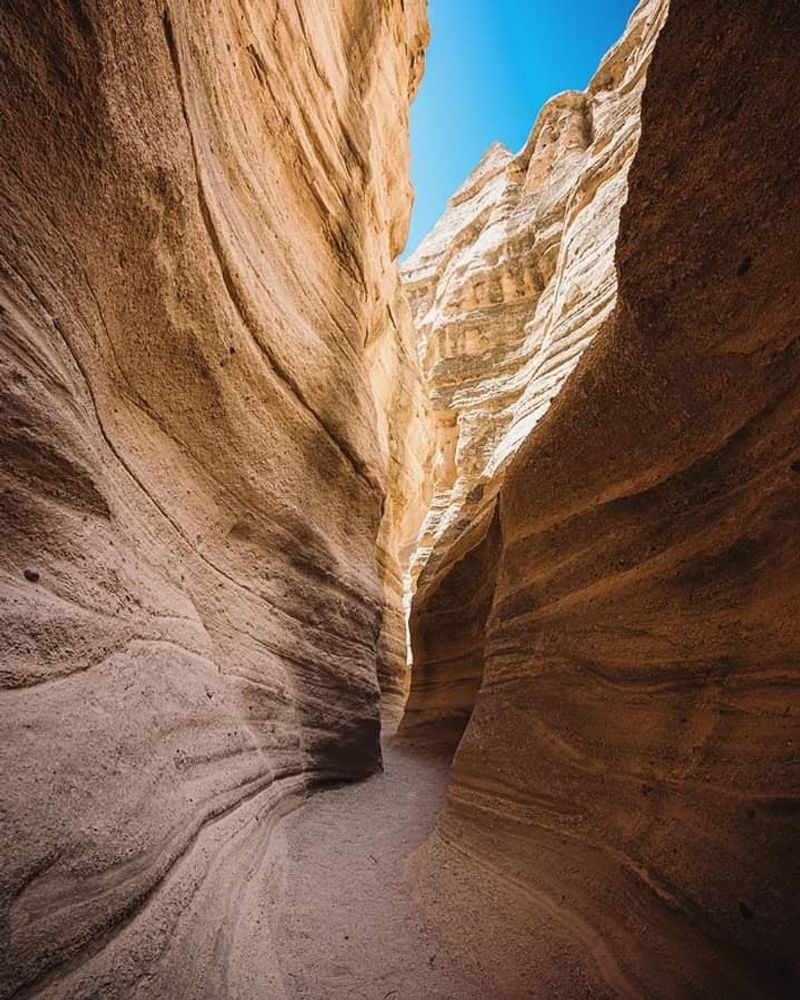
My first step into the slot canyon felt like crossing into a completely different world. The walls on either side rose steeply, their pale volcanic tuff smoothed into gentle curves by centuries of rushing water.
Sunlight barely reached the canyon floor, casting the whole passage in cool, soft shadow.
The Canyon Trail at this monument guides you through a passage roughly 300 feet long, and every inch of it feels deliberate, like the rock itself is directing your path. Some sections narrow so dramatically that you turn sideways and feel the stone graze your shoulders.
That physical closeness with ancient geology is something no photograph fully prepares you for.
I kept pausing to run my fingers along the contoured walls, amazed that volcanic ash and pumice could be shaped into something so graceful. The trail surface underfoot is compact gravel, and the footing stays manageable even when the walls close in tight.
Hikers of many fitness levels tackle this section, and I watched a grandmother navigate it with total confidence.
By the time I emerged from the canyon’s narrowest point, I already knew this hike was going to stay with me, and I had only just reached Kasha-Katuwe Tent Rocks National Monument at 0 NM-22, Cochiti Pueblo, NM 87072.
Where Volcanic Stone Turns Dreamlike
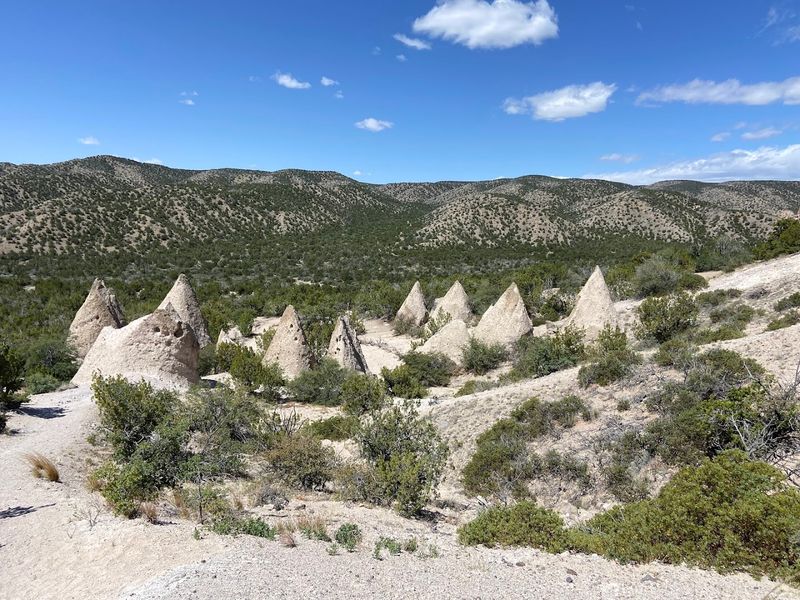
Six to seven million years ago, the Jemez volcanic field erupted and buried this entire plateau under thick deposits of pumice, ash, and tuff. What erosion did with those raw materials over the following millennia is nothing short of astonishing.
The result is a field of cone-shaped formations called hoodoos, each one tapered at the top and surprisingly graceful for something made of compressed volcanic debris.
I stood among them on a clear morning and genuinely struggled to believe I was still on Earth. The cones vary in height from just a few feet to a towering 90 feet, and many carry a balanced boulder cap perched right at the tip.
That boulder protects the softer pumice beneath from eroding too quickly, which is the only reason these dramatic spires still exist today.
The color palette shifts subtly as you move through the formation field, ranging from creamy white to warm beige and faint pink. Early morning light makes the whole scene glow in a way that feels almost theatrical.
I took more photos in this section than anywhere else on the trail, and I still could not capture what it actually felt like to stand there.
Pale Cliffs Under A Wide Desert Sky
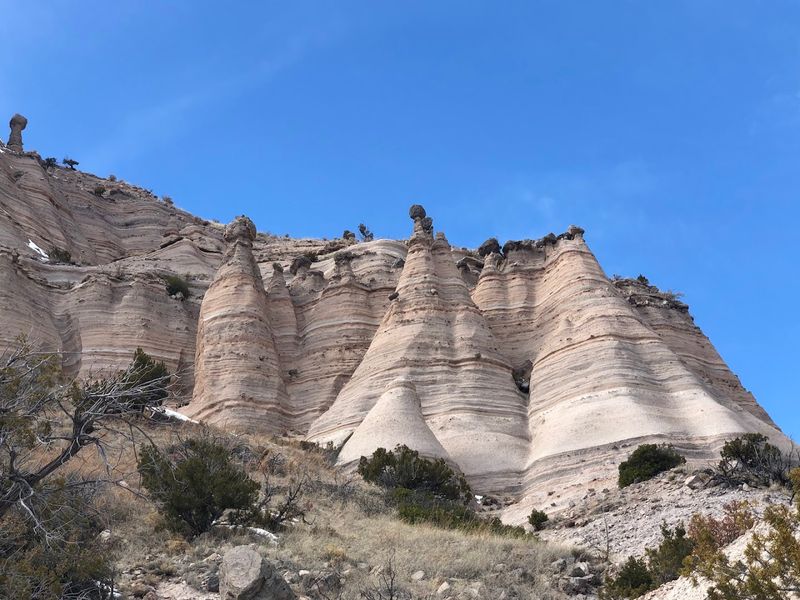
The Keresan-speaking people of Cochiti Pueblo named this place Kasha-Katuwe, which translates to white cliffs, and the moment you see the cliff faces glowing in full sun, that name makes complete sense. The light-colored volcanic tuff reflects sunlight with an almost luminous quality, especially in the late morning when the sky above the high desert turns a saturated, cloudless blue.
That contrast between pale rock and brilliant sky is one of the most visually arresting things I have ever seen on a trail.
The monument sits at elevations ranging from 5,570 feet to 6,760 feet above sea level, which means the air is clear and the sky feels enormous. There is no tree canopy blocking the view up here, so the cliffs stand fully exposed against that wide open expanse.
I found myself stopping repeatedly just to look up and appreciate the sheer scale of the rock faces towering above me.
On the day I visited, a few clouds drifted across the sky and cast moving shadows on the cliff walls, which added a slow, almost cinematic quality to the whole scene. The light here changes constantly, and no two moments look quite the same.
A Trail Framed By Towering Cones
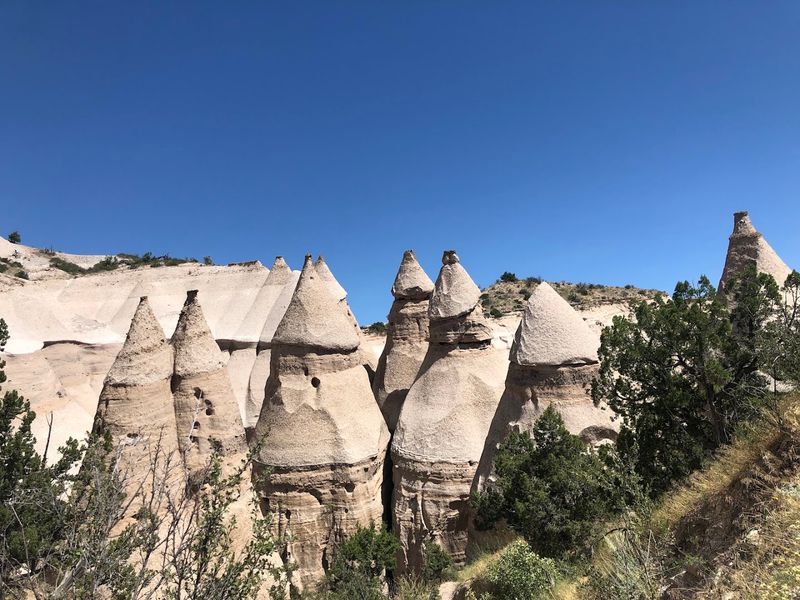
After the slot canyon section, the trail opens up into the main formation field, and that transition feels genuinely dramatic. One moment you are enclosed by smooth canyon walls, and the next you are standing in an open corridor lined with tent-shaped rock towers stretching in every direction.
The path winds naturally between them, and the cones frame every forward view like a series of geological doorways.
What struck me most was the variety in the formations. Some cones are broad and squat, while others are slender and impossibly tall with that signature boulder balanced at the peak.
A few cluster together in groups that create their own miniature valleys, and walking through those clusters feels like moving through a stone neighborhood with its own strange architecture. The trail is well-marked throughout this section, which is reassuring given how easy it would be to wander off course among so many striking shapes.
Hikers are asked to stay on the designated path to protect the fragile pumice and tuff from foot traffic damage. That rule makes total sense once you see how delicate some of the thinner formations actually are.
Every step off-trail could erase thousands of years of patient sculpting.
Narrow Passages With Otherworldly Texture
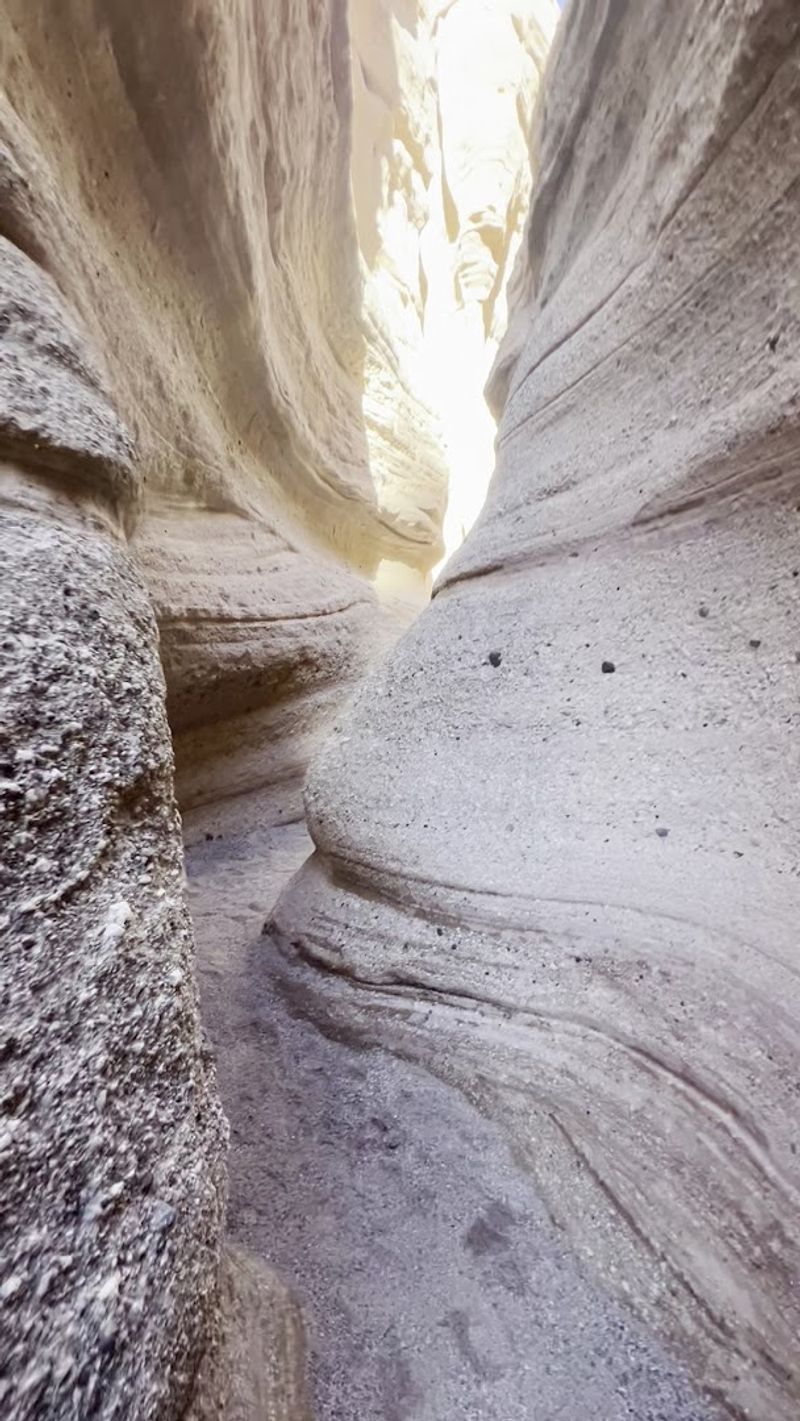
Rock texture is not something most people think about before a hike, but inside the narrowest passages at this monument, texture becomes the entire story. The walls of the slot canyon have been smoothed and contoured by water that rushed through here repeatedly over thousands of years, leaving behind surfaces that look hand-polished.
The curves are so fluid and continuous that the rock almost appears soft.
Some passages tighten to the point where you need to angle your body sideways and use your hands to steady yourself against the walls. That physical engagement with the rock makes the experience feel far more immersive than a typical trail walk.
You are not just observing the geology here, you are moving through it and touching it directly.
The tuff that makes up these walls is a fascinating material, porous and relatively lightweight for stone, yet durable enough to hold these intricate carved shapes for millions of years. Up close, you can see tiny air pockets and mineral variations that give the surface a subtle complexity.
I spent a long time in one particular narrow section just studying the patterns at eye level, and I was genuinely reluctant to move on.
Soft Light On Ancient Tuff Layers
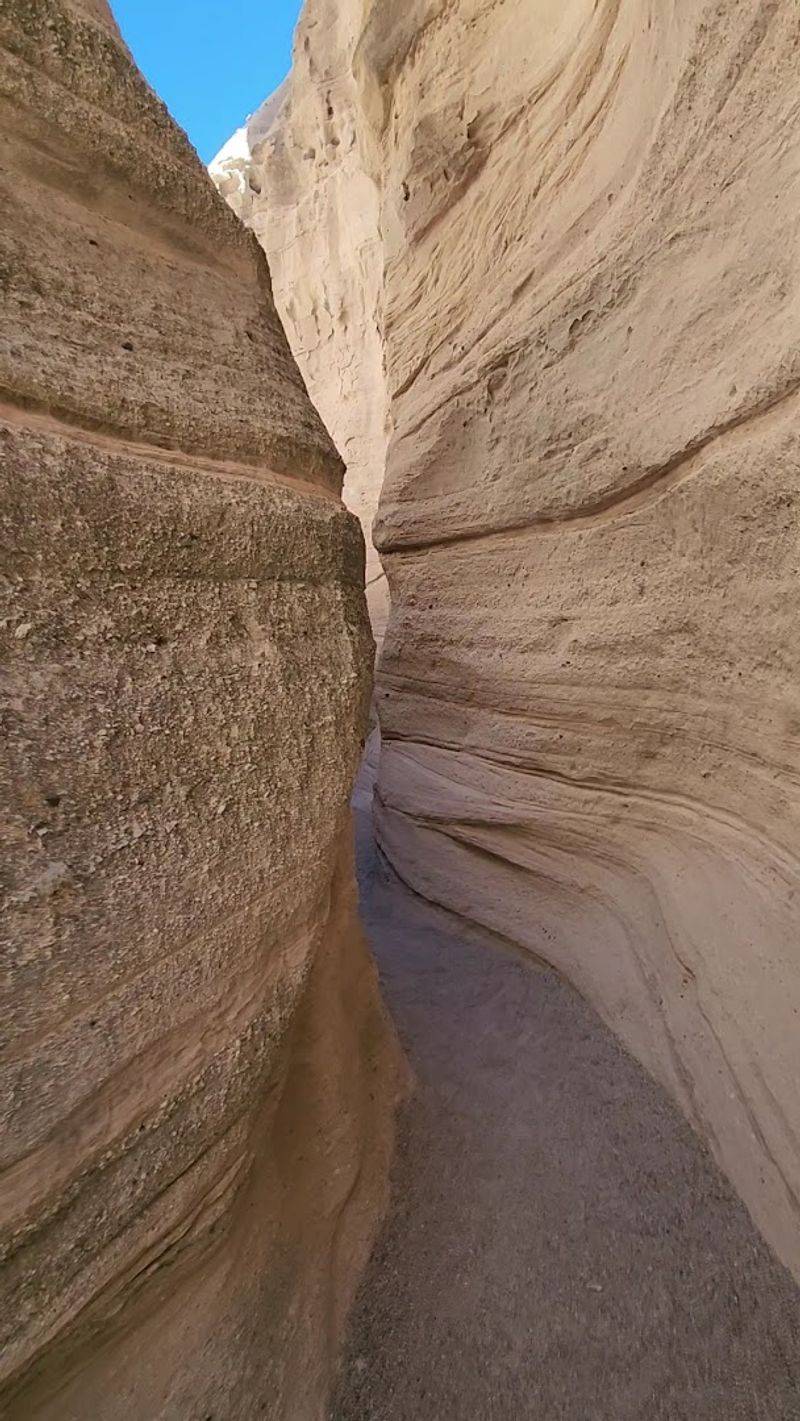
There is a particular quality of light inside the canyon that I have not encountered anywhere else on a trail. Because the slot is so narrow and the walls rise so high, direct sunlight never reaches the canyon floor for most of the day.
Instead, light filters down indirectly, bouncing off the pale tuff walls and filling the space with a soft, even glow that makes the rock layers pop with unexpected clarity.
Those layers tell a geological story spanning millions of years. Bands of grey, beige, and faint pink alternate along the cliff faces, each one representing a different volcanic event or a shift in the type of material deposited.
The pumice, ash, and tuff settled in distinct strata over time, and erosion has now exposed those layers like pages in a very old book. I am not a geologist, but even I found myself trying to count the bands and imagine what each one represented.
Morning visits reward you with the most dramatic light conditions, when the angle of the sun creates a warm glow at the canyon entrance while the interior stays cool and softly lit. That combination of warmth and shadow makes every photograph look effortlessly composed.
A High-Desert View Worth The Climb
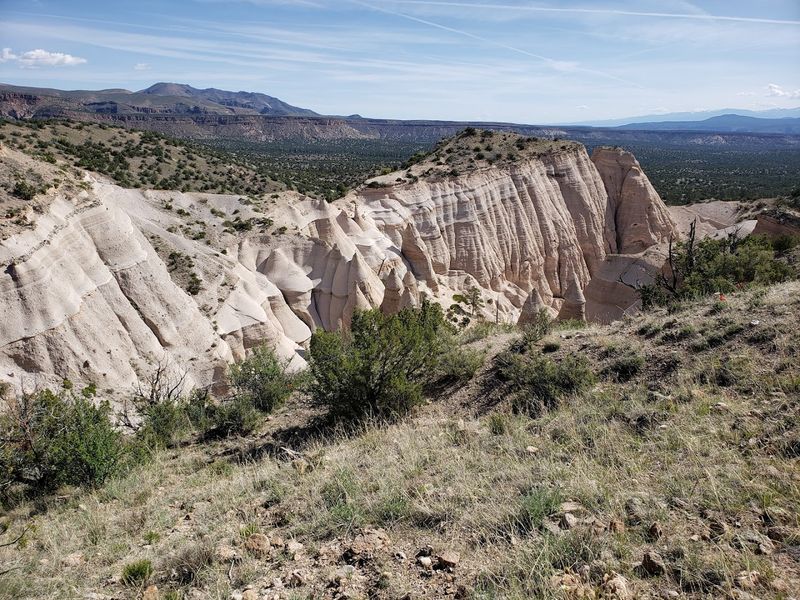
Past the slot canyon, the trail pivots sharply upward and the real physical challenge begins. The ascent to the mesa top gains roughly 630 feet in elevation over a relatively short distance, which means the trail is steep, rocky in places, and genuinely demanding.
I was breathing hard by the halfway point, but I kept moving because other hikers coming back down had a very specific look on their faces, the kind that means the view was worth every step.
They were absolutely right. From the top, the entire high-desert landscape of New Mexico spreads out in every direction.
The Sangre de Cristo Mountains rise to the northeast, the Jemez Mountains fill the western horizon, and the Sandia Mountains anchor the south. The Rio Grande Valley cuts through the scene below, and you can trace its path for miles.
Standing up there, I felt the particular satisfaction of having physically earned a view rather than simply arrived at it.
The overlook also gives you a completely new perspective on the tent rocks themselves, seen now from above rather than from within. That aerial view reveals the full geometry of the formation field in a way that the trail below never could.
Wind-Carved Shapes At Every Turn
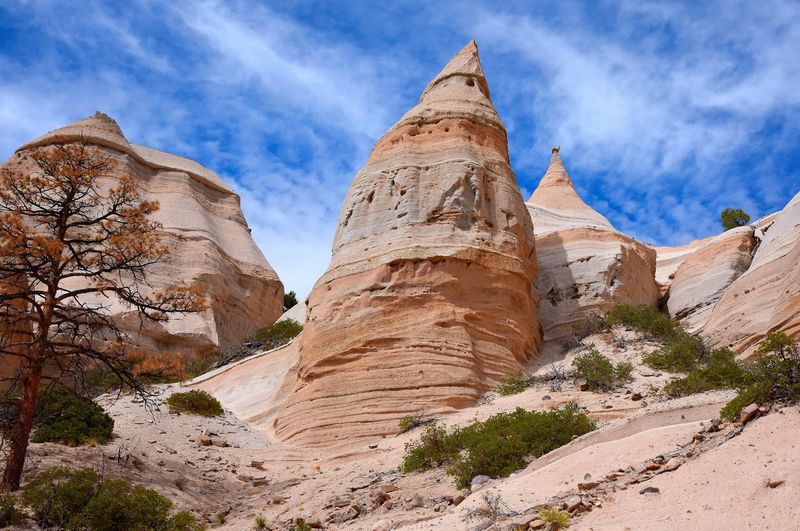
Wind gets less credit than water in shaping this landscape, but its contribution is visible everywhere you look. The scalloped edges along the hoodoos, the shallow hollows scooped into cliff faces, and the intricate ridgelines running across the tuff surfaces all carry the signature of long-term wind erosion working with seasonal rains.
The result is a constantly changing gallery of abstract shapes that rewards slow, attentive walking.
I noticed that every time I rounded a bend, something new demanded my attention. A formation that looked like a breaking wave from one angle became something completely different from twenty feet further along the path.
That shifting quality keeps the hike visually engaging, which is not always guaranteed on a trail of this length. The total round trip on the Canyon Trail runs about three miles, and I never once felt bored.
The monument is open Thursday through Monday, with visitor check-in and last entry ending at 1 PM, and all visitors must exit by 4 PM. Advance reservations through Recreation.gov are required, along with a separate Cochiti Pueblo Tribal Access Pass.
Planning ahead is essential, since tickets are limited online and released on a set schedule.