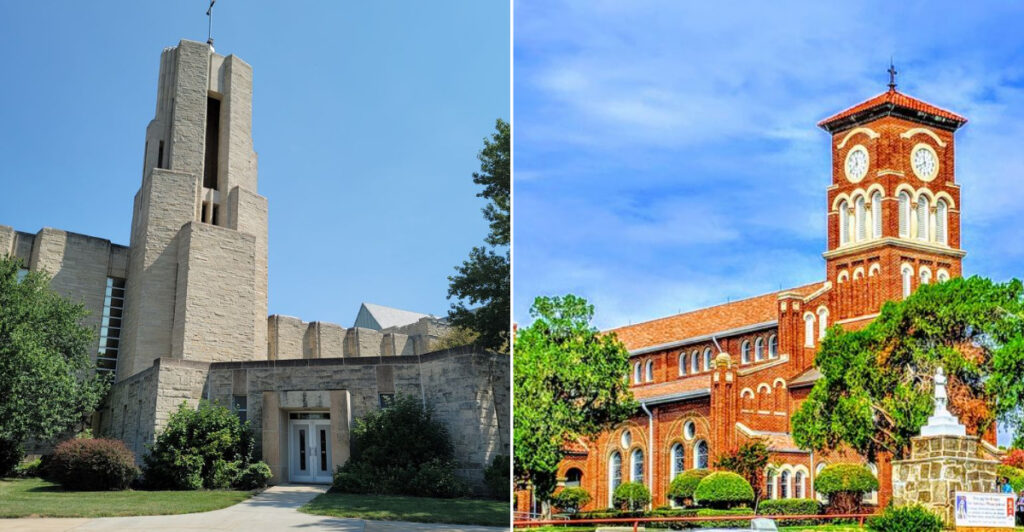
A church can stop traffic without making a sound.
Kansas has religious buildings that do exactly that, using unexpected shapes, dramatic towers, unusual materials, and designs that seem almost out of place against the surrounding towns and prairie.
Some look centuries older than they are. Others seem like they were sketched by someone determined to ignore every ordinary rule of church design. Architecture like this rewards a second look.
Even people who are not especially interested in churches can find themselves staring at the roofline or walking around the block just to see how the building changes from another angle.
These are the kinds of places that make a road trip feel more curious. I once pulled over because a church looked so strange from the highway that I thought I had misread what I was seeing.
Ten minutes later, I was still circling the building with my camera out. Since then, I have learned that Kansas can hide some of its best surprises in plain sight.
1. Basilica Of St. Fidelis, Victoria
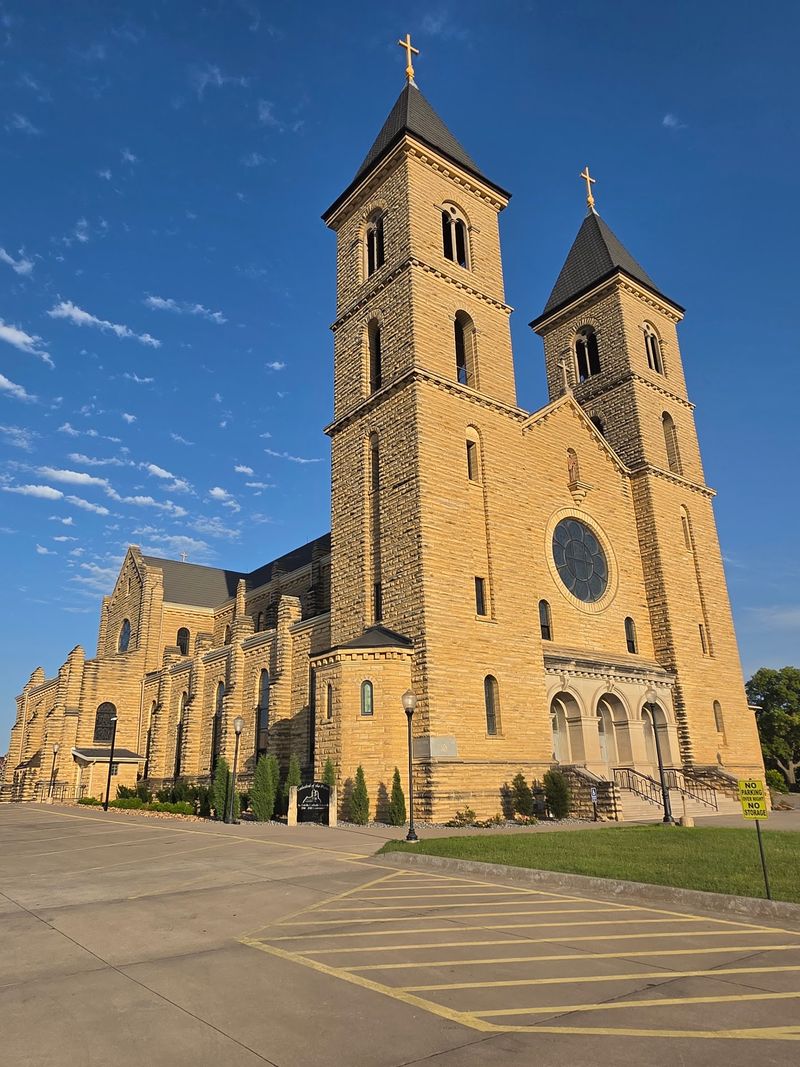
They call it the Cathedral of the Plains, and one look at those twin towers explains why.
Rising 141 feet above a town of about 1,200 people, the limestone giant seems to have wandered in from Europe and decided to stay.
Volga German immigrants built it between 1908 and 1911, hauling native limestone by wagon from a quarry seven miles away.
Families were expected to deliver six wagonloads each, which tells you how much sweat sits inside these walls.
Presidential candidate William Jennings Bryan visited in 1912 and gave St. Fidelis its famous nickname, and the name stuck for good reason.
The interior seats about 1,100 and holds historic furnishings plus stained glass windows made in Munich and installed in 1916.
Romanesque arches, a rose window, and stone thick enough to keep the summer heat outside make the space feel older than it is.
Sunlight moving across the nave in late afternoon is the reason photographers linger.
Pope Francis declared it a minor basilica in 2014, the first basilica in Kansas. You will find the Basilica of St. Fidelis at 900 Cathedral Avenue in Victoria, Kansas, just off Interstate 70 for visitors passing through today.
2. Cathedral Of The Immaculate Conception, Wichita
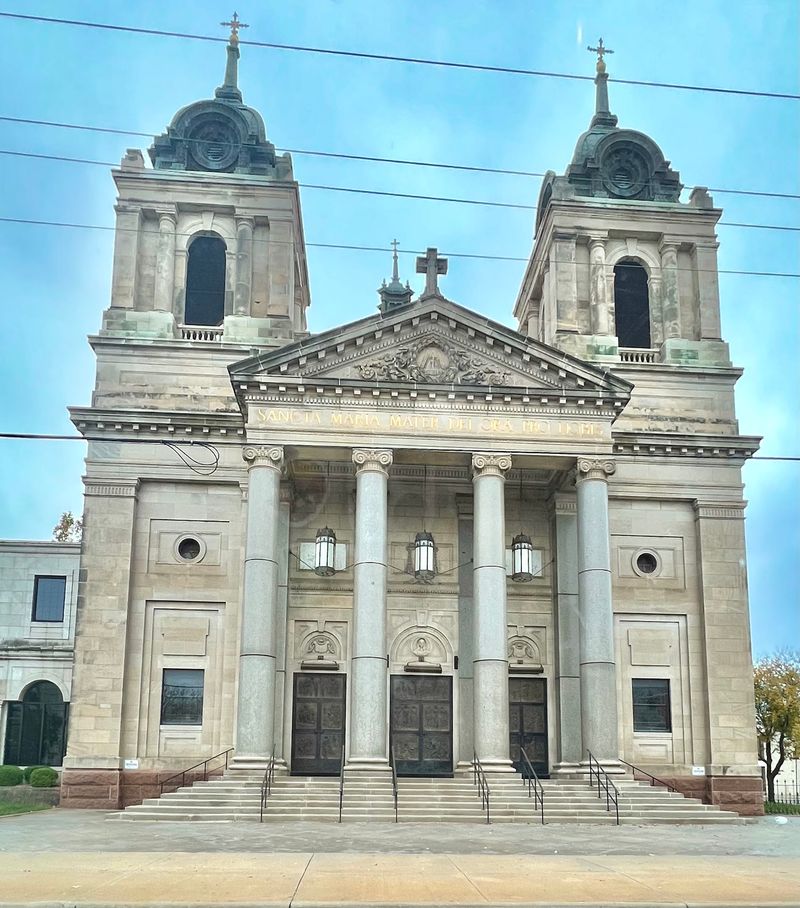
Big city churches usually blend into the skyline, but this one refuses.
Twin towers and a broad Italian Renaissance front give downtown Wichita a slice of old Rome dropped between office buildings.
Construction wrapped up in 1912, and the design leans on Roman basilica ideas rather than the pointed Gothic look most people expect from a cathedral.
The result is rounded, warm, and surprisingly bright inside. Marble columns, a coffered ceiling, and a wide sanctuary make the Cathedral of the Immaculate Conception feel wider than it is tall.
Mosaic work and gold accents catch every bit of light that slips through the clerestory windows.
Look up at the towers and you will spot detailing that took stonecutters months to finish, the kind of patience modern budgets rarely allow.
The building has hosted more than a century of city milestones, and its bells still carry over the traffic below.
Weekday visitor access is suspended during dome work, with the cathedral open for weekend Masses only.
Head to 430 North Broadway in Wichita, Kansas, and park nearby to appreciate how the Cathedral of the Immaculate Conception anchors the whole block.
3. St. Benedict’s Abbey Church, Atchison
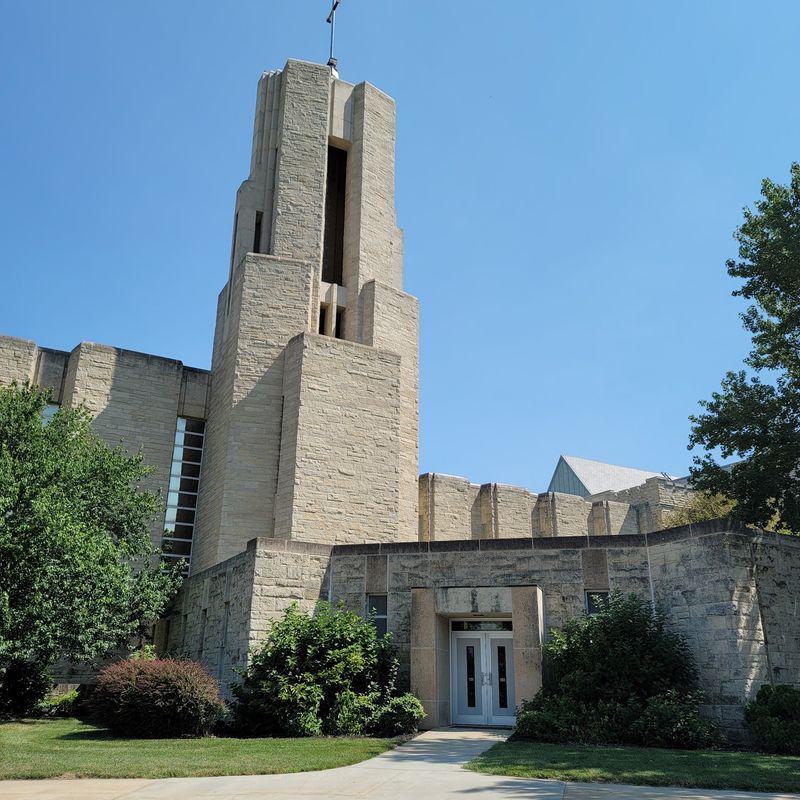
Concrete, glass, and clean angles: not what most people picture when they hear the word abbey.
Perched on a bluff above the Missouri River, this one broke every rule its neighbors followed.
Finished in 1957 and designed by architect Barry Byrne, a student of Frank Lloyd Wright, the church went full modernist while the rest of Kansas was still stacking limestone. Some locals were baffled at the time.
Inside, the monks’ choir stalls face each other in the center, an old Benedictine layout wrapped in a thoroughly twentieth century shell. Tall vertical windows pull daylight down the walls in narrow ribbons.
The surrounding Benedictine College North Campus Historic Complex is listed on the National Register of Historic Places, while this 1957 Abbey Church is chiefly recognized as an important American modernist design by Barry Byrne.
Sunday visitors often stay for the chanted prayers, and the acoustics do a lot of heavy lifting in that bare space.
Find St. Benedict’s Abbey Church at 1020 North Second Street in Atchison, Kansas, near the Benedictine College campus, and take a minute for the river view outside.
4. St. John’s Catholic Church, Beloit
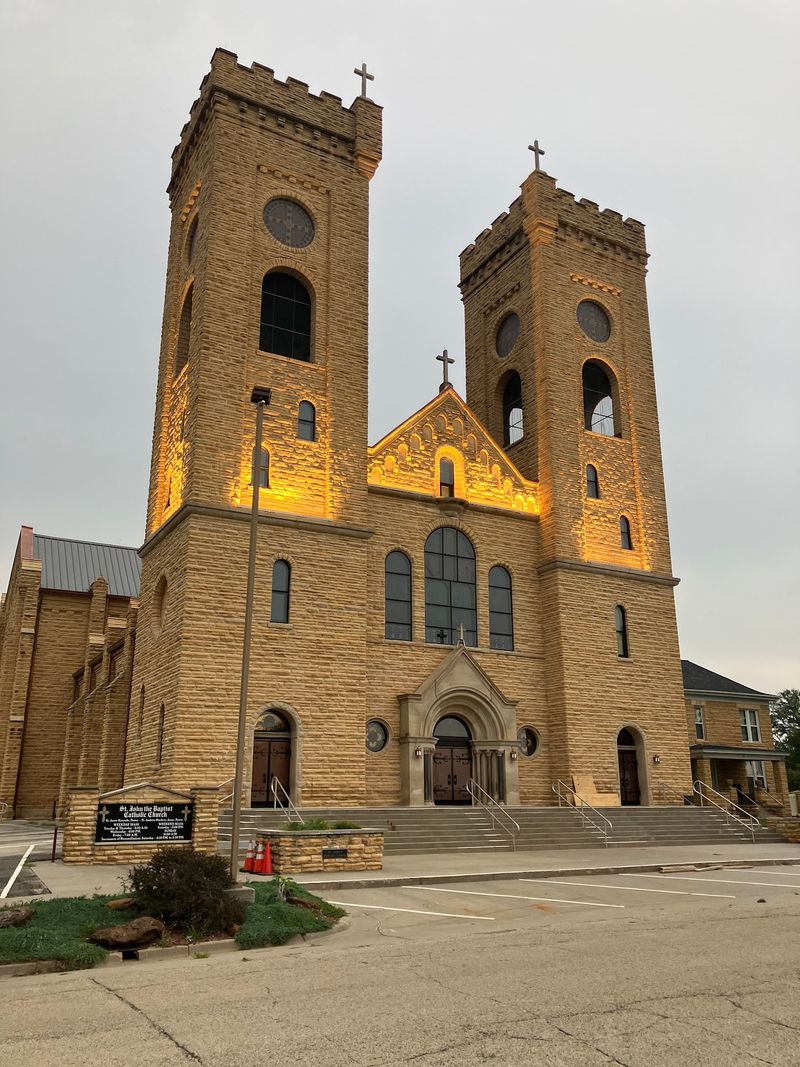
Small town, massive stone walls, and a whole lot of ambition baked into the design.
Beloit sits in north central Kansas, and its skyline belongs entirely to this Romanesque landmark.
Construction began in 1900, and the parish followed plans modeled after the Romanesque Church of St. Richard in France.
Flying buttresses and a stone ceiling give the building its unusual scale. Planned steeples were omitted because of concerns about strong Kansas winds.
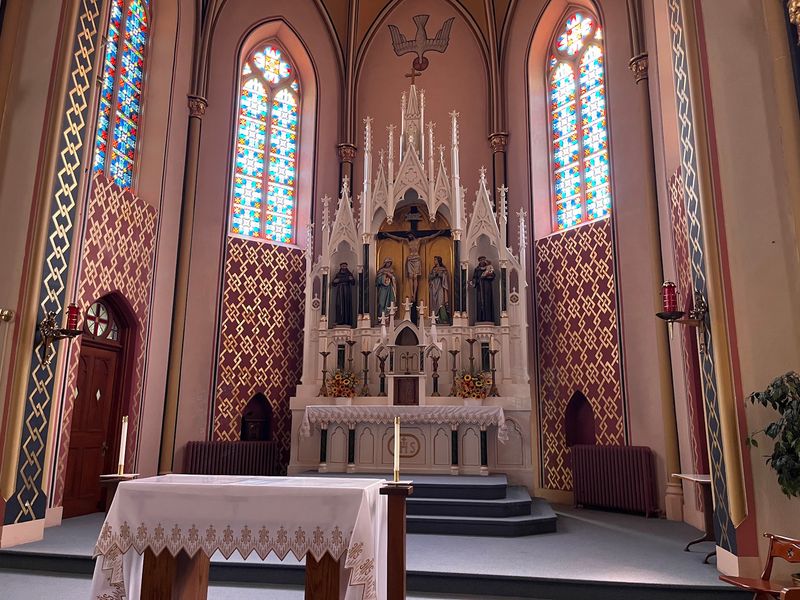
Step inside St. John the Baptist Catholic Church and the stained glass does the talking, throwing colored patches across pale plaster and dark wood pews.
The vaulted stone ceiling makes voices carry in a way that surprises first time visitors. Carved woodwork, stone columns, and detailed architectural features show craftsmanship that would cost a fortune to reproduce today.
The twin towers are visible well before you reach the church, which makes it a handy landmark for road trippers cutting across town.
St. John the Baptist Catholic Church stands at 701 East Court Street in Beloit, Kansas, and the exterior stonework alone is worth a slow walk around the block.
5. Holy Cross Church, Pfeifer
Three spires, endless wheat, and almost no town left around them.
Pfeifer barely registers on a map, yet it holds one of the most photographed churches in western Kansas.
Volga German settlers finished the building in 1918 using native limestone, creating a striking Gothic church sometimes called the Cross in the Valley.
Its central spire rises 165 feet, while the two smaller side towers reach 100 feet.
Holy Cross Church stopped serving as an active parish in 1993, but Holy Cross Charities keeps the building open daily and maintains the church and cemetery.
Occasional special Masses and events still take place inside. The interior features a rib-vaulted Gothic ceiling, decorative columns, pointed arches, and details preserved from the original church.
Roads lead into tiny Pfeifer from the surrounding countryside, and the drive itself is half the experience, with open fields and limestone landmarks along the way. Sunset is the golden hour here, no contest.
Holy Cross Church sits in Pfeifer, Kansas, in Ellis County south of Victoria, and visitors can normally enter during the day without arranging a parish visit first.
6. St. Joseph Catholic Church, Damar
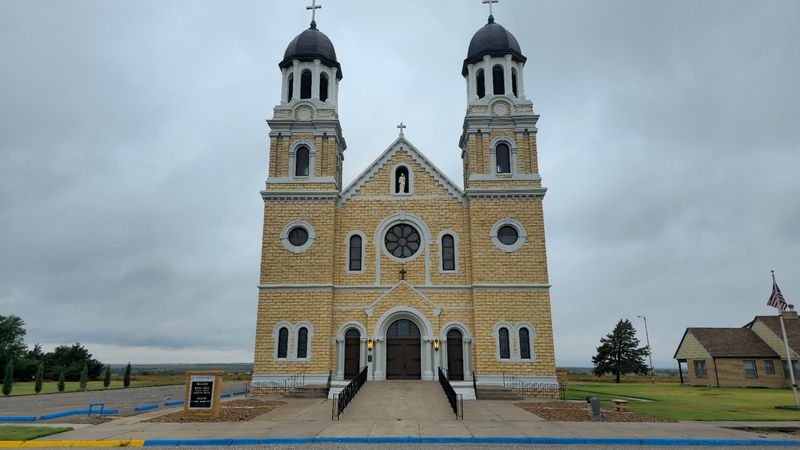
French Canadian settlers put their stamp on Kansas, and this is the proof.
Damar sits in Rooks County with fewer than 150 residents and a church built for far more. Construction began in 1912, and the limestone structure was completed in 1913.
The design is Romanesque, with twin towers and rounded architectural forms that distinguish it from many nearby Volga German churches.
St. Joseph Catholic Church rose from limestone quarried near Waldo, about fifty miles east, while parishioners supplied much of the labor. The parish remains active today with Masses.
Inside, the high nave is decorated with stained glass and elaborate painted details added during later finishing and restoration campaigns.
The interior was completed gradually over decades, with plastering finished in 1917, pews and heating installed in 1929, and decorative work and stained glass added between 1944 and 1952.
The towers appear on the horizon minutes before you arrive, a classic plains reveal that never gets old.
St. Joseph Catholic Church stands at 107 Oak Street in Damar, Kansas, roughly twenty miles west of Plainville and easy to combine with other regional church stops.
7. St. Bridget Catholic Church, Axtell
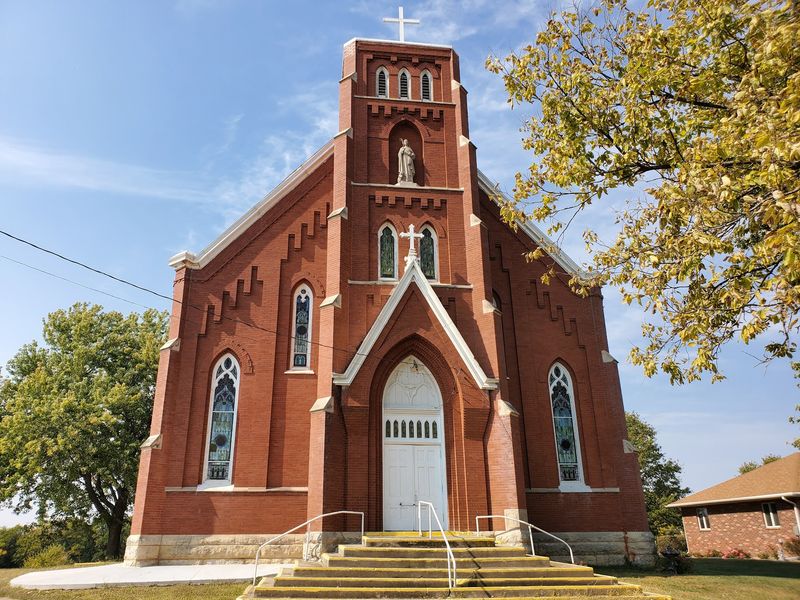
Red brick instead of limestone, and the change in material changes everything.
The historic St. Bridget settlement sits in Marshall County, several miles north of Axtell.
The current building was begun in 1902 and completed in 1908 by descendants of Irish settlers who established the parish decades earlier.
Gothic pointed arches, stepped buttresses, and a strong central tower give it a distinctive profile.
St. Bridget Catholic Church breaks the pattern of German and French parishes that dominate the rest of this list, which makes it a genuinely different stop. Detailed brickwork around the windows repays a closer look.
The interior features high suspended vaults, dark woodwork, and stained glass depicting biblical scenes and saints, including St. Patrick.
The parish remained active until 1967, and the building is now preserved as a historic site listed on the National Register of Historic Places.
Look for St. Bridget Catholic Church at 341 30th Road north of Axtell, Kansas.
It is open by appointment only, so arrange access before making the gravel-road trip to see the interior and surrounding historic cemetery as well.
8. Immaculate Heart Of Mary Church, Windthorst
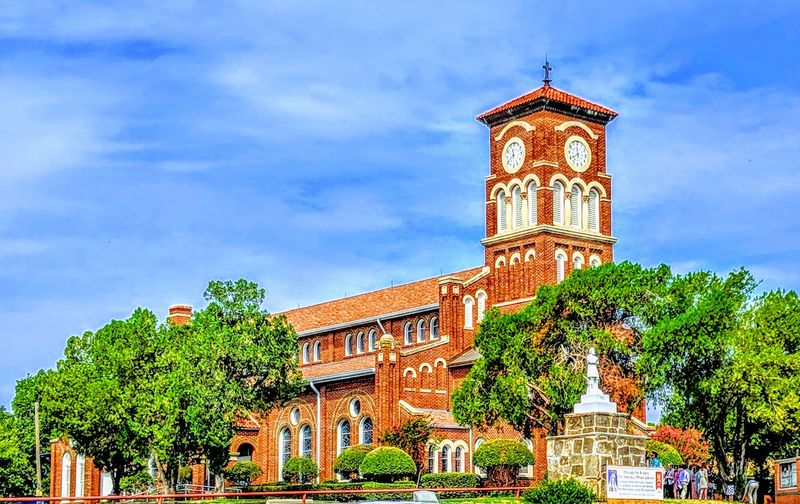
Windthorst is less a town than a historic settlement, plus one very determined church.
Ford County farmland surrounds it in every direction with little to block the view.
German Catholic settlers established the community in 1878, and the present church was built between 1912 and 1913.
Red brick walls, limestone details, buttresses, and a 125-foot tower combine Gothic and Romanesque Revival influences.
Immaculate Heart of Mary Church no longer has an active congregation. The Catholic parish was dissolved in 1997, and Windthorst Heritage Inc. now preserves the building and surrounding history.
Inside, original pews, statues, Stations of the Cross, stained glass, and ornate altars preserve much of the church’s early twentieth-century character.
The isolation is the attraction here, since standing outside you can hear wind, birds, and very little else.
Immaculate Heart of Mary Church is open daily from eight to five at 10848 131 Spur Road, Spearville, Kansas, northeast of Dodge City.
Visitors can explore the building without waiting for a weekday service or an active parish schedule while learning about Windthorst’s settlement history.
9. Church of the Assumption, Topeka
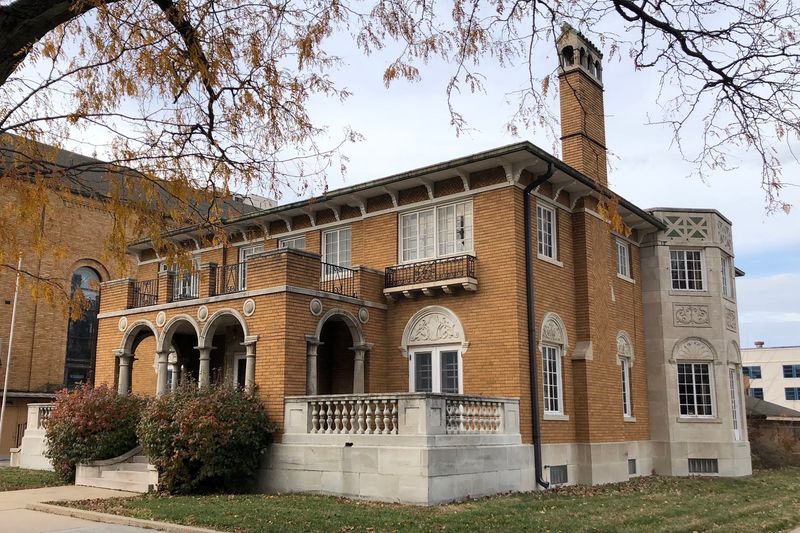
The Church of the Assumption gives downtown Topeka a surprising architectural twist.
Built in 1924, the present church combines Renaissance influences with Mission and Spanish Revival details, a mix that immediately separates it from the more familiar Gothic churches found across Kansas.
Its warm brick exterior, twin square towers, broad central arch, and large circular window create a façade that looks both substantial and unexpectedly Mediterranean.
The story reaches much farther back than the building itself. Assumption Parish dates to 1862, making it Topeka’s earliest Catholic congregation, and the current structure stands on the site associated with that long history.
The church and its rectory were added to the National Register of Historic Places in 2008 for their architectural significance.
Inside, exposed roof trusses stretch above rows of pews and give the sanctuary a dramatic sense of height without relying on the pointed arches people often expect in historic churches.
It is a fascinating reminder that Kansas church architecture can borrow from several traditions and still create something completely distinctive in the heart of Topeka.
10. St. Mary’s Catholic Church, St. Benedict
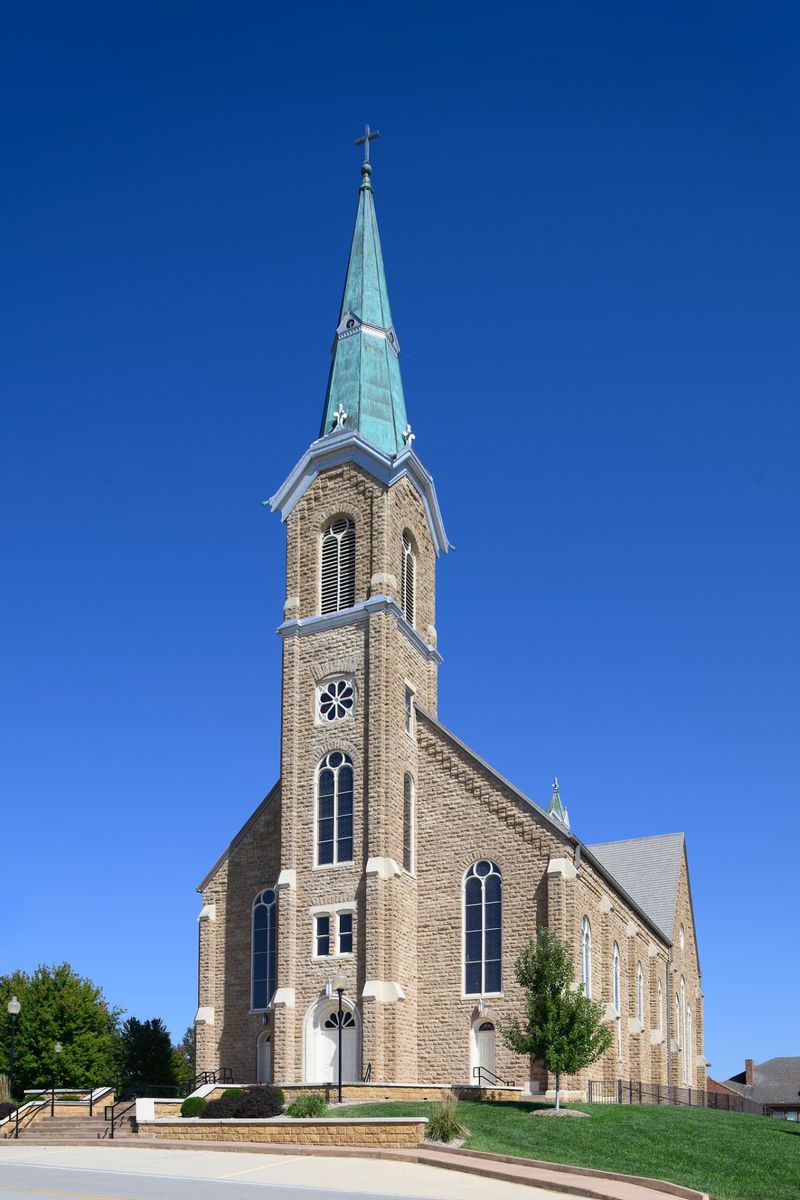
St. Mary’s Catholic Church rises above the tiny community of St. Benedict with the kind of presence you would expect in a much larger town.
Built in 1893, the Gothic Revival church uses tall pointed windows, stone walls, buttress-like projections, and a soaring central steeple to create a striking silhouette against the open Kansas landscape.
The contrast is part of what makes it so memorable. St. Benedict is small and rural, yet this church looks monumental, almost as though a piece of old European architecture landed on the prairie.
Its craftsmanship also reflects the importance of Catholic immigrant communities in northeastern Kansas during the late nineteenth century.
St. Mary’s was added to the National Register of Historic Places in 1980, helping preserve one of the state’s most impressive rural churches.
From a distance, the steeple acts like a landmark. Up close, the narrow arched windows and carefully worked masonry reward a slower look.
For architecture lovers, this is the sort of Kansas church that turns an ordinary country drive into a wonderfully unexpected detour.