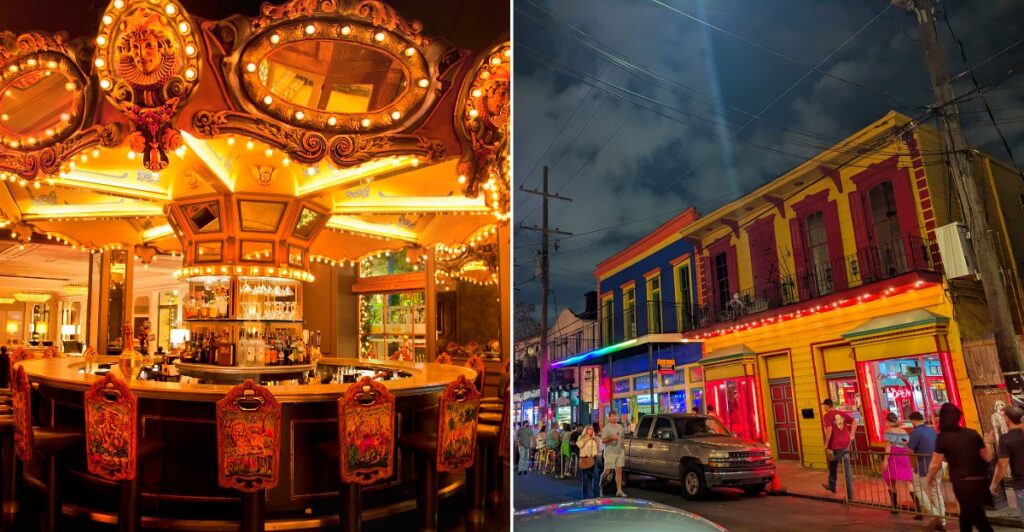
New Orleans after dark feels less like the city is winding down and more like it is changing costumes. Cathedral lights sharpen the skyline, music drifts out of doorways, and the Mississippi keeps sliding past as if none of the noise concerns it.
Some stops are lively enough to pull you in immediately, while others reward a slower pace, especially along quieter stretches of the river or tucked-away corners nearby.
After sunset, Louisiana’s famous city reveals a different rhythm through glowing landmarks, live music, river views, and late-evening streets full of character.
What I love is the contrast. One block can feel electric, the next surprisingly calm, and the whole route becomes better when you stop trying to rush it.
Even places that close before darkness can fit naturally into the evening, especially if you start early. The real pleasure is letting the city unfold one mood at a time.
10. Jackson Square
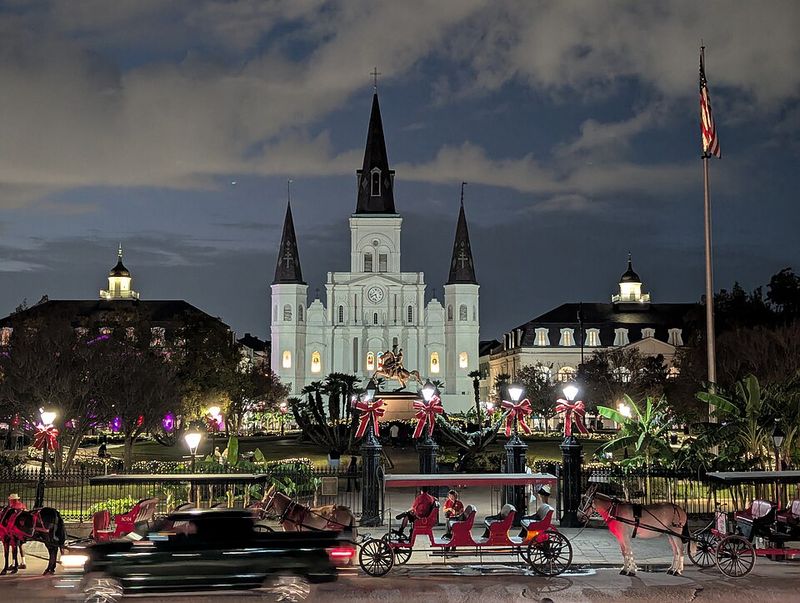
Cathedral lights rising above the dark outline of the square create one of those views that immediately announces where you are. Jackson Square sits at the center of the French Quarter, surrounded by St. Louis Cathedral, historic buildings, artists, performers, and streets that stay active well after the park itself closes.
The important distinction is that the gated square is not a late-night park. Current city hours are 8 a.m. to 7 p.m. during Daylight Saving Time and 8 a.m. to 6 p.m. in winter, so nighttime visitors experience it from the surrounding sidewalks rather than from inside.
That hardly diminishes the atmosphere. Decatur Street gives you a broad cathedral view, while walking toward Chartres Street changes the angle enough to make the familiar scene feel completely different.
Musicians and performers may still be working nearby, and horse-drawn carriages add their own soundtrack of wheels and hooves. The Mississippi is only a short walk away if the square feels busy.
Do not treat this as a photograph-and-leave stop. Stand still for a few minutes and watch the layers build.
Lights hit the cathedral, people cross the foreground, music drifts in from somewhere unseen, and one of New Orleans’ most photographed places suddenly feels much less static.
9. St. Louis Cathedral
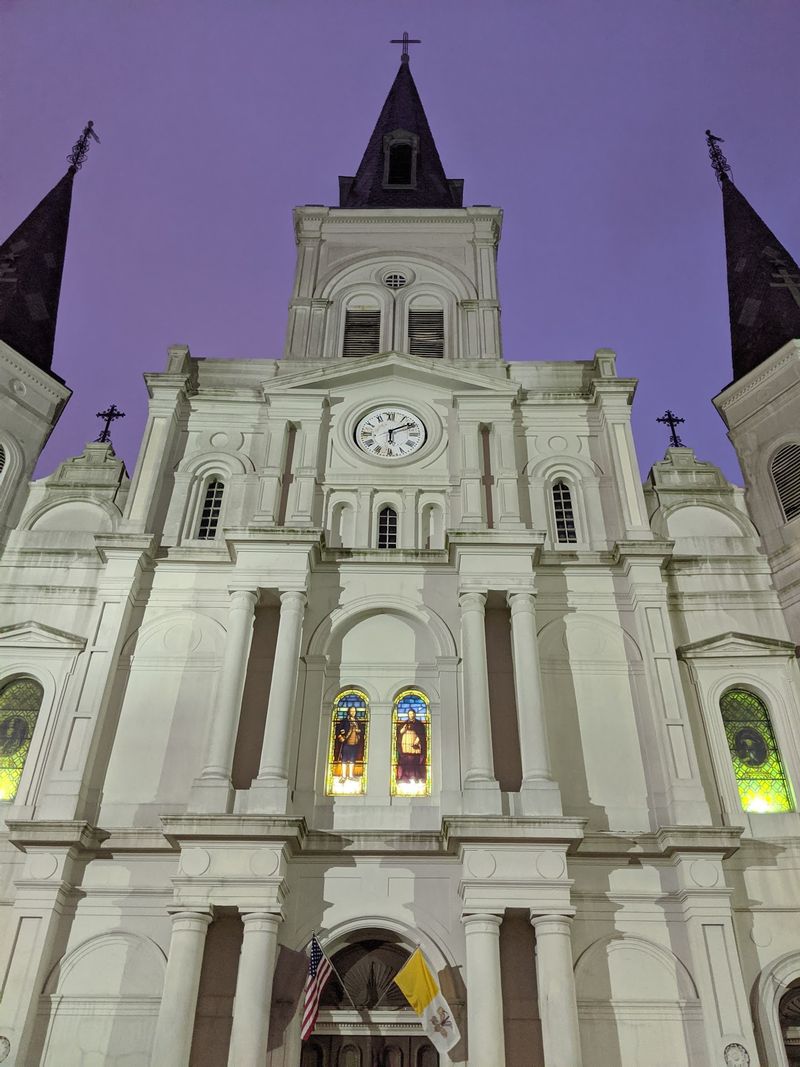
Three bright towers above Jackson Square can stop a conversation halfway through. St. Louis Cathedral looks especially striking at night, when its lit facade stands out against the sky.
From outside, you can take in its shape without the daytime bustle competing for your attention.
Keep this visit simple: look from across the square, then move closer to see how the doors, windows, and towers fit together. The cathedral is a place of worship, not a late-night sightseeing stop, so check visiting hours if you hope to go inside on another day.
Its setting also makes a useful meeting point before an evening walk. Nearby streets can be lively, yet the building offers a moment of stillness.
You do not need a long lesson in architecture to notice how much history one well-lit corner can hold at once.
8. Frenchmen Street
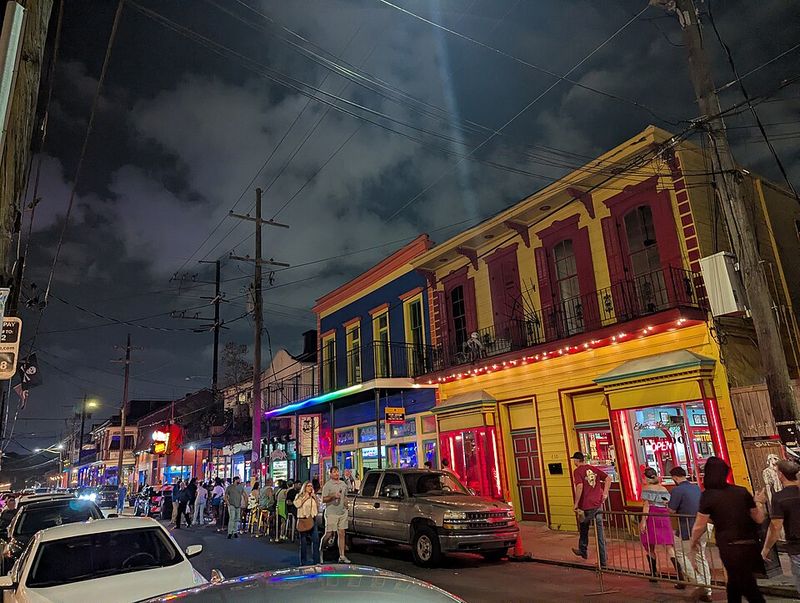
Music begins leaking onto the sidewalk before you have decided where to stop. Frenchmen Street in Faubourg Marigny concentrates live jazz, blues, funk, reggae, and other sounds into a few particularly active blocks between Esplanade Avenue and Royal Street.
That concentration makes wandering part of the experience. Snug Harbor, d.b.a., The Spotted Cat, Blue Nile, and other venues sit close enough together that you can hear several possibilities before committing to one room.
The Frenchmen Art Bazaar adds another nighttime layer. The outdoor market currently opens at 7 p.m., bringing local paintings, jewelry, sculpture, and other work into a setting already busy with musicians and late-night foot traffic.
Venue rules vary considerably. Some performances are ticketed, some spaces restrict entry by age, and schedules change nightly, so checking individual listings matters if one particular artist is the reason for visiting.
Otherwise, leave the evening loose. Walk first, listen from outside, and choose the sound that catches your attention rather than arriving determined to follow an elaborate checklist.
Frenchmen has become far less secret than its old local reputation suggests, but the musical density remains difficult to reproduce elsewhere.
One doorway may offer jazz, another something louder, and a street musician can suddenly become the performance you remember best.
7. Lafitte’s Blacksmith Shop Bar
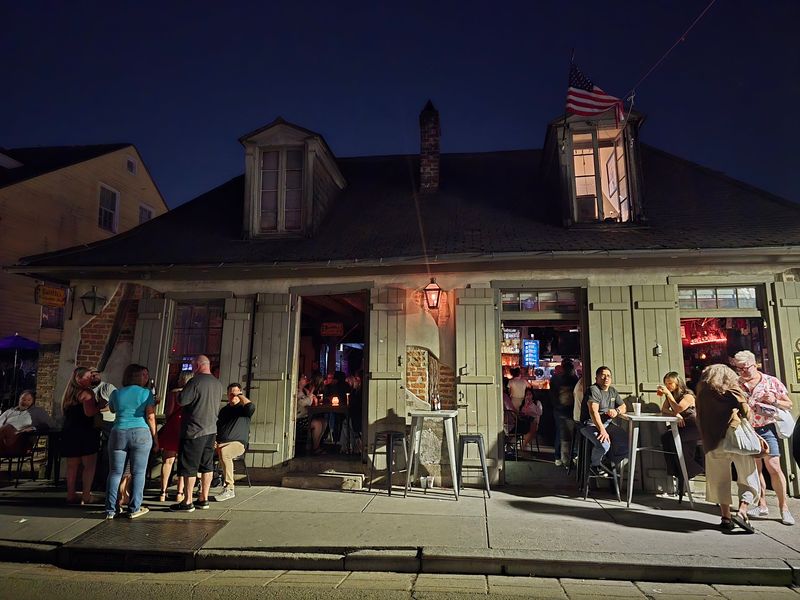
At the quieter end of Bourbon Street, an old building seems to hold its ground while the neighborhood moves around it. Lafitte’s Blacksmith Shop stands at the corner of Bourbon and St. Philip Streets and is among the city’s oldest surviving structures.
Its rough brick and low light make it easy to imagine a very different New Orleans.
A popular story connects the site with privateer Jean Lafitte and his brother Pierre, though the details of that link are uncertain. Enjoy the tale as a tale, then look closely at the building itself.
You can appreciate its historic exterior during a walk without going inside. Night photos work best when you step aside and let others pass, since the corner is still part of an active street.
Here, the most interesting sight is the structure, not the legend around it.
6. Preservation Hall
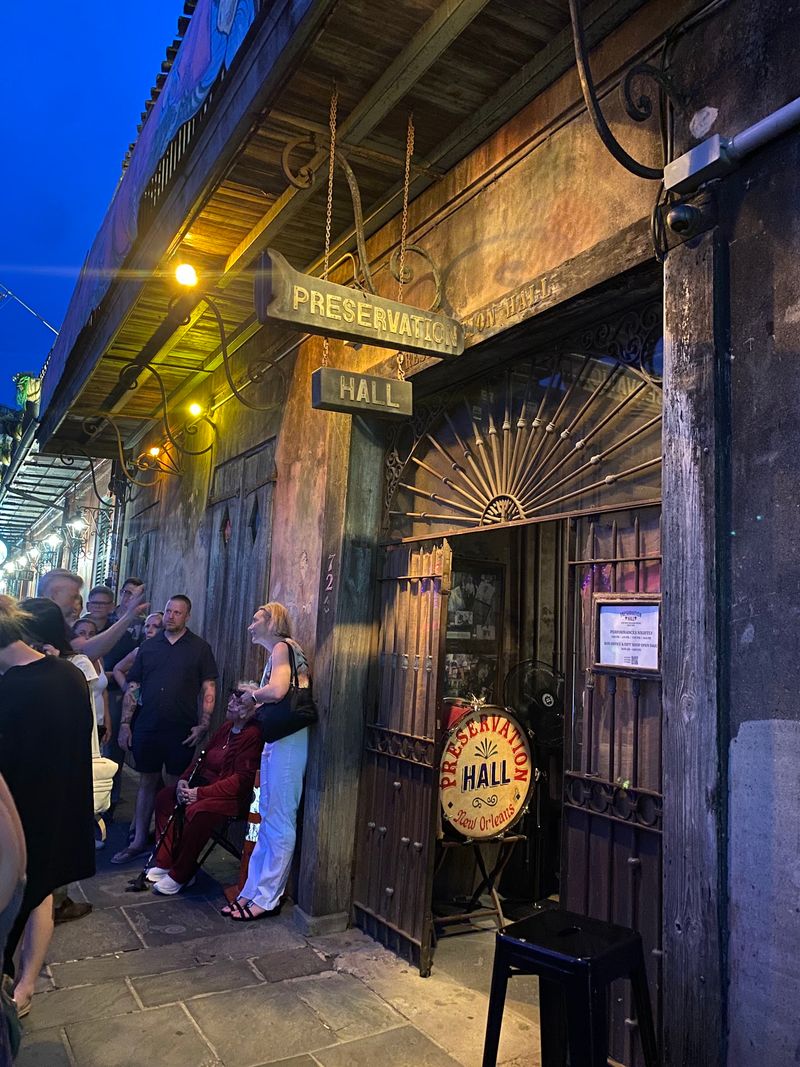
A plain wooden entrance on St. Peter Street hides one of the city’s most concentrated musical experiences. Preservation Hall at 726 St. Peter Street has presented traditional New Orleans jazz since 1961, keeping the room deliberately simple so the musicians remain the center of attention.
The intimate scale changes how the music feels. There is very little physical distance between performers and listeners, and the acoustic setting strips away much of what would normally distract from the rhythm, improvisation, and communication happening among the players.
The Preservation All-Stars draw from a collective of more than 60 local traditional jazz musicians, with lineups changing regularly. That means two visits can produce very different ensembles while remaining rooted in the same musical tradition.
Current performances are ticketed, and reserving ahead is the safest approach. Showtimes and seating arrangements depend on the date, so this is one stop where spontaneity can leave you listening from outside instead.
The institution also carries cultural weight beyond tourism. Preservation Hall helped provide a stage for traditional musicians and integrated audiences during an era when segregation remained embedded across the South.
Knowing that history adds another dimension without turning the experience into a lecture.
5. Royal Street
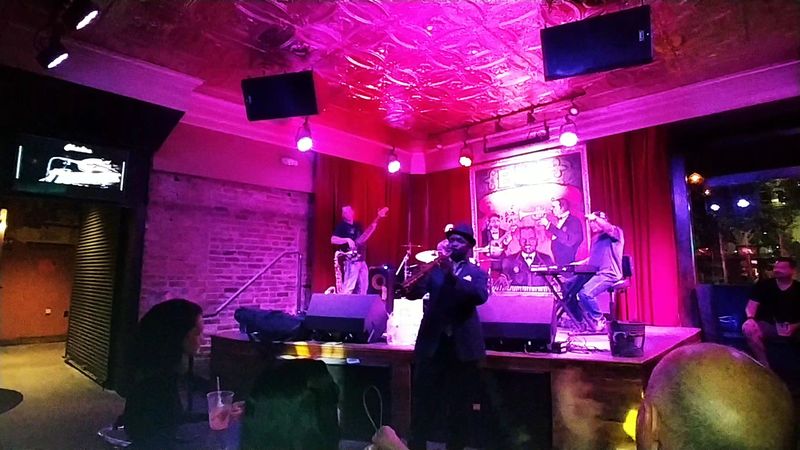
Window shopping works unusually well after closing time on Royal Street. Gallery displays and antique shop fronts offer plenty to study, while lamps pick out the curves of wrought-iron balconies overhead.
Compared with nearby Bourbon Street, an evening walk here often feels less hurried.
Start near Jackson Square and follow the blocks at your own pace, looking up as often as you look into windows. Many shops will be closed, so save any planned purchase for daytime and enjoy the street as an outdoor display instead.
You may hear a musician along the way, but leave room for the quieter sounds too: footsteps, conversation, and the steady movement of the Quarter. Watch for uneven pavement and passing traffic at crossings.
Royal Street asks for no special plan, only enough time to notice details that would disappear in a hurry.
4. New Orleans Riverfront
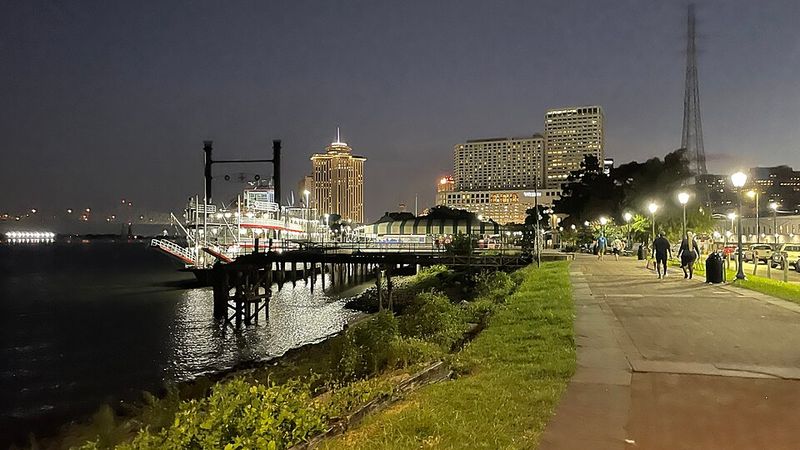
The Mississippi keeps moving through the darkness as though the city beside it is almost incidental. New Orleans’ riverfront offers one of the easiest ways to change the pace of a French Quarter evening without traveling far from its busiest streets.
Goldring Woldenberg Riverfront Park is the natural starting point. A major riverfront redevelopment completed in April 2026 expanded and upgraded the promenade, creating roughly two and a quarter miles of improved riverfront space with paths, shade features, restrooms, and clearer connections along the Mississippi.
At night, the strongest attraction remains wonderfully simple. Find an open viewpoint, watch illuminated vessels move along the river, and notice just how broad and active the Mississippi feels once the opposite bank becomes a line of distant lights.
The difference from the Quarter can be immediate. A few minutes earlier, music and conversation may have been bouncing between buildings; beside the water, sound has somewhere to escape.
River breezes can also make the temperature feel noticeably cooler, so a light layer helps outside the hottest months. Stay on open, well-lit public routes and pay attention to any posted access restrictions.
The riverfront is especially useful when the rest of the evening starts feeling overstimulating.
3. Carousel Bar & Lounge
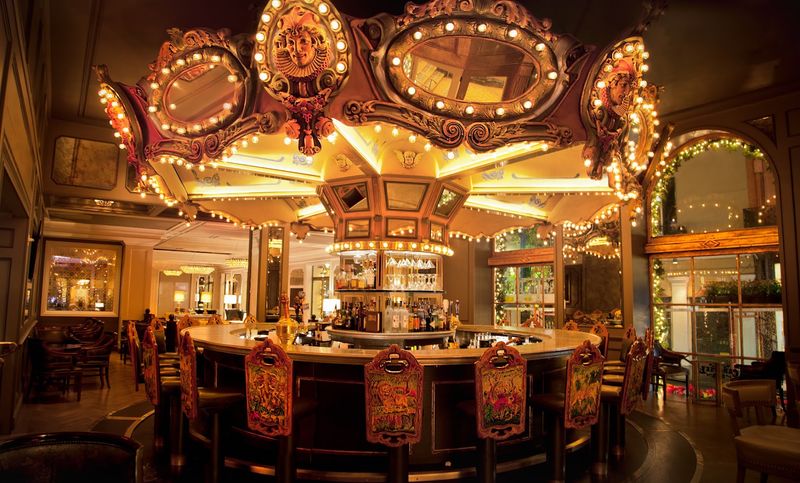
The room moves so slowly that you might miss it at first. Inside the Hotel Monteleone on Royal Street, the Carousel Bar’s circular counter has turned since 1949, making a full rotation in about 15 minutes.
Its painted canopy and star-like ceiling lights lend the room a playful look after dark.
Finding a place at the 25-seat counter is not guaranteed, especially when the hotel is busy. You can still notice its unusual design from elsewhere in the room if access allows; check current hours and entry rules before visiting.
The hotel has long been linked with writers, including Tennessee Williams and Truman Capote, but you need no literary homework to enjoy the setting. Watch the view shift a little, then glance back at Royal Street outside.
It is a small reminder that New Orleans can be surprising without raising its voice.The first strange sensation is realizing the room is moving even though nobody around you seems concerned. Inside Hotel Monteleone at 214 Royal Street, the famous Carousel Bar revolves slowly beneath an ornate canopy, completing one full rotation roughly every 15 minutes.
The rotating counter has been operating since 1949 and contains only 25 seats, so getting one is never guaranteed. The surrounding lounge still offers a clear look at the mechanism and décor when the carousel itself is full.
Night brings the room to life visually. Painted carousel details, small lights overhead, and the slow movement of the counter create an atmosphere that feels playful without turning into a theme-park attraction.
Live music is currently scheduled seven nights a week, giving the space another reason to work as an evening stop. Hours run daily from 11 a.m. until midnight, with entry restricted to guests age 21 and older after 6 p.m.
The hotel’s literary associations add another layer, with writers including Tennessee Williams among the famous names connected with the property over the years. You do not need that history to enjoy the design, though.
Stand somewhere still and watch the carousel make part of a revolution.
The effect is subtle enough that it takes a moment to register, which somehow makes it more charming.
2. Bourbon Street
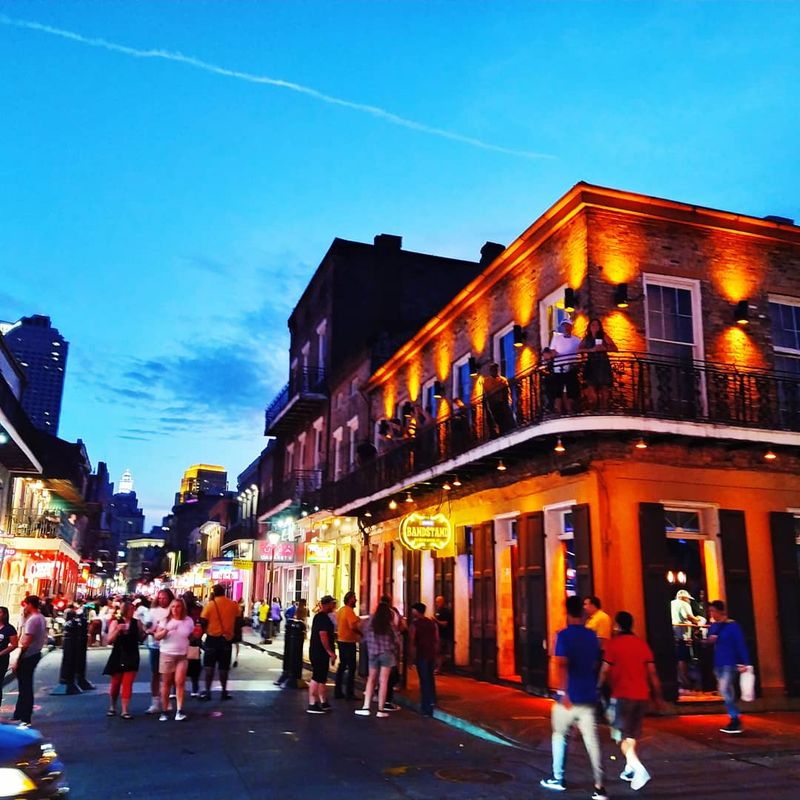
Neon, music, balconies, crowds, and competing sounds make subtlety almost impossible here. Bourbon Street after dark is the loudest entry on this list, a corridor where New Orleans nightlife becomes less an activity than something physically surrounding you.
The street itself dates to the French colonial layout of the city and takes its name from the House of Bourbon. Its current entertainment identity developed much later, layering modern nightlife onto blocks filled with older architecture.
That contrast is worth noticing. Bright signs grab attention at eye level, but looking upward reveals shutters, balconies, façades, and details from a very different New Orleans.
The busiest section can become intensely crowded at night, especially on weekends, major event dates, and festival periods. Anyone who wants the visual experience without the densest foot traffic should arrive earlier in the evening, then move toward quieter cross streets once the sidewalks begin tightening.
You do not need to spend hours here to understand its reputation. Walking several blocks gives you the essential mix of street performers, balcony activity, music, architecture, and human traffic.
Keep moving thoughtfully and avoid stopping in the middle of narrow pedestrian flows for photographs.
1. Sydney And Walda Besthoff Sculpture Garden
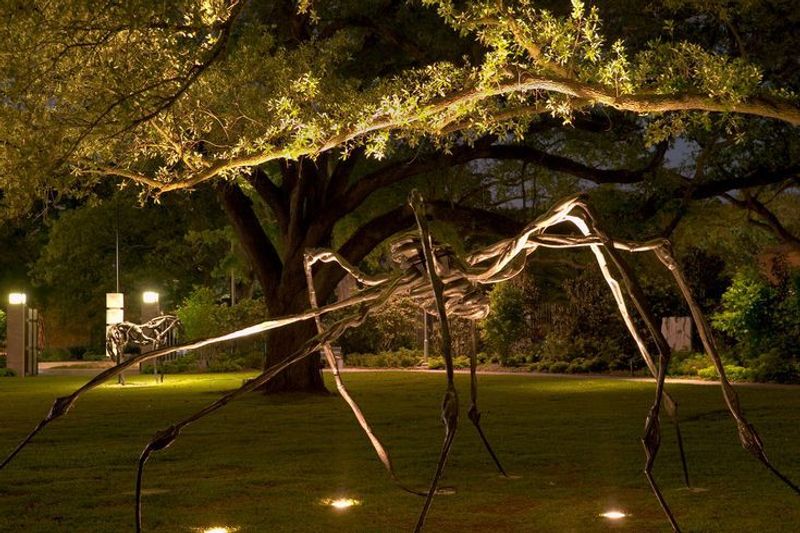
Live oaks, lagoons, winding paths, and monumental sculptures create an atmosphere that deserves to begin the evening rather than end it. The Sydney and Walda Besthoff Sculpture Garden beside the New Orleans Museum of Art in City Park is the one entry here that should not be saved for after dark.
Current hours are 10 a.m. to 6 p.m. from April through September and 10 a.m. to 5 p.m. from October through March. Admission remains free, and the garden is open seven days a week except for specific holiday and Mardi Gras-related closures.
More than 90 works are spread through roughly 11 acres of mature landscape. Sculptures appear among live oaks, magnolias, pines, lagoons, bridges, and open lawns, making the route feel less like moving through an outdoor gallery than discovering art gradually inside a park.
Late afternoon is particularly useful for an evening itinerary. Softer light changes the trees and water, while finishing near closing time leaves plenty of night ahead for the French Quarter, Frenchmen Street, or the riverfront.
Do not arrive expecting illuminated sculptures and late-night wandering. The gate will settle that misunderstanding quickly.