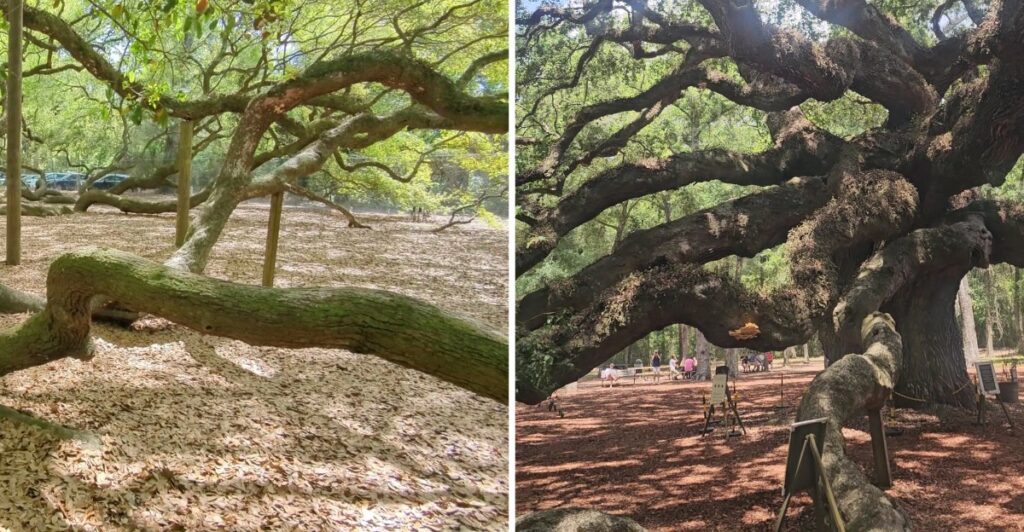
If trees had elbows, this one would need a lot more room.
Most oaks seem interested in reaching upward. This one decided sideways deserved some attention too.
On Johns Island, enormous limbs stretch away from the trunk until several dip low enough to rest on the ground. The result looks less like one neat tree and more like an entire patch of landscape claimed by branches.
It has been doing this for centuries.
Nobody knows the exact age, but estimates place it somewhere in the hundreds of years, giving South Carolina plenty of time to get attached.
And the measurements only make it stranger.
The canopy spreads across roughly 17,000 square feet.
But I would forget the numbers for a minute and stand underneath it.
Then try answering one simple question:
Where exactly does this tree end?
Angel Oak May Be Around 400 To 500 Years Old
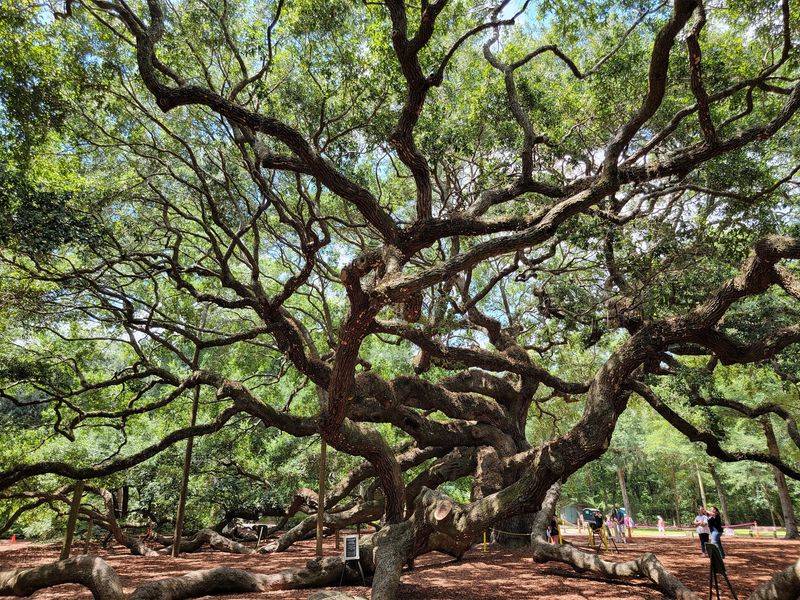
Nobody knows the exact age of Angel Oak, which is why published estimates cover a fairly wide range.
Age estimates range from roughly 300 to 500 years, although the tree’s exact age remains unknown. Either range puts the oak among the oldest living landmarks in the Charleston area.
Angel Oak is a Southern live oak, or Quercus virginiana, a species known for broad crowns and heavy horizontal limbs.
The tree’s age is reflected in a broad canopy, thick trunk, deeply ridged bark, and massive lateral limbs. The tree is not exceptionally tall compared with some forest giants. Its scale comes from a thick trunk, wide crown, and limbs extending far from the center.
Take a slow walk around the viewing area rather than stopping at the first open angle. The shape changes as you move, and different sections of the canopy become visible from each side.
The tree has endured centuries of heat, coastal storms, and changing conditions on Johns Island. Its long life is visible in the heavy trunk, deeply ridged bark, and the way older limbs have spread far beyond the center of the canopy.
Keep to the public viewing area and use the open lawn to compare the tree from several distances.
Massive Limbs Stretch Out And Rest On The Ground
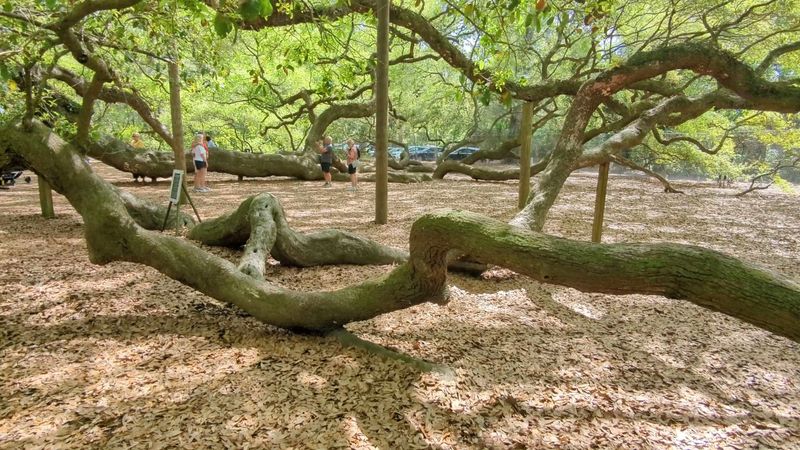
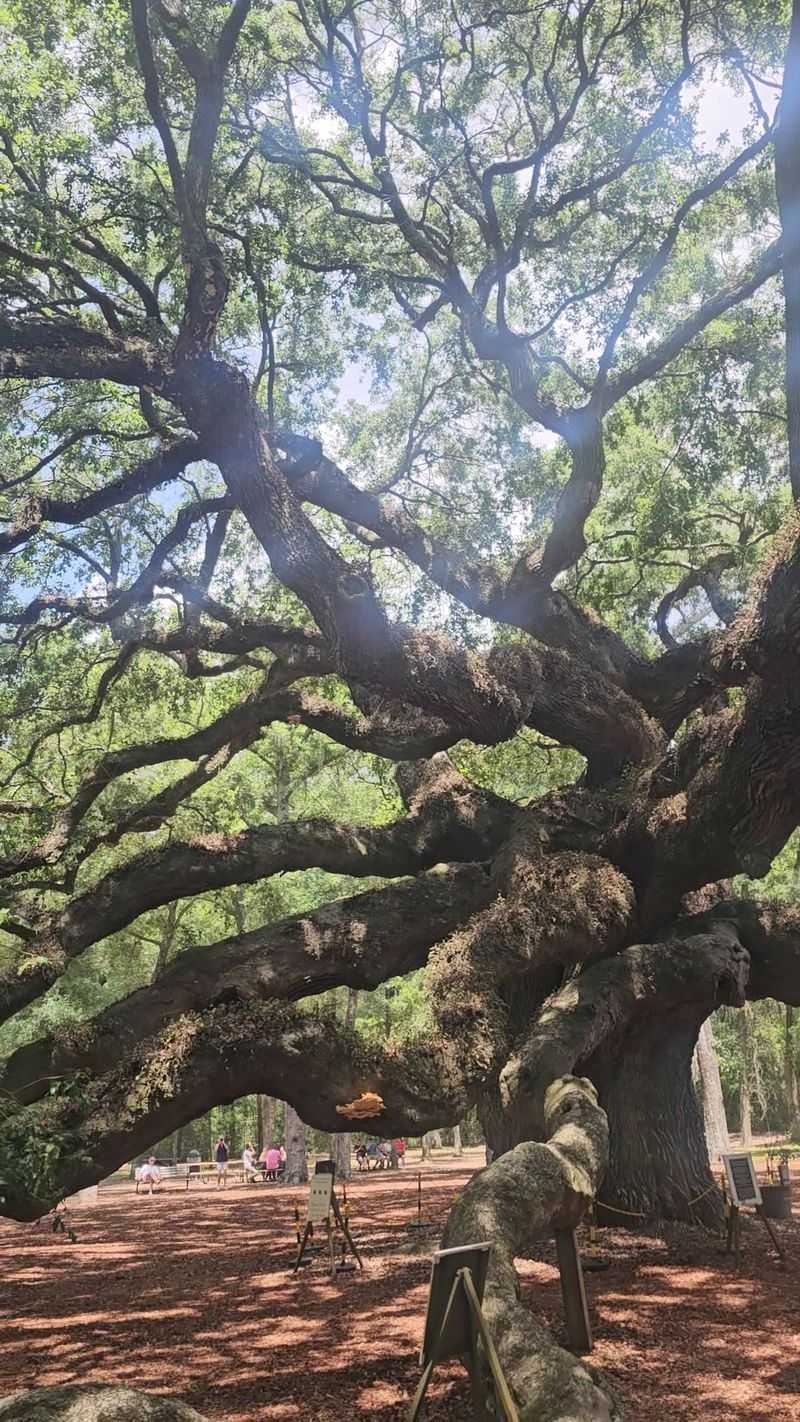
Angel Oak’s most recognizable feature is not its height. It is the way several enormous limbs sweep outward, bend low, and rest directly on the ground.
That growth pattern appears in very old Southern live oaks, whose branches can become thick and heavy as they extend away from the trunk. At Angel Oak, the limbs spread in several directions and create a broad, layered canopy.
From some angles, a branch looks almost like a second trunk running horizontally through the grass. Other limbs curve upward again after touching or nearing the ground.
Visitors need to stay off the tree and remain behind the protective barriers. Climbing, sitting on the branches, or stepping into restricted areas can damage bark, roots, and soil around the tree.
You can still see the twisting bark and branching structure from the public viewing area. Look at how the limbs divide, dip, and change direction as they move away from the trunk.
For photos, a wide-angle setting helps capture more of the canopy without entering protected space. Tripods are not allowed around the tree, so handheld photos or a phone panorama are the practical options.
Move farther back if you want the full outline rather than trying to squeeze the trunk and branches into one close frame.
The Canopy Covers About 17,000 Square Feet
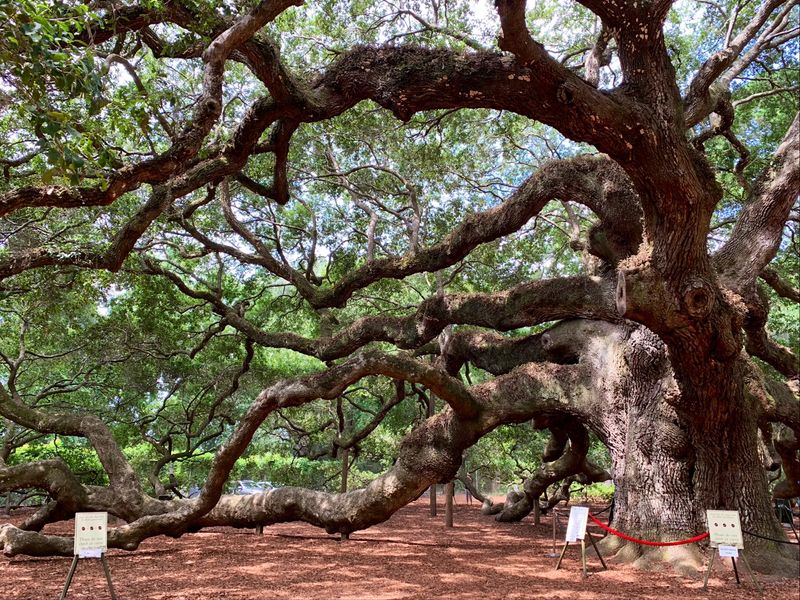
Angel Oak stands about 65 feet tall, but its canopy gives the tree its enormous footprint.
The crown covers roughly 17,000 square feet, creating a broad ceiling of leaves and branches. The trunk circumference is about 25.5 feet, adding another sense of scale once you are close enough to compare it with the people nearby.
Southern live oaks naturally grow wide. Instead of concentrating most growth upward, they often develop heavy lateral limbs across open ground.
At Angel Oak, that pattern has produced a canopy stretching well beyond the trunk in several directions.
The shaded area changes through the day as sunlight moves across the branches. In warmer months, the difference between the open lawn and the space beneath the canopy can be noticeable.
If you are visiting in summer, an earlier arrival can make the walk more comfortable. Bring water and sun protection, and remember that the tree sits outdoors with limited shelter beyond its own shade.
Picnic tables are available nearby. Keep food and drinks away from the protected area around the oak itself, where site rules are stricter.
The park is small enough that you can move between the viewing area, tables, and gift shop without turning the stop into a long walk.
Centuries Of Growth Have Given The Tree Its Unusual Shape
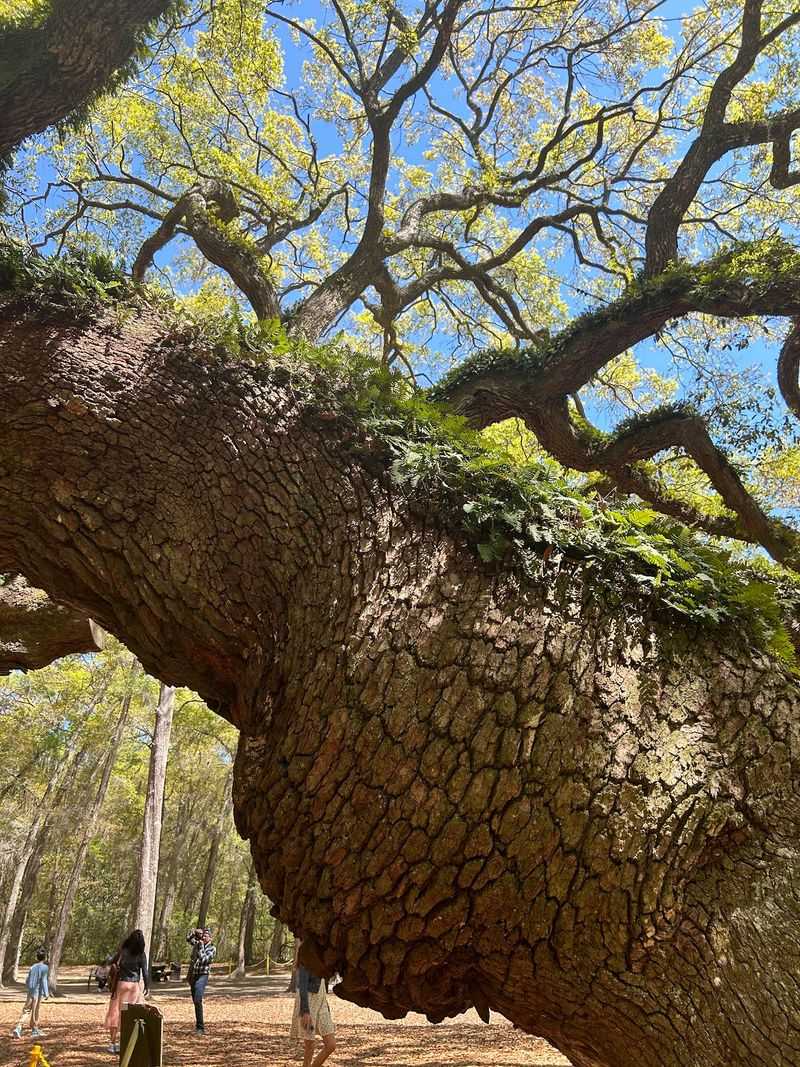
Angel Oak does not have the straight, narrow outline of a pine or the compact crown of a younger street tree.
Its form comes from centuries of outward growth. Southern live oaks naturally spread horizontally, and Angel Oak has had hundreds of years to develop thick limbs, bends, forks, and sweeping sections close to the ground.
The trunk is broad and deeply textured, while major branches split into smaller limbs that weave across the canopy.
Coastal South Carolina regularly experiences strong winds, heavy rain, tropical systems, and summer heat, all conditions the tree has endured through its long life.
Barriers around the tree also reduce soil compaction and damage to the root zone.
Walk around the outer path and watch how the silhouette changes. From one side, the trunk dominates the view. From another, a low branch may stretch across most of your field of vision.
A wide lens can help fit more of the canopy into one image. Because tripods and props are prohibited near the tree, handheld photography keeps things simple.
The Oak Once Stood On Land Tied To The Angel Family
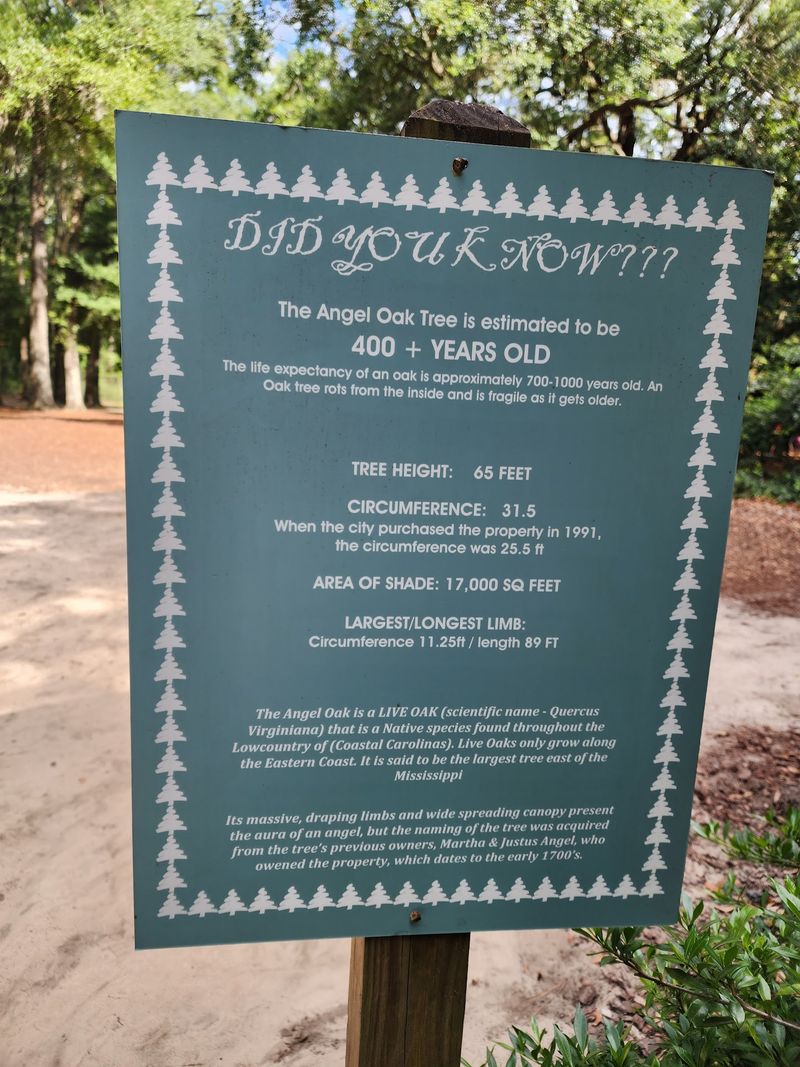
Angel Oak’s name comes from the property history surrounding the tree rather than from its appearance.
The oak stood on land associated with the Angel family, including Justus Angel and Martha Waight Angel. The property became known as Angel Plantation, and the family name eventually became attached to the tree.
The surrounding land has a much longer history than the park visitors see today. Johns Island was shaped by plantation agriculture, changing ownership, and generations of people who lived and worked across the Lowcountry.
That history includes enslaved labor, an essential part of the plantation economy that developed throughout the region before the Civil War.
Today, the tree remains while the surrounding landscape serves a different purpose as a public park.
Spend a few minutes reading the signs and looking at the scale of the property around the oak. The tree stands within a landscape that has changed repeatedly over several centuries.
The Angel name survives in the park, road, and tree, while the site also carries broader Lowcountry history.
Charleston Turned The Site Into A Public Park
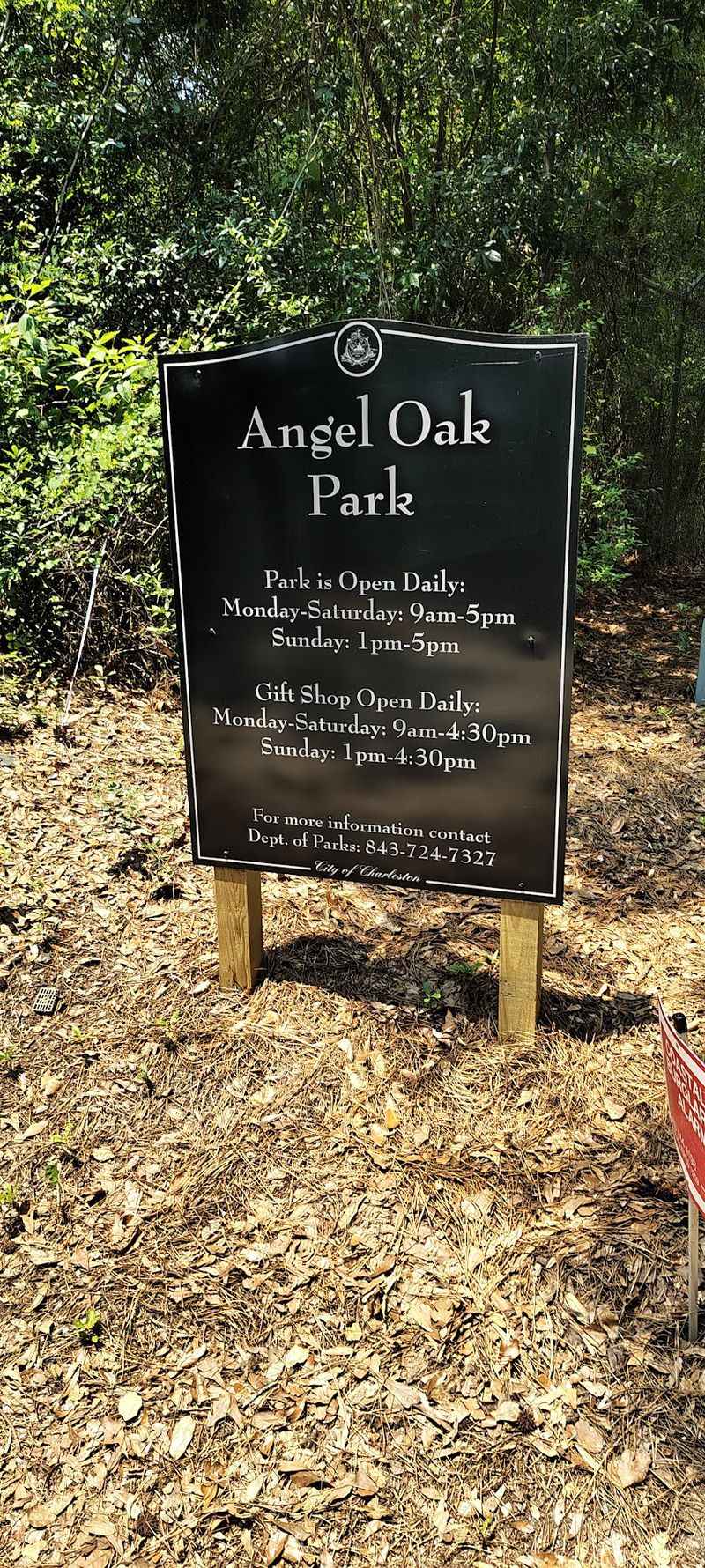
The City of Charleston acquired Angel Oak Park in 1991, turning the site into a public park centered on the historic tree.
General admission is free, and donations are accepted.
The park includes picnic tables, a small gift shop, and open areas around the protected viewing zone. The tree itself is surrounded by rules designed to limit damage to the trunk, limbs, roots, and soil.
Tripods, props, blankets, food, and drinks are not allowed around the tree. Visitors also need to stay behind barriers and avoid climbing or sitting on the branches.
Current public hours are 9 a.m. to 5 p.m. Monday through Saturday and 1 p.m. to 5 p.m. Sunday, with the last entrance shortly before closing.
Holiday closures and weather-related changes can affect access, so check conditions before heading out.
The park is at 3688 Angel Oak Rd, Charleston, SC 29455.
Parking is available on site. Give yourself time to circle the viewing area, look at the canopy from several angles, read the posted information, and sit nearby if the weather cooperates. An earlier visit can also help you avoid the strongest afternoon heat during warmer months.
Angel Oak Joined The National Register In 2026
Angel Oak reached a new milestone on May 21, 2026, when it was listed in the National Register of Historic Places.
The listing recognizes the tree and its setting as a historic resource connected to the cultural landscape of Johns Island and the Charleston area.
The oak measures about 65 feet tall, has a trunk circumference of roughly 25.5 feet, and spreads a canopy across about 17,000 square feet.
Its estimated age of roughly 400 to 500 years places its early growth centuries before the current park, modern roads, or the development now surrounding parts of Johns Island.
For visitors, the experience remains straightforward. You arrive at a small public park, walk toward an enormous live oak, and view it from behind protective barriers.
Take time to look beyond the trunk itself. Notice where the branches touch the ground, how far the canopy spreads, and how much open space the tree occupies.
Then step back far enough to see the entire outline.
Angel Oak is still growing, still protected, and still part of the Lowcountry landscape centuries after its earliest years. The 2026 National Register listing formally recognizes Angel Oak as a historic resource, while the park remains open to daytime visitors.