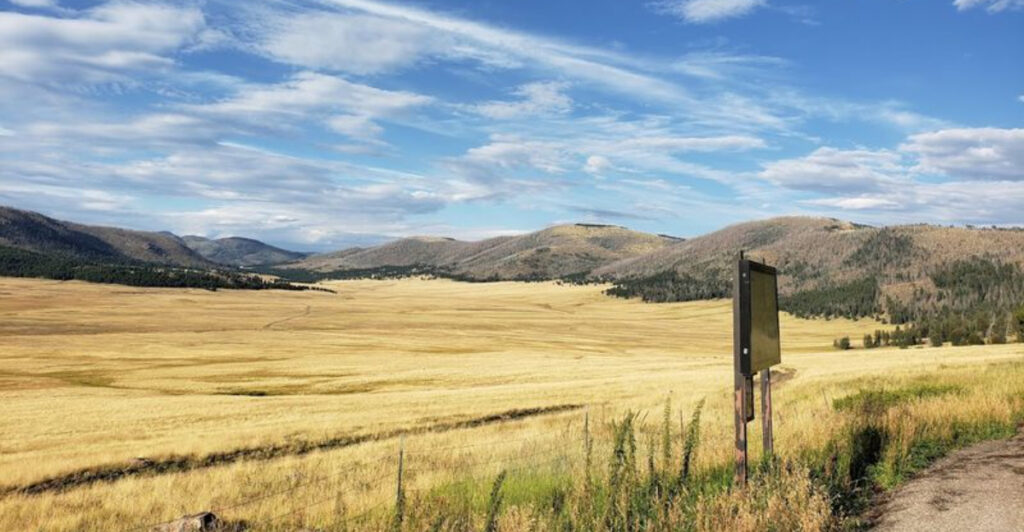
I pulled over for the view, but the view had other plans. Across the road, a huge green valley opened up so suddenly that I just stood there, trying to take it in.
It looked peaceful, almost too peaceful, considering how it was made. About 1.25 million years ago, a supervolcanic eruption changed this landscape in a way that still feels hard to wrap your head around.
After the eruption, the ground collapsed, forming a nearly 14-mile-wide bowl. Today, it looks calm enough for elk to wander through and visitors to stare in silence.
That is what makes the place so striking. You are not just looking at scenery.
You are looking at the remains of a force powerful enough to rewrite the land. New Mexico has plenty of dramatic views, but this one comes with a story that grabs you fast.
Here are the facts worth knowing right now.
A Wide Meadow Beneath Volcanic Ridges
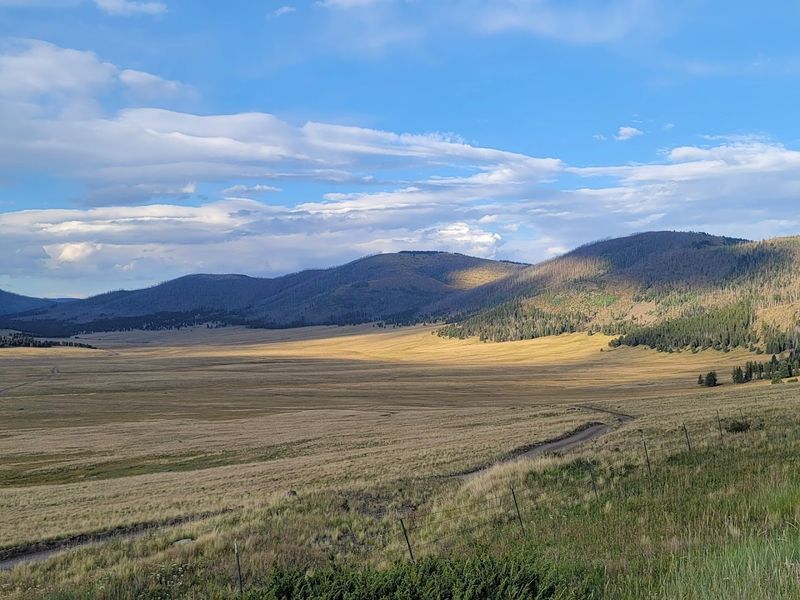
Nothing quite prepares you for the moment the trees part. A meadow the size of a small city opens up in front of you.
The Valle Grande is the largest and most accessible valley within the Valles Caldera National Preserve, and from the overlook on NM-4, the scale of it makes your brain pause for a second.
The meadow floor stretches out in a wide, grassy expanse, ringed on all sides by volcanic ridges that climb into pine-covered slopes. What you are looking at is the interior of a caldera, the sunken bowl left behind after a massive volcanic eruption emptied the magma chamber beneath it roughly 1.25 million years ago.
The ridges framing the meadow are not just scenic backdrops; they are the ancient walls of that collapsed volcano. Grasses ripple in the mountain breeze, and on quiet mornings, the only sounds are birds and the occasional distant bugle of an elk.
I stood here thinking about how something so violent could leave behind something so unexpectedly serene. That contrast never really stops being fascinating to sit with at Valle Grande Overlook, 40858 NM-4, Jemez Springs, NM 87025.
Golden Grasslands Framed By Forested Hills
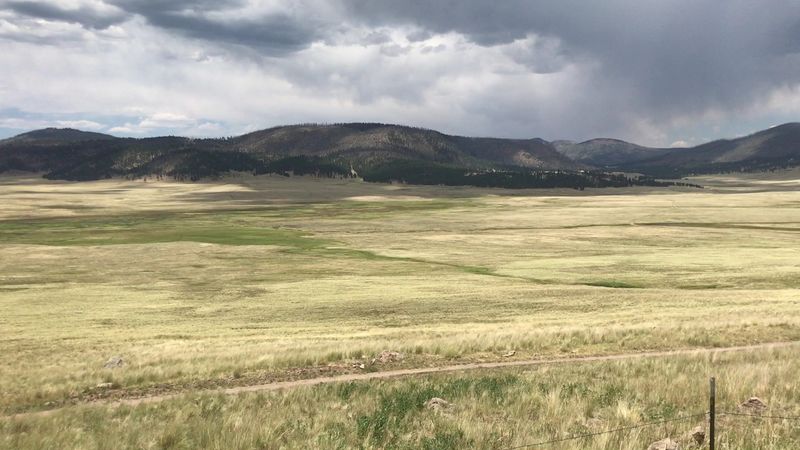
Late summer and early fall transform the Valle Grande into something that looks almost painted, with the meadow grasses shifting from green to deep gold as the season changes.
Seen from the overlook, those golden tones stretch across the valley floor in long, rolling waves, framed on every side by dark green forested hills that rise steadily toward the ridgeline.
The color contrast is one of those things visitors consistently mention, and I understood exactly why the moment I pulled off at the scenic pullout and just stood there taking it in.
The forests are primarily ponderosa pine and mixed conifer, giving the surrounding hills a rich, layered texture that makes the open grassland feel even more dramatic by comparison.
This kind of landscape is rare in the American Southwest, where open grasslands at high elevation are not exactly common, and the Valles Caldera owes its unusual terrain entirely to its volcanic origins.
The caldera floor, flattened by millennia of erosion and filled with sediment, created ideal conditions for this wide, fertile meadow.
Every time the light shifts, the golden grasslands seem to glow a little differently, which makes it nearly impossible to take just one photo.
Soft Clouds Over An Ancient Caldera
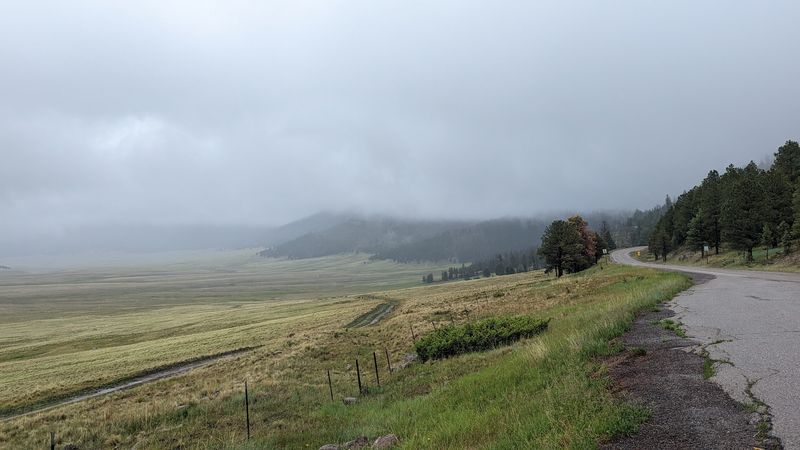
Clouds can completely change the feeling of this place. On a partly cloudy afternoon, the overlook seems to shift every few minutes.
Clouds over the caldera do something visually remarkable, casting slow-moving shadows across the meadow floor that shift the colors of the grass from gold to deep olive green and back again in a matter of minutes.
The Valles Caldera sits at high elevation in the Jemez Mountains, which means weather patterns here move quickly and dramatically, making the sky itself part of the scenery.
The caldera formed about 1.2 to 1.25 million years ago when an eruption of extraordinary scale caused the ground above the magma chamber to collapse inward, creating this enormous natural bowl.
Its high-elevation basin, deep soils, and moisture help keep the valley floor greener than much of the surrounding terrain.
On the day I visited, clouds rolled in from the west and softened the harsh midday light into something almost cinematic.
Shadows racing across a supervolcano from a roadside pullout are exactly the kind of unexpected magic that makes road trips through New Mexico so rewarding.
A Scenic Pullout With Endless Views
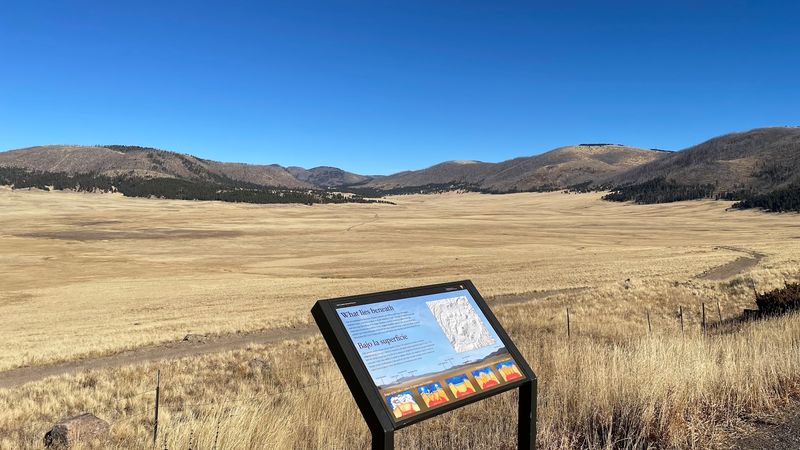
Several pullouts along NM-4 offer sweeping views of the Valle Grande. Each one gives you a slightly different angle on the same spectacular landscape.
The main pullout is well-marked, easy to access, and large enough to accommodate multiple vehicles, which makes it genuinely stress-free to stop, park, and spend as much time as you want taking in the view.
A signboard at the overlook explains the volcanic history of the caldera and includes a map that helps orient you to the ridges and valleys you are looking at, which I found surprisingly useful for understanding the geography.
From this vantage point, the full breadth of the Valle Grande opens up in front of you, and the scale of it is something photographs simply cannot capture the way standing there in person does.
Binoculars are genuinely worth bringing, because the elk herd that roams the valley floor can sometimes be spotted from here as small moving shapes in the distance.
Visitors often praise the overlook for its easy access and huge, open views, and after stopping here, I found that completely unsurprising.
Valle Grande Overlook along NM-4 is the kind of stop that turns a drive into a memory you carry home with you.
Quiet Roads Through High Mountain Meadows
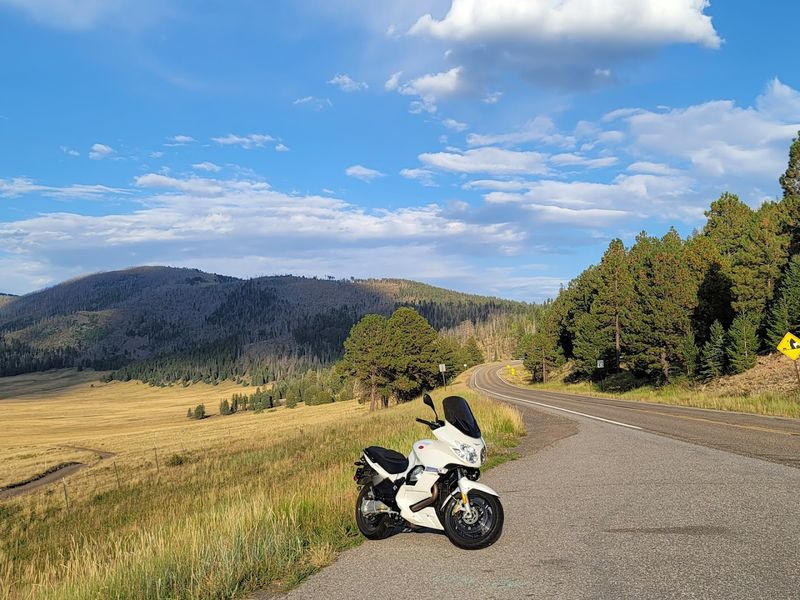
The drive to Valle Grande Overlook is half the pleasure. NM-4 through the Jemez Mountains earns its own appreciation long before you reach your destination.
The highway winds through dense stands of ponderosa pine and Douglas fir, climbing steadily through the mountains before suddenly opening up to reveal the caldera in a way that feels almost theatrical.
High mountain meadows appear at intervals along the route, small grassy clearings surrounded by tall trees that hint at the larger landscape waiting ahead.
The elevation along this stretch runs well above 8,000 feet, which means temperatures stay noticeably cooler than the desert towns below, making summer drives here a genuine relief.
Traffic often feels lighter than on busier park roads, though road and crowd conditions can vary by season, weather, and time of day.
I stopped at least three times before reaching the main overlook, each time drawn by a different angle of light or a meadow I wanted to see up close.
Roads like this remind me why driving through New Mexico never gets old, because the landscape keeps revealing new layers the further you go.
Where Elk Graze Across Open Valleys
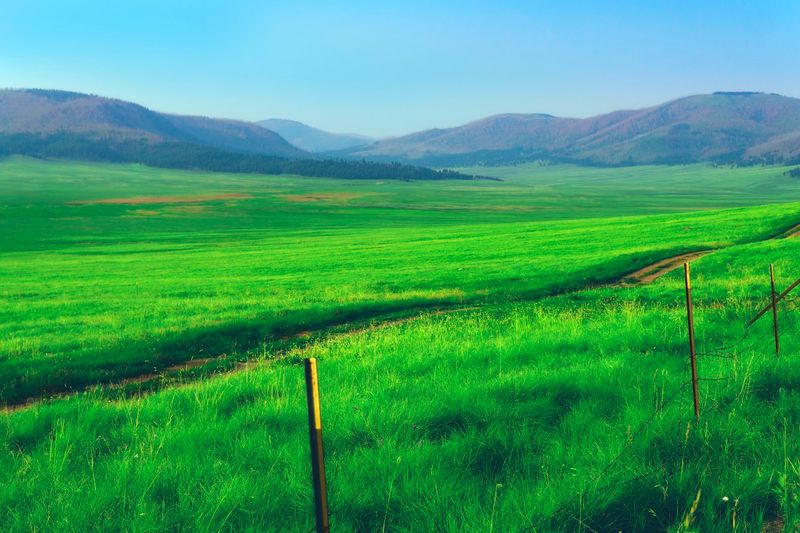
Few wildlife encounters in the American Southwest match this kind of view. Several thousand elk can move across an open valley below.
The Valles Caldera is home to one of New Mexico’s notable large elk herds, and the Valle Grande meadow serves as prime grazing habitat, especially during the fall rut when bulls bugle across the valley in a sound that carries remarkably far.
From the overlook, elk sometimes appear as small dots scattered across the distant grass, but with binoculars or a zoom camera, you can watch them graze, move, and interact with surprising clarity.
A massive herd may look like tiny dots to the naked eye, but through a zoom lens or binoculars, the scene becomes dramatically more impressive.
Recent wildlife movement changes from day to day, so it is worth checking current preserve information before heading to the overlook.
The caldera’s protected status as part of the Valles Caldera National Preserve helps keep this wildlife habitat intact and undisturbed.
Seeing elk graze inside a supervolcano is one of those surreal, quietly wonderful moments that New Mexico seems to specialize in delivering.
Pines And Rolling Volcanic Slopes
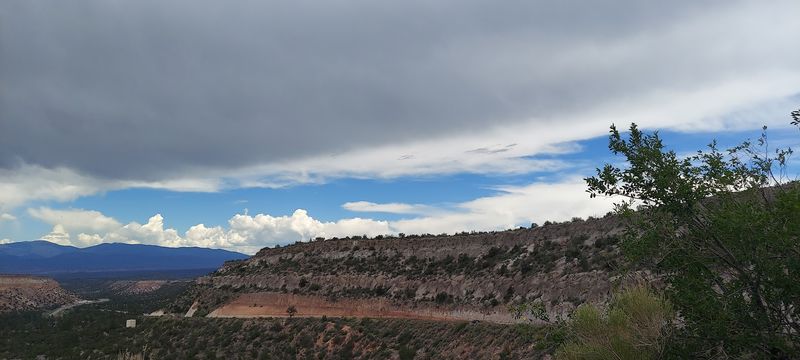
The forested slopes surrounding the Valle Grande are not uniform. That variety is a big part of what makes the landscape so visually rich.
Aspen groves cluster on the volcanic domes and north-facing slopes, turning brilliant yellow in October, while ponderosa pines and mixed conifers cover the broader ridgelines in deep, year-round green.
Those volcanic domes are themselves a fascinating geological feature, formed by thick, slow-moving lava that pushed up through the caldera floor after the initial eruption, creating rounded forested hills that dot the landscape.
The Valles Caldera contains a prominent resurgent dome and multiple lava domes, visible reminders that the geology here did not simply stop after the big collapse 1.25 million years ago.
From the overlook, the interplay between open meadow and forested dome creates a layered, textured view that changes character depending on the season and time of day.
Fall is particularly spectacular, when aspens ignite in gold against the darker pine backdrop, and the contrast with the tawny meadow grass below is genuinely striking.
The rolling slopes feel alive in a way that makes you want to hike into them rather than just admire them from the road.
A Peaceful Vista With Deep Geologic Drama
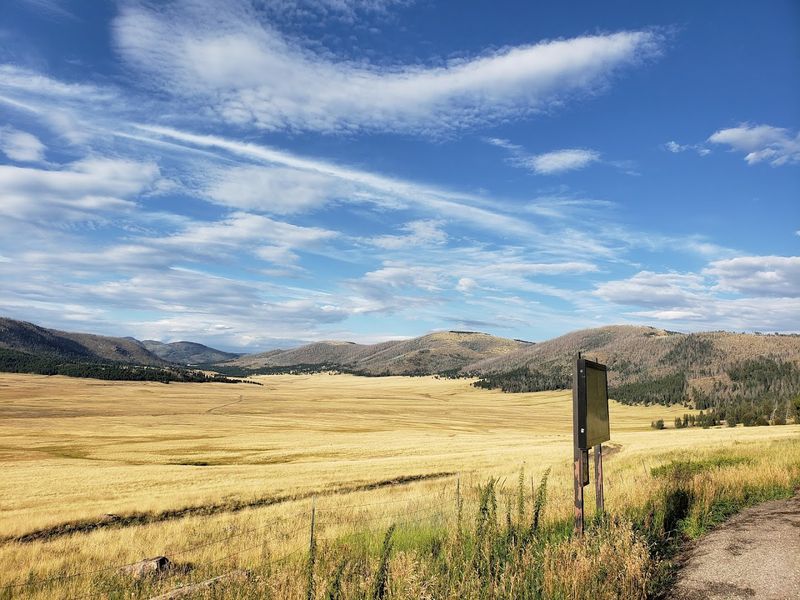
A peaceful valley can feel even more extraordinary when you know how it was made. This vista was created by one of North America’s great caldera-forming eruptions.
The eruption that formed the Valles Caldera ejected hundreds of times more material than the 1980 eruption of Mount St. Helens, and it spread ash across large portions of New Mexico in what geologists call the Tshirege Member of the Bandelier Tuff.
Today the caldera is considered dormant but not extinct, with hot springs and fumaroles still present within the preserve, and scientists monitoring seismic activity describe it as remarkably quiet for now.
That phrase, remarkably quiet, feels fitting when you are standing at the overlook listening to nothing but wind and birdsong.
The Valles Caldera was designated a National Natural Landmark in 1975 and is now managed as a unit of the National Park System, protecting both its geological and ecological significance.
The view can make you think about beauty and violence at the same time, which is about as accurate a description as I can imagine.
The peacefulness here is not ordinary stillness; it is the deep, settled calm of a landscape that has been through something enormous and come out the other side looking like this.