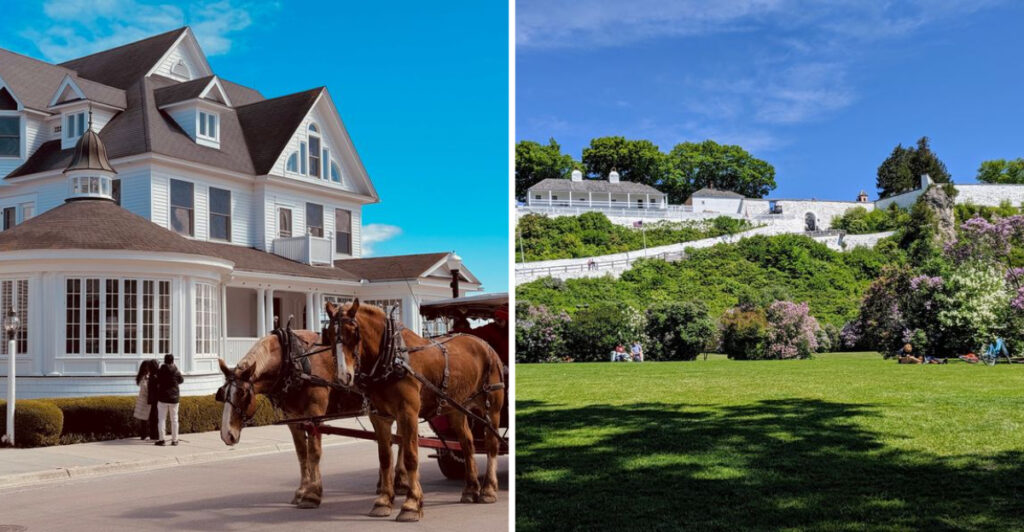
Okay, friend, Mackinac Island has a few rules. Trust me, you want to know them before you start treating this like an ordinary getaway.
The island runs on its own rhythm. Cars mostly disappear, and horses take over. Bicycles suddenly matter a lot more than expected.
Then come the little local habits nobody thinks about until they are already there.
Nothing is difficult. But showing up completely unprepared can make you feel like everyone else got a memo you somehow missed.
I like knowing that stuff before I arrive. It saves me from standing around confused while the locals quietly wonder what I am doing.
1. Don’t Treat The Street Like An Extra Sidewalk
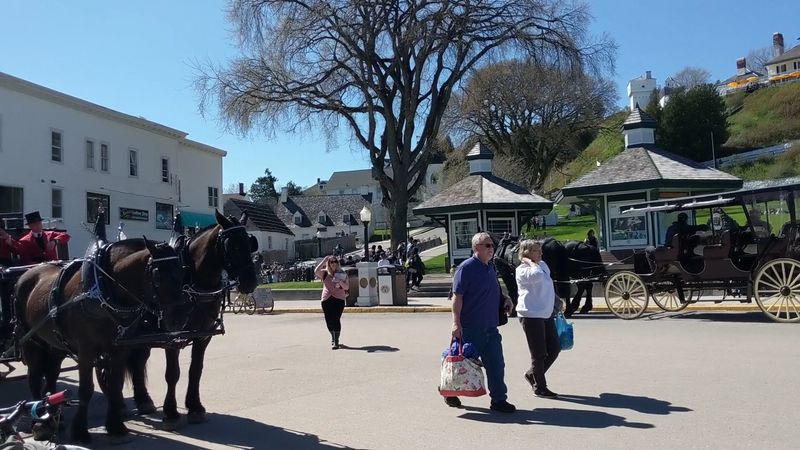
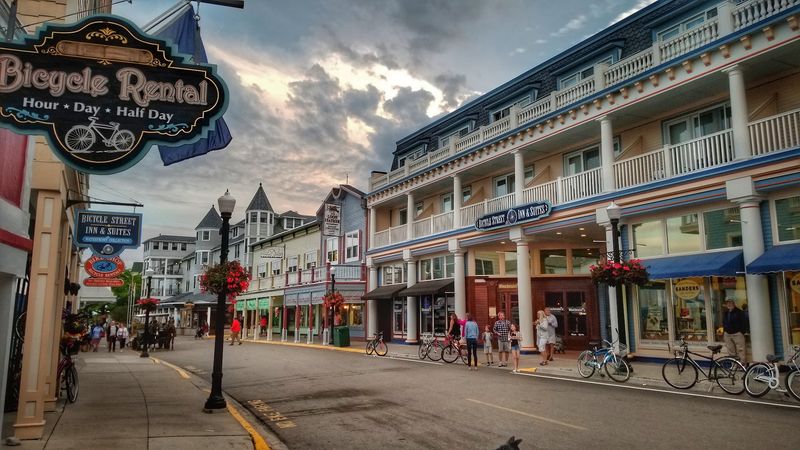
Downtown can look deceptively informal. Without normal automobile traffic, it is tempting to drift into the roadway while checking a map, taking a picture, or talking with someone in your group. That is exactly where pedestrians need to pay more attention.
Mackinac Island’s streets carry bicycles and horse-drawn vehicles, while sidewalks are intended for people on foot. Where sidewalks, footpaths, and crosswalks are available, pedestrians should use them rather than walking along the traffic lane.
The distinction matters most downtown, where several types of traffic meet in a relatively compact space. A bicycle may be approaching from behind while a carriage is moving through the same stretch ahead.
Need a photograph from the opposite side of Main Street? Wait for a clear opportunity to cross instead of stopping halfway through the roadway to frame it. The same rule helps when your group needs to regroup or decide where to go next.
Once you get away from downtown, footpaths and trails provide much more room for an unhurried walk. In the busiest blocks, however, treating the sidewalk as your home base keeps the road available for the traffic that actually needs it.
2. Give Horses The Right Of Way
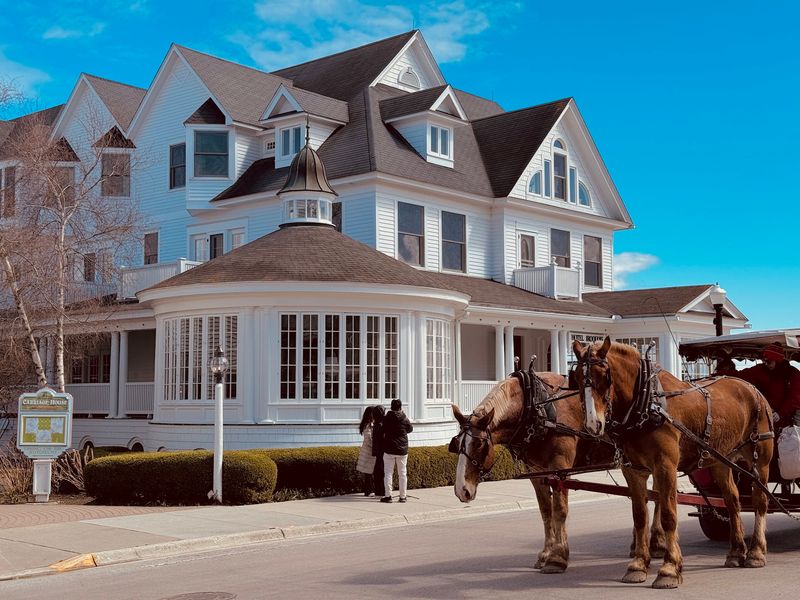
A horse-drawn carriage may look slow enough to give you plenty of reaction time. The important detail is that horses cannot stop or maneuver like a bicycle or automobile.
Horses have the right of way on Mackinac Island. Visitors walking or cycling should give them room, avoid cutting across their path, and keep sudden movements to a minimum.
Cyclists should also reduce speed in crowded areas where horses, pedestrians, and bicycles are sharing the same space.
Their role goes far beyond sightseeing. Horses pull taxis, carry passengers on carriage tours, and handle deliveries around town. That makes them part of the island’s working transportation network rather than a feature that appears only for visitors.
When a carriage is approaching an intersection, resist the urge to squeeze through before it arrives. Waiting several seconds is easier than forcing the driver, horse, cyclist, and pedestrians to react to the same unexpected move.
The same restraint helps when taking photographs. Give working horses enough space and avoid rushing close to them simply because they are moving slowly.
On Mackinac Island, patience around horses is not ceremonial etiquette. It is part of using the streets correctly.
3. Follow The Island’s Bike Rules
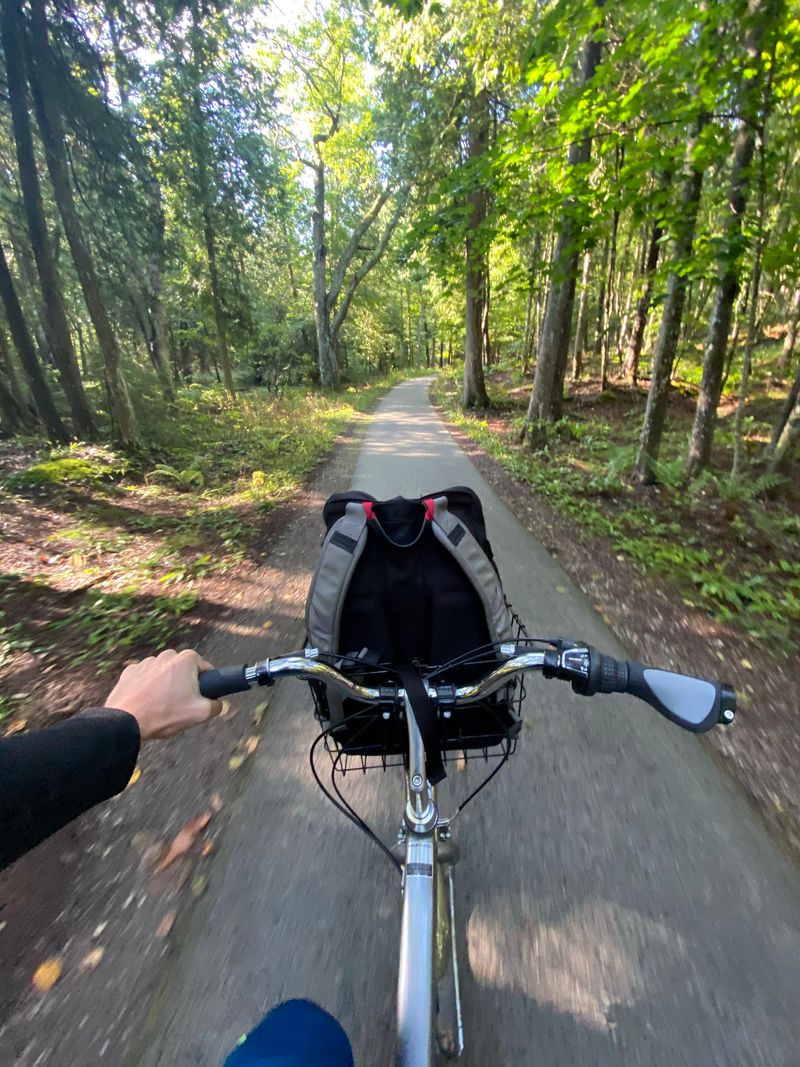
With more than 1,500 rental bicycles available and thousands of bikes potentially sharing island roads, cycling can become the default way to travel surprisingly quickly. That does not make the roads a bicycle-only system.
Ride on the right side of the street and yield to horses and pedestrians. Normal traffic signs still matter, and crowded downtown stretches call for slower speeds and more awareness than the open shoreline road.
That difference becomes obvious once you leave town. M-185 opens into long stretches where riders naturally spread out, while Main Street may put bicycles, pedestrians, carriages, and parked bikes within a much tighter space.
Signal before turning instead of making a sudden move across the road. Look behind you before changing position. When a horse-drawn vehicle is ahead, give it space rather than attempting to squeeze through a narrow opening.
Bringing children? There is another specific rule to know: bicycles with training wheels cannot be operated on Main Street, Market Street, or the designated stretch of Cadotte Avenue between Market Street and Grand Hotel.
A slower pace downtown costs very little time and makes the transition to the island’s shared-road system much easier.
4. Use Designated Areas When Parking Your Bike
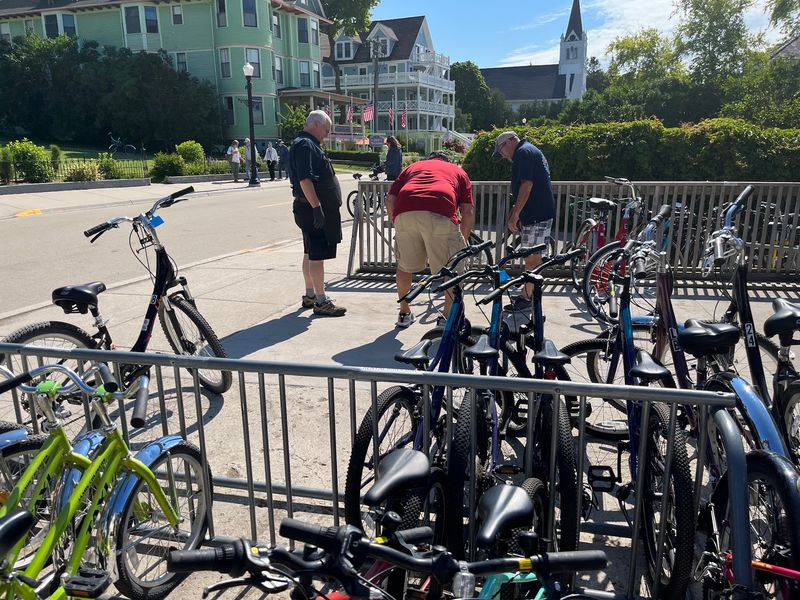
Finding your destination is only half the job. The bicycle still needs to go somewhere.
Sidewalks are not bicycle parking areas on Mackinac Island. Bikes parked along the street should remain within the white parking line, while designated off-street areas handle additional bicycles.
Tandems, Burley-style trailers, and bikes without kickstands belong in off-street parking areas.
Locking a bicycle to a fixed object is also something to skip. Lampposts, railings, and other permanent fixtures are not substitutes for approved parking areas.
That may require an extra minute when downtown racks and parking areas are busy, but it prevents a bicycle from becoming an obstacle on a sidewalk already carrying steady pedestrian traffic.
The same habit is useful at attractions. Before leaving the bike, look for the designated parking area rather than stopping at the closest patch of pavement to the entrance.
Traveling with a tandem or a child trailer makes that planning more important because those setups occupy substantially more space than a standard bicycle.
Once you recognize the white lines and off-street parking signs, the system becomes easy to use. Park first, then forget about the bike while you explore on foot.
5. Double-Check That Rental Bike Before Riding Off
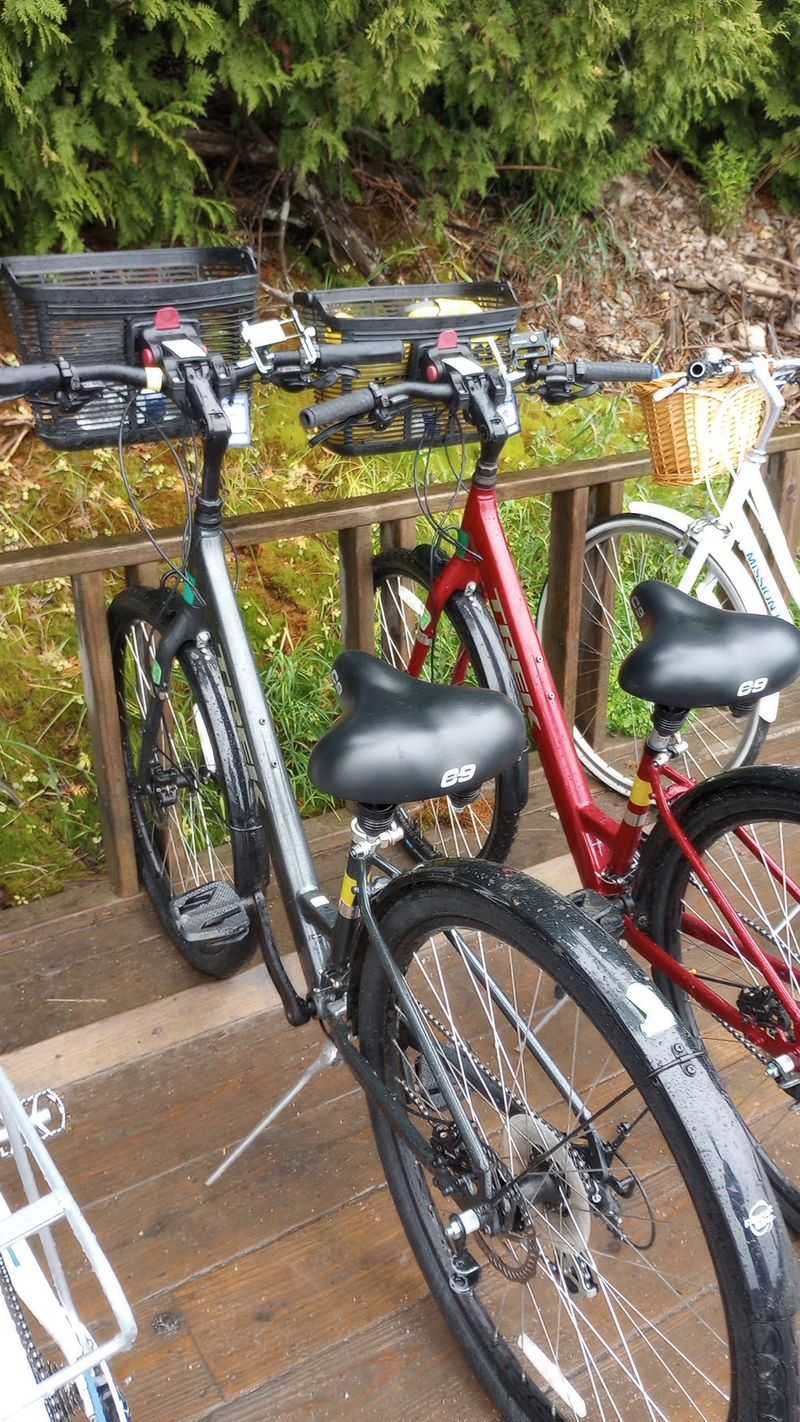
A row of rental bicycles can become surprisingly anonymous after an hour away from yours.
Mackinac Island does not operate a community-wide bike-share system. The bicycles you see are either privately owned or rented through individual businesses, and many rental bikes can look extremely similar.
Before leaving a restaurant, shop, attraction, or trail stop, check the identifying details on your bicycle. A rental tag, basket, lock, color combination, or another feature can save you from rolling away on someone else’s nearly identical ride.
The scale of bicycle use explains why this deserves its own habit. There are more than 1,500 rental bikes available on the island, with cruisers, multi-speed models, tandems, children’s bikes, fat-tire bikes, and other configurations entering the mix.
Taking a quick phone photo of the bike when you rent it can make the later comparison easier. Include any number, tag, or identifying marker visible on the rental.
This becomes especially useful downtown, where long rows of bicycles can accumulate near busy businesses.
The pause takes only a few seconds. Match the bicycle before you start pedaling, especially when several machines from the same rental company are parked together.
6. Know The E-Bike Rules Before You Bring One
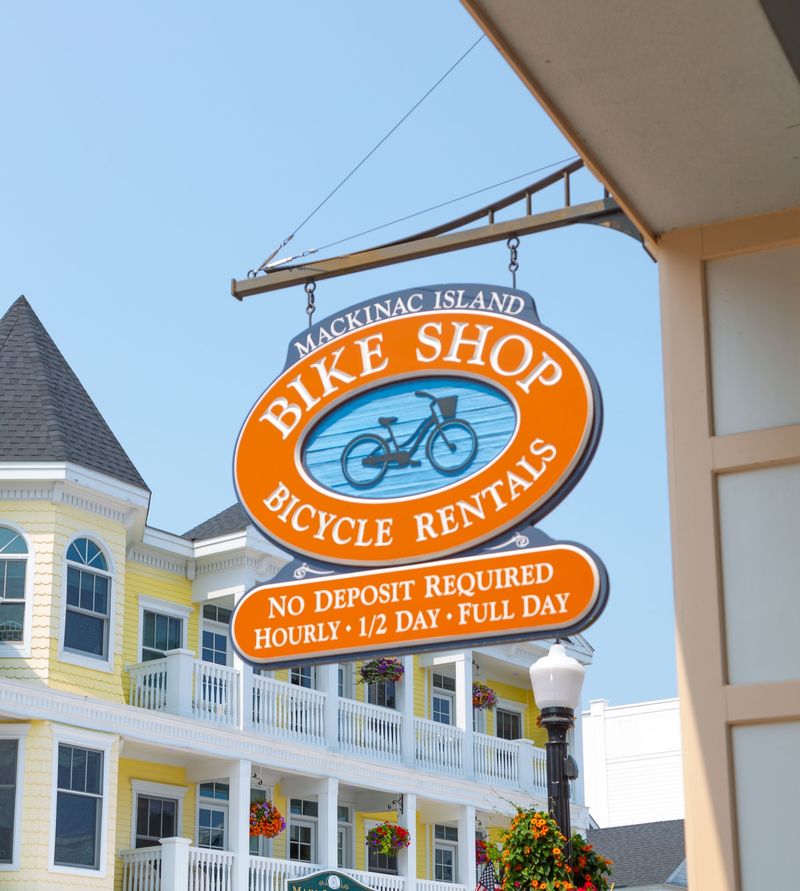
A standard pedal bicycle is straightforward on Mackinac Island. An e-bike is not.
Current rules restrict e-bike use in both the City of Mackinac Island and Mackinac Island State Park. People with qualifying mobility disabilities can obtain authorization, but the type of e-cycle matters and licensing requirements apply.
For two-wheel e-bikes, Class 1 pedal-assist models are the permitted type for qualifying riders. They provide assistance only while the rider is pedaling and stop providing assistance at 20 mph.
A throttle-equipped two-wheel e-bike does not qualify unless it has been modified to meet the applicable requirements.
Three-wheel e-tricycles have somewhat different provisions, including potential authorization for certain Class 2 models. Every e-cycle must also carry the required classification information.
Planning is especially useful here because the licensing process can be handled in advance. Same-day processing may be possible, but approval or availability is not guaranteed.
Do not assume that a bicycle is allowed simply because pedals are attached to it.
For visitors who do not need an authorized e-cycle, a traditional bicycle remains the simplest choice. Rental shops offer a large range of pedal-powered options once you arrive.
7. Leave The Car On The Mainland
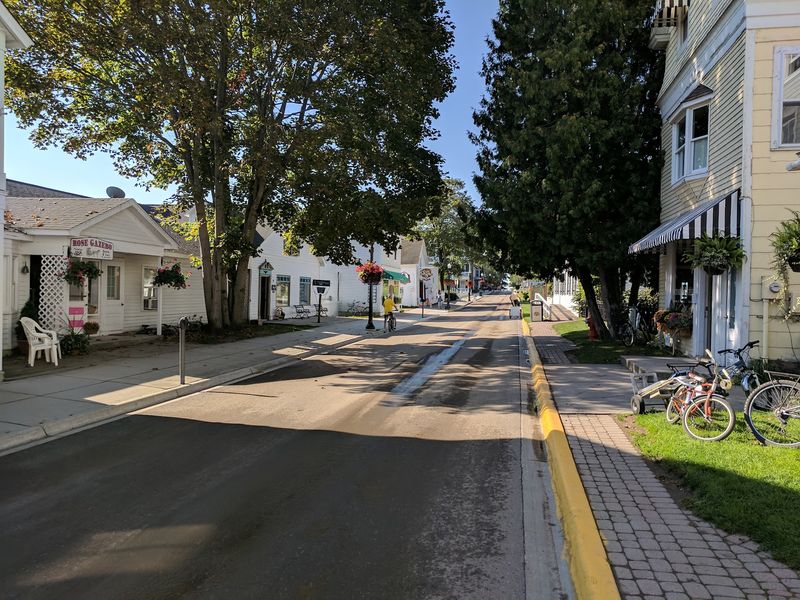
Leave the ordinary road-trip mindset on the mainland.
Normal visitor transportation on Mackinac Island happens by foot, bicycle, horse-drawn carriage, taxi, wheelchair, or mobility device rather than by personal automobile.
M-185, the 8.2-mile highway circling the island, is notable for operating without regular automobile traffic.
The car restrictions trace back to the late 19th century, when the appearance of early automobiles conflicted with an island transportation system already built heavily around horses. The result still shapes almost every trip today.
That means planning where to park on the mainland before boarding the ferry rather than wondering where your vehicle will go after arrival.
Luggage does not require a car, either. Horse-drawn taxis operate on the island, and dockporters can help move bags between ferry docks and lodging. During the main season, taxis are dispatched rather than hailed from the street.
Once the ferry docks, think in terms of distance rather than parking. A nearby destination might be easiest on foot, while a longer route may call for a bicycle or horse-drawn taxi.
The transportation system is part of the island, not an inconvenience to work around.
8. Carry Some Cash For Small Expenses And Tips
A wallet containing only cards can handle many transactions, but carrying some cash remains useful on Mackinac Island.
Cash is particularly practical for horse-drawn taxis, dockporters, tips, and certain smaller expenses. ATMs are available on the island, so forgetting cash is not a disaster, but having it before boarding the ferry removes an unnecessary errand after arrival.
Think in small bills rather than carrying a large amount. A taxi ride, luggage assistance, or another service may create a situation where a modest cash payment or tip is simply easier.
Horse-drawn taxis can also be arranged during the island’s main season, and the unusual transportation system means visitors interact with drivers and baggage handlers more often than they might on a typical driving vacation.
A practical routine is to separate a small amount of cash before leaving the mainland instead of waiting until you need it.
That also means you can go straight from the ferry to your hotel, bike rental, meal, or first attraction without searching for an ATM.
Cards still have a place in the trip. The point is not to replace them, only to avoid making them your single payment option.
9. Don’t Assume The Whole Island Is As Flat As M-185
The shoreline can give cyclists false confidence.
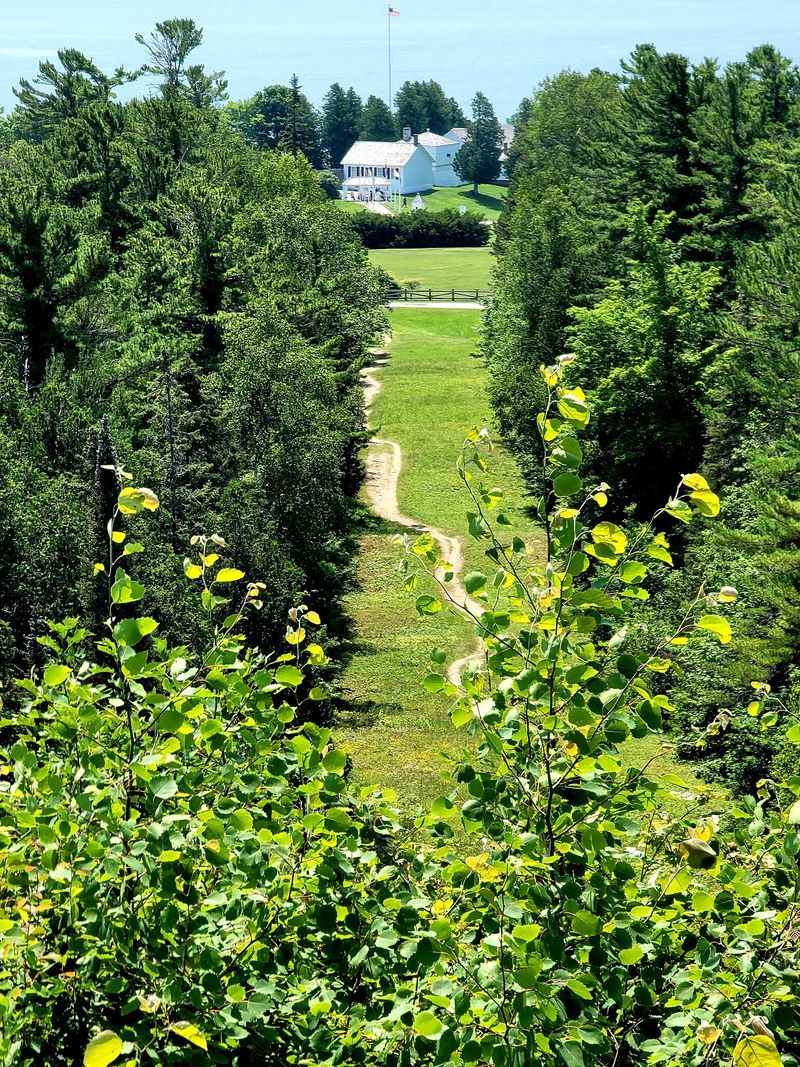
M-185 makes an 8.2-mile loop around Mackinac Island and is mostly flat, with an average grade of about 1 percent and a maximum grade around 3 percent. For many riders, that makes the perimeter one of the easiest ways to cover significant distance.
Turn toward the island’s interior and the terrain changes.
More than 70 miles of roads and trails run through Mackinac Island, with interior routes ranging from manageable inclines to steep and rocky sections. Routes toward places such as Fort Holmes and Sugar Loaf can demand considerably more effort than the waterfront loop.
Fort Holmes makes the contrast especially clear. The highest point on the island stands about 320 feet above lake level, and one approach includes 141 stairs from Rifle Range Road.
Choose your bicycle accordingly. A multi-speed bike becomes more useful once climbing enters the plan, and walking some sections is a perfectly sensible option when the grade becomes uncomfortable.
Water matters too. Once you move into the interior trail network, resupply opportunities become much less frequent.
Enjoy the easy shoreline lap, but do not use it as your measuring stick for every road on the island.
10. Respect Private Property Beyond The State Park Boundaries
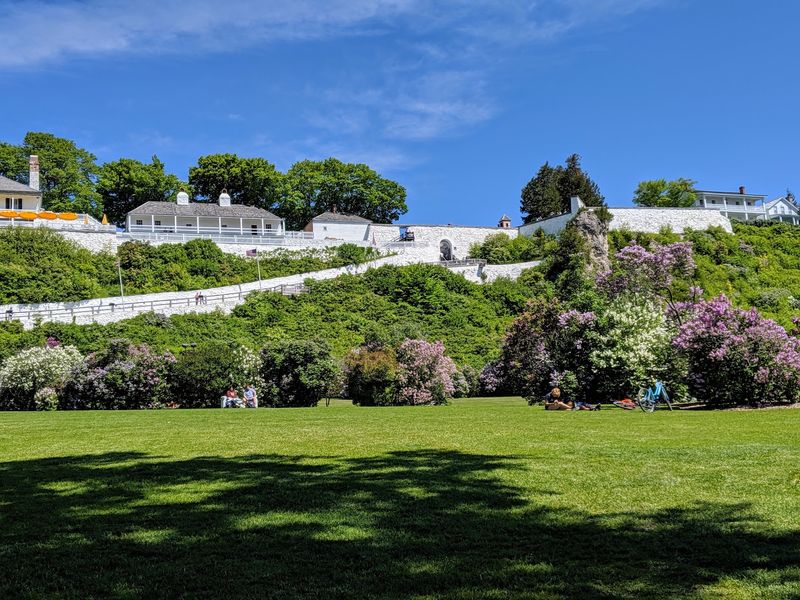
Mackinac Island State Park covers more than 80 percent of the island, which makes it easy to assume nearly everything beyond downtown is public parkland.
The boundaries are more complicated than that.
Park lines meander around downtown, the west end, private property, leaseholds, and areas under City of Mackinac Island jurisdiction. Visitors need to remain aware that an inviting lawn, driveway, side path, or waterfront area is not automatically open for public use.
Marked roads and trails make exploration much easier. The island contains more than 70 miles of them, providing plenty of choices without requiring improvised shortcuts across property whose status is unclear.
When a path appears to enter a residence, lodging property, service area, or another clearly occupied space, turn back rather than treating it as a continuation of the park.
The same principle applies near the edges of downtown. State park property and city-controlled areas can sit close together, and different rules may apply depending on exactly where you are.
A map helps when heading into the interior, both for navigation and for staying on established routes.
With most of Mackinac Island already open through roads, trails, historic sites, and parkland, respecting the remaining boundaries does not limit the trip. It simply keeps exploration where it belongs.