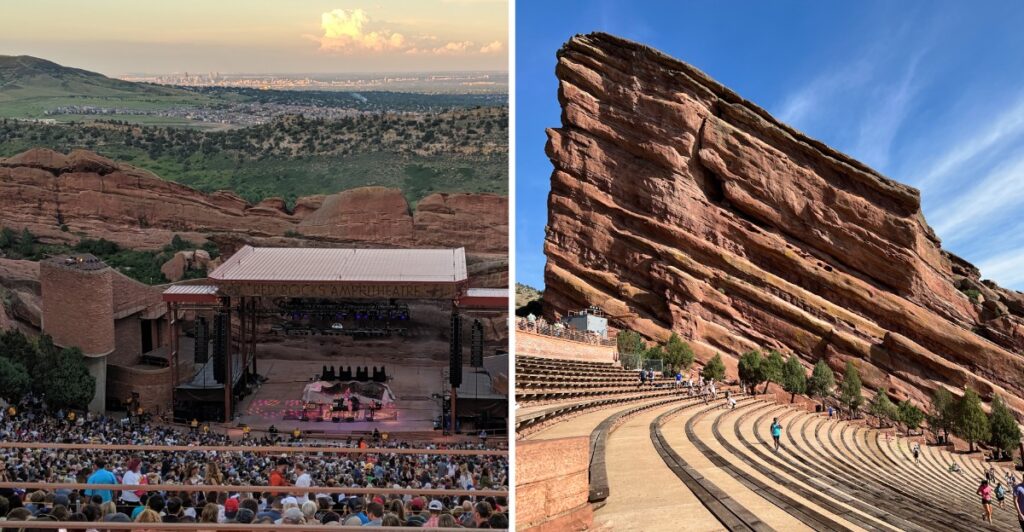
Most concert venues have walls.
This one has giant sandstone cliffs.
So before the band even walks out, the venue has already done a little showing off.
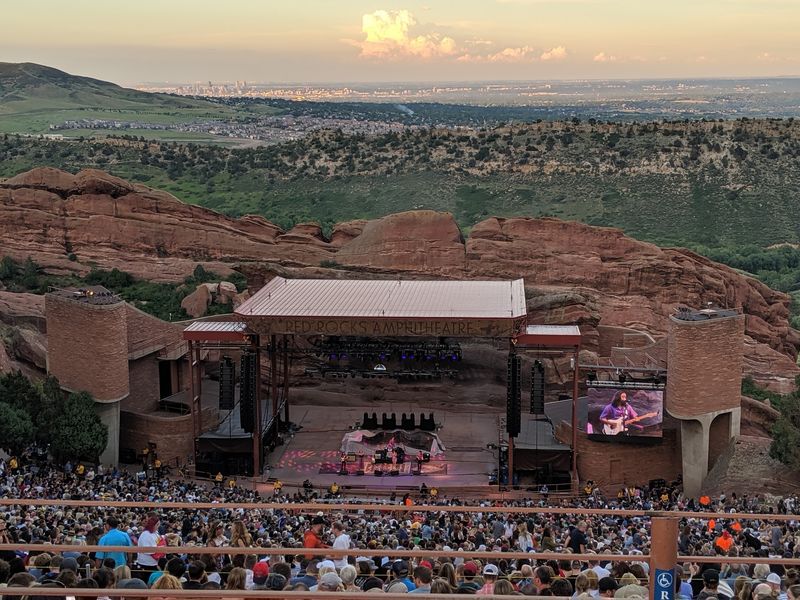
The stage sits right between the rocks. Rows of seats climb above it, with open sky overhead.
Performances have filled this spot since the 1940s, but music is only half the story.
During the day, the place feels completely different.
The stage goes quiet. Trails lead through the surrounding park. That is when the Colorado foothills start competing with the concert history.
Then showtime changes the mood again.
Lights come on. The seats fill. The rocks suddenly feel like part of the crowd.
There is some climbing involved, so your legs may have their own review of the evening.
Still, how many concert venues can say the scenery was already there millions of years before the first ticket was sold?
Two Towering Sandstone Giants Frame The Stage
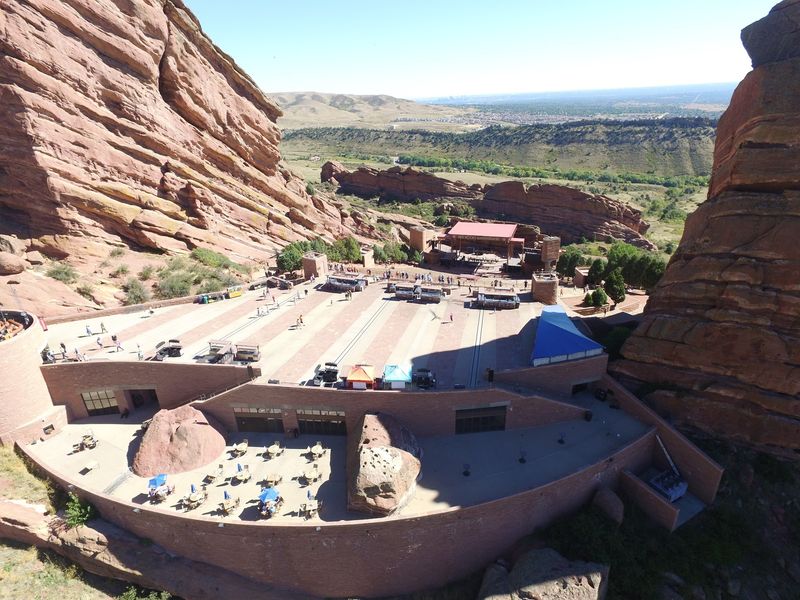
Nature provided the walls long before the amphitheatre had its present seating. Ship Rock and Creation Rock rise on opposite sides of the performance area, their red surfaces standing above the rows and surrounding paths.
The two sandstone monoliths reach approximately 300 feet and are among the defining features of Red Rocks Park.
The formations show layers, crevices, and changing shades of red and orange. Look across the venue from the upper plaza to see how the seating fits between them.
From the lower rows, the rock faces occupy much more of your view, while the stage sits against a broad opening in the landscape.
For photographs, consider how the light moves across the rock during the day. A view from one side of the amphitheatre differs from a view near the top, so there is no need to rush through the first overlook.
Keep to public walkways and stay away from closed sections of the formations.
Sound Between The Natural Rock Walls
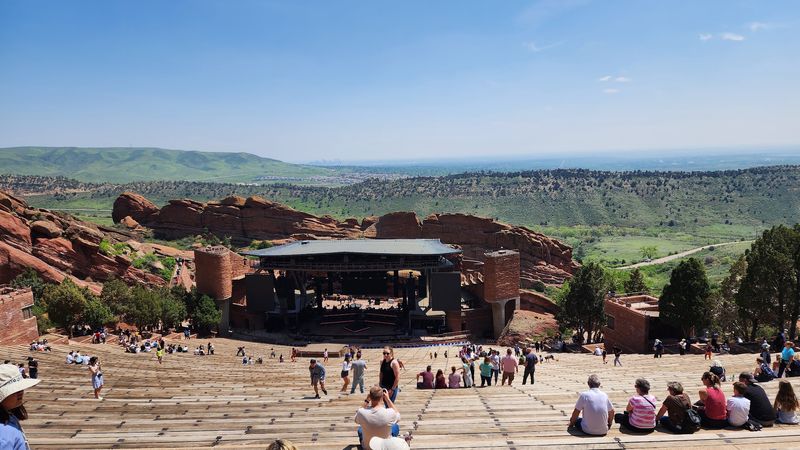
The arrangement of the sandstone formations gives the venue its recognizable shape. Ship Rock and Creation Rock flank an open-air stage, while the seating rises in a long slope rather than wrapping around the performers like an indoor theater.
A concert here combines amplified music with the surrounding outdoor environment. The rocks help define the performance space, but sound is also affected by the speaker system, wind, weather, and each listener’s position.
Avoid assuming two seats will produce exactly the same listening experience.
Large image-magnification screens stand to either side of the stage. They can show live video and venue information during events, although individual performers sometimes choose not to use the screens.
They are a useful feature to know about when choosing seats farther from the stage.
At roughly 6,450 feet above sea level, the site also asks a little more from your legs than a flat indoor arena.
Pause on the steps as needed, and keep drinking water handy.
Bringing shoes suitable for stairs and paved approaches is a practical choice whether you are attending music or exploring in daylight.
Hard Work From The 1930s Built Every Row
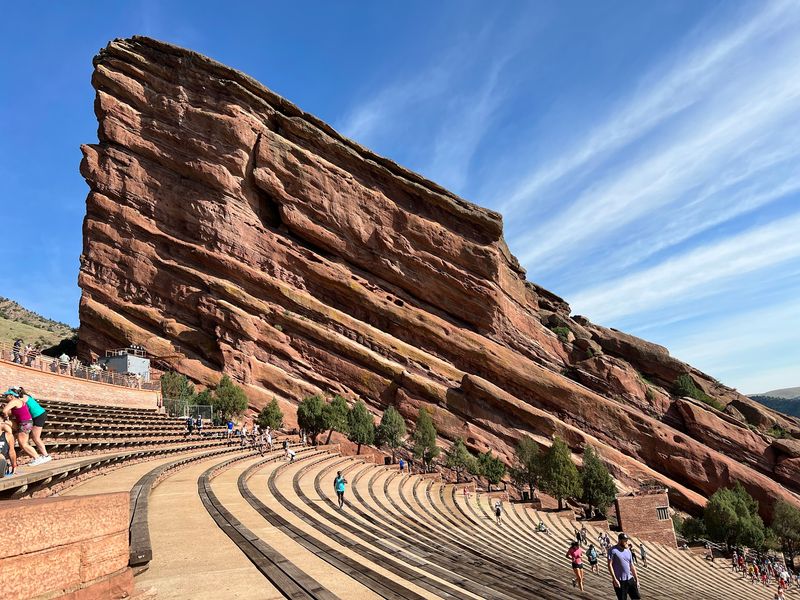
The landscape has drawn attention for far longer than the modern venue has existed.
Construction of the present amphitheatre took shape during the Great Depression, when Civilian Conservation Corps crews helped transform the site into a formal public performance space.
The crews worked amid steep ground and exposed rock, building seating and paths into the existing terrain. Architect Burnham Hoyt designed the amphitheatre, working with the natural formations rather than covering them with a conventional enclosed structure.
Red Rocks Amphitheatre was officially dedicated on June 15, 1941. The opening program included music from opera and a performance by the Denver Municipal Chorus.
Today, the amphitheatre has a capacity of 9,525, with its audience spread across long rows climbing the slope.
Red Rocks Park and the Mount Morrison Civilian Conservation Corps Camp were designated a National Historic Landmark in 2015. The park’s development belongs to a broader story of public works, landscape design, and outdoor recreation in Colorado.
There is plenty of elevation change between levels. Plan for it when choosing a parking area or setting aside time for a brief visit, particularly if climbing stairs is difficult.
Famous Performances And The Music History Inside
The Beatles played Red Rocks on August 26, 1964, during their first North American tour. The date remains part of the amphitheatre’s recorded concert history, along with appearances by performers from numerous styles of music.
In June 1983, U2 performed at the venue in wet, windy conditions. Footage from that concert became part of the film “Under a Blood Red Sky: U2 at Red Rocks,” extending the performance beyond the audience that attended that night.
That history continues inside the Visitor Center, which opened in 2003. Its Red Rocks Hall of Fame recognizes performers associated with the venue, while other exhibits explore the park and amphitheatre.
The center also includes the Heart of the Rock Theatre and places to take a break from the outdoor conditions.
You don’t need an event ticket to explore the Visitor Center during ordinary public visiting hours. From March through October, it is normally open from 7 a.m. to 7 p.m.; from November through February, it is normally open from 8 a.m. to 4 p.m.
On event days, access may become restricted to ticket holders in the afternoon.
Music Under Wide Colorado Skies
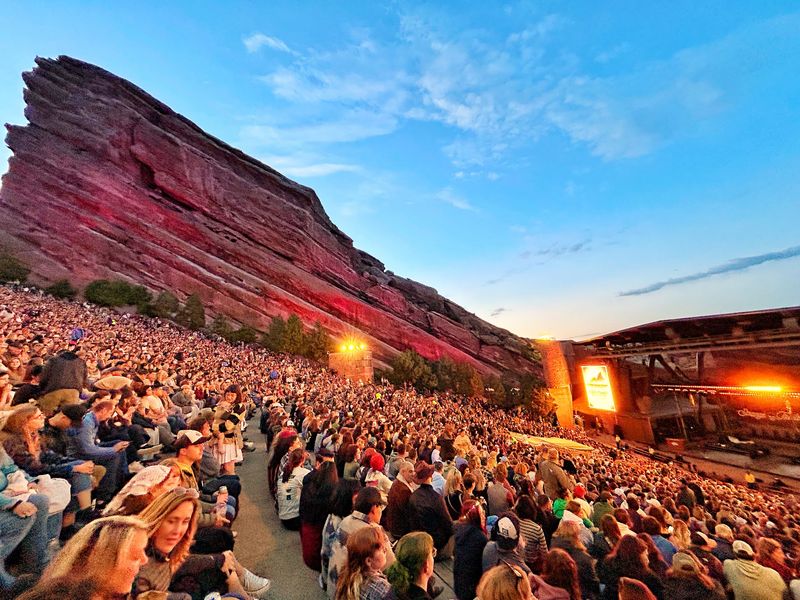
The open eastern side of the amphitheatre faces the plains, and some upper-level vantage points look toward the Denver metropolitan area. The landscape around the venue is a meeting point between the Rocky Mountain foothills and the Great Plains.
That setting also brings changeable weather. Afternoon sunshine does not guarantee a warm evening, especially when wind passes through the park. Pack a layer you can put on after sunset, and check the forecast close to the date of your visit.
A lightweight rain poncho may be more practical than relying on an umbrella at an event. Severe weather can interrupt activity, and venue staff may direct guests to seek shelter. Learn where the exits are when you arrive, and follow instructions if conditions deteriorate.
The experience can look quite different at midday and after dark. A free daytime visit gives you a clear view of the rock layers and seat arrangement, while a ticketed evening performance places the stage lighting against the landscape.
Choose the one that fits your schedule, or make separate visits if you want both.
Remember that the park’s public hours and the amphitheatre’s event access are not interchangeable. Some areas are unavailable when preparations for a show are underway.
Trails, Overlooks, And A Hall Of Fame Beyond The Stage
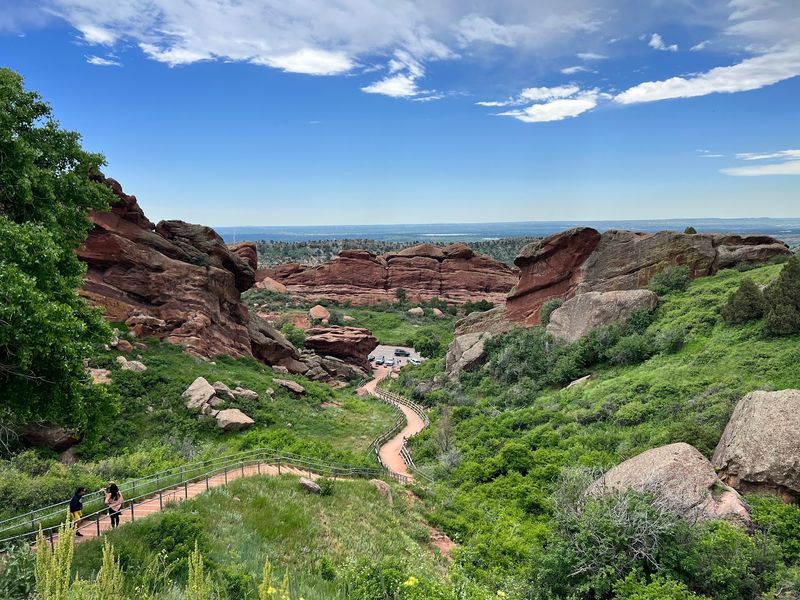
Red Rocks Park covers approximately 738 acres. Beyond the amphitheatre, it includes red rock formations, foothill habitat, and walking routes with views of the surrounding terrain.
The Trading Post Trail makes a compact outdoor excursion before or after a look at the venue. It loops through the rock landscape and includes uneven footing and changes in elevation. Choose sturdy shoes and carry water instead of treating it like a level city sidewalk.
The Trading Post provides another stopping point in the park. It operates from 9 a.m. to 6 p.m. from March through October and from 9 a.m. to 5 p.m. from November through February, with holiday exceptions. Its location also provides access to nearby scenery.
For a shorter visit, focus on the upper plaza and the Visitor Center rather than trying to cover a trail as well. The displays and Hall of Fame give you a way to explore the venue’s cultural history without making the whole trip a hike.
The amphitheatre is also used for fitness activities when access is permitted. Exercising on the steps is not a substitute for following the park’s rules: stay clear of closed areas, leave landings open, and respect restrictions on group activity and equipment.
Smart Planning For Tickets, Parking, And Free Visits
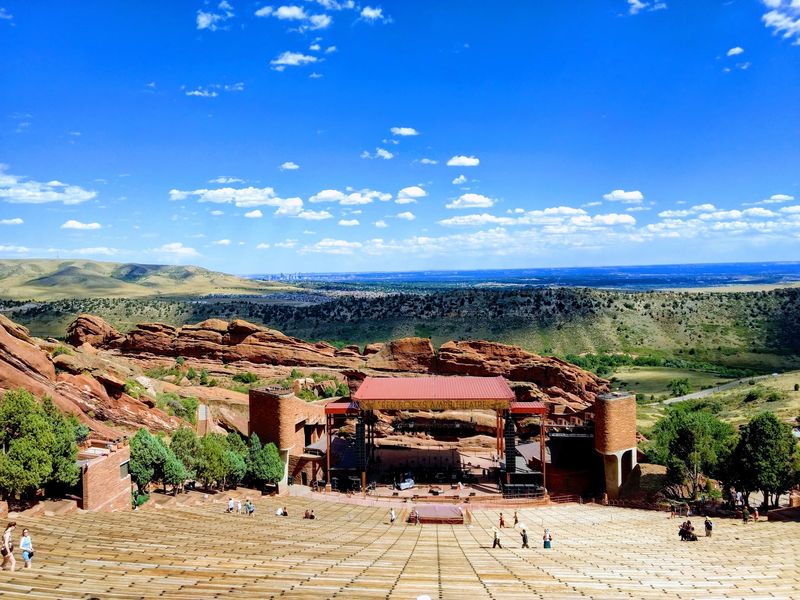
You can explore Red Rocks Park and Amphitheatre without buying a concert ticket when the public areas are open. The park’s regular daily hours run from one hour before sunrise to one hour after sunset, and non-event admission and parking are free.
On concert days, the amphitheatre generally closes to daytime visitors around 2 p.m., sometimes earlier. A private function can also limit access on a day without a public concert. Check the calendar and current closure information before making the drive.
For a show, purchase the ticket for the performance you intend to attend and review its door time.
Tickets use mobile delivery, and some seat locations have additional conditions. Official event parking normally opens two hours before doors, and attendants may direct drivers to specific lots.
The uphill approaches and long stairways matter when choosing where to park. Accessible seating is available in designated rows, with specific ticket requirements.
Accessible parking and an event shuttle serve guests with qualifying mobility needs, but the shuttle does not operate during ordinary daytime park hours.
If you’re visiting primarily to see the venue, start at 18300 West Alameda Parkway, Morrison, CO 80465. Allow time to orient yourself after parking, explore the public plaza, and enjoy the scenery without blocking walkways or stair landings.
A camera, water, comfortable shoes, and an extra layer cover the basics. Whether you are staying for a brief walk or an entire concert, let the schedule and conditions shape your plans.