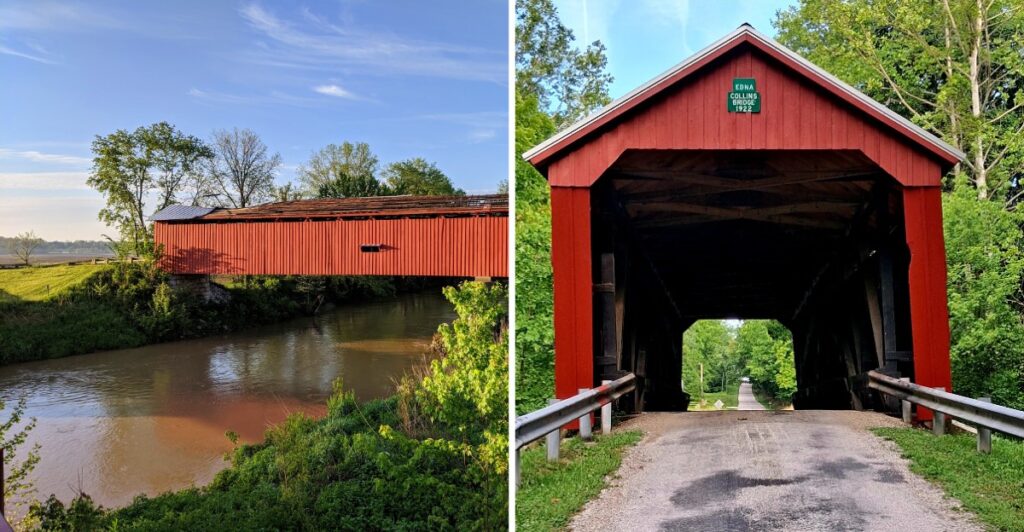
Covered bridges have one unfair advantage: they make even a wrong turn look intentional.
That works especially well in this part of Indiana, where old wooden spans keep appearing between fields, creeks, and quiet country roads.
Seven of them can easily shape the day, but the fun is not in checking boxes.
Some still carry traffic. Others make you stop, get out, and actually look at the timber instead of treating the bridge like scenery flashing past the windshield.
The county has nine surviving covered bridges in all, and every one landed on the National Register of Historic Places in 2024.
So yes, the history is real.
But I’d still be the person slowing down because the next bridge looks too good to pass without a photo.
Cornstalk Covered Bridge Starts The Drive In Northern Putnam County
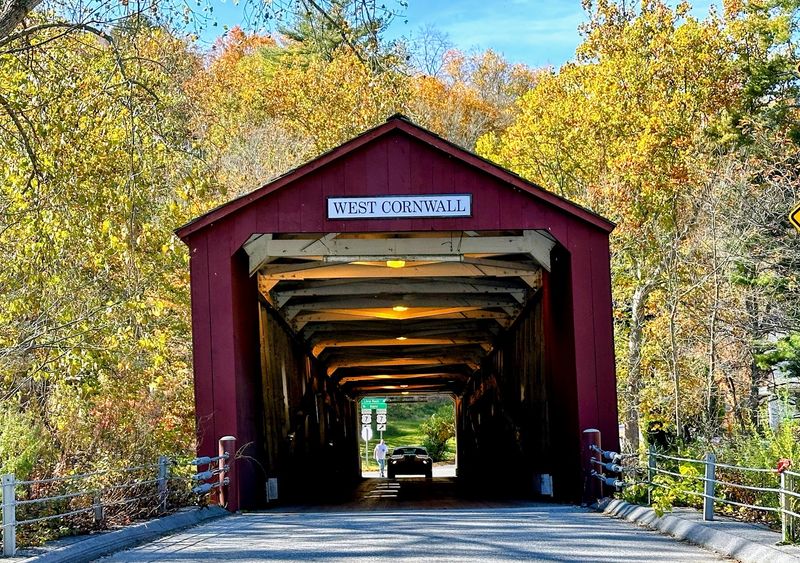
Cornstalk Covered Bridge sits on County Road 1350 North over Cornstalk Creek, east of US 231 near Roachdale.
Joseph A. Britton built the single-span bridge in 1917 using a Burr arch truss. It measures about 84 feet overall and was rehabilitated in 1990.
The bridge takes its name from Cornstalk Creek, and local history connects the creek name with Peter Cornstalk, a Shawnee leader associated with the area.
An Indiana historical marker connected with Chief Cornstalk stands in Parkersburg, a short drive northwest in Montgomery County.
Private property surrounds the bridge, so this is one stop where parking deserves extra attention. There is room for roughly one vehicle near the east end, and drivers should pull completely clear of the road without blocking local traffic or stepping onto neighboring land.
The bridge remains part of the county road system, so vehicles still pass through the one-lane crossing. Check the opening before driving in and give oncoming traffic room.
Once you have had a good look at the Burr arch and the narrow creek below, continue south. The next stop trades this compact crossing for a broader Big Walnut Creek setting.
Baker’s Camp Covered Bridge Pairs Timber With Big Walnut Creek
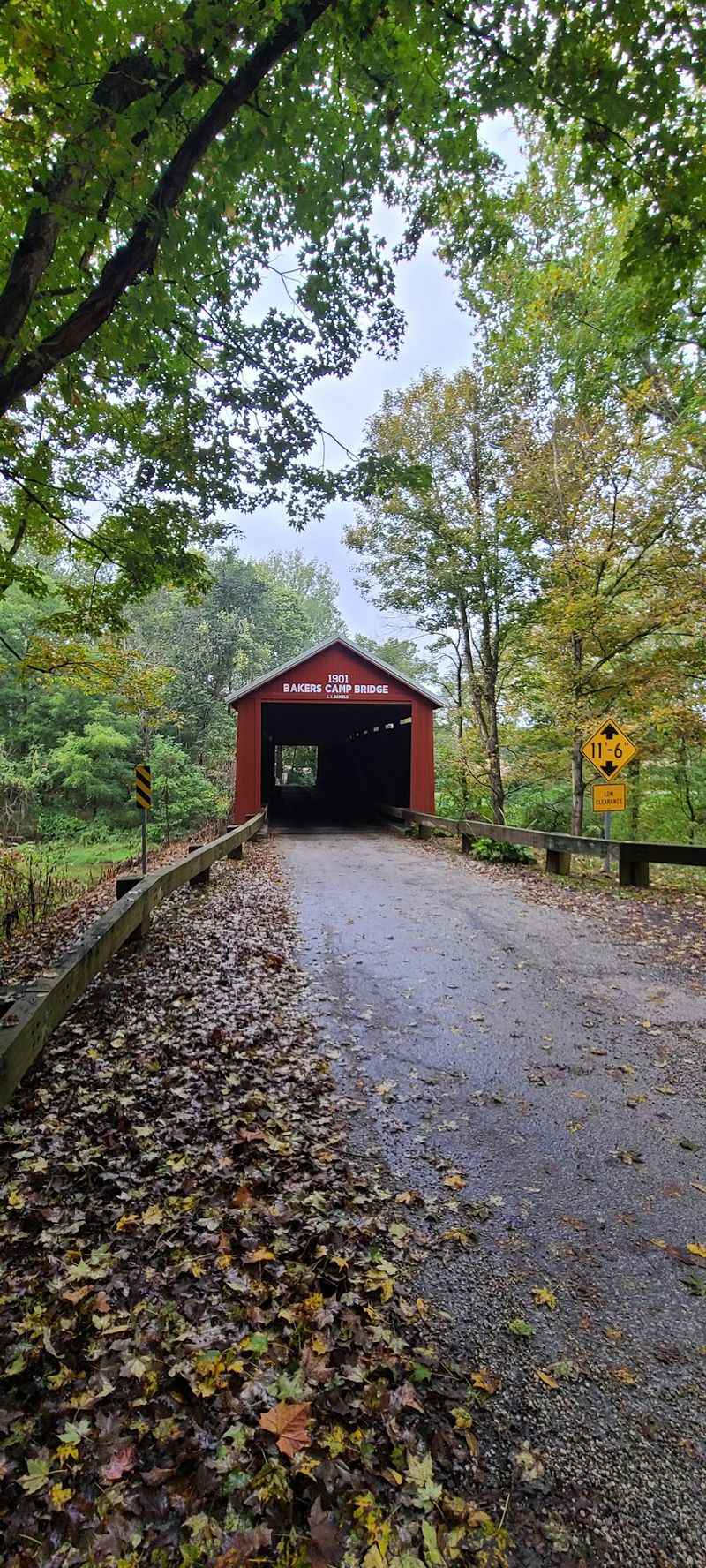
Baker’s Camp Covered Bridge carries County Road 650 North over Big Walnut Creek east of Bainbridge.
J.J. Daniels built the bridge in 1901 using a single-span Burr arch design. It measures about 125 feet overall and still rests on its original cut-stone abutments.
The bridge remains open to vehicle traffic, so you can still drive through. Slow down before the entrance, check for oncoming traffic, and let the timber interior do the rest once the car is inside.
Baker’s Camp also sits near the Big Walnut Natural Area, a large protected landscape of wooded slopes, ravines, and creek habitat. Hall Woods Nature Preserve is nearby too, which gives the day an easy walking option if everyone has spent enough time inside the car.
Parking is limited around the bridge, so use only safe public space and leave private property alone.
This stop works especially well in fall, when the woods along Big Walnut Creek shift through gold, red, and orange. Even outside peak color, the stone abutments, creek, and Burr arch give you plenty to notice before the route turns toward the center of Putnam County.
Edna Collings Covered Bridge Adds Local Folklore To The Drive
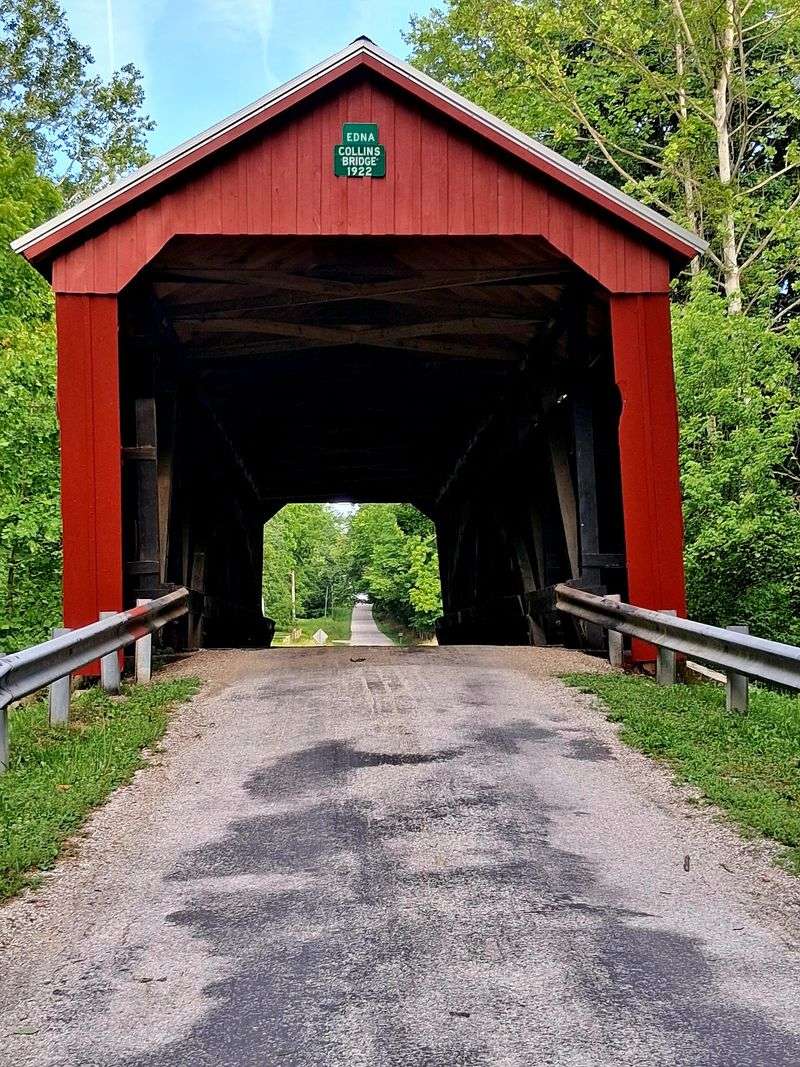
Edna Collings Covered Bridge crosses Little Walnut Creek on County Road 450 North near Clinton Falls.
Charles Hendrix built the 84-foot Burr arch bridge in 1922, making it the newest of Putnam County’s nine surviving historic covered bridges and the last covered bridge built in the county.
Its name is unusual too. Edna Collings lived near the crossing, and this is the only known covered bridge in Indiana named for a woman.
The bridge also carries a long-running haunted reputation. Several versions of the story have circulated locally over the years, so the tale works best as folklore rather than a historical claim.
By daylight, the stop is straightforward. The bridge crosses a narrow creek in a rural setting, and its shorter span lets you take in the structure quickly before continuing toward Greencastle.
The bridge remains part of the Covered Bridge Quest and still gives drivers a close look at a later Burr arch design. Use care around the road, stay off private property, and keep the visit focused on the public crossing.
Compare it with Cornstalk before moving on. They are close in length, but they came from different builders and different moments in the county’s bridge-building era.
Dunbar Covered Bridge Is Now A Walk-Up Stop Near Greencastle
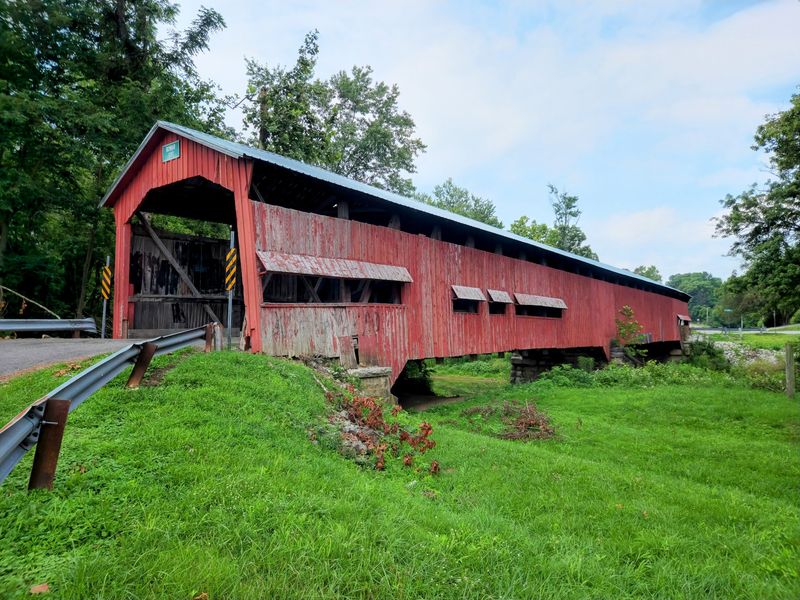
Dunbar Covered Bridge stands on County Road 25 near Big Walnut Creek just west of Greencastle.
Built in 1880, the two-span Burr arch bridge measures about 175 feet. Its sides include distinctive open-air windows that bring daylight into the timber interior and frame views toward the creek.
The identity of Dunbar’s builder remains uncertain. Timber supplied from the Dunbar farm helped create the span, linking the structure directly to the surrounding countryside.
Dunbar was rehabilitated in 2010 and is now closed to vehicle traffic. Visitors can park on the southeast side and approach on foot.
Without a car behind you, there is time to notice the two-span construction, the open sections along the walls, the timber joints, and the creek below.
Greencastle is only minutes away, so this is a useful midpoint for food, restrooms, or a longer break before continuing south.
Walk from one portal to the other, then pause before turning back. The bridge rewards a slower look much more than a quick drive-by ever could.
Oakalla Covered Bridge Brings Railroad History Into The Loop
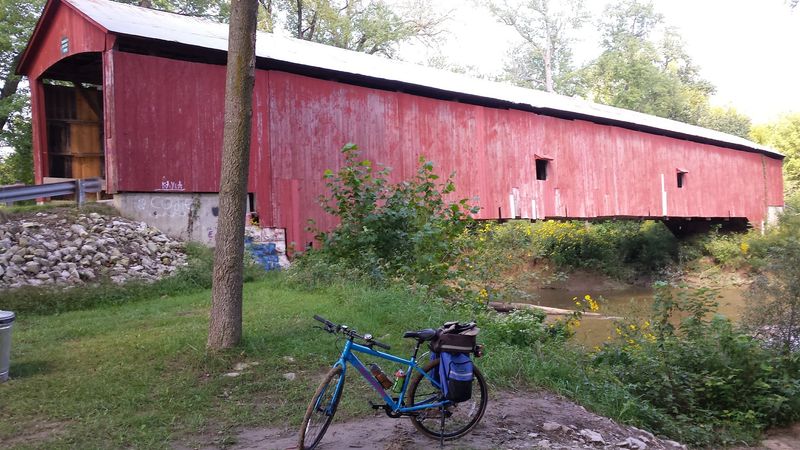
Oakalla Covered Bridge crosses Big Walnut Creek on County Road 375 West southwest of Greencastle.
J.J. Daniels built the single-span Burr arch bridge in 1898. It measures about 165 feet overall and takes its name from the former Oakalla Station on the old Big Four Railroad.
That railroad connection gives this stop a different historical angle from bridges tied mainly to farms and county roads. The crossing served local transportation while the nearby station linked the area to a larger rail network.
Oakalla is currently closed to vehicle traffic. Visitors can park on either the north or south side, depending on the direction of approach, and walk in for a closer look.
Step inside and follow the Burr arch framing from one end toward the other. The interior is dark enough to make the open countryside beyond each portal stand out sharply, especially late in the day.
Because Oakalla is close to Greencastle, it fits naturally after Dunbar without forcing a long jump across the county.
With vehicle traffic closed, this stop works best as a short walking break. Leave the vehicle parked, take your time, and let the structure do the work.
Houck Covered Bridge Lets You Leave The Car Behind
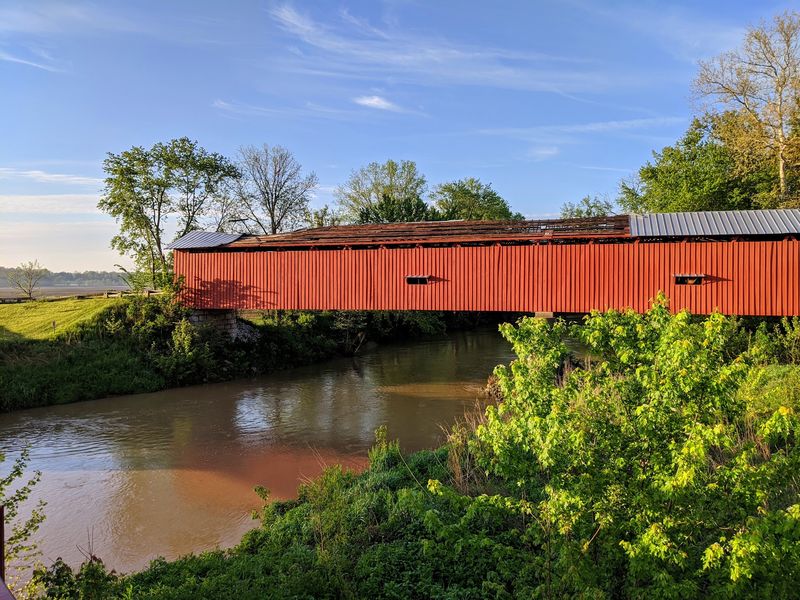
Houck Covered Bridge stands along County Road 550 South over Big Walnut Creek southwest of Greencastle.
The Massillon Bridge Company built the two-span Howe truss bridge in 1880. It measures about 208 feet overall, making it one of the longer surviving covered bridges in Putnam County.
Houck is the clearest pedestrian stop on this route. The road was rerouted around the bridge, and the old crossing no longer carries through traffic. Four free parking spaces sit on the west side, giving visitors a straightforward place to leave the car and explore on foot.
The setting is open and agricultural, with fields around the bridge and pollinator plantings nearby. That wider view makes Houck look and feel different from the more enclosed crossings along Big Walnut Creek.
Walking the full span also gives you time to notice the Howe truss. Instead of the sweeping wooden arches seen at Baker’s Camp, Edna Collings, Dunbar, and Oakalla, the structure uses diagonal framing and metal components within the timber system.
Walk through, turn around, and look back toward the countryside framed by the portal.
Once everyone has stretched their legs, the final stop waits farther south, where Putnam County’s longest covered bridge gives the route a fitting finish.
Dick Huffman Covered Bridge Finishes With The County’s Longest Span
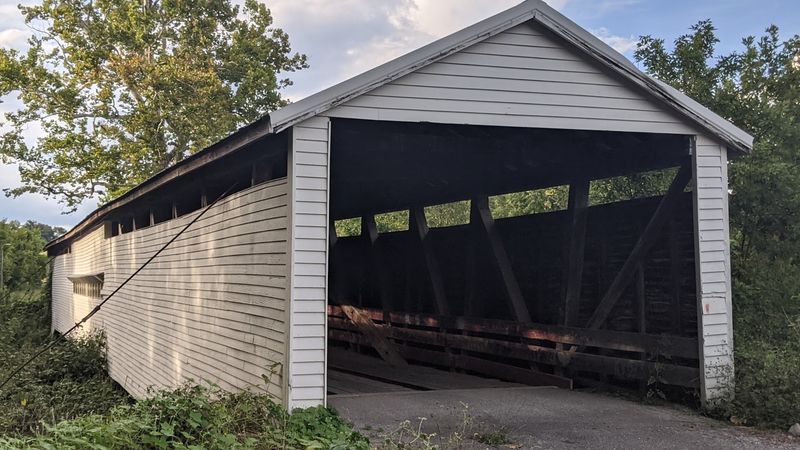
Dick Huffman Covered Bridge carries County Road 1050 South over Big Walnut Creek south of Reelsville and near Cloverdale.
Built in 1880 by E. Anderson & Sons, the two-span Howe truss measures about 267 feet, making it the longest covered bridge in Putnam County.
The bridge was once known by other names connected with nearby mills and landowners before the Huffman name took hold.
Today, its length is the first detail you notice. Two spans stretch across the creek, so the drive-through takes noticeably longer than it does at the shorter northern bridges.
The bridge remains part of the active road system. Parking is available on the east side near the field, which gives you a safer place to stop for photos than the travel lane.
The Howe truss also gives you one final comparison with Houck. Both date to 1880 and use the same broad structural system, yet one still carries vehicles while the other works best as a pedestrian stop.
By the time you reach Dick Huffman, the road trip has moved through Burr arches and Howe trusses, active crossings and walk-up bridges, creek valleys and open farmland.
Seven bridges are plenty for one day. Putnam County still has two more waiting when the next covered-bridge drive needs a reason to happen.