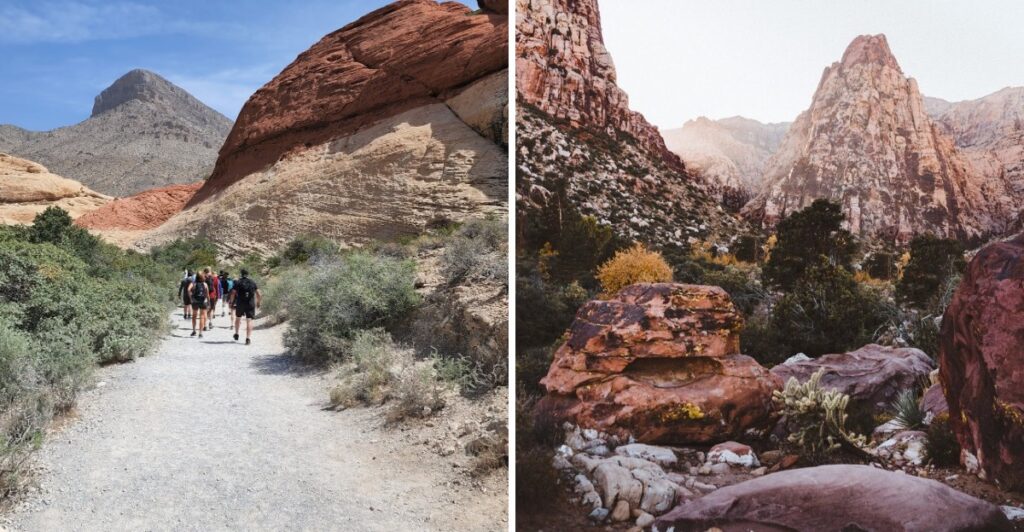
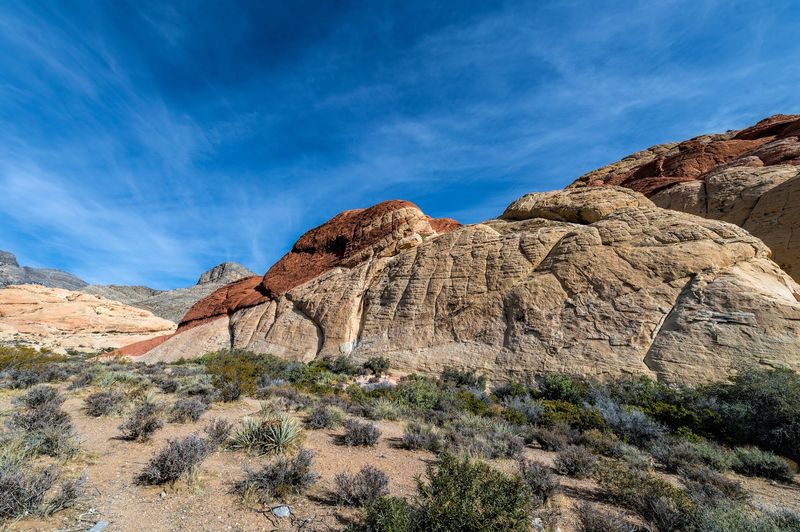
These red cliffs in Nevada used to be sand dunes, piled more than half a mile deep. Then they hardened into stone and picked up iron stains in shades of rust and sunset, which is quite the glow-up for a pile of sand.
Before the dunes, this spot sat at the bottom of an ocean. Later, a massive fault shoved older gray rock right on top of the younger red stuff, like the Earth folded its laundry in the wrong order.
Your geology teacher would call that a thrust fault. You’ll probably just call it a great photo.
The cliffs sit about 17 miles from a glowing neon skyline, so trading city noise for canyon quiet takes less than an hour. Visit in the cooler months, because the only thing that should turn red out here is the rock.
An Old Ocean Floor Now Wears A Red Desert Coat
About 600 million years ago, this ground sat underwater. Red Rock Canyon National Conservation Area holds the proof in up to 9,000 feet of limey sediment that became limestone.
Then the climate turned dry around 180 million years ago. Wind piled sand dunes more than half a mile deep, which is a lot of sand for one backyard.
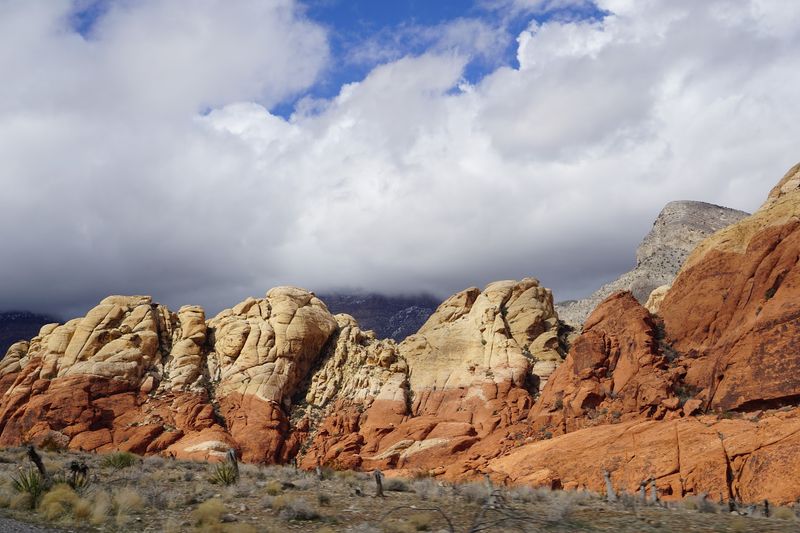
Those dunes didn’t stay loose. Iron oxide and calcium carbonate cemented the grains together, forming the hard Aztec Sandstone you see in the cliffs today.
The colors tell their own story. Oxidized iron minerals, mainly hematite, create the deep reds and oranges that make the rock glow.
The pale buff and cream patches mean something too. In those spots, groundwater dissolved the iron coatings, or the iron never settled there at all.
Look closely and you’ll start spotting bands where red fades into cream. Each stripe is a clue left by water moving through ancient sand.
Here’s a fun bonus for science fans. Tracks from small two-legged dinosaurs and ancient arthropods, possibly relatives of today’s spiders and scorpions, have turned up in this sandstone.
Not bad for a pile of old dunes in Nevada. Every cliff is basically a history book with a sunburn.
Older Rock Climbed On Top, And Nobody Stopped It
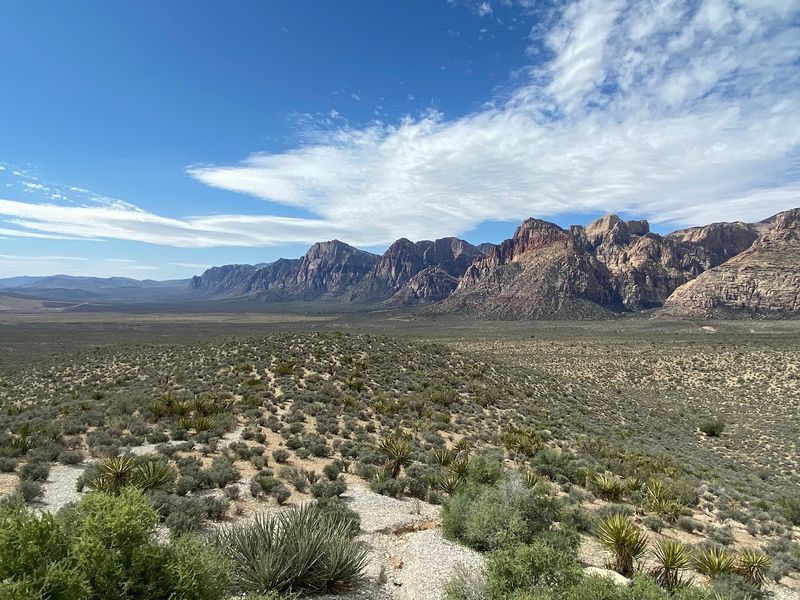
Geologists have a word for rocks stacked in the wrong order, and here it’s a big deal. The Keystone Thrust Fault is the most important geologic feature in the whole area.
Roughly 65 million years ago, immense pressure pushed older rock up and over younger stone. The result looks a bit like a giant slid a gray blanket over a red bed.
That’s why you can find gray limestone sitting on top of the younger red Aztec Sandstone. Normally, younger layers rest on older ones, so this view flips the usual rule.
Want to see it up close? The Keystone Thrust Trail is built for exactly that kind of curiosity.
The contrast is easy to spot once you know what to look for. Gray on top, red below, and millions of years of drama squeezed between them.
Bring a friend who claims rocks are boring. A few minutes at the fault line usually changes their mind fast.
The Visitor Center explains the fault before you go, which helps a lot. Knowing the backstory turns a pretty view into a jaw-dropping one.
Few places let you stand beside a mistake this large and this old. Nature clearly didn’t read the textbook.
Thirteen Miles Of Pull-Over-Again Scenery
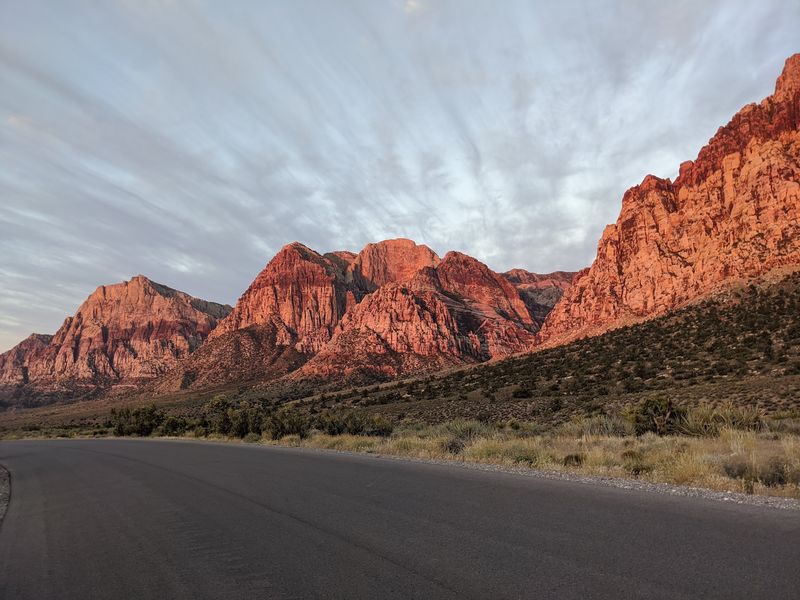
Some road trips need a full tank and a weekend. The Scenic Drive at Red Rock Canyon National Conservation Area needs about 45 minutes to an hour and a half.
It’s a 13-mile, one-way loop that reaches many of the area’s best features. Trailheads, overlooks, and pullouts pop up along the route.
The Calico Hills appear early, bright red against gray mountains. Many drivers stop there first, and it’s easy to see why.
Hours shift with the seasons. From November through February, the drive runs from 6 a.m. to 5 p.m.
March and October stretch until 7 p.m. From April through September, gates stay open until 8 p.m.
Vault toilets sit at most pullouts, which is a relief on a longer loop. Plan for the one-way design, though, because you can’t simply turn around and go back.
Cell service is unreliable out here. Download maps and any passes before you leave town.
Even if hiking isn’t your thing, the windshield view delivers. You’ll likely stop more times than planned, and nobody will blame you.
Your Boots Have Plenty Of Ways To Have Fun
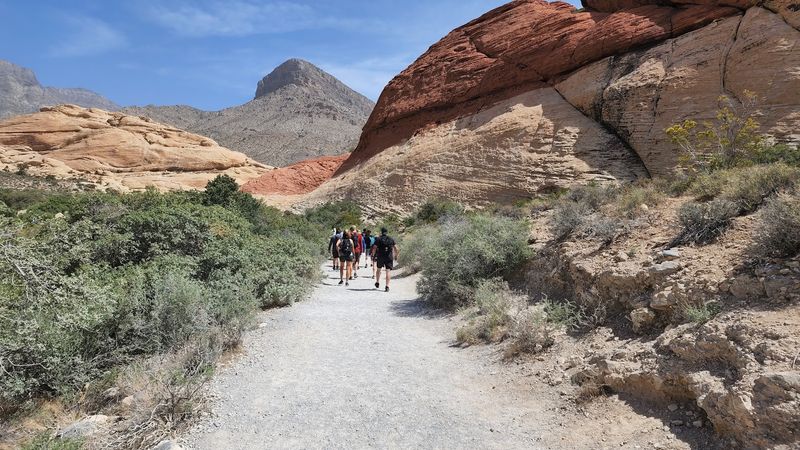
Miles of hiking trails wind through this desert, offering everything from easy walks to challenging mountain routes.
Easy strolls and serious climbs both made the list.
Short on time? The Moenkopi Trail starts near the Visitor Center and covers about 2 miles in an hour and a half.
It offers wide views of the Calico Hills and the Spring Mountains. That’s a lot of payoff for a modest walk.
Willow Spring Loop is another good pick at about 1.5 miles. It winds through canyon and streamside scenery and passes archaeological sites along the way.
Then there’s Turtlehead Peak, which doesn’t mess around. This strenuous 5-mile hike gains about 2,000 feet of elevation.
The reward is a big view of the canyon and the Las Vegas skyline. Your legs might file a complaint, but your camera will be thrilled.
Cool weather makes all of these far more pleasant. Summer heat can top 100 degrees, so autumn and spring are the sweet spots.
Pack plenty of water no matter the season. Good shoes help too, since footing shifts between sand, slickrock, and uneven ledges.
Thousand-Year Stories Are Etched Right Into The Walls
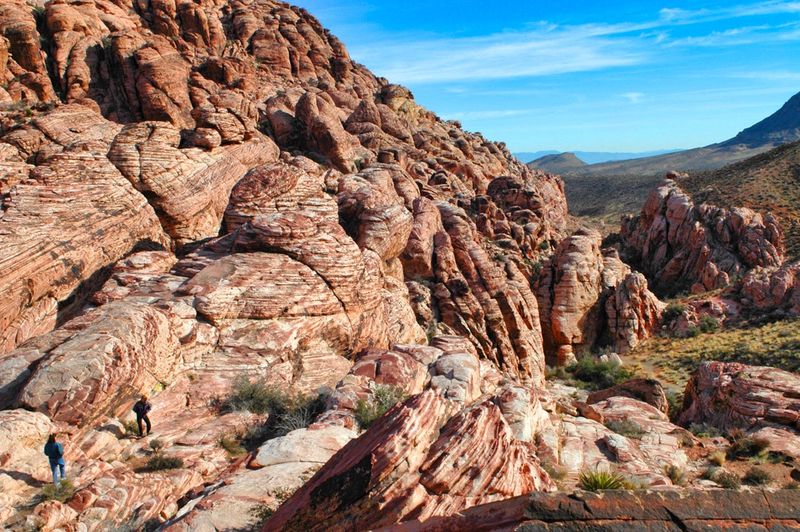
People lived here long before scenic loops and gift shops. The land is the ancestral homeland of the Southern Paiute, Chemehuevi, and Western Shoshone.
Evidence of human life goes back to Paleo-Indians around 11,000 BCE. Southern Paiute presence dates to around 900 CE.
Petroglyphs, which are etchings carved into canyon walls, survive across the area. The Petroglyph Wall Trail near Willow Spring Picnic Area makes them easy to reach.
That trail is only about 0.15 miles long. Plan for roughly half an hour so you can really look.
Agave roasting pits are another fascinating find. Indigenous communities used them to cook agave, an important food source in the desert.
The Willow Spring Loop passes roasting pits and pictographs along its route. It feels like a quiet outdoor museum without glass cases.
Treat these sites with care and keep your hands off the art. Oils from skin can damage carvings that have lasted for centuries.
A short walk here adds real depth to the trip. The red rocks get even more meaningful when you know who came first.
Smart Explorers Start With Tortoises And Maps
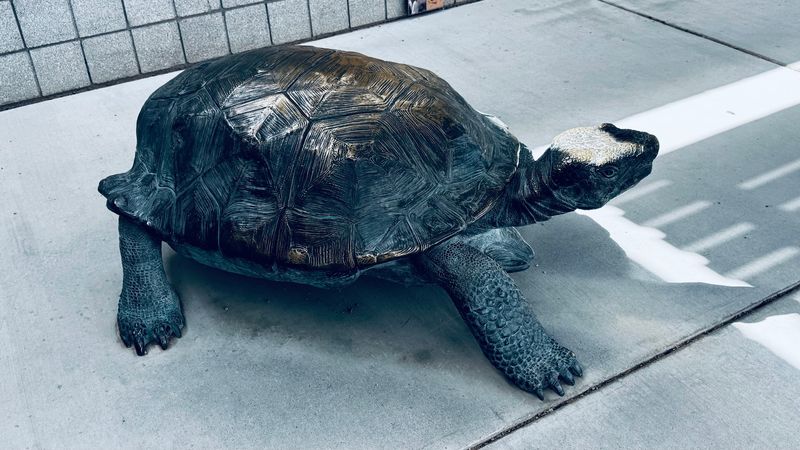
Live desert tortoises have their own outdoor habitat at the Visitor Center, and that alone earns it a stop.
These slow-moving locals are some of the most popular residents at the Visitor Center.
The center is LEED Gold certified and usually opens daily from 8 a.m. to 4:30 p.m., with shorter hours on Thanksgiving and Christmas.
Its exhibits are organized around four themes: earth, air, fire, and water.
You’ll learn about geology, wildlife, and even dust devils. Plant specimens from the canyon are on display too.
Staff and volunteers at the information desk can suggest hikes that fit your group. That beats guessing at a trailhead with no cell signal.
A book and gift store sits inside, run by the Southern Nevada Conservancy. Proceeds help support programs and maintenance across the conservation area.
Clean restrooms and accessible parking make this a handy first stop. Use it to grab a map and get your bearings.
For directions, set your GPS to 1000 Scenic Loop Drive, Las Vegas, NV 89161. Then check out the tortoise habitat before heading out, even if its slow-moving residents are tucked away for winter.
Sandstone Walls That Pull Climbers From Everywhere
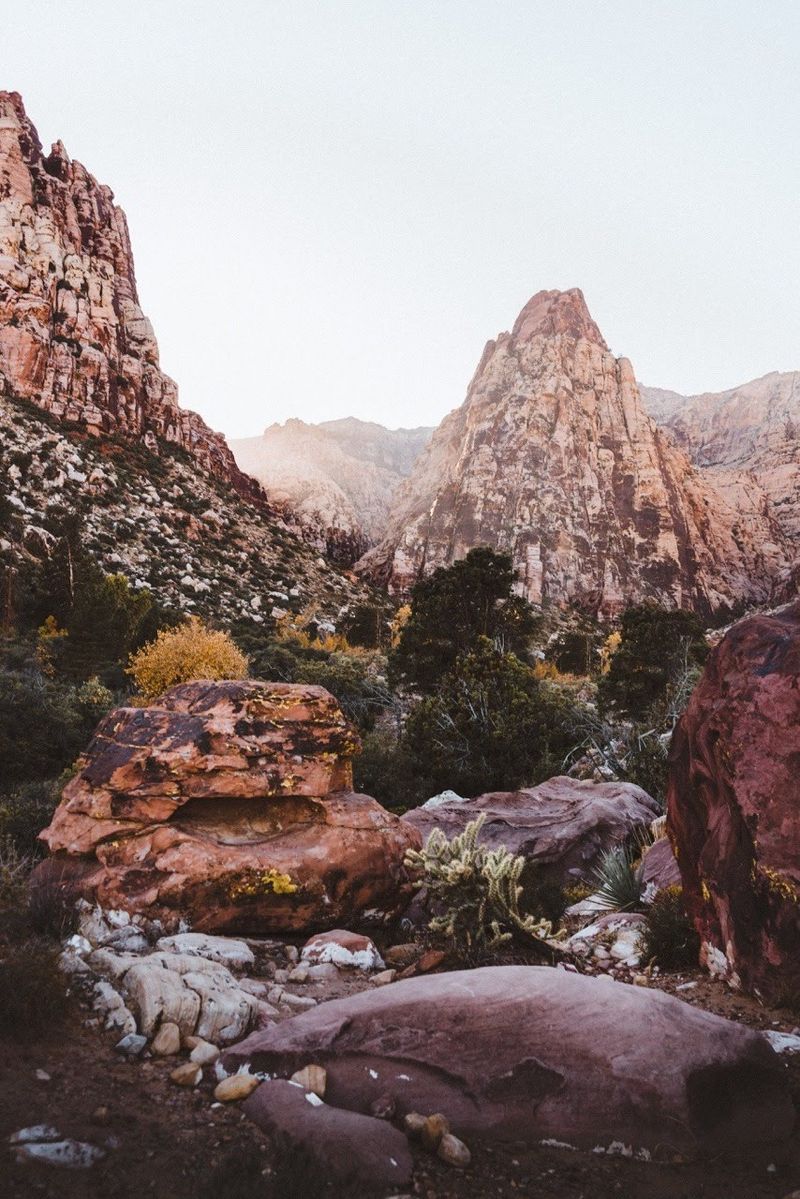
Climbers treat these cliffs like a world-class playground.
Hundreds of climbing routes wind across the area’s famous Aztec Sandstone cliffs, with challenges for beginners and experienced climbers alike.
One rule really matters for safety.
Sandstone turns brittle when wet, so climbers are advised to wait at least 24 to 48 hours after rain, depending on how heavy it was.
Watching climbers inch up a sheer wall is a show all its own. Bring a snack and enjoy the view from solid ground.
Cyclists have room to roll too. Bikes are allowed on the one-way Scenic Drive, paved spur roads, and designated mountain bike trails.
Mountain bikes aren’t permitted on hiking trails, though. Stick to the right routes to keep everyone happy.
Plan carefully before pedaling out. There’s no water, air, or repair station along the loop.
Horseback riding is another way to see the formations. Cowboy Trail Rides offers options, including sunset rides.
Whether you prefer ropes, pedals, or saddles, cooler months make it all more comfortable. Hot rock in July is nobody’s friend.
Book That Time Slot Before The Calendar Runs Out
Cool-weather season and reservation season overlap almost perfectly. Timed entry is required for the Scenic Drive from October 1 through May 31.
That rule covers entry between 8 a.m. and 5 p.m. Reservations go through Recreation.gov.
America the Beautiful passes are accepted for the fee. You’ll still need a timed reservation during peak season.
Fee-free days don’t skip the rule either. Plan ahead even when admission costs nothing.
October and November are especially comfortable for all-day visits. April and May have their charms too, though afternoon temperatures often climb into the 80s and even 90s as summer approaches.
Winter can bring snow to the mountains, which looks amazing against red rock. Late afternoon hikes and sunsets shine that time of year.
Red Rock Canyon National Conservation Area became Nevada’s first National Conservation Area in 1990. It sits about 30 minutes from the Las Vegas Strip, with no public transit out there.
Arrange rides in advance, since cell service is spotty. Lock in your date, and finish 2026 surrounded by glowing Nevada stone.