Your weekend plans may need a quiet word with themselves.
High in western Virginia, a tiny county seat offers mountain roads, deep breaths, and very little competition for elbow room.
You can trade traffic lights for ridgelines and discover that an afternoon does not require a packed schedule to count.
This corner of Virginia also knows how to keep things interesting.
Historic buildings carry the town’s story, nearby back roads turn folk art into a driving route, and maple season gives the calendar one wonderfully sticky interruption.
Even the local fire tower asks you to work for the view, because apparently the mountains believe in earning dessert.
You arrive with a full mental inbox. By the time you leave, silence may have handled several messages for you.
Monterey Keeps The Outside Noise Beyond The Mountains
Population signs rarely double as crowd-control plans, but this one comes close.
Highland County recorded 2,232 residents in the 2020 Census, making it Virginia’s least-populous county. Small is not a decorative adjective here. It is basic arithmetic.
Monterey serves as the Highland County seat and was established in 1848. The town’s roots reach back another year, when James Bell laid out the settlement in May 1847 and it was selected as the seat of the newly created county.
The original plan contained 42 lots across just over 26 acres. You can explore that history without joining a timed tour or chasing a guide down the sidewalk.
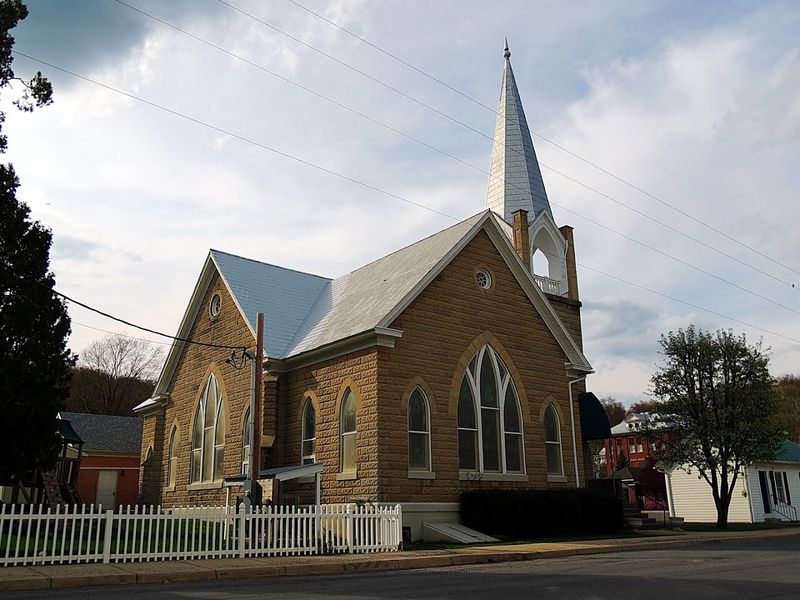
Highland County introduced a self-guided Historic Monterey walking-tour brochure in 2026, covering buildings and local stories around the compact town center.
Pick up a copy at the Highland County Visitor Center inside the Highlander at 27 West Main Street, Monterey, Virginia. The stop gives you a practical starting point without turning the day into homework.
Virginia’s Little Switzerland Earns Its Nickname
The nickname arrives wearing hiking boots and carrying a Swiss passport.
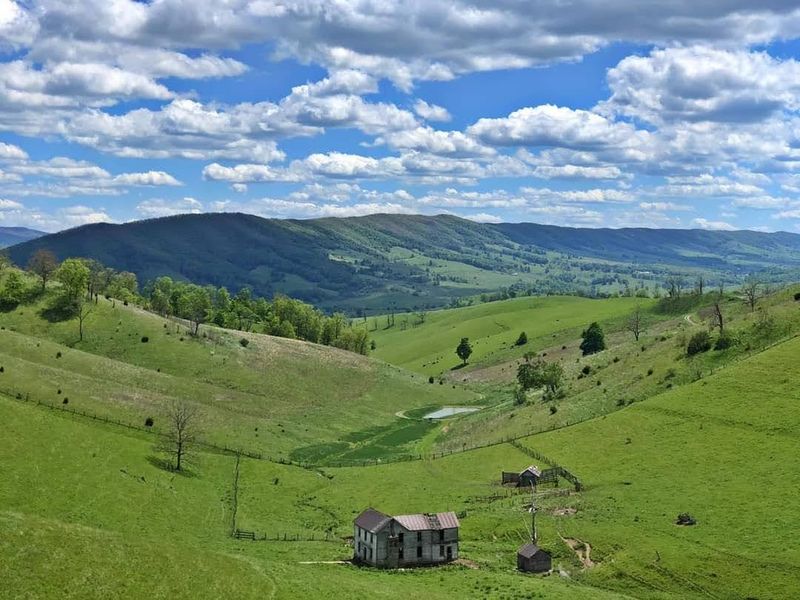
Highland County is often called Virginia’s Little Switzerland, a nod to its elevated, mountain-heavy landscape. The county itself was named for its altitude, and local historical material describes it as having one of the highest mean elevations east of the Mississippi River.
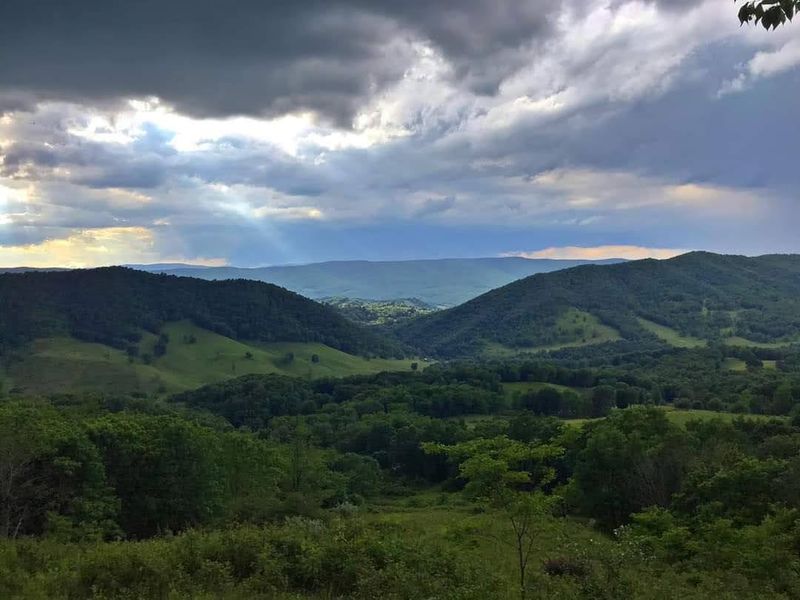
That geography becomes obvious before you need anyone to explain it. Ridges overlap beyond pastureland, narrow valleys separate wooded slopes, and long stretches of road give you room to watch the landscape change rather than flash past it.
The county covers roughly 416 square miles, yet its small population shares all that room. Highland County’s 2020 population density was only 5.4 people per square mile, which helps explain why the roads and overlooks rarely seem pressed for space.
Summer does not erase the mountain character. Higher elevations can bring cooler conditions than lower parts of the region, while open farmland and forest create broad views in nearly every direction.
Pull-offs along the county roads can turn a simple drive into a repeated exercise in saying, “Fine, one more photo.”
After sunset, the rural surroundings also make darker skies easier to find away from streetlights. The scenery does not clock out when the sun does.
The landscape handles the sales pitch. You only have to look up.
Main Street Makes Slowing Down Surprisingly Easy
Main Street will not wear out your shoes, but it may ruin your tolerance for rushed Saturdays.
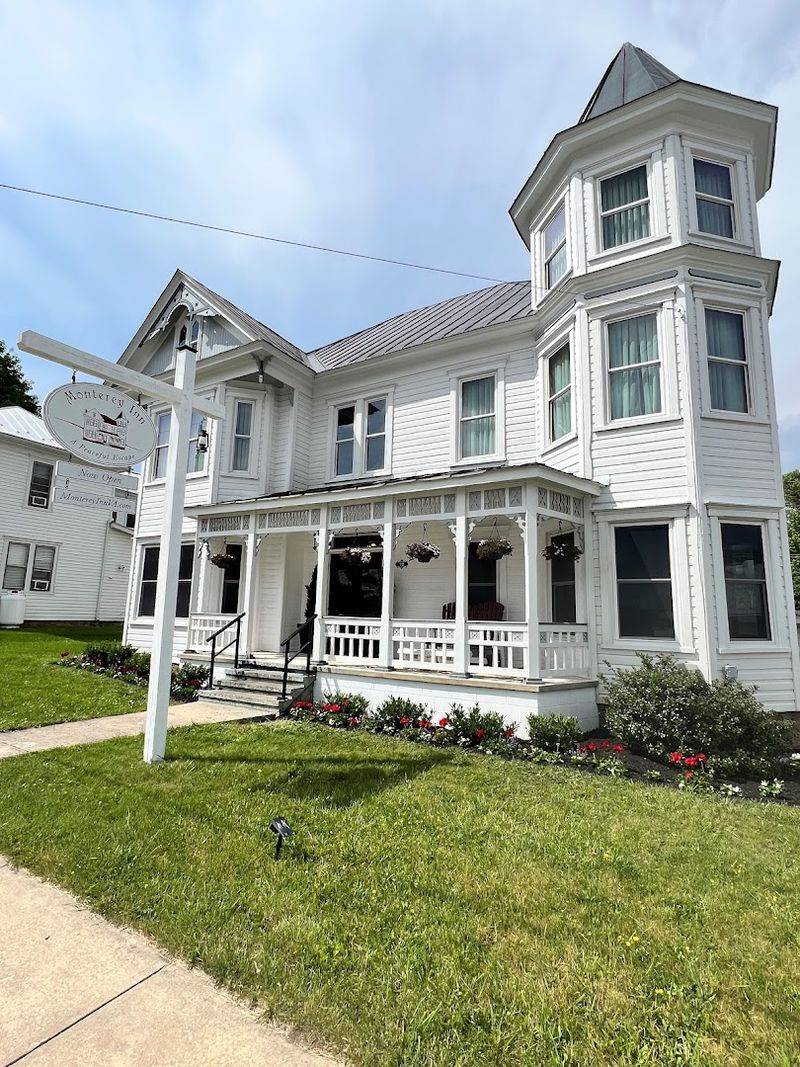
The town center is compact, and the walking route connects buildings that explain Monterey’s history without putting it behind museum glass. At 32 West Main Street, the Chestnut House dates to 1903 and represents Colonial Revival design.
The native-sandstone Citizens Bank building at 164 West Main Street dates to 1919. It housed Monterey’s second bank before later serving as the post office and eventually becoming office space.
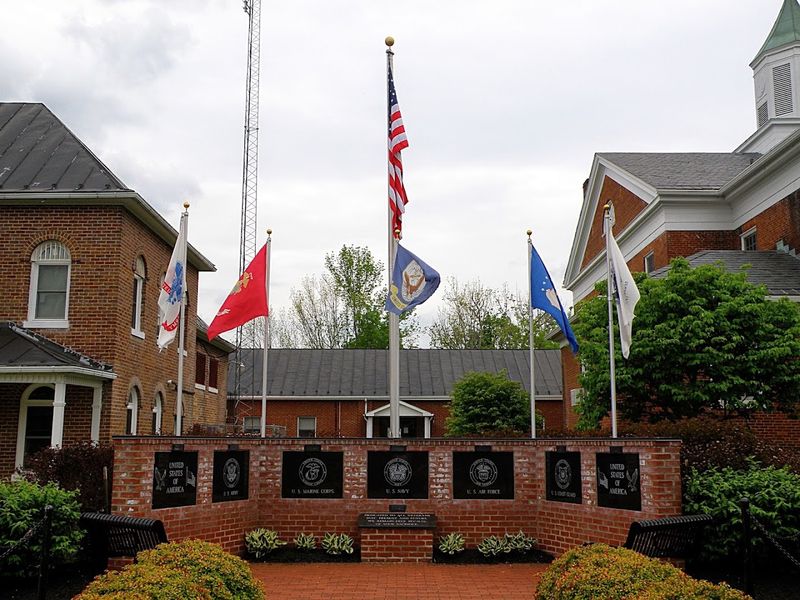
Across the street, the Highland County Courthouse stands on the site of an earlier courthouse destroyed by fire in February 1947.
The current Greek Revival building was constructed in 1948 on the original footprint, using columns that survived the blaze. That gives the courthouse a better comeback story than most sequels.
The wider county calendar keeps the quiet from becoming sleepy.
Wintertide brings seasonal activities in December, the Hands and Harvest Festival returns in autumn, and the Mountain Mama Road Bike Challenge sends cyclists across a demanding collection of roads and climbs each summer.
You do not need to catch an event to enjoy the center of town. The historic storefronts, courthouse lawn, and short distances make casual exploring easy, especially when your only firm appointment is deciding where to stop next.
By the time you reach the end of Main Street, your hurry may have wandered off without you.
Sounding Knob Puts The Quiet Into Perspective
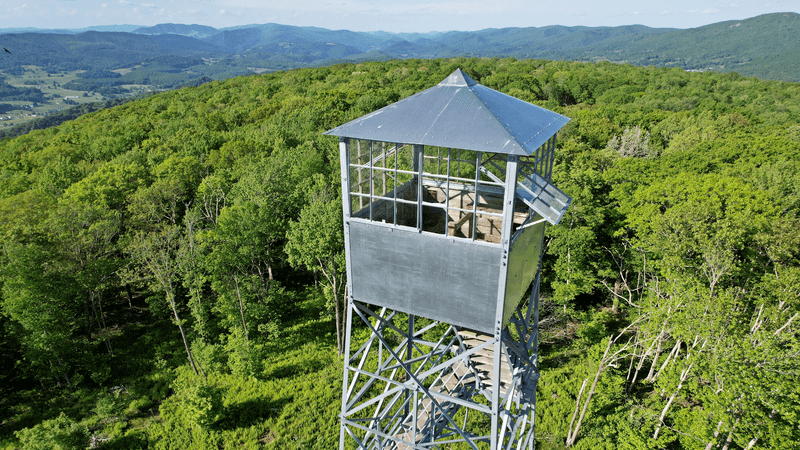
Sounding Knob is where your step count starts bragging before you do.
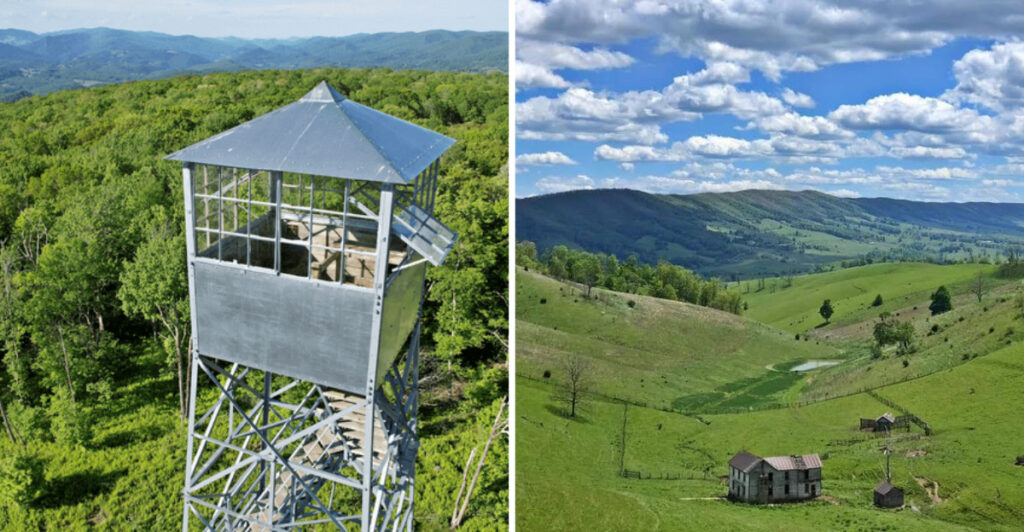
The restored fire tower sits 1.3 miles up Sounding Knob Road from U.S. Route 250. More than 100 steps lead to the lookout, so the view arrives with a short workout attached.
Skip Jones and Steve Good restored the tower in 2017, returning a long-range vantage point to the mountains near Monterey. It is listed as open every day throughout the year from sunrise to sunset.
The open staircase deserves your full attention, especially when wind or changing weather joins the climb. Anyone uneasy around heights should take one look upward before allowing enthusiasm to make decisions on their behalf.
Reaching the top opens a broad view across Highland County’s forests, farms, ridges, and scattered buildings. The scale of Monterey becomes especially clear from above, where the town occupies only a small patch within a much larger mountain landscape.
This stop does not require a complicated program. You climb, catch your breath, study the horizon, and discover that “more than 100 steps” sounds much friendlier during the descent.
The tower gives you the county in widescreen, and your knees provide the percussion.
Country Roads Lead Through Virginia’s First Barn Quilt Trail
Highland County turned its barns into a roadside gallery, then skipped the admission desk. Beginning in 2011, the county became the first in Virginia to establish its own Barn Quilt Trail.
The self-guided route carries you through Monterey, McDowell, Blue Grass, and surrounding farm country, where painted quilt designs appear on barns, fences, businesses, and other rural buildings.
You could spend an entire afternoon searching and still find reasons to keep driving.
Local artist Margie Boesch created the majority of the trail’s pieces, while other makers have added their own designs. Many carry stories connected to families, farms, businesses, plants, animals, or important moments.
Patterns listed by the county include Foxes Making Tea, California Poppy, Mug Club, Creation Sings, and Rising Star. The names alone suggest that ordinary labels were politely shown the door.
The art gives you a destination, but the roads keep stealing the frame. Mountain backdrops, working farms, weathered barns, pastureland, and winding lanes fill the distance between one design and the next.
A trail map helps, although strict efficiency misses half the fun. Leave room to stop, double back, or follow another road simply because the next bend looks promising.
You may begin by hunting quilt blocks, but the countryside quickly becomes the larger collection.
Maple Season Gives This Small Town Its Biggest Celebration
March arrives in Highland County with sticky fingers.
The Highland County Maple Festival began in 1959, drawing visitors to local sugar camps and maple producers. The celebration takes place over two weekends in March, not February, and has become the county’s signature annual gathering.
Virginia designated the Highland County Maple Festival as the Commonwealth’s official maple festival in 2014. The designation now appears in the Code of Virginia alongside the state’s other official emblems and celebrations.
Festival maps direct visitors to sugar camps around the county, where producers explain or demonstrate parts of the syrup-making process.
Depending on the location, you may see sap collection equipment, boiling operations, working sugar houses, or displays connecting current production with older methods.
Monterey becomes one of the main activity centers, with vendors and community spaces serving far more people than the town encounters during an ordinary weekend. That surge is part of the fun, but it changes the pace completely.
Visit during the festival when you want community energy, local maple products, and a rare look inside working sugar operations. Choose another weekend when open roads and quiet sidewalks rank higher on your list.
For two weekends, the county proves that syrup can cause traffic.
Hayfields State Park Adds A Gentle Outdoor Detour
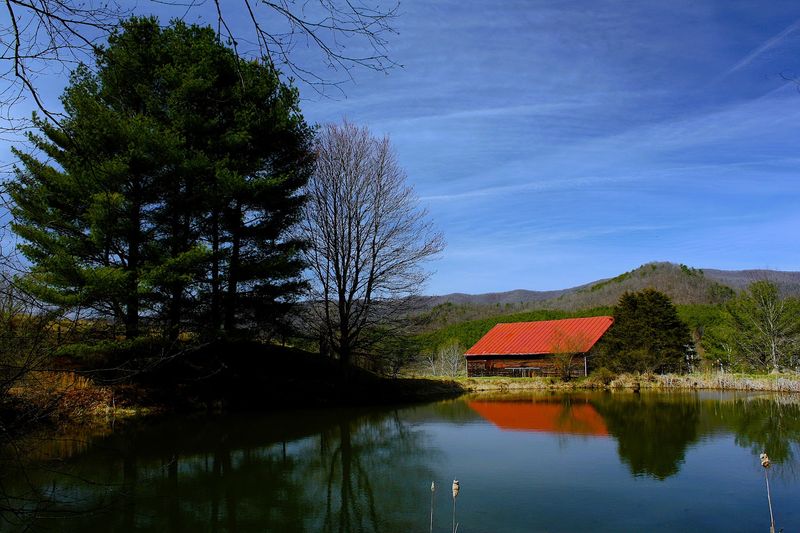
Hayfields State Park opened in Highland County in 2025 as the Commonwealth’s 44th state park. Located near McDowell, east of Monterey, it adds four miles of easy-to-moderate hiking and biking trails to the area’s outdoor options.
The Bullpasture River runs through the property for about a mile, and the park provides fishing access along that stretch. The river frontage is known for trout fishing, although anglers must follow current Virginia licensing and fishing regulations.
Eagle’s Rest Trail offers a 1.5-mile moderate route to an observation point above the Bullpasture River Valley before descending toward the water. The route includes elevation changes, so “moderate” should receive more attention than the modest mileage suggests.
You can use the park as a relaxed half-day outing or pair it with time in Monterey. A morning hike leaves room for the historic walking route, while a riverside stop works nicely after driving the Barn Quilt Trail.
The park is new enough that facilities and programming may evolve, so current conditions are worth checking before you set out. The central appeal is already clear: trails, river access, mountain scenery, and enough space to let the day breathe.
The final challenge is leaving before the river talks you into another hour.