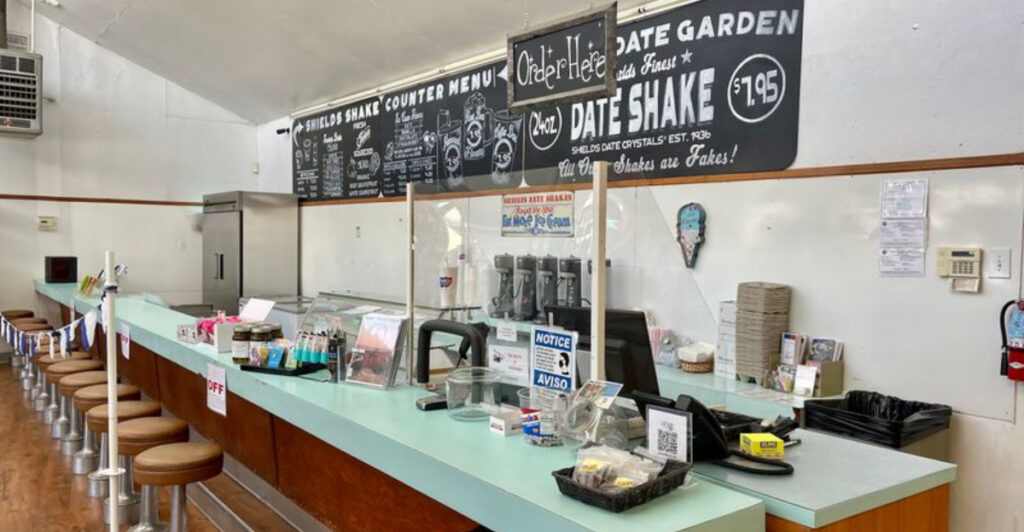
Somewhere along a sun-baked stretch of California desert highway, a cup of something cold and impossibly thick can stop a road trip in its tracks. Date shakes have been doing exactly that for generations of travelers passing through the state’s southeastern desert country, where palm trees line irrigation canals and roadside stands sell fruit straight from the farm.
The drink sounds simple enough, but one sip of a properly made version tends to reframe the whole idea of what a milkshake can be. California’s date-shake tradition runs deeper than any single stand or secret recipe, and tracing it back reveals a story about climate, agriculture, and a regional food culture that has quietly thrived for nearly a century.
The date shake belongs to California’s desert-food tradition
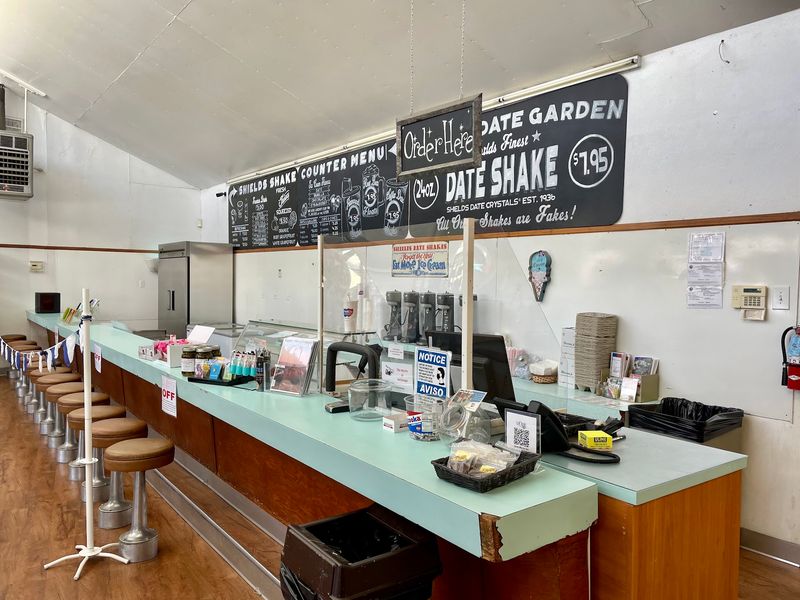
Pull off the highway anywhere between Cabazon and the Salton Sea and you will find yourself in the middle of one of the most productive date-growing regions in the United States. Southeastern California, and the Coachella Valley in particular, concentrates the vast majority of domestic date production.
USDA Agricultural Research Service data identifies southeastern California, including the Coachella and Bard valleys, as the center of U.S. date cultivation, and UC Davis research confirms California as the leading date-producing state in the country.
The desert climate made all of this possible. Date palms require long, intensely hot summers with very low humidity during fruit ripening, conditions that the Coachella Valley delivers reliably.
University of California agricultural extension materials document how growers in the region cultivated varieties suited to those conditions, with Deglet Noor and Medjool becoming the most commercially significant. Early agricultural development brought date-palm offshoots from North Africa and the Middle East, and California Department of Food and Agriculture reporting traces how the industry took root through careful variety introduction and irrigation development.
From that agricultural foundation, a regional food culture grew alongside the date harvest. Roadside stands, date gardens, and farm shops began offering fresh and dried dates to travelers, and the date shake emerged as a way to showcase the fruit in a form that suited the desert heat.
Calling any one stand the birthplace of this tradition overstates what the record can confirm. The drink belongs to the valley as a whole, shaped by the crops, the climate, and the long tradition of feeding people passing through on their way somewhere else.
No single recipe defines a California date shake
Order a date shake at one stand and you might get a cup dense with chopped Deglet Noor dates blended into cold milk. Order one at the next stop and you could receive something altogether smoother, made from date crystals dissolved into low-fat vanilla milk.
Both are recognizably part of the same tradition, yet they taste and feel noticeably different. That variation is not a flaw in the style; it reflects how the drink has evolved across dozens of businesses over many decades.
The range of documented ingredients is wider than most people expect. Recipes in the region use whole pitted dates, date puree, date paste, and commercially produced date crystals.
The dairy component shifts just as much, from whole milk to low-fat milk, and from no frozen dairy at all to generous scoops of ice cream, frozen yogurt, or ice milk. Hadley Fruit Orchards’ current cafe page specifies Deglet Noor dates as the fruit base for its shakes, while Shields Date Garden’s current menu lists date crystals blended with low-fat vanilla milk as the foundation of its version.
Neither formula is more authentic than the other; they simply represent different choices made by different businesses.
Saveur’s reporting on Shields and a Coachella Valley Water District cultural resources document both describe the shake as a regional specialty with a consistent identity but no single locked-in formula. The date form, the dairy choice, the sweetness level, and the presence or absence of ice cream all shift from place to place.
Knowing that going in makes the comparison between stops more interesting, not less.
Why some versions become thick and spoon-worthy
A date shake that earns the description “thick enough to eat with a spoon” is not an accident. Several factors work together to produce that dense, almost pudding-like consistency, and understanding them helps explain why the same basic concept can range from a pourable drink to something closer to soft-serve in a cup.
Frozen dairy is one of the biggest contributors when it appears in the recipe. Ice cream, frozen yogurt, or ice milk adds both body and cold temperature without the diluting effect of extra liquid.
A 1994 Los Angeles Times feature on desert date shakes describes them as thick, velvety, and soul-satisfying, language that points to versions made with frozen dairy and a restrained pour of liquid. The amount of milk or other liquid matters enormously: less liquid means less thinning, which means the finished shake stays close to the density of its frozen and fruit components.
The form of dates used also shapes the final texture in ways that are easy to overlook. Whole chopped dates or date paste can create visible pieces and a fudgy pull, while date crystals dissolve more completely and contribute sweetness with a smoother result.
Shields’ archival recipe collection includes a shake calling for date crystals, ice cream, and only a partial cup of milk, a combination that would produce a very substantial texture. Saveur’s detailed look at the Shields recipe reinforces that the low liquid-to-solid ratio is central to achieving a dessert-like consistency.
Blending time and speed also play a role. A shorter blend keeps more air out and maintains a denser texture, while over-processing can introduce air and loosen the structure. “Spoon-worthy” is ultimately a sensory description, not a technical measurement, and what qualifies varies by person and by pour.
What the evidence does confirm is that specific ingredient choices and proportions, not dates alone, are what push a shake from drinkable to something you reach for a spoon to finish.
The origin story remains qualified
Every regional food has its founding myth, and the California date shake has one too. Russell Nicoll, sometimes spelled Nicholl in historical accounts, is the name most often attached to the drink’s invention, and Valerie Jean Date Shop near the town of Thermal is the location most frequently cited as where it all started.
The story has a satisfying shape: a desert entrepreneur, a surplus crop, and a cold blended drink that travelers could not stop ordering.
The historical record, though, adds some important qualifications. A Coachella Valley Water District cultural resources report describes Valerie Jean Date Shop as only “assumed” to have originated the date shake, a word choice that signals the conclusion rests on tradition and association rather than documented proof.
A 1987 Los Angeles Times article credits Nicoll as the figure generally associated with developing the modern version of the drink, while a 1994 Los Angeles Times feature describes him as “generally credited” rather than definitively proven to be the sole originator.
That kind of qualified credit is common in regional food history, where recipes develop gradually, spread informally, and get attached to colorful personalities after the fact. The date shake almost certainly evolved from the broader practice of blending fresh or dried fruit with cold dairy, a technique that multiple Coachella Valley businesses were experimenting with during the mid-twentieth century.
Nicoll and Valerie Jean remain part of the story worth telling, but the honest version of that story acknowledges that the drink’s true beginning is more diffuse than a single inventor at a single stand on a single afternoon.
What a roadside date-shake stop can actually promise
Road-trippers hunting for a date shake along the California desert corridor have real options, and knowing what each type of stop actually offers makes the experience more satisfying than arriving with inflated expectations. Hadley Fruit Orchards in Cabazon sits right off the interstate and functions as a high-traffic roadside shop where travelers can pick up dried fruit, nuts, and a shake on the way through.
Hadley’s cafe page confirms its current menu and Deglet Noor date shake offering, though hours, pricing, and availability should always be verified before making a special stop.
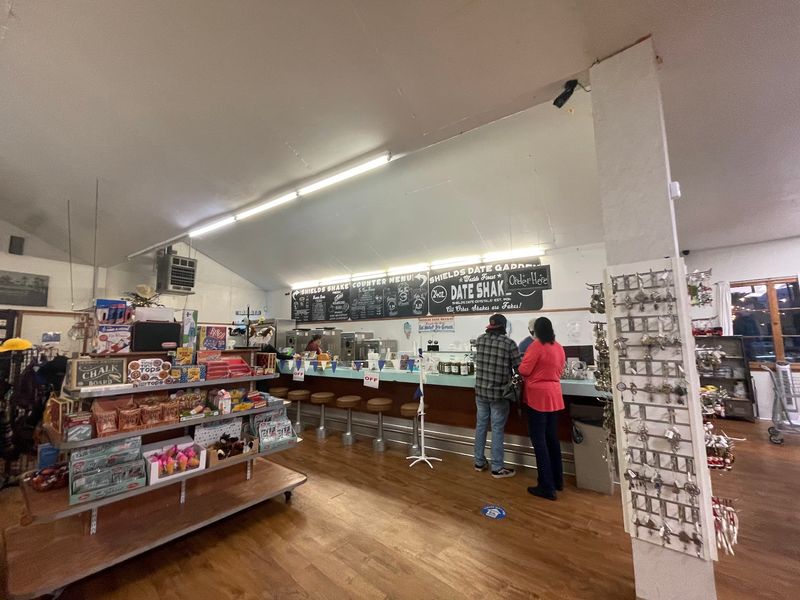
Shields Date Garden in Indio offers a different experience: a working date farm with a cafe, a gift shop, and decades of accumulated atmosphere. The setting is more deliberate, with the date garden itself visible from the property, and the shake comes from a recipe the business has been refining for generations.
Neither Hadley nor Shields can be assumed to source all of its dates from its own land without direct confirmation, but both represent documented, currently operating stops with confirmed date shakes on the menu.
Roadfood’s entry on date shakes situates the drink within the broader American roadside-food tradition, describing it as a regional specialty tied to a specific agricultural landscape. The contrast between a modest, sun-faded building and a cup of something unexpectedly rich is part of the appeal, but that contrast is an editorial impression rather than a guarantee.
What any given stop can actually promise is a cold drink made from dates and dairy in some combination. The rest depends on the specific business, the specific recipe, and the specific day you walk through the door.
Adapt the style at home with prepared dates and safe dairy
Recreating a date shake at home is genuinely achievable, but a few preparation steps make the difference between a gritty, uneven blend and something closer to the smooth, substantial version you might find at a valley stand. Start with the dates themselves, because their condition before blending matters more than most people realize.
California Dates’ handling and storage guidance explains that Medjool dates have a shorter room-temperature storage window than Deglet Noor dates, and that airtight storage, refrigeration, or freezing preserves quality for both varieties. Dates that have dried out during storage benefit from soaking in warm water before blending.
Shields’ archival recipe collection directs users to hydrate date crystals before mixing them, and the same principle applies to dried or slightly hardened whole dates: a short soak softens the flesh and helps the blender incorporate the fruit evenly.
For the dairy component, choose pasteurized milk, ice cream, or frozen yogurt. FDA guidance on raw milk risks is clear that unpasteurized dairy can carry serious foodborne health hazards, and additional FDA food safety information recommends pasteurized products for exactly this reason.
Raw milk is not a more authentic choice; it is simply a riskier one.
Serve the shake immediately after blending for the best texture and food safety. If you need to delay serving, keep the shake refrigerated.
USDA food safety guidance identifies 40 degrees Fahrenheit as the cold-storage benchmark and advises discarding perishable food left above that temperature for more than two hours, or just one hour when the ambient temperature exceeds 90 degrees Fahrenheit. On a desert road trip, that one-hour window can close faster than you expect.
A home version will differ from any restaurant’s formula in flavor, texture, and proportion, and that is fine. The goal is a cold, date-forward drink that you can adjust to your own preference.
A regional specialty worth tasting without the mythology
California’s date shake earns its reputation not because of one legendary stand or one perfected formula, but because a specific agricultural region produced the right conditions for a distinctive regional drink to take hold and persist. The Coachella Valley’s date-growing culture gave local businesses both the raw material and the reason to experiment, and decades of roadside commerce shaped the specialty into something travelers actively seek out.
The range of documented versions, from Hadley’s Deglet Noor shakes to Shields’ date-crystal and low-fat milk formula, shows that no single recipe owns the style. What makes some versions feel dessert-like and spoon-worthy comes down to frozen dairy when used, concentrated date products, reduced liquid, and blending technique working together rather than any one magic ingredient.
Hadley’s cafe and Shields represent two documented, currently operating examples among many, each with its own sourcing, preparation, and atmosphere.
Decades of Los Angeles Times coverage on the valley’s date-shake culture capture something that holds true today: the drink’s appeal is inseparable from its setting, a cold, sweet, intensely flavored cup consumed in the middle of the desert. Approach it as a genuine regional experience with real variation among stops, and the mythology becomes less necessary.
The shake itself is interesting enough.