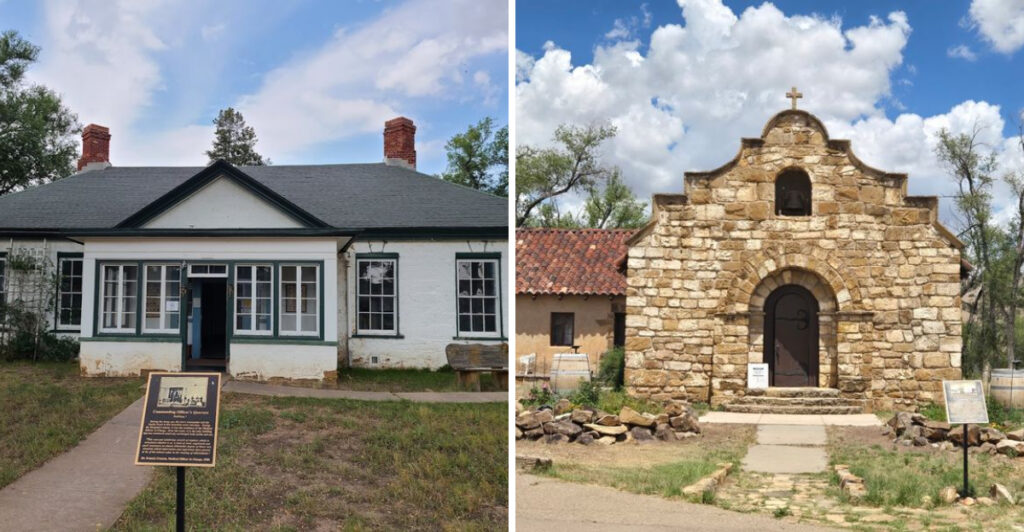
At first glance, this place looks like a classic frontier fort, with white buildings wrapped around a broad parade ground. Spend a little time here, though, and the story gets much more surprising.
Soldiers once trained on these grounds, including members of the Buffalo Soldiers. Years later, the same property became a tuberculosis hospital, a wartime internment site, and a women’s prison.
That is a lot of history packed into one quiet stop. You can wander past old quarters, step inside former hospital spaces, and follow paths that reveal another chapter around nearly every corner.
It never feels like a dry history lesson, either. The setting is peaceful, the buildings are easy to explore, and the details keep pulling you in.
This New Mexico landmark is the kind of place you visit out of curiosity and leave wondering how you had never heard about it before.
Whitewashed Buildings Frame The Parade Ground
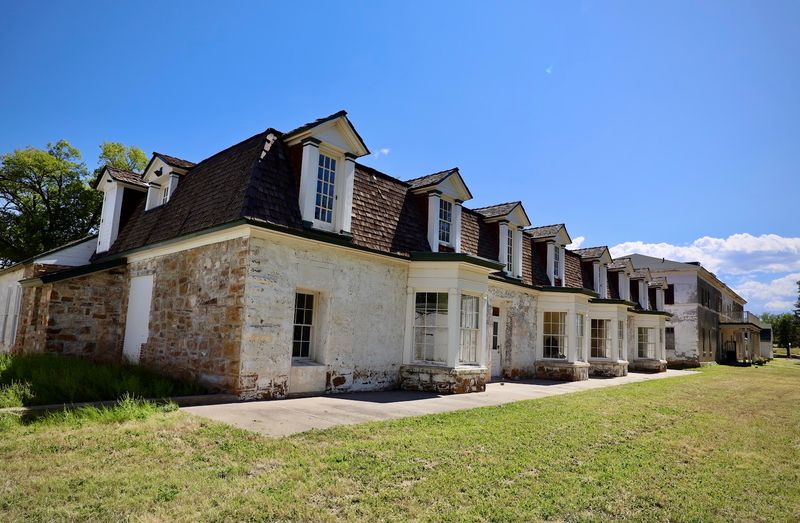
Step onto the parade ground here and time seems to fold back on itself. A sweep of whitewashed buildings surrounds the open field, standing in crisp formation just as they would have in the mid-1800s.
The visual effect is striking, almost theatrical, yet every wall and roofline is entirely real.
Several of these structures date to the fort’s founding in 1855, including what is now the museum and visitor center, which originally served as soldier barracks. Officers’ Quarters line one side of the ground, their simple facades hinting at the rank and routine of frontier military life.
The Buffalo Soldiers of the 9th Cavalry once drilled across this very field, and standing at its center, you can feel the weight of that legacy beneath your boots.
Restoration work is ongoing, and the completed sections look remarkably sharp against the surrounding high desert terrain. A small admission fee gets you into the visitor center, where a short film on the fort’s history sets the stage perfectly.
This central open space is the beating heart of Fort Stanton Historic Site at 104 Kit Carson Rd, Fort Stanton, NM 88323.
Stone Walls Still Echo With Frontier History
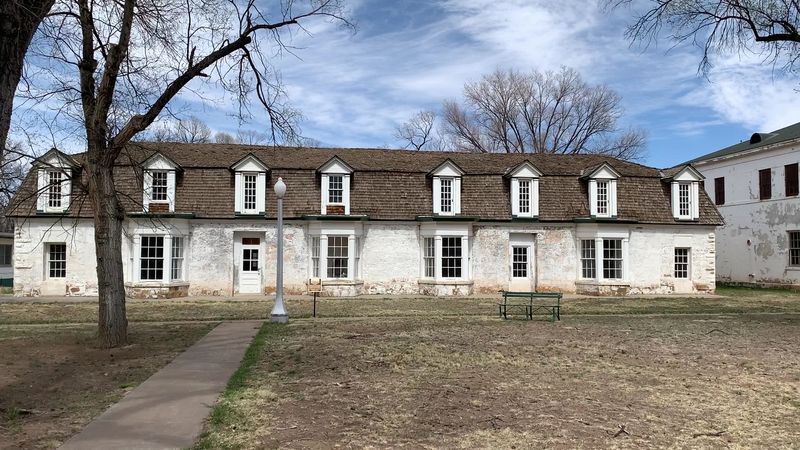
Few things speak louder than old stone, and at this site the masonry does all the talking. Soldiers quarried and shaped local rock to construct the original fort buildings in 1855, and those same walls have quietly absorbed more than 170 years of American history since then.
The Civil War brought serious damage to the post, but a determined rebuilding effort launched in 1868 gave the fort a second life. What visitors see today is essentially an architectural timeline, with layers of construction from different eras stacked against one another like pages in a thick book.
Historians consider it one of the most intact 19th-century military forts in the entire American Southwest, which is a distinction that carries real meaning when you press your hand against the rough surface of a wall built before the railroad reached New Mexico.
The stone also carried practical value in a region where timber was scarce and temperatures swung wildly between seasons. Thick walls kept interiors cool in summer and retained warmth through cold desert nights.
Every crack and weathered edge tells a story of soldiers, patients, and caretakers who all called this rugged compound home at one point or another.
Long Porches Recall Life At A Military Outpost
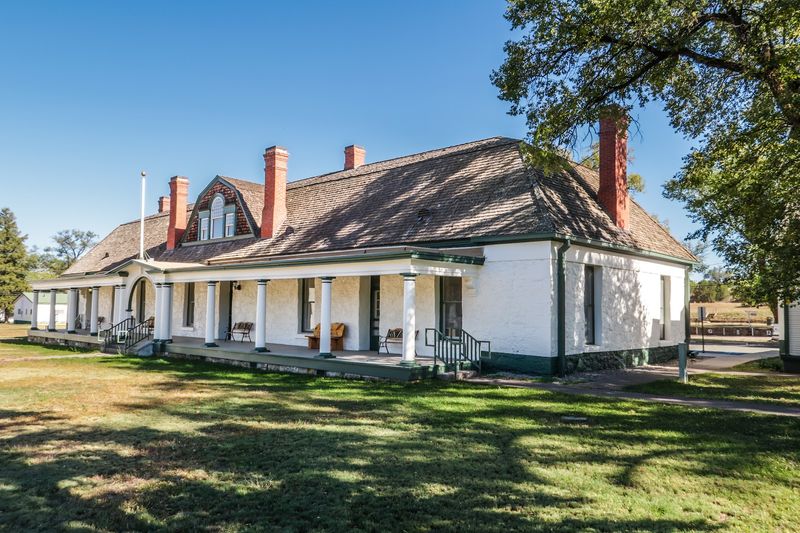
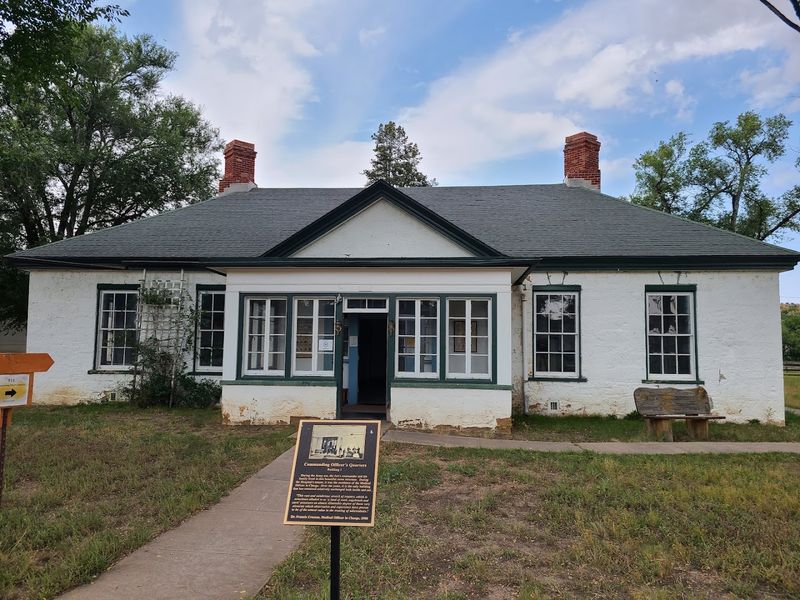
Not everything at a frontier post was about drills and dispatches. A closer look at the Officers’ Quarters reveals small front porches added during renovations around 1887, and these modest covered spaces say a great deal about the human side of garrison life.
Officers and their families would have gathered on these porches to catch the evening breeze, watch the parade ground activity, or simply trade conversation after a long day. The Rio Bonito Valley sunsets visible from this vantage point must have offered genuine comfort to people stationed far from eastern cities.
Even in a place defined by duty and discipline, the instinct to build a porch and sit for a while proved irresistible.
Today, walking past these quarters and studying the porch details gives visitors a texture that no exhibit case can fully replicate. You get a sense of the rhythm of daily life here, the mornings of inspection, the afternoons of paperwork, and the quiet evenings that passed with surprising normalcy.
The porches are a small architectural footnote, yet they humanize the entire compound in a way that makes the history feel personal rather than distant.
The Old Hospital Reveals A Haunting Chapter
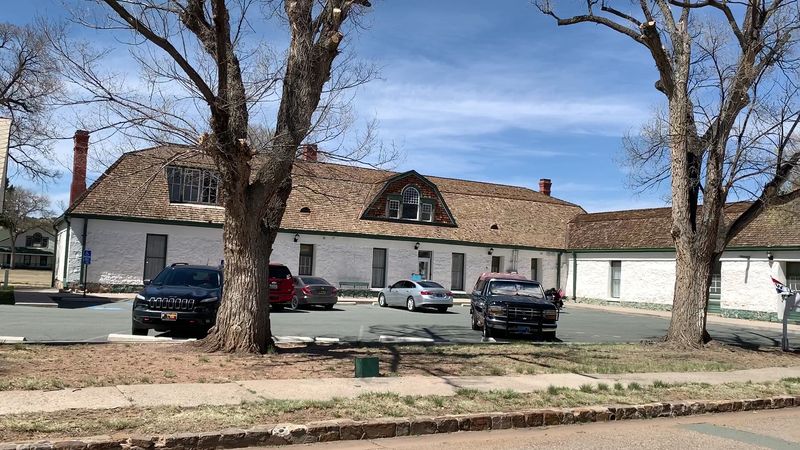
In 1899, the federal government made a decision that would transform Fort Stanton entirely. Rather than continuing its military function, the site was converted into the country’s first federal tuberculosis sanatorium, specifically designated to serve Merchant Marines seeking recovery in New Mexico’s dry, clean air.
Over its 54-year run as a sanatorium, more than 5,000 patients arrived hoping the high desert climate would offer relief. Many lived in specially designed tent cottages built to maximize sunlight exposure, a standard treatment approach of the era.
A second hospital building constructed in 1936 featured the first electric elevator in New Mexico, surprisingly modern against the rustic backdrop of the compound.
That 1936 building now houses a museum devoted to the fort’s sanatorium years, where exhibits include original X-ray equipment, a period dentist’s chair, and medical artifacts that paint a vivid picture of early 20th-century healthcare. After 1953, the site continued shifting roles, serving as a state hospital and later a women’s correctional facility.
Each transition added another chapter to a story that was remarkably complex, and the old hospital wing stands as a quietly powerful building on the entire historic property.
A Historic Chapel Rises Among The Quarters
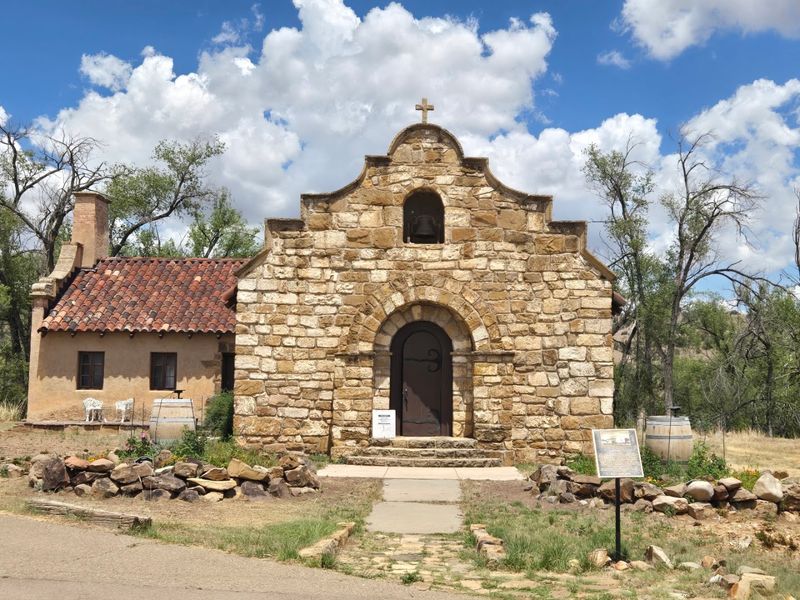
The chapel at Fort Stanton carries one of the most unusual preservation stories on the entire property. New Mexico Historic Sites dates its original construction to the first half of the 1930s, when it stood near the old hospital, before workers moved it to its present location in 1943.
The relocation preserved a worship space during a period of major construction and demolition across the compound. Its stone exterior also reflects the fort’s long habit of reusing materials and adapting older buildings as the property changed roles.
Today, the chapel remains one of the most distinctive structures visitors encounter while walking between the former barracks and medical buildings.
The space is still available for scheduled events, including weddings, which gives it a living role rather than leaving it frozen as a museum piece. Visitors can also study the interior and its details while considering how faith fit into daily life during the hospital era.
Amid the military history and medical drama that define Fort Stanton, the chapel offers a quieter counterpoint, showing how the community created room for reflection even as the surrounding property kept changing around it through decades of institutional change and preservation work underway nearby.
Tree-Lined Walkways Lead Through The Compound
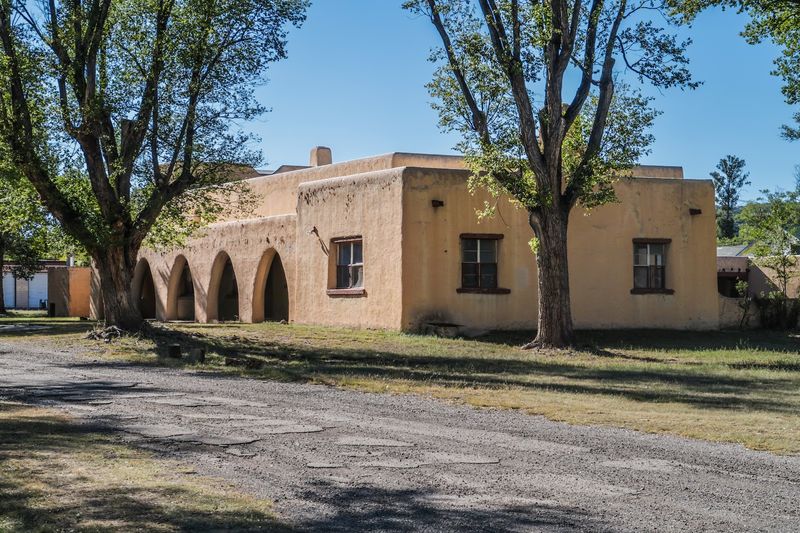
Beyond the buildings and exhibits, the grounds of Fort Stanton invite a slower, more contemplative kind of exploration. Cottonwood trees tower along the pathways, their canopies shifting with the breeze and casting dappled shade across the gravel walkways that connect the compound’s various structures.
The fort sits in the Rio Bonito Valley, a setting defined by open meadows, juniper and pinon woodlands, and the gentle sound of water nearby. An old acequia, a traditional irrigation channel, once carried fresh water directly from the Rio Bonito to the fort, and much of its original path has been converted into a charming boardwalk trail that visitors can follow today.
It is the kind of detail that connects the site’s agricultural and domestic history to the landscape in a very tangible way.
Hiking trails extend beyond the main compound into the surrounding terrain, winding through subtle canyons and fragrant woodland stretches that feel worlds away from the institutional history at the fort’s core. Spending time on these walkways gives the visit a natural rhythm, alternating between the intensity of indoor exhibits and the open, unhurried beauty of the valley.
The grounds reward anyone willing to slow their pace and look carefully.
The Cemetery Trail Continues Beyond The Walls
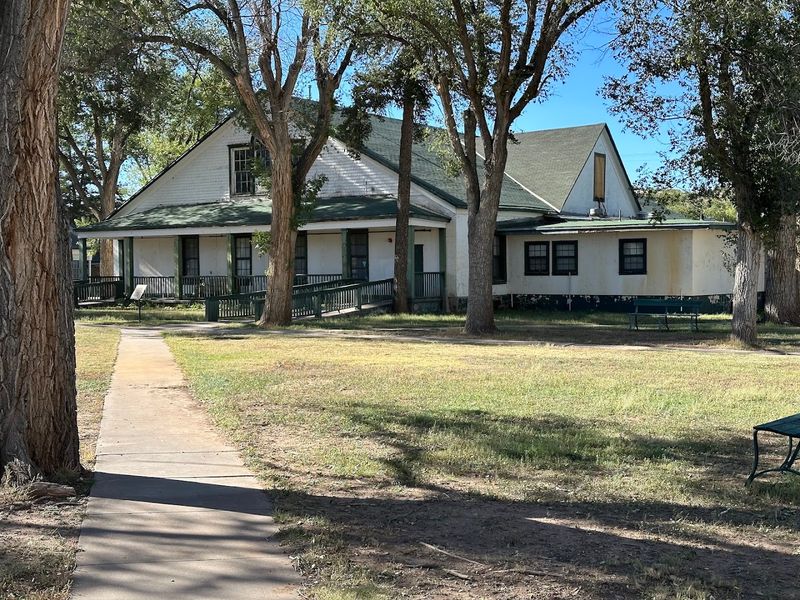
A short walk from the main compound leads to one of the most reflective spaces at the entire site. The Merchant Marine Military Cemetery, established in 1899, holds the remains of approximately 1,500 tuberculosis patients who passed away during the sanatorium years, their graves marked by rows of white crosses that stretch across the hillside in quiet, orderly lines.
A taller central monument anchors the cemetery and creates a dramatic visual anchor against the mountain backdrop. Nearby, a newer New Mexico State Veterans Cemetery opened in 2017 and continues the site’s long tradition of honoring those who served, with a master plan accommodating up to 3,500 graves.
The two cemeteries together create a layered memorial landscape that spans more than a century of history.
Guided tours of the older post cemetery bring individual stories to life, covering burials from the 1850s through the 1970s and including veterans of multiple conflicts alongside figures connected to the Lincoln County War. The full cemetery trail runs approximately 2.5 miles and offers both historical depth and genuine natural beauty.
Few experiences on the property leave as lasting an impression as walking quietly among those rows of crosses.
Mountain Ridges Create A Dramatic Backdrop
No photograph fully prepares you for the scale of the landscape surrounding this site. The fort sits in the eastern foothills of the Sierra Blanca, with the Capitan Mountains rising to the north and the Sacramento range visible further in the distance, all folded into the vast expanse of Lincoln National Forest.
The Mescalero Apache, who knew this territory long before any fort was built here, called the area zúuníidu, meaning beautiful land, and that description holds up completely. On clear days, the snow-capped peak of Sierra Blanca floats above the horizon like a painted backdrop, adding a level of drama to the scene that no architect could have planned.
The visual contrast between the compact, whitewashed buildings and the enormous mountain ridges behind them is genuinely arresting.
The drive to the site from Ruidoso winds through open countryside that feels cinematic in its own right, with two-lane roads cutting through golden grasslands and scattered trees. Arriving with the mountains already framing the view means the experience begins well before you reach the parking area.
The natural setting is not just scenery here; it is an essential part of what makes this place feel so singular and worth the trip.