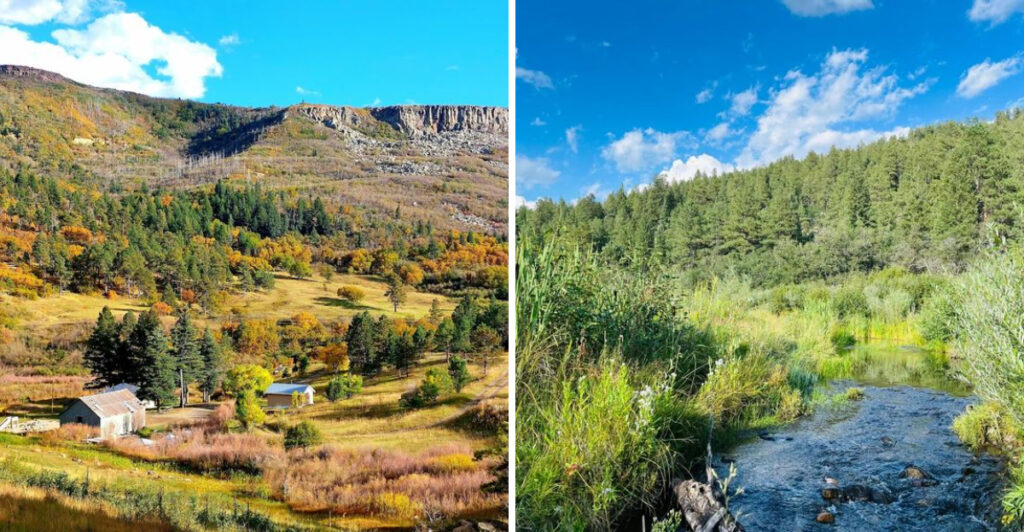
The best road trips have a habit of ruining your schedule, and this one starts doing it immediately. Northeastern New Mexico keeps giving you reasons to stop, look around, and stay longer than planned.
A blue reservoir suddenly appears beneath the open sky. Historic ruins pull you into stories that stretch back centuries.
Farther along, dinosaur fossils and mountain trails make the drive feel less like a route and more like a string of discoveries. The pace is easy, but the scenery never feels repetitive.
Each stop changes the mood without making the journey feel scattered. You can spend the morning near the water, then end the day beside a cool forest stream.
That variety is hard to resist. Bring extra time and a flexible plan, because these seven destinations deserve more than a glance through the windshield.
This is a road trip built for scenic detours and lingering stops.
1. Ute Lake State Park, Logan
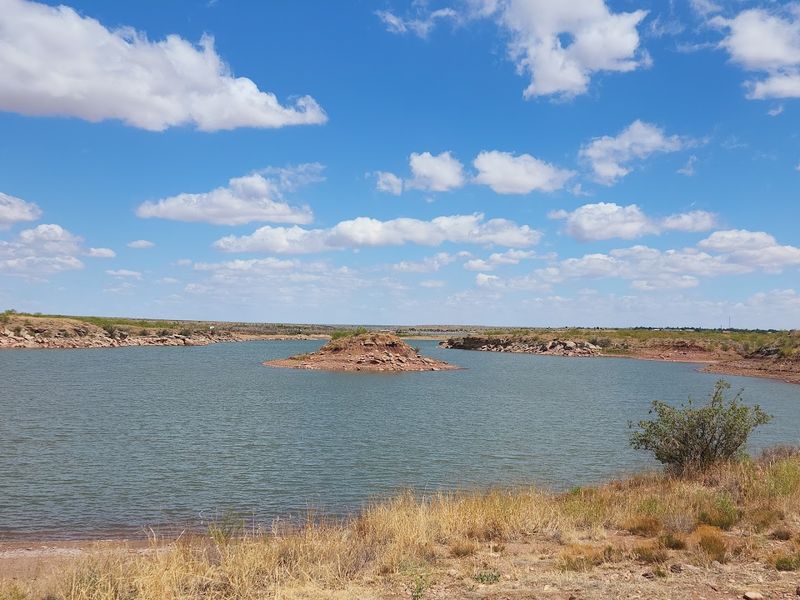
Out on the high plains of northeastern New Mexico, a long ribbon of blue water cuts through rocky canyon country in a way that stops you cold the moment you catch your first glimpse.
Ute Lake State Park sits at 1800 540 Loop, Logan, NM 88426, and the lake itself stretches for nearly 13 miles through the Canadian River Valley, making it one of the longest lakes in the state.
Water sports are front and center here, with motorized boating, water skiing, and sailing all drawing visitors who want to make the most of that wide-open surface.
Paddlers who prefer a quieter pace can slip a canoe or kayak into calmer coves and simply drift while the desert breeze does all the work.
Anglers are especially loyal to this park, and for good reason, since Ute Lake has produced some record-breaking walleye catches, along with solid numbers of largemouth bass, channel catfish, and crappie.
Back on dry land, hiking and birding trails thread through the natural landscape, rewarding patient walkers with sightings of native plants and wildlife that thrive in this rugged setting.
Camping options range from developed RV sites at the Yucca, Zia, and Logan Park campgrounds to more rustic primitive setups for those who want nothing between them and the stars.
A full marina, multiple boat ramps, and a visitor center with interpretive exhibits round out the amenities, making it easy to settle in for a few days rather than just a few hours.
One engineering detail that surprises most first-time visitors is that the dam holds the largest Labyrinth Weir Spillway in the United States, a quiet but impressive footnote for a park that already has plenty going for it.
You may arrive planning to stay one night and find yourself renegotiating that plan by sunrise the next morning.
2. Conchas Lake State Park, Conchas Dam
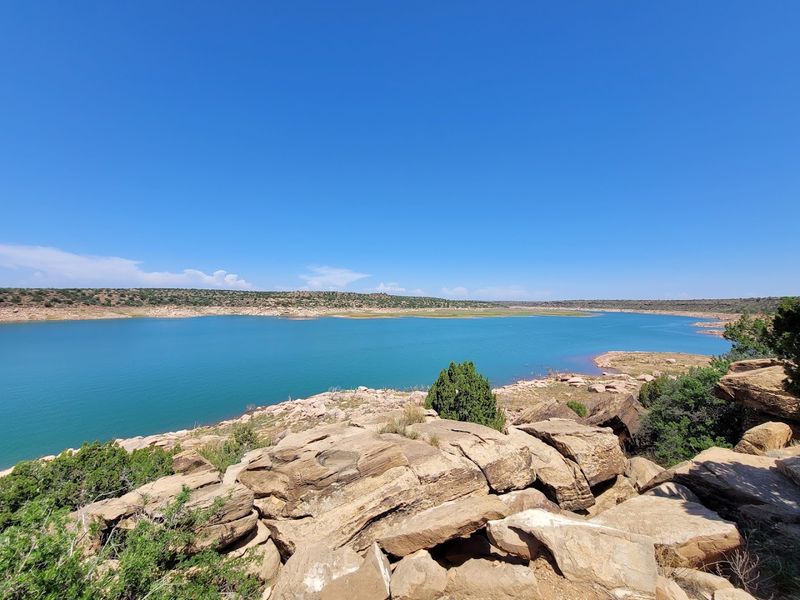
A short drive northwest of Tucumcari, the landscape opens up into something that feels almost too grand for a place most travelers have never heard of.
Conchas Lake State Park, located at 501 Bell Ranch Road, Conchas Dam, NM 88416, wraps around a reservoir that unfurls for roughly 25 miles, revealing secluded coves, dramatic canyon walls, and sandy beaches that invite you to kick off your shoes and stay awhile.
The lake draws water sports fans in droves, with motorized boating, sailing, water skiing, and paddling all available for visitors who like their adventures wet.
Fishing is equally popular here, with walleye, largemouth bass, bluegill, channel catfish, and crappie keeping lines busy from sunrise to sunset.
Developed sites and an estimated 500 primitive campsites spread along the shoreline offer plenty of options, giving visitors ample room to spread out even during especially busy summer weekends.
Hikers and birdwatchers can explore the surrounding terrain at their own pace, while picnic areas provide a comfortable spot to refuel between activities.
A public nine-hole golf course operates near Conchas Dam, offering a quirky bonus for travelers who want to add a round to their lake visit.
The dam itself carries a compelling backstory, having been built between 1935 and 1939 by the U.S. Army Corps of Engineers with New Deal relief funding, while nearby historic buildings display Territorial and Spanish Pueblo Revival influences.
Exploring the shoreline by boat is one of the best ways to appreciate the scale of this place, especially when the canyon walls catch the late afternoon light and the water shifts from turquoise to deep cobalt.
Conchas Lake is the kind of stop that earns a permanent spot in your road trip highlight reel long before you even reach the main course of this journey.
3. Mesalands Community College Dinosaur Museum, Tucumcari
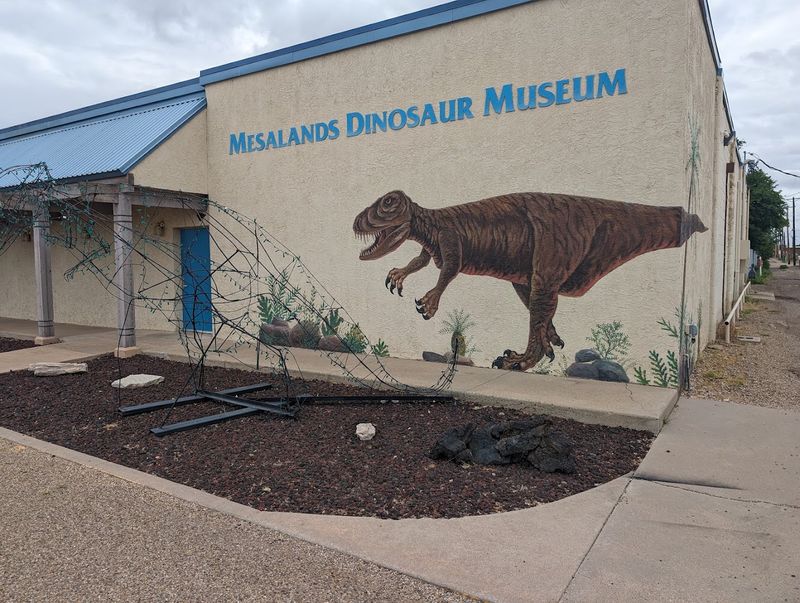
Tucumcari sits along the legendary stretch of historic Route 66, and right in the heart of town, something extraordinary is waiting behind a modest museum entrance that absolutely punches above its weight.
The Mesalands Community College Dinosaur Museum at 222 East Laughlin Street, Tucumcari, NM 88401, covers more than 10,000 square feet of exhibit space packed with genuine fossils, mineral specimens, and meteorites that span millions of years of prehistoric history.
The focus lands squarely on the Mesozoic Era, covering the Triassic, Jurassic, and Cretaceous periods with enough detail to keep both curious kids and seasoned fossil enthusiasts glued to every display case.
A 40-foot Torvosaurus skeleton commands attention the moment you walk in, and knowing it ranks among the most complete specimens of its kind anywhere in the world makes standing next to it feel genuinely surreal.
The bronze dinosaur sculptures scattered throughout the museum are another highlight, and the fact that many were crafted by students from the college’s own Fine Arts Bronze program adds a layer of local pride to every piece.
Many of the authentic fossil exhibits were excavated by paleontology students during local digs, which means the collection carries a hands-on research energy that you rarely find in larger, more polished institutions.
Younger visitors can roll up their sleeves at the Dig for Bones Sandbox, where the thrill of uncovering a fossil, even a simulated one, sparks the kind of excitement that tends to linger long after the drive home.
The museum also doubles as an active research center, so the work of understanding this region’s ancient past is ongoing rather than frozen in time behind glass.
Few stops on this road trip deliver the same mix of wonder and education, and fewer still manage to make prehistoric creatures feel so immediate and alive.
4. Pecos National Historical Park, Pecos
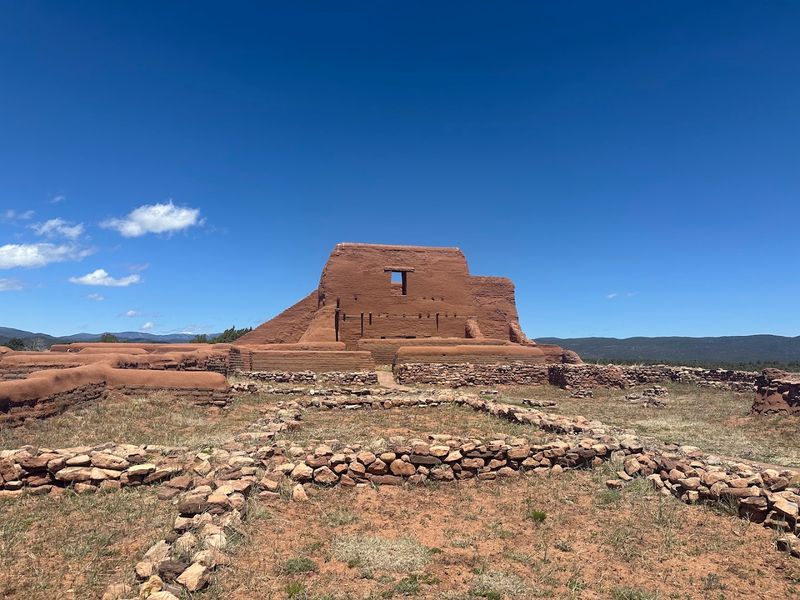
About 25 miles southeast of Santa Fe, a trail winds through the remnants of a world that flourished long before European explorers ever set foot in the Southwest.
Pecos National Historical Park at 1 Peach Drive, Pecos, NM 87552, preserves more than 12,000 years of human history layered across a landscape that shifts from open grassland to forested ridge with quiet drama.
The ruins of Pecos Pueblo once supported a village that rose four to five stories and sheltered around 2,000 people, and even in their weathered state, the adobe walls carry an unmistakable sense of the lives lived within them.
Nearby, the remains of a Spanish Mission Church originally built in 1625 tell a different chapter of the same story, one defined by cultural collision, adaptation, and remarkable resilience.
A 1.25-mile self-guiding trail connects the pueblo and mission sites, and midway through, you can step down into a partially restored kiva, a ceremonial space that offers a rare and quiet moment of connection to ancestral Pueblo traditions.
The park also protects visible wagon ruts from the historic Santa Fe Trail, and standing beside them, it is easy to picture the steady procession of traders and settlers who once passed through this valley.
History layers upon history here, with the Forked Lightning Ranch and the site of the Civil War Battle of Glorieta Pass both falling within the park’s boundaries.
The visitor center screens an orientation film and houses exhibits that help stitch these different eras together into a coherent and deeply human narrative.
On summer weekends, demonstrations of traditional crafts from northern New Mexico bring an additional dimension to the visit, connecting the ancient past to living culture in a way that no exhibit panel alone can fully achieve.
Pecos rewards slow walkers and curious minds, and it lingers with you well past the drive home.
5. Sugarite Canyon State Park, Raton
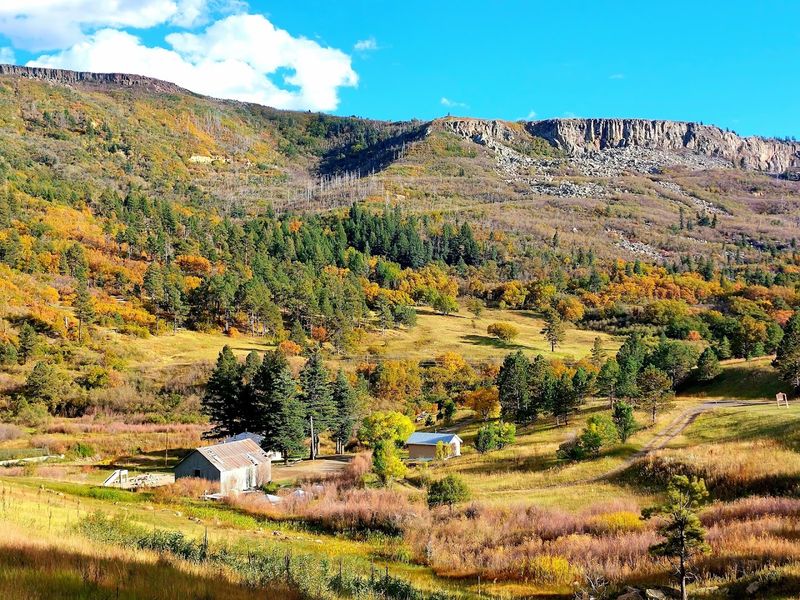
The drive toward Raton already hints at something different, as the terrain shifts and the Rockies begin to assert themselves against the wide prairie sky.
Sugarite Canyon State Park at 211 Highway 526, Raton, NM 87740, occupies a lush pocket of canyon country where forests of oak, spruce, and pine create a canopy that feels worlds away from the open desert just a short distance south.
Two scenic lakes anchor the park’s outdoor offerings, with Lake Alice and Lake Maloya both providing excellent fishing, canoeing, kayaking, and sailing for visitors who want to spend their days on the water.
Lake Alice was originally constructed in the late 1800s to supply water to Raton, while Lake Maloya came later and was subsequently enlarged, and a newer Lake-to-Lake trail now connects them with views dramatic enough to earn a photo stop at nearly every bend.
More than 20 miles of trails make the park a solid destination for hikers and mountain bikers alike, and when winter settles in, those same paths become routes for cross-country skiing, snowshoeing, and sledding.
Wildflowers carpet the meadows during warmer months, and the diversity of birds and butterflies drifting through the forest makes the park a rewarding spot for naturalists of every skill level.
A historic early-twentieth-century coal-mining camp adds an unexpected cultural thread to the visit, with an interpretive trail departing from the visitor center, a building that once functioned as the mining town’s post office.
Fall is arguably the most theatrical season here, when the aspens and oaks ignite in shades of gold and amber against the dark green of the conifers.
Sugarite Canyon is the kind of place that makes you recalibrate your expectations for what a state park can actually deliver, and it does so without any fanfare at all.
6. Fort Union National Monument, Watrous
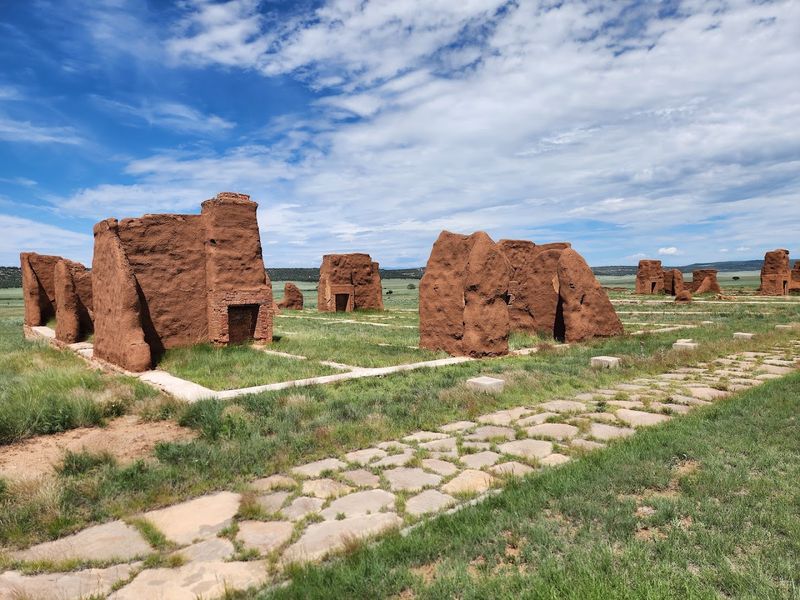
The windswept prairie around Watrous carries a particular kind of silence that makes the crumbling adobe walls of Fort Union National Monument feel even more powerful against the open sky.
Located at 3115 NM Highway 161, Watrous, NM 87753, this site preserves the largest surviving remains of a 19th-century military fort in the entire Southwest, standing in a broad valley that was once one of the busiest corridors in the American West.
Fort Union was established in 1851 and served for four decades as a critical post along the Santa Fe Trail, offering protection to travelers, acting as a supply depot, and functioning as a hub of commerce and migration across a vast and often unpredictable frontier.
Walking among the preserved walls today, you can follow the faint impressions of wagon ruts pressed into the earth by pioneers who passed through long before any of this was a national monument.
The 1.2-mile Fort Ruins Trail guides visitors through the most significant remains, and the scale of what was once here becomes clearer with every step, as the fort complex was genuinely enormous by any era’s standards.
A well-stocked visitor center provides context through exhibits and ranger programs that cover the fort’s military history, its role in trade, and the lives of soldiers and civilians who called it home.
Spring and fall are the most comfortable seasons to visit, since the exposed plains location means summer heat and persistent wind can make a long outdoor walk less enjoyable than it deserves to be.
The sense of standing at a genuine crossroads of American history is palpable here in a way that even the most polished museum exhibit rarely manages to replicate.
Fort Union is a place where the landscape and the story it holds feel perfectly matched, and that combination is hard to forget.
7. Coyote Creek State Park, Guadalupita
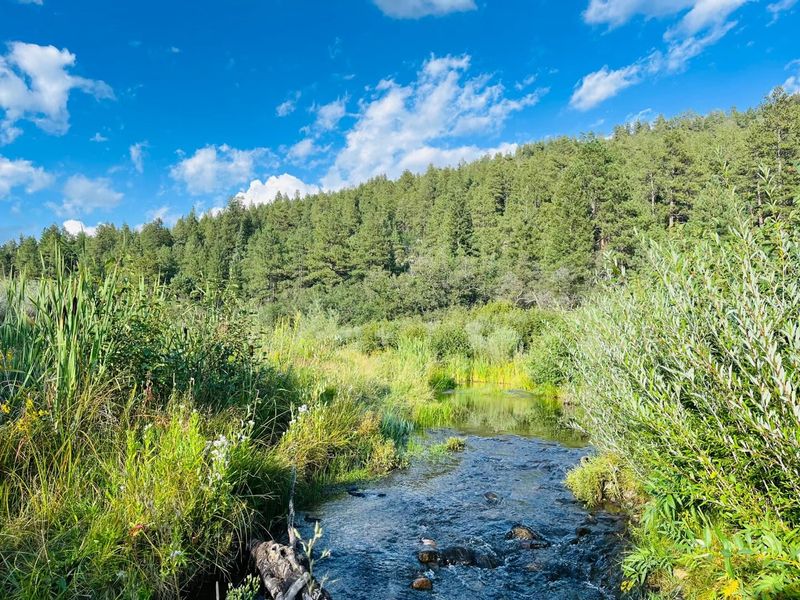
Set within a narrow valley in the Sangre de Cristo Mountains, this park rewards the effort of finding it with a kind of quiet that city life rarely allows.
Coyote Creek State Park sits along Highway 434 at Mile Marker 17, Guadalupita, NM 87722, where the Rio Coyote winds through a dense forest of oak, spruce, and pine in a setting that shifts its personality with every season.
Spring and summer bring wildflowers in abundance, painting the valley floor in colors that contrast beautifully with the cool green of the canopy overhead, while fall transforms the whole scene into a slow-burning display of amber and rust.
Fly fishing is the sport of choice along the creek, and the trout that hold in its clear, cold runs have a way of making even experienced anglers stay longer than planned.
The park currently lists 0.75 mile of hiking trail, giving visitors a short route through this remarkably peaceful mountain setting without requiring a long or difficult outing for the average first-time visitor.
Birding and wildlife viewing are equally rewarding and accessible here, with the forested valley acting as a natural corridor for species that thrive in the cooler mountain environment.
Camping options cover a wide range of preferences, from tent sites and RV hookups to group areas and the newer cabins in the Asseradero Loop, which offer a cozy base for those who prefer a roof over their heads without sacrificing the mountain atmosphere.
The park’s history reaches back to 1837, when a community land grant from the Mexican government first brought settlers to this valley, and the historic acequias that irrigated those early fields still carry water today, with one running directly through the Encino Campground.
Coyote Creek is the perfect final chapter for this road trip, leaving you refreshed, unhurried, and already plotting a return visit.