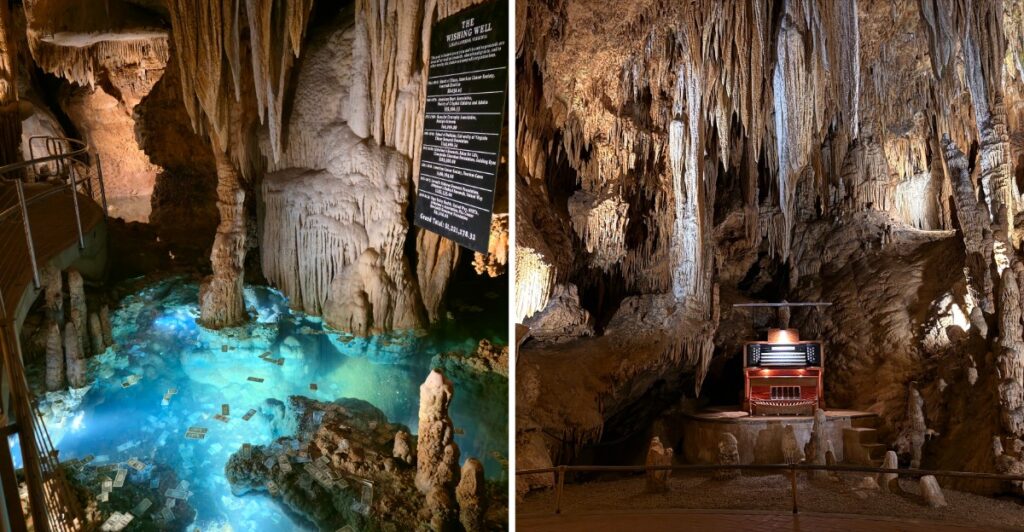
Most caves echo, but this one can play a tune.
Deep below Virginia, carefully chosen stalactites become part of a giant musical instrument, with tiny hammers tapping the rock and sending notes through the cavern.
Yes, the cave is basically helping with the soundtrack.
You can follow the illuminated path past towering formations, thin stone curtains, and pools so still they double the scenery.
But the music is what gives the whole visit its strange little twist.
You do not need to know anything about geology.
Or music, for that matter.
Just listen closely.
How often does the ceiling get to perform?
Stone That Sings In The Dark
Music usually comes from pianos, guitars, or a phone speaker in your pocket. At Luray Caverns, it comes from ancient rock hanging from the ceiling. The Great Stalacpipe Organ creates musical notes by striking natural stalactites inside the cavern.
Each chosen formation produces its own tone, almost like a stone bell. When those notes come together, a melody carries through the underground chambers.
The instrument uses real cave formations rather than recordings of stone sounds. An automated performance plays during the regular cavern experience, so visitors can hear the instrument without booking a separate concert.
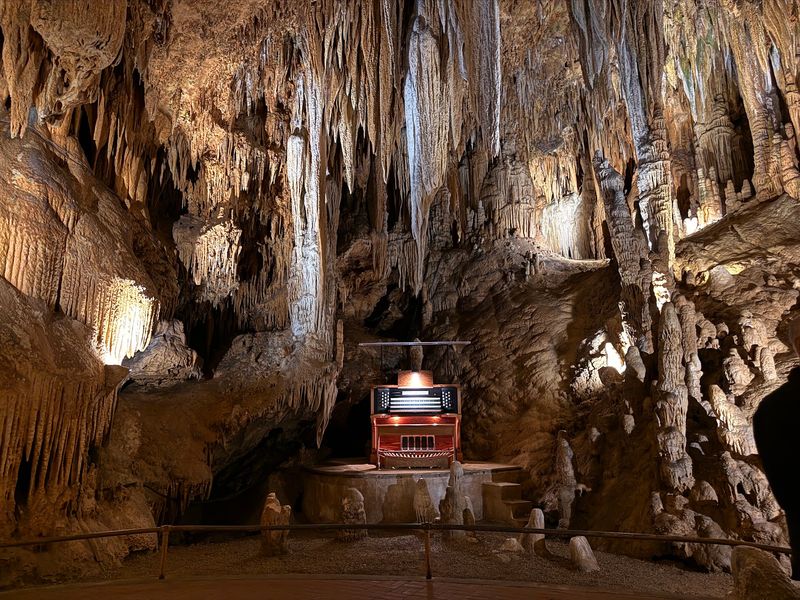
Its console resembles an organ keyboard, but the sounding parts are distributed across the cave instead of being housed in a conventional cabinet.
Can you picture it already? Take a moment to listen rather than rushing immediately toward the next illuminated feature.
The instrument is part of the underground tour, not a hands-on display. Guests cannot play it themselves, and manual console performances are reserved for special approved occasions. Keep your ears open along the route.
At this stop, listening is just as important as looking.
A Summer Day In 1878 Changed Everything
August 13, 1878, began with an unusual clue in a Page County field: cool air rising through a limestone opening. Andrew Campbell, William Campbell, and Benton Stebbins noticed the draft while exploring the area.
After clearing away rocks and debris, Andrew Campbell and his young nephew Quint entered the cavern with candles, beginning the recorded history of its discovery.
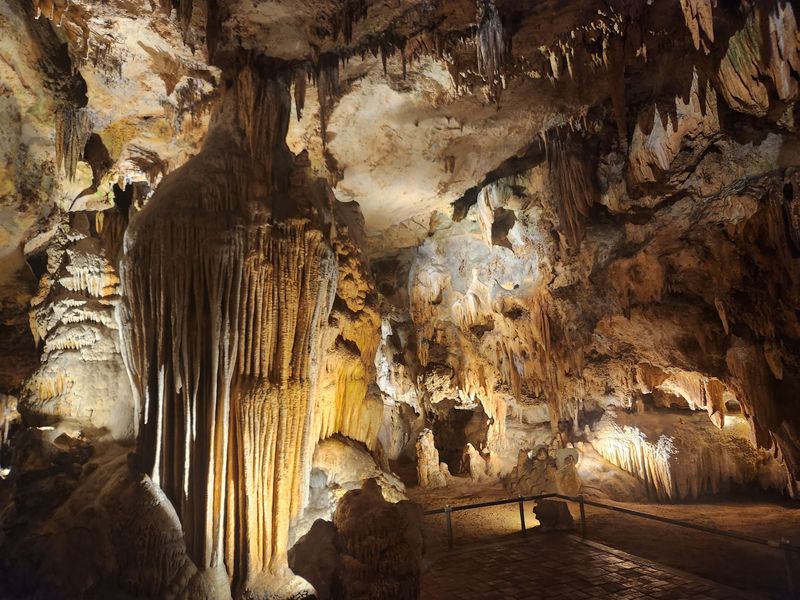
The chambers hidden below contained enormous columns, reflecting pools, and formations shaped by water moving through limestone. A tour passes through spaces that once could be explored only by the light the early visitors carried with them.
Paved walkways replaced earlier wooden paths in the twentieth century, and modern lighting now highlights the rock without requiring visitors to carry lamps. The cavern was designated a National Natural Landmark in 1974.
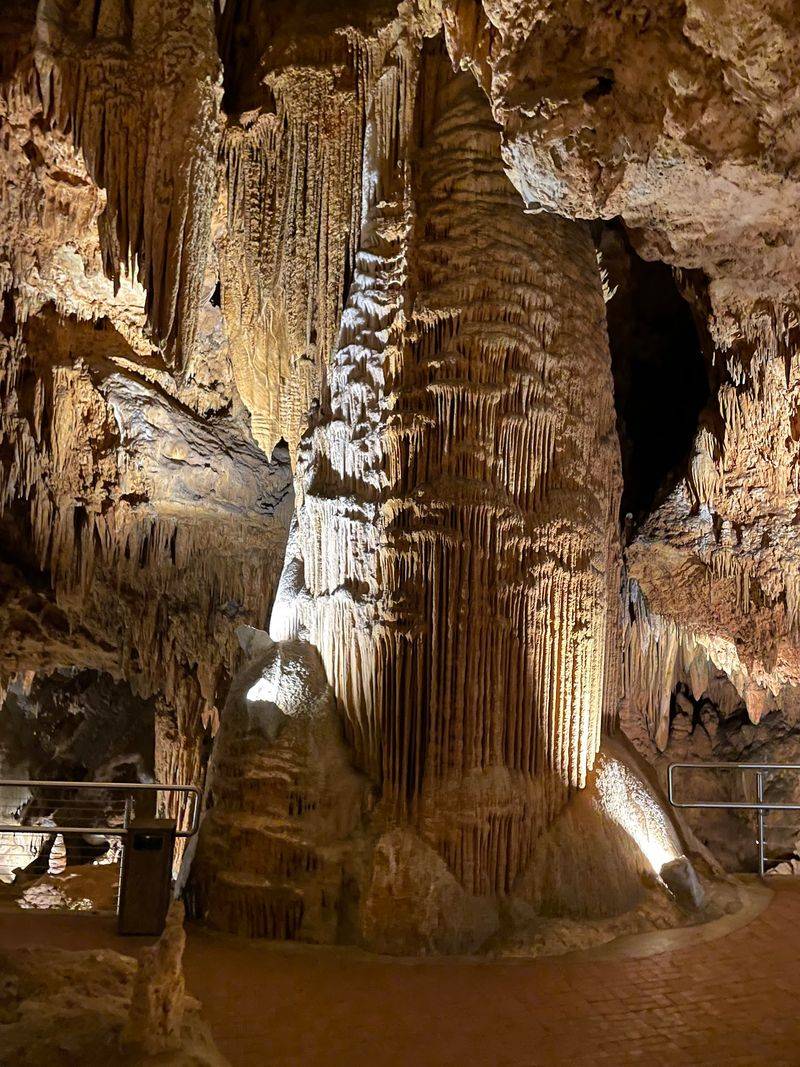
Look closely at the walls as you walk. Stalactites descend from ceilings, stalagmites rise from floors, and some formations meet to create tall columns. Water carrying dissolved minerals deposited the calcite that formed these shapes over long periods.
A new layer may be tiny, but the accumulated structures can tower above the path.
Pause at the larger chambers and look from floor to ceiling before moving on.
The Curious Mind Behind The Organ
Most people tap a rock and hear a dull thunk. Leland W. Sprinkle heard musical possibilities.
A mathematician and electronics scientist working at the Pentagon, he developed the Great Stalacpipe Organ after watching a guide strike a cavern formation with a mallet in 1954.
Sprinkle spent the following years searching for stalactites capable of producing distinct pitches.
He worked with thirteen English tuning forks, testing formations throughout the cave.
Selected stalactites were carefully adjusted to sound specific notes, turning an unusual idea into a working instrument.
The organ was dedicated in 1957. Its console has four manuals, or keyboards, connected to mechanisms placed near the tuned stalactites. Unlike a pipe organ, which moves air through pipes, this instrument produces sound when the rock itself is struck.
Every chosen note required a suitable piece of stone and a mechanism positioned to reach it.
The electrical controls connect to formations that existed long before Sprinkle began his experiments. Listen for the contrast between a short, bright tone and a longer ringing note.
Sprinkle played the instrument manually for years, but today’s regular demonstrations run automatically. You can hear the finished invention without needing to understand the wiring, though its mechanics are interesting enough to deserve a closer look.
Rubber Mallets With A Gentle Touch
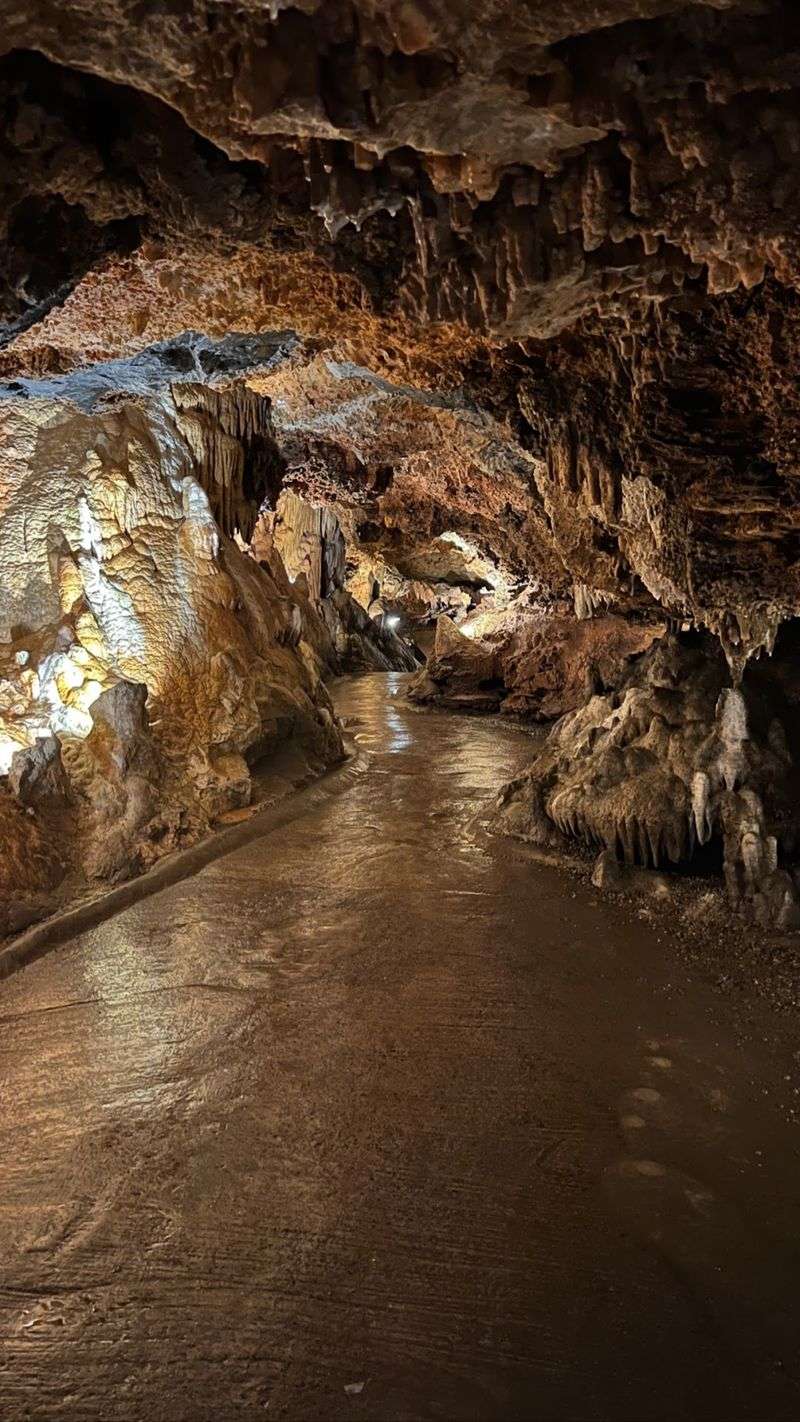
Hitting a delicate cave formation with a hammer sounds like a terrible idea. The organ uses a more controlled approach. An electronic system activates rubber-tipped plungers that strike selected stalactites.
Each contact produces a musical tone, and the system determines when each note sounds.
Wires link the mechanisms to the console, allowing notes to be triggered from a central control point. The instrument can be played from its keyboard, but regular performances use an automated sequence similar in principle to a music box.
The mallets are spread through the cavern and respond electrically. Listen to the beginning and end of a note. Some tones ring briefly, while others seem to linger against the surrounding stone.
Look without touching any of the rock, whether it belongs to the organ or not.
A useful game for younger travelers is to listen for high and low notes during the demonstration. The different pitches make it easier to imagine how individual formations combine into a tune.
Then return your attention to the ceiling and see how difficult it is to distinguish the organ’s sounding stones from the many others overhead.
An Instrument Spread Across Acres Of Rock
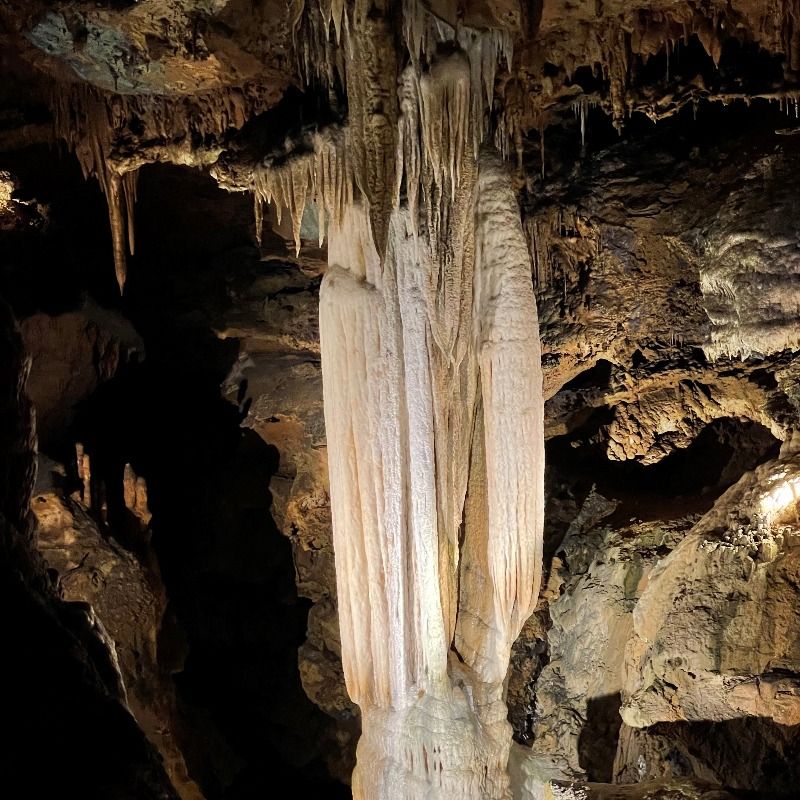
Picture a piano whose sounding parts are distributed across a cavern instead of gathered in one case. That gives a sense of the Great Stalacpipe Organ’s unusual scale.
Sprinkle selected stalactites from an area spanning more than three acres, giving the instrument a reach far beyond the console visible along the tour.
Their positions follow the natural layout of the cave, with electronic connections running to the selected stones. Some notes originate near the organ chamber, while others come from farther away.
Because the sounding parts are separated, the music can seem to arrive from more than one direction. For the listener, there is no need to locate each mallet to enjoy the effect.
Look up at the many stalactites and try to imagine searching for ones that produce suitable musical pitches.
Each candidate had to be tested, and only selected formations became part of the instrument.
The original project involved years of patient work across uneven underground spaces.
It sits within the cavern experience, among the same natural features you see throughout the walk. Stop for the music, then keep an eye out for the other shapes and textures along the route.
As you continue, notice the contrast between the instrument’s electrical controls and the mineral formations surrounding them. One was built in the twentieth century; the other developed naturally over far longer stretches of time.
Cool Air, Brick Paths, And Mirror Pools
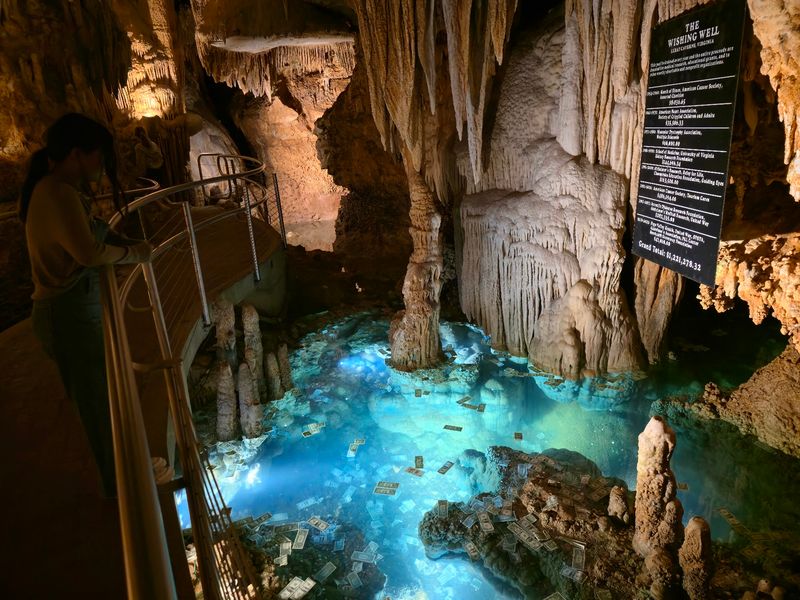
Bring a light jacket, even in July. The caverns remain around 54 degrees Fahrenheit throughout the year, and the high humidity can make the air feel warmer than that number suggests. Comfortable walking shoes are another practical choice for the underground route.
The self-guided tour follows 1.25 miles of paved, illuminated walkways. A step-free entrance permits wheelchair access, although portions of the route have moderate grades and may require assistance. The caverns are not classified as fully accessible for all mobility needs.
Visitors can move through the regular experience at their own pace.
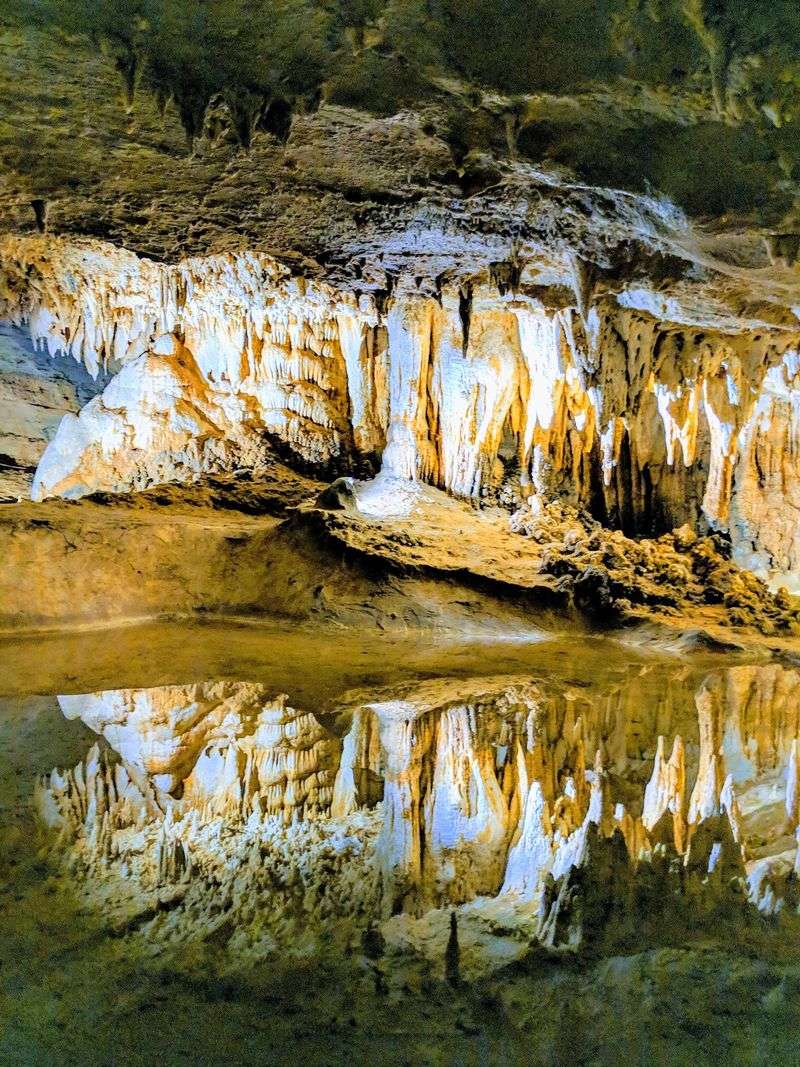
Along the way, you’ll pass towering columns, flowing-looking draperies, and pools that reflect formations above them. Dream Lake creates an especially striking illusion. The water is shallow, but its still surface mirrors the ceiling so clearly that it can appear much deeper.
Look for the Double Column in Giant’s Hall, where stalactite and stalagmite formations meet. It rises 47 feet. Elsewhere, Titania’s Veil offers a pale example of calcite deposits.
Slow down at these features; different viewing angles reveal changes in shape and texture.
A self-guided visit typically takes a little over an hour. Allow longer if you like examining individual formations or taking photographs. Food and drinks are not permitted inside the caverns, so finish refreshments above ground before beginning the walk.
Choose shoes you can walk in comfortably and take advantage of your own pace instead of hurrying from one feature to another.
Planning Your Trip To Hear The Singing Stalactites
Got a free weekend and a curious family? The Shenandoah Valley offers more than the cavern route alone. The attraction is open every day of the year, with seasonal operating hours.
From after Labor Day through October, the regular schedule is 9 a.m. to 6 p.m. Winter hours are shorter, so let the season guide your arrival time.
General admission includes the self-guided cavern tour, the Car & Carriage Caravan Museum, Shenandoah Heritage Village, and Toy Town Junction. The Garden Maze is a separate attraction with its own admission.
The regular cave visit does not require a reservation, and tickets may be purchased on arrival or in advance.
Guided Discovery Tours offer a separate historical experience with different admission arrangements.
Choose the self-guided option for flexible pacing or the guided option for a more structured historical visit.
Plan on two to three hours if you want to explore the included attractions as well as the caverns. Parking is free near the entrance. There are food options above ground, and picnic food may be enjoyed on the grounds rather than inside the cave.
Approaching from U.S. Route 211, follow the signs to Cave Hill Road. The destination for navigation is 101 Cave Hill Road, Luray, VA 22835.
Once you’re there, put the phone away for a moment and let the sound of the stone organ accompany part of your walk.