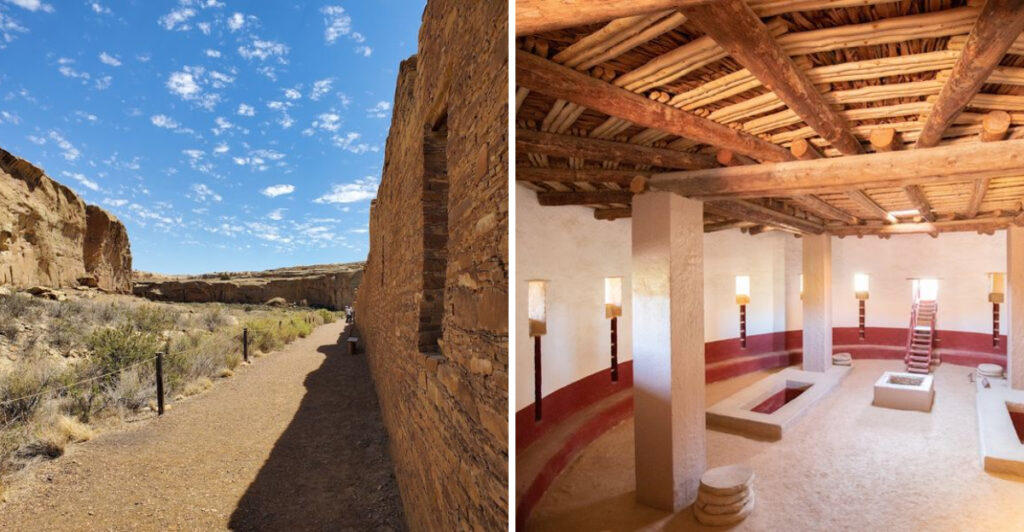
Nearly 900 years separate you from the people who once moved through these rooms, yet the distance seems to shrink with every doorway. The self-guided path takes visitors inside an ancestral Pueblo great house instead of keeping the structure at arm’s length.
Low passages make you duck, while connected chambers pull you deeper. Original wooden beams remain overhead in several areas, giving the ancient architecture a human scale.
This New Mexico monument also includes a reconstructed Great Kiva, helping visitors picture how ceremonial life fit within the community. Nothing here needs dramatic effects.
The survival of the site creates its own sense of wonder, especially when you notice how the rooms connect and how each wall was built. By the end of the trail, those nine centuries no longer feel quite so distant.
For a moment, the people who lived here feel closer than any history book could make them feel.
A Stone Passage Into Another Century
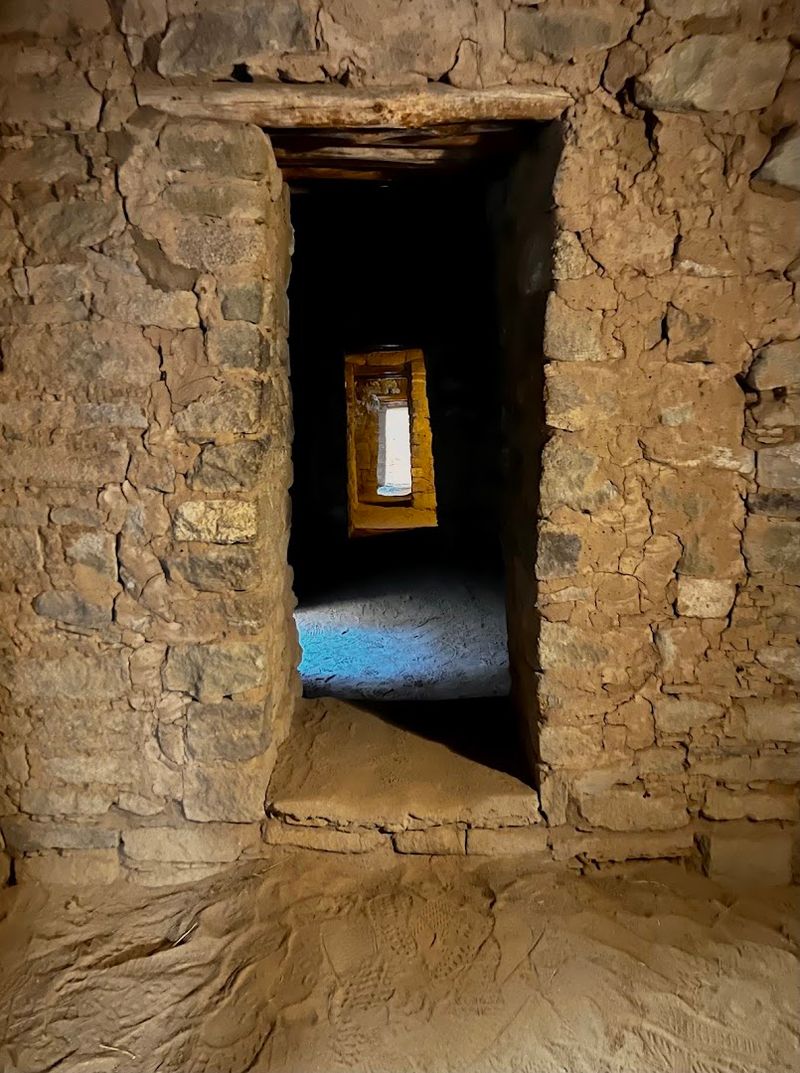
Most people read about ancient civilizations in textbooks, but at this remarkable site in the Southwest, you literally walk through one. The self-guided trail leads you into the ancestral Puebloan great house, where you move from room to room exactly as the original inhabitants once did.
Each narrow passage connects to the next chamber, building a rhythm that feels surprisingly intimate for a structure nearly nine centuries old.
The sandstone walls rise around you in warm shades of gold and brown, textured by the hands of skilled masons who shaped each block with precision. You can feel the cool air shift as you step deeper into the complex, the outside world fading behind you.
It is genuinely hard to believe you are standing inside something so ancient and so intact.
Unlike sites where ropes and barriers keep you at arm’s length, this great house pulls you right into its story. The tactile connection to the past here is rare and deeply affecting.
This extraordinary walk through stone and time begins at Aztec Ruins National Monument at 725 Ruins Rd, Aztec, NM 87410.
Low Doorways Lead Into Ancient Rooms
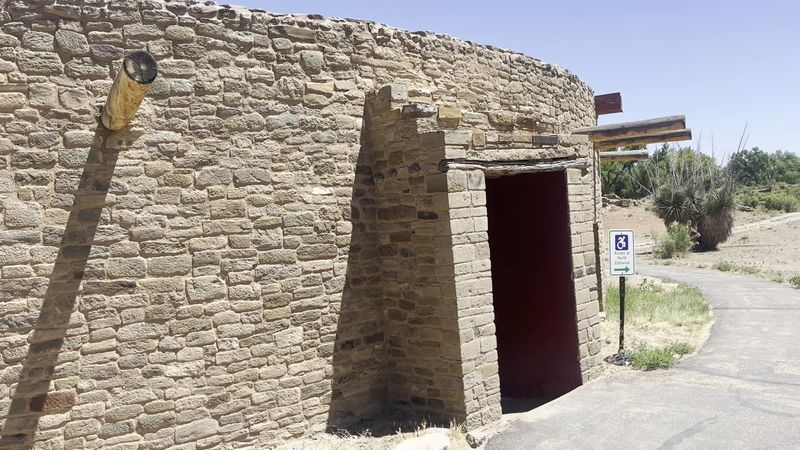
Tall visitors, consider this your friendly heads-up: the doorways here were not designed with modern heights in mind. The ancestral Puebloans built many entrances low and compact, which means you may need to crouch, bend, and occasionally squeeze your way through.
Far from being an inconvenience, this physical adjustment becomes one of the most memorable parts of the whole visit.
Every time you duck through one of these small openings, there is a split second when the age of the structure feels especially real. The exact reasons behind the doorway dimensions are not fully known, so explanations involving warmth or symbolic meaning remain interpretations rather than established facts.
Similar doorway styles appear at Chaco Canyon and other major ancestral Puebloan sites in the region, linking this monument to a broader architectural tradition in the ancient Southwest. Kids may move through these passages more easily, while adults receive a humbling reminder that the spaces were built on a different scale.
Every careful crouch becomes a small, physical connection with the past and a reminder of how differently these rooms were experienced centuries ago by their original residents daily.
Original Timber Ceilings Still Survive
Look up. Seriously, do not forget to look up when you are inside the great house, because what you will see overhead is genuinely astonishing.
Original timber ceiling beams, some dating back to the early 12th century, are still in place above certain rooms. These are not replicas or restorations; they are the actual wooden beams that ancestral Puebloan builders cut, hauled, and installed nearly 900 years ago.
Scientists have used dendrochronology, the study of tree ring patterns, to date these timbers with impressive precision. The wood species used included ponderosa pine, spruce, and aspen, materials that had to be carried from forests many miles away.
That logistical effort alone tells you something powerful about how seriously these builders took their craft.
Standing beneath a ceiling that has outlasted empires, generations, and centuries of New Mexico weather is a quietly staggering experience. The preservation here is exceptional, and the National Park Service works carefully to maintain these fragile organic materials.
Most ancient structures lose their roofs entirely over time, which makes these surviving timbers a true rarity in the world of Southwestern archaeology.
The Great Kiva Feels Almost Otherworldly
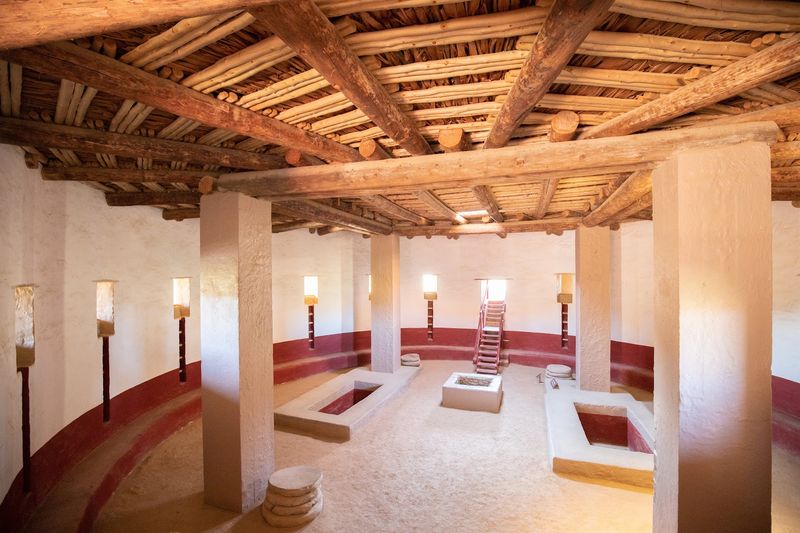
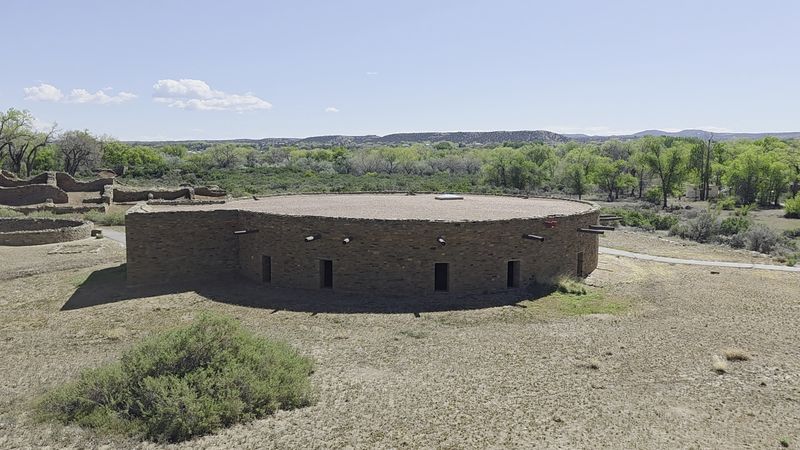
Nothing quite prepares you for stepping inside the Great Kiva. The moment you descend into this vast circular chamber, the noise and brightness of the outside world simply disappear.
The reconstructed structure is the third-largest kiva ever excavated, and its scale creates an atmosphere that feels completely removed from everyday life.
Four enormous stone piers rise from the floor, supporting the reconstructed roof above. The original kiva would have been covered, making it a fully enclosed ceremonial space connected to community gatherings and spiritual practices central to Puebloan life.
Fifteen surface rooms surround the chamber, an unusual feature whose original purpose remains unknown.
Archaeologist Earl Morris excavated the Great Kiva in 1921 and directed its reconstruction in 1934 using evidence documented at the site. The result remains deeply impressive, especially when viewed from the chamber floor, where the reconstructed scale becomes much easier to appreciate.
Standing at the center of this chamber, surrounded by the curved walls and the quiet gravity of the space, you can begin to understand its importance within the larger community. It is the kind of place that stays with you long after you have stepped back out into the sunlight.
T-Shaped Doorways Frame The Past
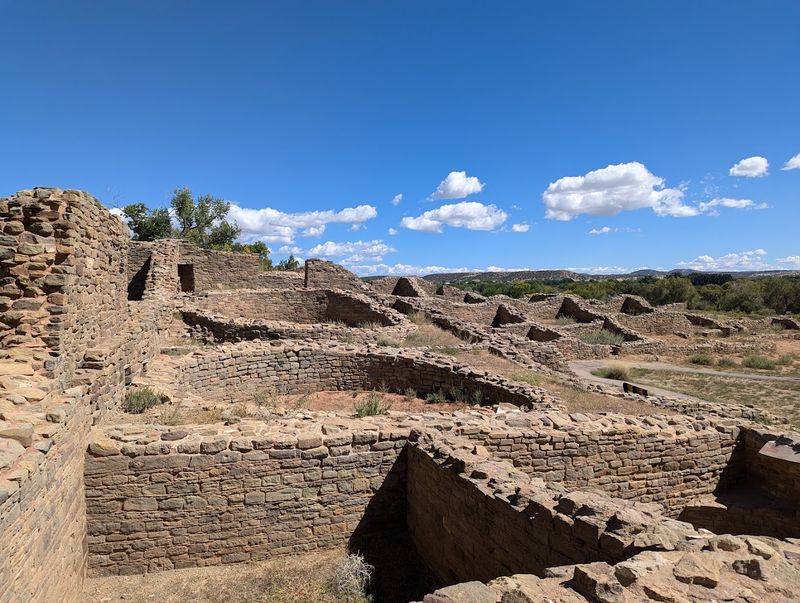
Among all the architectural details worth noticing on your walk through the ruins, the T-shaped doorways deserve a long, thoughtful look. These openings are wider at the top and narrower at the bottom, creating a silhouette that is instantly recognizable as a hallmark of ancestral Puebloan construction.
They appear throughout the great house, often marking transitions between significant spaces.
Archaeologists have debated their function for decades. One practical theory suggests the wider upper section made it easier to carry large bundles or baskets through the opening without tipping them sideways.
Other researchers point to symbolic interpretations connected to Puebloan spiritual beliefs and the layered cosmology that shaped how these communities understood the world around them.
What is clear is that T-shaped doorways appear consistently at major Chacoan-style sites across the region, suggesting a shared architectural language that united distant communities. At this monument, you can step directly through several of these distinctive frames, positioning yourself in the exact spot where people passed daily for generations.
Each one acts as a kind of portal, not just physically connecting rooms, but visually anchoring you to a design tradition that is both ancient and unmistakably deliberate.
Sunlight Brings The Stonework To Life
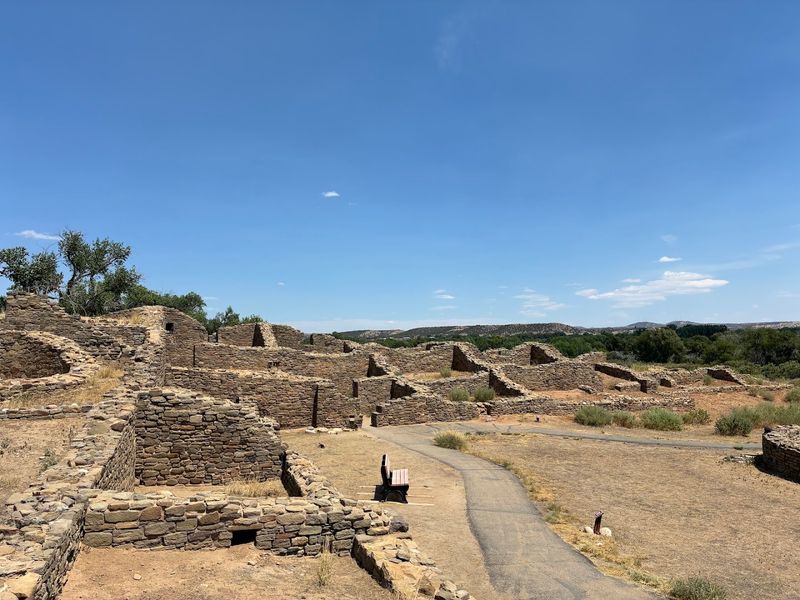
The masonry at this site is not just structurally impressive; it is visually striking in a way that changes completely depending on when you visit. New Mexico sunlight has a particular quality, especially in the morning and late afternoon, that rakes across stone surfaces and pulls out textures less visible at midday.
The walls can seem to glow when the angle is just right.
One of the most striking features is a band of green stone that the ancestral Puebloan builders incorporated into certain wall sections. Under direct sunlight, this greenish stripe creates a vivid contrast against the warm golden sandstone surrounding it.
Its precise visual or symbolic purpose is not firmly established, so claims about deliberate decoration should remain cautious.
The site also contains documented solar relationships. During the summer solstice sunrise and winter solstice sunset, the north wall of the Aztec West great house aligns with the sun near the horizon.
Possible light alignments can also be observed inside the reconstructed Great Kiva, although their cultural meaning has not been conclusively determined. Early morning visits remain especially rewarding for photography and the feeling of having the place nearly to yourself during the quieter morning hours.
A Vast Plaza Opens Beyond The Walls
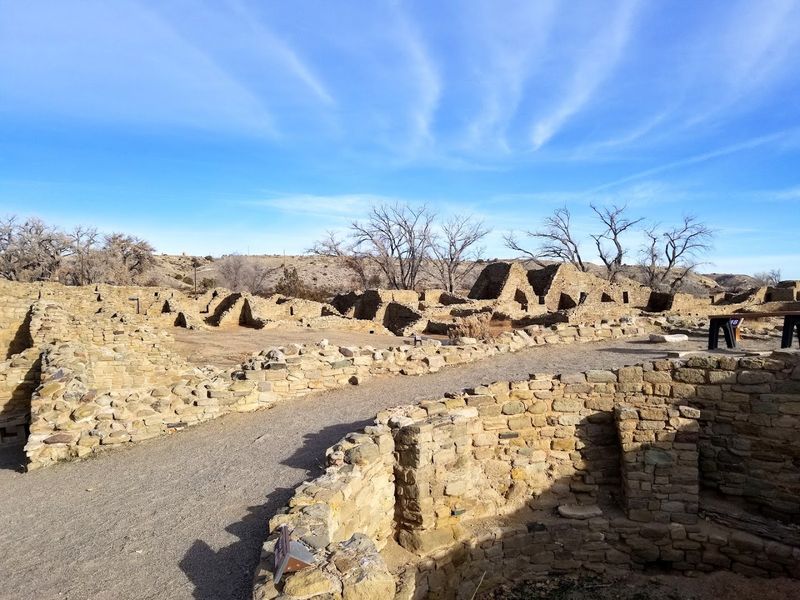
After navigating the close quarters of the interior rooms, stepping out into the central plaza feels like a deep breath. The open space stretches wide, framed on multiple sides by the remaining walls of the great house, giving you a strong sense of the original settlement’s impressive footprint.
At its peak, this community was a major hub of ancestral Puebloan life in the region.
The plaza served as the social and ceremonial center of daily life. Public gatherings, trading activity, and communal celebrations all took place in this open-air space, which was surrounded by multi-story rooms on several sides.
Smaller kivas were also embedded within the complex, offering more intimate ceremonial spaces alongside the grand scale of the Great Kiva.
Standing in the plaza and looking back at the surviving walls, you get a powerful visual sense of how organized and deliberate the settlement’s layout was. This was not a collection of random structures; it was a planned community built with clear social and ceremonial logic.
The wide New Mexico sky above the plaza adds to the feeling of openness, making the whole scene feel both ancient and remarkably alive.
History Feels Close Enough To Touch
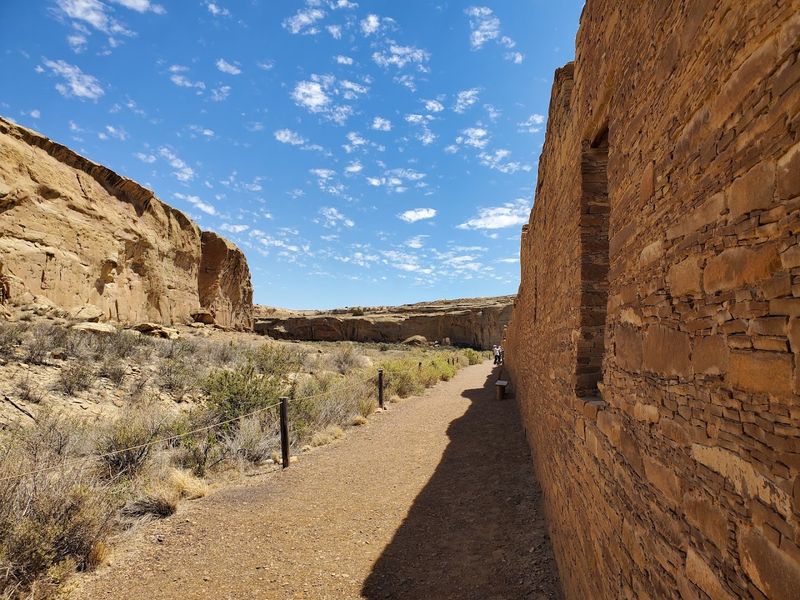
Few archaeological sites in the country allow visitors to move through ancient rooms as closely as this one does. At many monuments, barriers and distance are the norm, but here the marked trail passes beside original masonry walls that ancestral Puebloan builders laid stone by stone nearly nine centuries ago.
Visitors should avoid touching or leaning against these fragile surfaces.
That proximity transforms the experience from observation into something more immediate. You are not just looking at history; you are sharing space with it.
The low passages require your body to adapt to the route. Original timber ceilings remain overhead in several rooms.
The Great Kiva wraps its curved walls around you like a story told in stone and wood.
The self-guided trail, the National Park Service audio tour, and the visitor center museum all work together to give context to what you are feeling and seeing. Admission is free, and the archaeological site normally opens at 7 AM on regular operating days, making an early morning visit especially peaceful.
Every detail at this site adds up to something rare: history that remains remarkably accessible while being carefully protected for future generations as well.