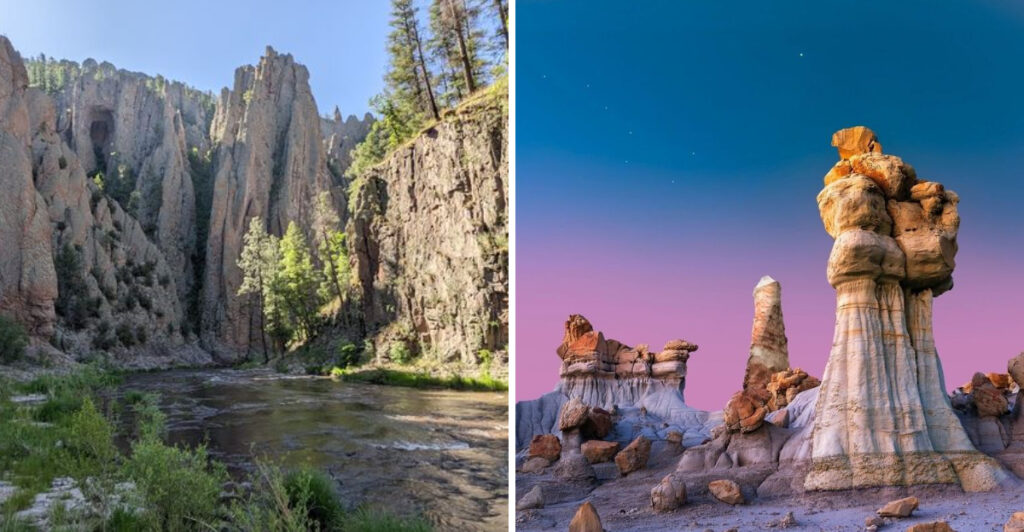
There is a point on every memorable road trip when the scenery takes over and conversation simply stops. This list is filled with places that create that moment.
Across New Mexico, strange badlands rise from open desert, ancient walls hold stories in stone, and black lava stretches toward the horizon. Giant radio dishes turn slowly beneath a huge sky.
River canyons invite you to stay longer than planned. Wildlife refuges fill with movement during migration, while mountain roads lead toward quieter country.
Some stops are easy to reach, but others sit beyond miles of dirt or gravel. Pack carefully and check current conditions before heading out.
The extra effort is worth it because these destinations feel removed from the usual road-trip routine. They ask you to pay attention.
Once you do, a short detour can become the part of the journey you keep talking about long after you get home.
1. Bisti/De-Na-Zin Wilderness
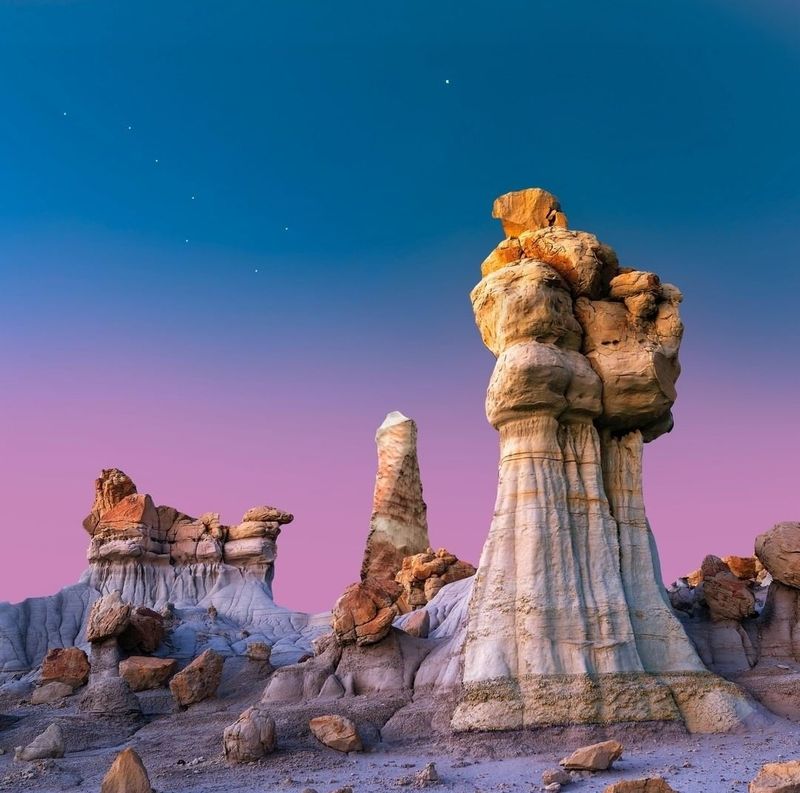
My jaw dropped the moment I crested the first ridge at Bisti/De-Na-Zin Wilderness, located off Farmington County Road 7297, Farmington, NM 87499, in San Juan County.
The landscape looks like nothing else on this planet, a sprawling expanse of eroded badlands filled with towering hoodoos, twisted spires, and natural arches sculpted from ancient shale and sandstone.
Millions of years ago, this ground was a coastal swamp teeming with prehistoric life, and if you look closely, you might spot petrified wood or fossilized plant matter embedded in the layers of exposed rock.
There are no marked trails here, which means the exploration is entirely on your terms, and that freedom is both thrilling and humbling.
A GPS device and plenty of water are absolute necessities, not suggestions, because the terrain shifts constantly and distances can be deceiving.
Primitive camping is permitted, and spending a night under the vast, star-filled sky above the badlands is an experience that quietly rewires how you think about solitude.
Pack your boots, leave your schedule behind, and let this strange and beautiful corner of the desert do the rest.
2. Chaco Culture National Historical Park
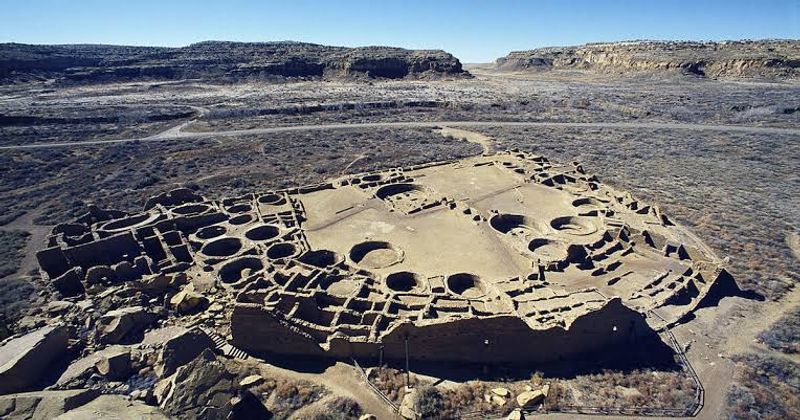
A thousand years of history press against you the moment you walk among the massive stone walls at Chaco Culture National Historical Park, located at 1808 County Road 7950, Nageezi, NM 87037.
This UNESCO World Heritage Site sits inside a high desert canyon in northwestern New Mexico, preserving the most ambitious architecture the ancestral Puebloan people ever built.
The great houses here, some rising multiple stories and containing hundreds of rooms, were aligned with the sun and stars in ways that still astonish researchers today.
Chaco once functioned as a major ceremonial, political, and economic hub, connected to surrounding communities by an engineered road network that stretched across the region.
After dark, the park earns its International Dark Sky Park certification in the most spectacular way possible, with ranger-led stargazing programs at the on-site observatory.
Getting here requires driving several miles of unpaved road, which keeps the crowds thin and the atmosphere appropriately reverent.
Plan to arrive with a full tank, a curious mind, and enough time to sit quietly among the ruins and actually absorb what you are looking at.
3. Villanueva State Park
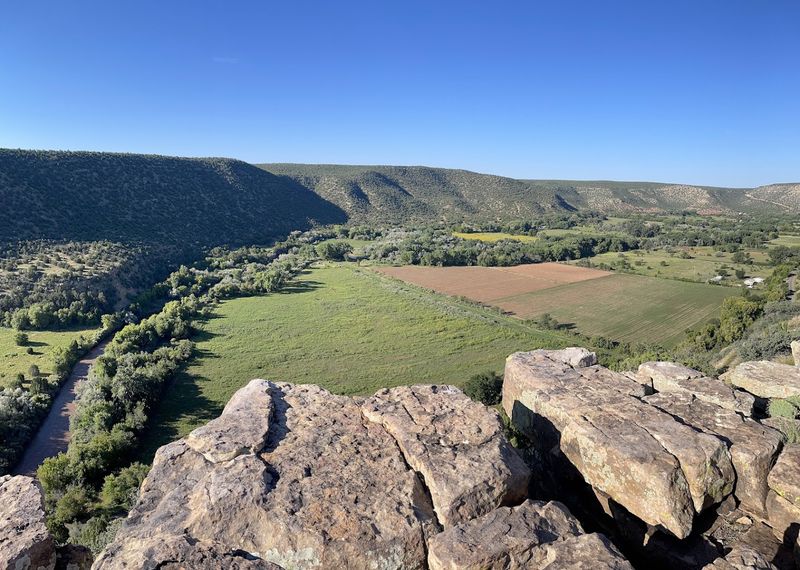
Villanueva State Park sits within a quiet canyon in Guadalupe County at 135 Dodge Road, Villanueva, NM 87583. Its beauty sneaks up on you slowly and then refuses to let go.
Dramatic yellow and red sandstone bluffs rise sharply above the Pecos River, framing a landscape that feels like a postcard someone forgot to mail.
The river runs gently enough through this stretch that tubing is one of the most popular warm-weather activities, and the laughter of people floating downstream echoes off the canyon walls in the best possible way.
Anglers rotate their target species with the seasons, chasing catfish in summer and switching to trout once cooler temperatures arrive.
Three hiking trails wind through the park, and the Canyon Rim trail is the standout, delivering sweeping views, crumbling Spanish colonial ruins, and an ancient grain threshing pit that stops most hikers in their tracks.
Shaded campsites under massive cottonwood trees make the park an inviting base for multi-day visits, and the birdwatching along the riverbanks is quietly excellent.
Villanueva rewards the unhurried visitor, the kind who is happy to sit beside moving water and call that a full afternoon.
4. Gila Wilderness
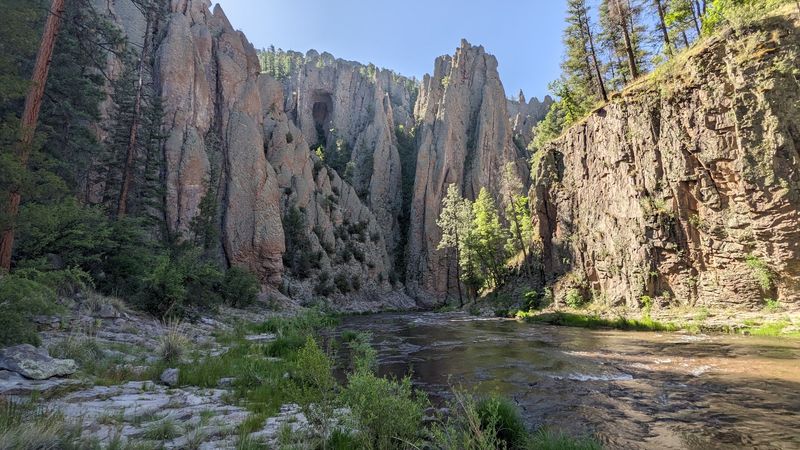
The Gila Wilderness near Silver City, NM 88061, accessed via NM-15, holds a title that still impresses over a century later, it was the first designated wilderness area in the world.
Established in 1924, this vast sanctuary of mountains, pine forests, and deep river canyons in southwestern New Mexico offers a level of raw solitude that is increasingly hard to find anywhere.
Hikers will encounter countless unmarked routes that wind along creek beds and climb through old-growth forest, each one testing your navigation instincts in a satisfying way.
The Gila Cliff Dwellings National Monument sits within the wilderness, preserving a series of Mogollon cave dwellings that feel almost impossibly well-hidden inside natural alcoves in the canyon walls.
Hot springs scattered across the backcountry provide a genuinely earned reward after a long day on the trail, and soaking in one while surrounded by forest is hard to top.
Elk, deer, black bears, and an impressive variety of bird species share this landscape, making every hike feel like a wildlife encounter waiting to happen.
The Gila does not hand its best moments over easily, but the effort you put in comes back multiplied in every direction you look.
5. Valley Of Fires Recreation Area
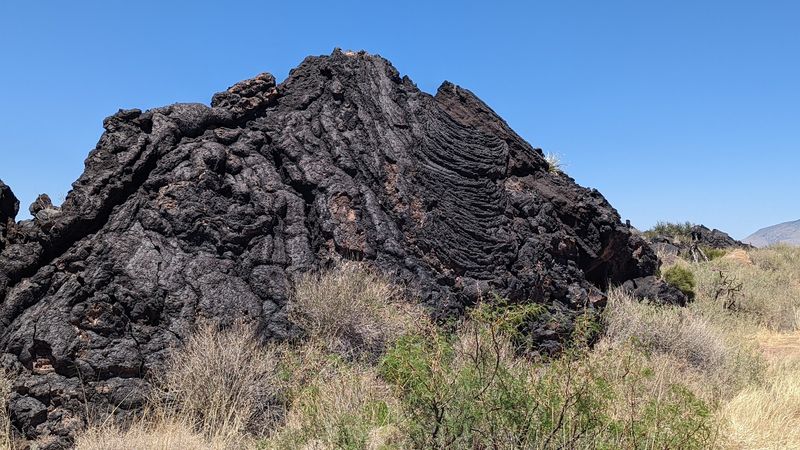
At first glance, the Valley of Fires Recreation Area at 6158 US-380, Carrizozo, NM 88301, looks like the earth simply ran out of patience and let loose.
A massive volcanic eruption left behind a frozen river of black basalt that stretches across 125 square miles and runs for 44 miles through the high desert landscape near Carrizozo.
This lava flow is among the youngest lava flows in the continental United States, and walking across it on the paved interpretive trail feels like stepping onto a different world without leaving New Mexico.
The trail passes pressure ridges, collapsed lava tubes, and formations that look like they were twisted and folded by some enormous invisible hand.
Despite the harsh appearance, life has found its footing here, with hardy plants pushing through cracks in the rock and small animals making their homes in the uneven terrain.
Sunrise and sunset are the golden hours for photography, when the dark basalt absorbs the warm light and the contrast against the surrounding desert becomes genuinely cinematic.
Camping and picnic facilities are available on-site, and the deep quiet that settles over the lava field after dark is the kind that makes you stop talking mid-sentence just to listen.
6. Caballo Lake State Park
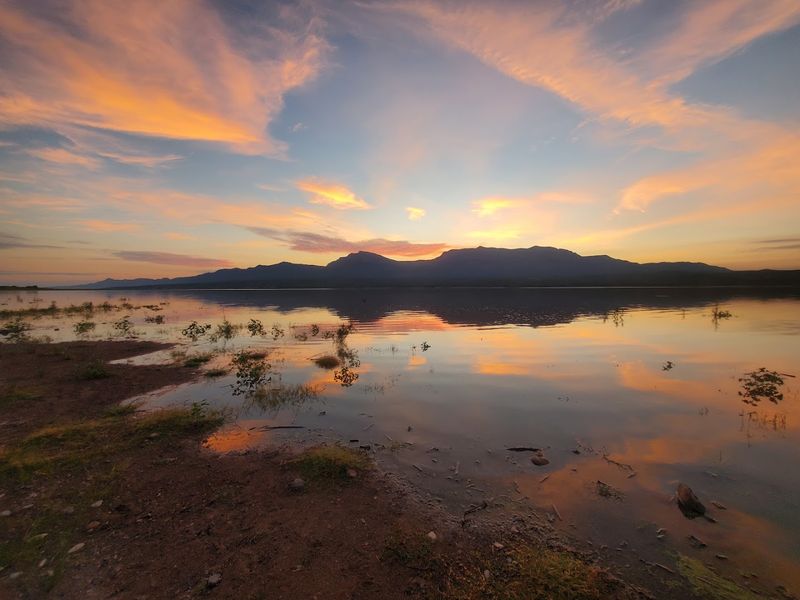
Caballo Lake State Park at 10 Palomino Road, Caballo, NM 87931, is the kind of place that makes you forget you are in the middle of a desert until you look up and see the mountains ringing the horizon.
The lake itself is fed by the Rio Grande and sits against the striking backdrop of the Caballo Mountains in southern New Mexico, creating a visual contrast that makes every morning on the water feel cinematic.
Boating, kayaking, canoeing, sailing, and swimming all thrive here, and the multiple boat ramps and docks make it easy to get out on the water without a fuss.
Fishing is a serious pursuit at Caballo, with anglers targeting a solid variety of species in waters that see far less pressure than more famous lakes.
Birdwatchers will find the riparian areas around the lake quietly productive, especially during migration seasons when the water draws in species from well beyond the desert.
With over 170 developed campsites, many with hookups for RVs, plus primitive lakeshore options for those who prefer their nights a little rougher, the park accommodates almost every travel style.
Caballo Lake is the kind of spot that fills your cooler, empties your to-do list, and sends you home sun-tired in the best possible way.
7. Monastery Of Christ In The Desert
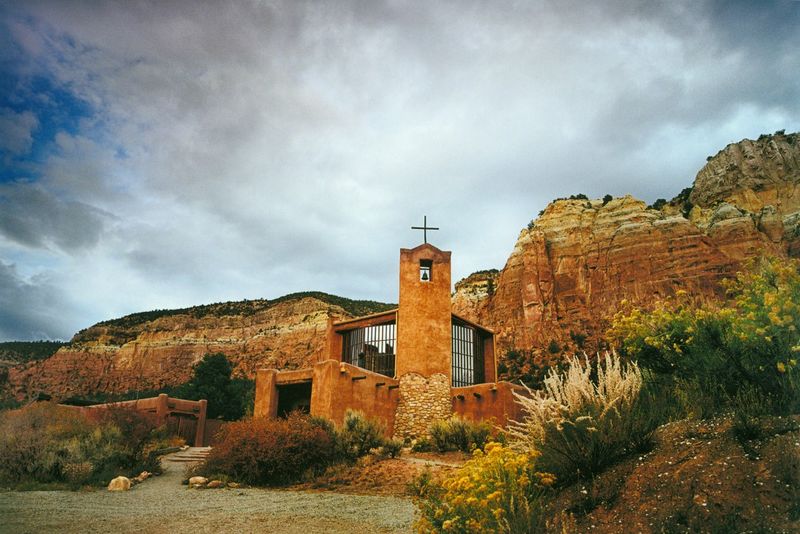
Few places I have ever visited demand quiet the way the Monastery of Christ in the Desert does. It stands at 1305 Forest Service Road 151, Abiquiu, NM 87510, deep inside a canyon that the modern world seems to have simply missed.
The 13-mile unpaved road leading to the monastery is part of the experience, slowing you down mile by mile until you arrive at an adobe complex that fits so naturally against its canyon walls it looks grown rather than built.
Benedictine monks have called this place home since 1964, living by a rhythm of daily prayer and work that has changed very little over the decades.
Visitors are welcome to attend the prayer services, which feature Gregorian chant echoing through the chapel, and the effect is one of the most unexpectedly moving things you can encounter on a road trip.
The surrounding Carson National Forest provides hiking and birdwatching opportunities for those who need to move their legs between moments of reflection.
The Chama River runs nearby, adding the sound of moving water to the canyon’s natural soundtrack of wind and birdsong.
If you are searching for a place that genuinely disconnects you from the noise of daily life, this monastery earns that description without needing to advertise it.
8. Very Large Array
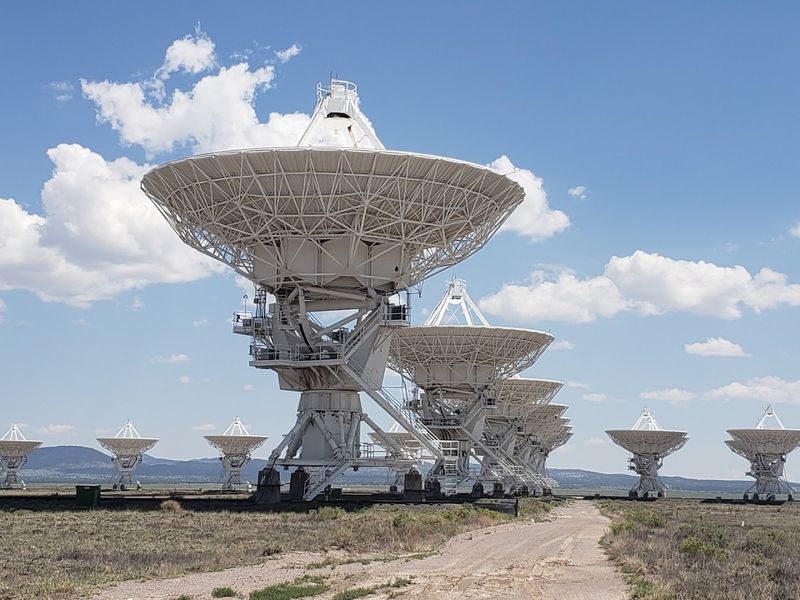
Nothing prepares you for the moment the Very Large Array comes into view across the Plains of San Agustin near Magdalena, NM 87825, off Old Highway 60.
Twenty-seven enormous white radio telescope dishes, each measuring 25 meters across, are arranged in a Y-shape that stretches across the high desert floor in a configuration that looks less like science and more like art.
Together, these dishes function as a single massive telescope, scanning the universe for radio waves that reveal things optical telescopes simply cannot see, including the behavior of black holes, quasars, and the structure of our own galaxy.
The facility was dedicated in 1980 and has since contributed to nearly every major branch of astronomy, earning a cameo in the film Contact that introduced it to a much wider audience.
The remote location is intentional, chosen specifically to keep human-generated radio interference from drowning out the faint cosmic signals the array is designed to detect.
Visitors can walk a self-guided trail among the dishes, read about the science being conducted overhead, and occasionally watch the massive structures pivot along their railway tracks as configurations shift.
The Very Large Array is proof that the most extraordinary things on Earth are sometimes pointed at everything but Earth.
9. Bitter Lake National Wildlife Refuge
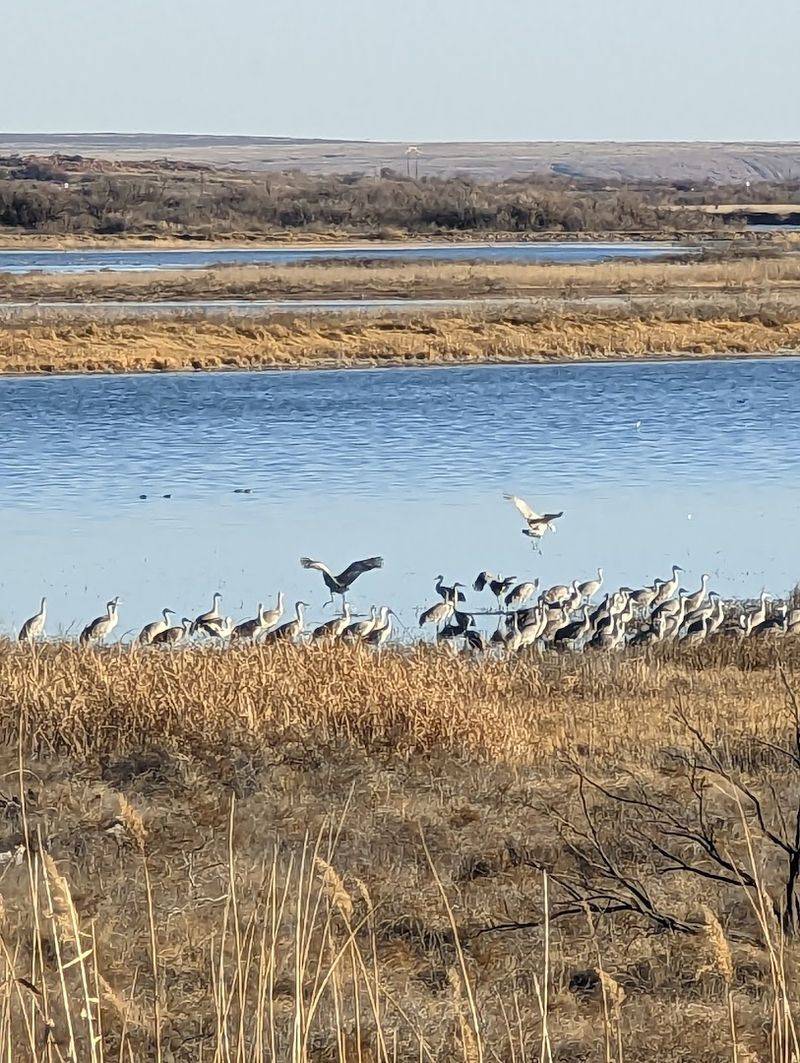
Most people associate Roswell with something a little more extraterrestrial. Bitter Lake National Wildlife Refuge at 4200 E Pine Lodge Road, Roswell, NM 88201, is the real otherworldly surprise just northeast of town.
Established in 1937, this 24,563-acre refuge sits at the crossroads of the Chihuahuan Desert, shortgrass prairie, and Pecos River wetlands, creating a mosaic of habitats that supports a staggering variety of life.
The refuge holds one of North America’s most diverse dragonfly and damselfly populations, with over 100 documented species zipping through the air above the shallow lakes and marshes.
A 6.5-mile Wildlife Drive allows visitors to cover the refuge by car or bicycle, while dedicated trails like the Dragonfly Overlook and Butterfly Trail put you on foot in the middle of the action.
Fall migration is the headline season here, when sandhill cranes arrive in enormous numbers and turn the sky above the wetlands into something you genuinely need to witness to believe.
Waterfowl, wading birds, and shorebirds cycle through the refuge throughout the year, giving birdwatchers a reason to return in every season.
Bitter Lake proves that the most rewarding wildlife experiences often hide in the places you would least expect to find them.
10. Red River
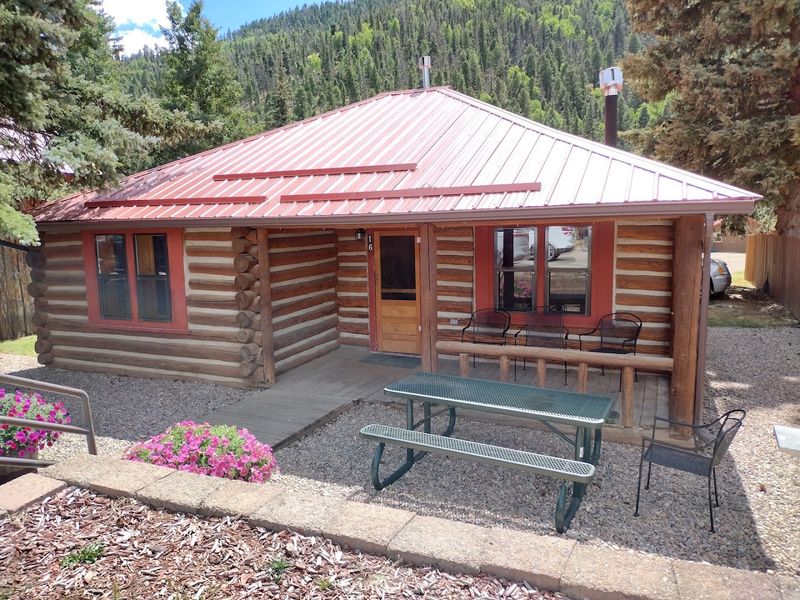
Red River is the rare mountain town that manages to feel festive and genuinely wild at the same time, thanks to its position deep inside the Sangre de Cristo Mountains.
Sitting at a lofty elevation with the Red River running straight through its center, this former mining settlement has traded ore carts for outdoor adventure without losing any of its frontier character.
Winter brings skiers and snowboarders to the Red River Ski and Summer Area, a mountain known for slopes that welcome beginners warmly while still offering enough vertical to keep experienced riders happy.
The torchlight parades that take place on the ski mountain after dark are a local tradition that manages to be both cheesy and completely unforgettable, which is exactly the right combination.
When the snow retreats, the surrounding mountains open up for hikers, mountain bikers, and horseback riders, with trails that follow streams through aspen groves and climb to ridgelines with views that stretch for miles.
Fly fishing in the Red River and nearby lakes draws serious anglers chasing trout in water that runs cold and clear year-round.
Red River is the kind of town that makes you check the calendar twice to see how many more days you can afford to stay.