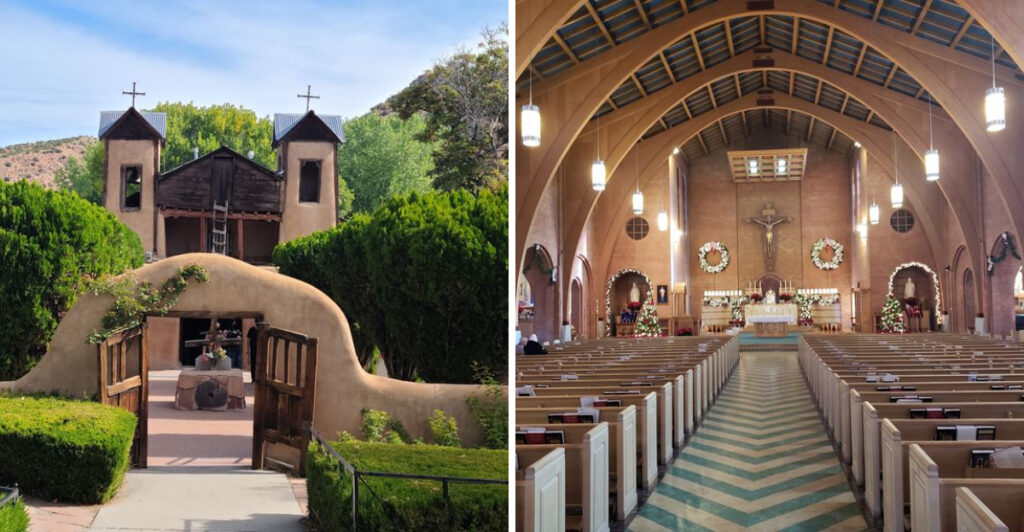
You could plan a road trip around scenery alone, but these stops give the drive something more to hold onto. New Mexico is filled with churches and shrines where history is written into the walls and windows, while bells still carry through the air.
Some buildings command attention immediately. Others make you slow down before the details start to register.
That shift in pace is part of the appeal. One stop may lead you beneath unfinished cathedral towers, while another brings you to an adobe sanctuary tied to a pilgrimage tradition that still draws people today.
These places are historic, but they are not relics sealed behind ropes. Most remain active centers of worship and community life.
Treat the route less like a race and more like a series of meaningful pauses. Give each place enough time, and the architecture becomes only the beginning of what makes the journey memorable.
1. Cathedral Basilica Of St. Francis Of Assisi, Santa Fe
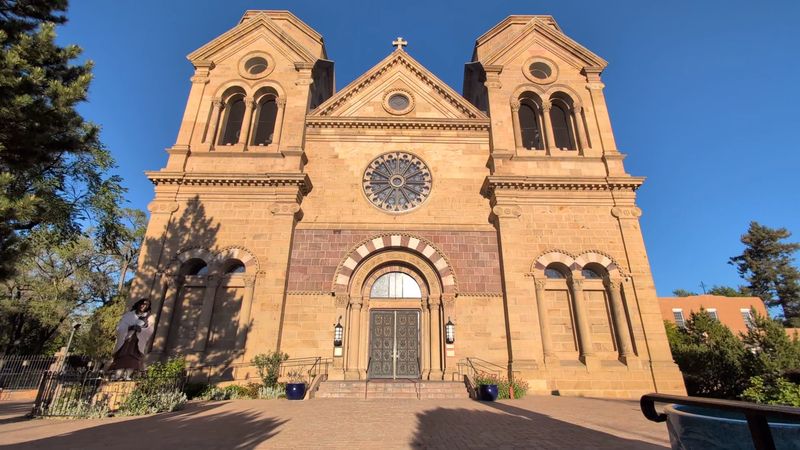
Those two stubby towers tell the whole story. Original plans called for soaring spires, but the money ran out, and the truncated towers became the most recognizable feature of this golden limestone landmark at 131 Cathedral Pl in Santa Fe, New Mexico 87501.
Archbishop Jean-Baptiste Lamy brought European craftsmen west to build it, and the yellow limestone blocks came from local quarries. Round arches, Corinthian columns, and a rose window give the facade a Neo-Romanesque look that stands out in a city famous for adobe.
Pope Benedict XVI raised it to basilica status.
Churches have occupied this ground since the 1600s, and the earliest one was destroyed during the Pueblo Revolt. The La Conquistadora Chapel is the oldest surviving portion of the building, and it holds a small wooden statue of the Virgin Mary carried up from Mexico centuries ago, also called Our Lady of Peace.
Statues of Saint Francis and Saint Kateri Tekakwitha stand near the entrance, a pairing that reflects both European and Native American devotion. Inside, stained glass and a grand altar reward anyone willing to sit still for a while.
Parking downtown fills quickly, so arriving early makes the visit far calmer. Few buildings anchor a city quite this firmly.
2. Basilica Of San Albino, Mesilla
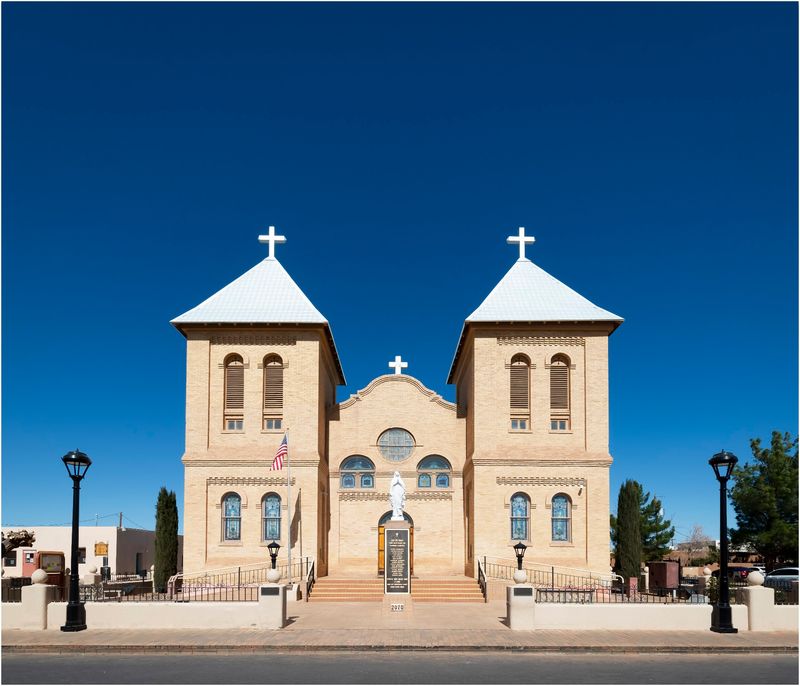
Ordered into existence by the Mexican government, this church began as a modest structure of mud and logs on Mesilla’s historic plaza. The address today is 2070 Calle De Santiago, Mesilla, New Mexico 88046, and the building looks nothing like that first humble chapel.
The fired-brick church standing now went up in the early 1900s in a French Gothic style, a nod to the strong French clerical influence in the area after the Gadsden Purchase brought Mesilla into the United States. Belfry facades mark each corner, and leaded stained glass windows show a lineup of saints.
Renovations in the 1960s stripped away the plaster inside and out, exposing the brickwork underneath. The blend of European design and southwestern setting is one of my favorite architectural surprises in the state.
Several bells here date to the 1870s, and the largest, called Campana Grande, still sends its voice across the Mesilla Valley. Daily Masses happen in both Spanish and English.
Basilica status arrived in 2008. The plaza outside brims with shops and food, so a visit pairs easily with a slow afternoon of wandering.
Bell ringing over an old plaza never gets old.
3. Cathedral Of The Immaculate Heart Of Mary, Las Cruces
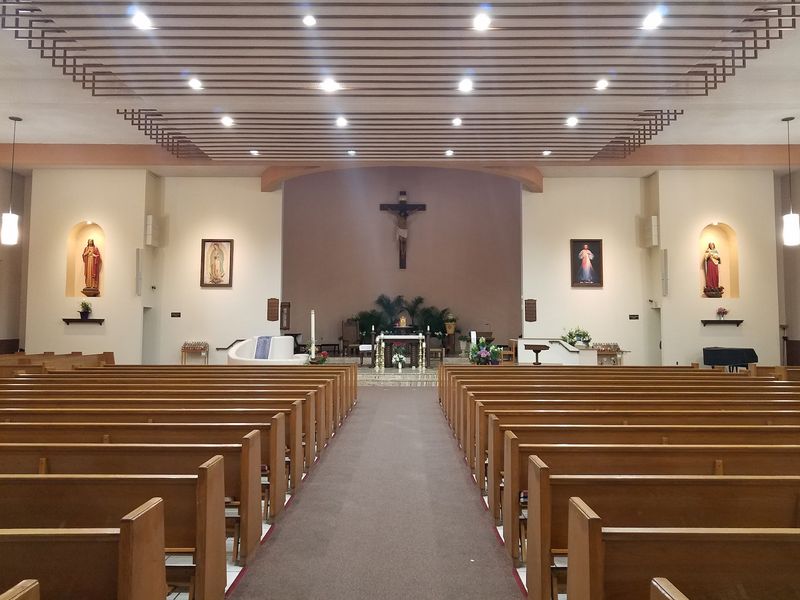
Fans of mid-century modern design get a treat here. Clean lines, bold geometry, and a stripped-down profile set this cathedral apart from the adobe and Gothic churches scattered across the region.
You will find it at 1240 S Espina St in Las Cruces, New Mexico 88001, where it serves as both the cathedral church and episcopal seat for the Roman Catholic Diocese of Las Cruces today. Consecration took place in the 1960s, and the diocese itself came along later.
What makes the space work is how the simplicity keeps attention on the altar rather than the ornament. Worship happens in English and Spanish, reflecting the mix of families who fill the pews on weekends.
Parish life here stretches well past Sunday services. Sacraments, community programs, and gatherings keep the doors busy throughout the week, which gives visitors a real sense of a working cathedral instead of a museum piece.
Travelers passing through southern New Mexico often skip modern churches in favor of older ones, and that feels like a missed opportunity. Quiet weekday hours are the easiest time to walk in and look around without interrupting anything.
Sometimes plain walls hold the loudest sense of calm.
4. Sacred Heart Cathedral, Gallup
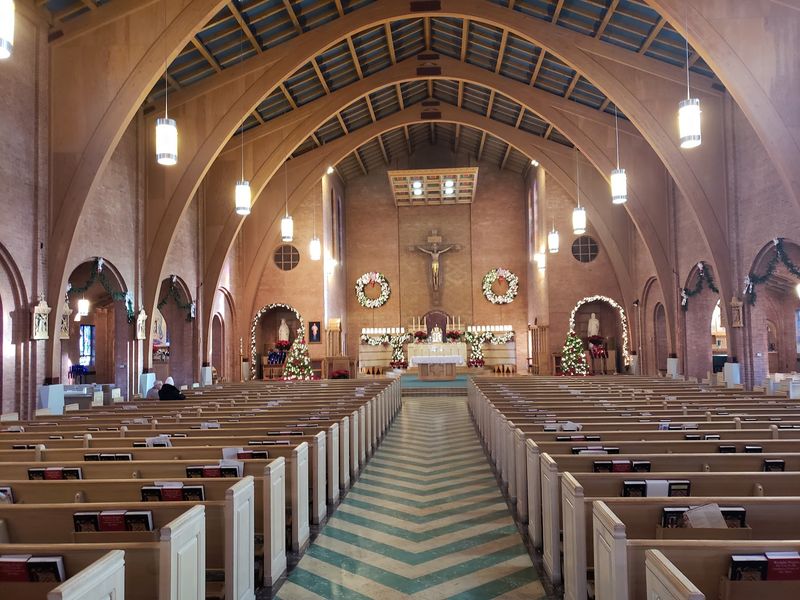
Coal mining brought the first congregation together. Immigrant workers drawn to the mines around Gallup needed a parish, and the original Sacred Heart church answered that call in the late 1800s.
The cathedral now standing at 415 E Green Ave, Gallup, New Mexico 87301, dates from the 1950s and lifts a slender Gothic spire above the streets. An earlier structure collapsed, a replacement followed, and the parish eventually rose to cathedral rank when the Diocese of Gallup was created.
Tall arches shape the interior, but the stained glass steals the show. Windows depict Native American, Asian, white, and Black faces together, illustrating the idea of one fold and one Shepherd, while others honor Saint Therese, patroness of missions.
Services run in Spanish, Polish, Korean, and Tagalog, which says plenty about who calls this parish home. I find that language list more impressive than any architectural detail.
Gallup sits along historic Route 66 in northwestern New Mexico, making the cathedral an easy stop between trading posts and red rock scenery. Morning light through those windows spreads color across the floor in the best possible way.
Craftsmanship here rewards visitors who slow down and look up.
5. Shrine Of The Little Flower, Albuquerque
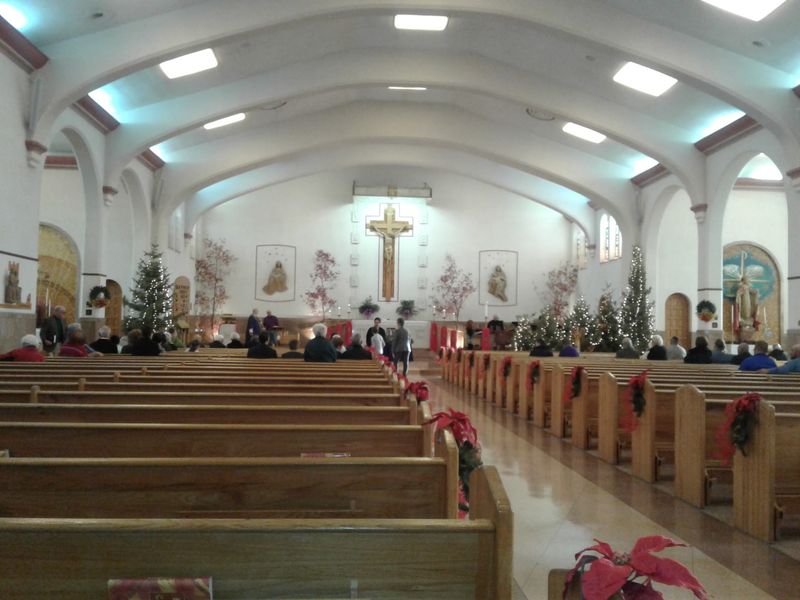
Marble by the ton, bronze accents, rich oak, and Italian glass mosaic tiles covering walls, floors, and altars. Officially St. Therese of the Infant Jesus Parish, the Shrine of the Little Flower ranks among the most lavish church buildings in the state.
Construction started in the mid-1950s at 3424 4th St NW, Albuquerque, New Mexico 87107, and dedication followed the next year. Every surface seems to have received attention from someone determined to make it glow.
The Shrine Room holds the most unusual treasure: a hand-carved wax figure of Saint Therese of Lisieux, reclining in a Carmelite habit and modeled from her death mask. Only a handful of such entombed statues exist anywhere in the world.
Outside, bronze sculptures of Our Lady of the Smile and Saint Therese by local artist Michele vandenHeuvel anchor the gardens, with relics placed inside the Therese sculpture. Stations of the Cross designed by French artist Maurice Lucien Loriaux line the contemplative route.
Access could hardly be simpler, with major interstates and historic Route 66 nearby. Pilgrims traveling the official Saint Therese route already know this address by heart.
Roses, wax, and mosaic tile make an unforgettable combination.
6. St. Augustine Church And St. Kateri Shrine, Isleta Pueblo
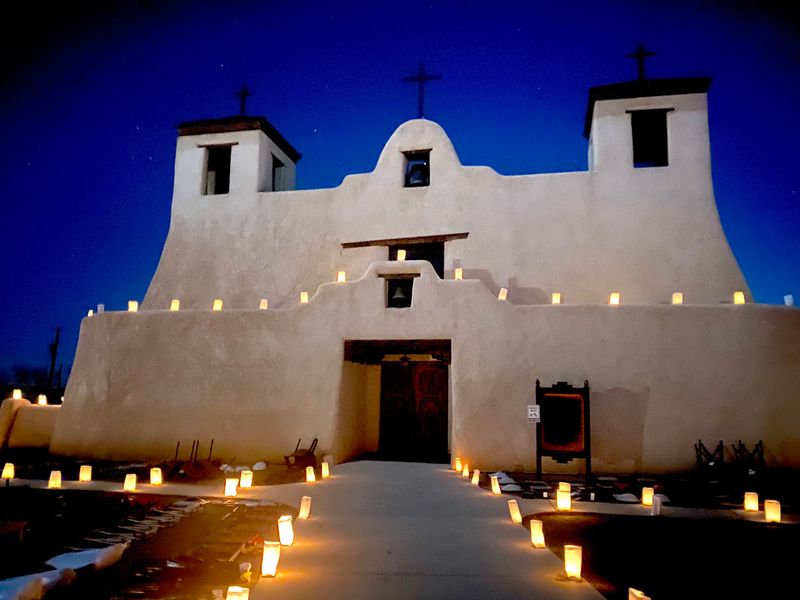
Massive adobe walls, wider at the base than at the top, have held this church upright for centuries. Standing at 71 Tribal Rd 35 in Isleta, New Mexico 87022, it counts among the oldest mission churches in the entire United States.
Founded in the early 1600s under the name St. Anthony, the building suffered damage during the Pueblo Revolt and was rebuilt and renamed St. Augustine in the following century. The original earthen walls survived it all.
Bell tower design here reflects French influence brought by Bishop Lamy. Inside, the long narrow chapel receives light through four large recessed stained glass windows, one showing Saint Kateri Tekakwitha, the first Native American woman canonized.
The church also holds the remains of Fray Juan Jose de Padilla, a missionary whose story adds to the site’s pilgrimage reputation.
Isleta Pueblo remains a living community, so visitors should treat the plaza as someone’s neighborhood rather than an attraction. Photography rules vary, and asking first is always the right move.
Feast days bring dances and gatherings that follow tribal protocols.
Ancient earth and enduring prayer share the same walls at this remarkable pueblo landmark.
7. Santuario De Chimayo, Chimayo
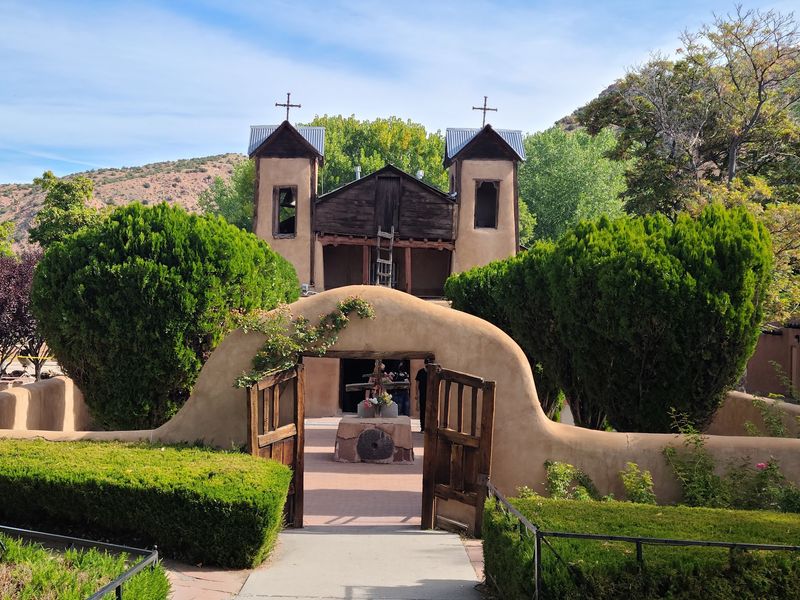
Crutches and walking sticks lean against the wall of a small side room, left behind by people who believe they no longer needed them. That single sight explains why the Santuario de Chimayó carries the nickname Lourdes of America.
Set in the foothills of the Sangre de Cristo Mountains at 15 Santuario Dr, Chimayo, New Mexico 87522, the adobe sanctuary traces its founding legend to a glowing crucifix discovered in the earth.
Hundreds of thousands of pilgrims arrive each year, many walking long distances along the highway, especially during Holy Week. Survivors of the Bataan Death March helped revive that walking tradition, giving the pilgrimage a deeply local meaning.
Twin front towers with belfries and a wall-enclosed garden give the little church its storybook look, while the interior mixes Spanish and Native American artistic styles.
The famous holy dirt sits in a small pit inside a prayer room, and visitors often carry a pinch home. Stone-carved Stations of the Cross were added later along a meditative path outdoors.
Nearby shops sell woven textiles and chile, both Chimayo specialties. Weekday mornings offer the quietest experience by far.
Faith feels close to the ground in this valley.
8. Shrine Of Our Lady Of Guadalupe, Santa Fe
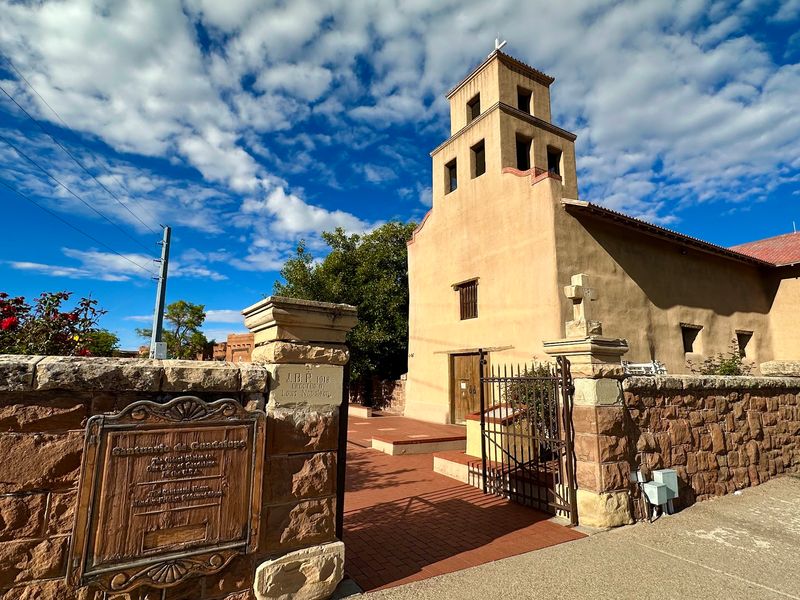
Claim to fame: the oldest standing shrine in the United States dedicated to the Blessed Mother under the title of Guadalupe. Built in the late 1700s, the cruciform adobe church sits at 100 S Guadalupe St, Santa Fe, New Mexico 87501.
Three-foot adobe walls and traditional pine vigas overhead make the age obvious the moment you step inside. A fire in the 1920s damaged portions of the building, and the restoration that followed introduced California Mission styling while keeping the historic bones intact.
A twelve-foot bronze statue of Nuestra Senora de Guadalupe by Mexican artist Doña Georgina Farias greets arrivals near the entrance. Inside hangs a large painting of Our Lady of Guadalupe by José de Alcíbar, considered the biggest of its kind in the country, and it survived that fire.
Six tile mosaics by artist Arlene Cisneros Sena line El Cerro de Tepeyac, a short walking path that tells the story of the apparitions to Juan Diego, step by step.
The Railyard district sits right nearby, with a farmers market and galleries, so a visit slots neatly into a Santa Fe morning.
Old adobe, bold bronze, and a story that keeps traveling.
9. Shrine And Parish Of Our Lady Of Guadalupe, Las Cruces
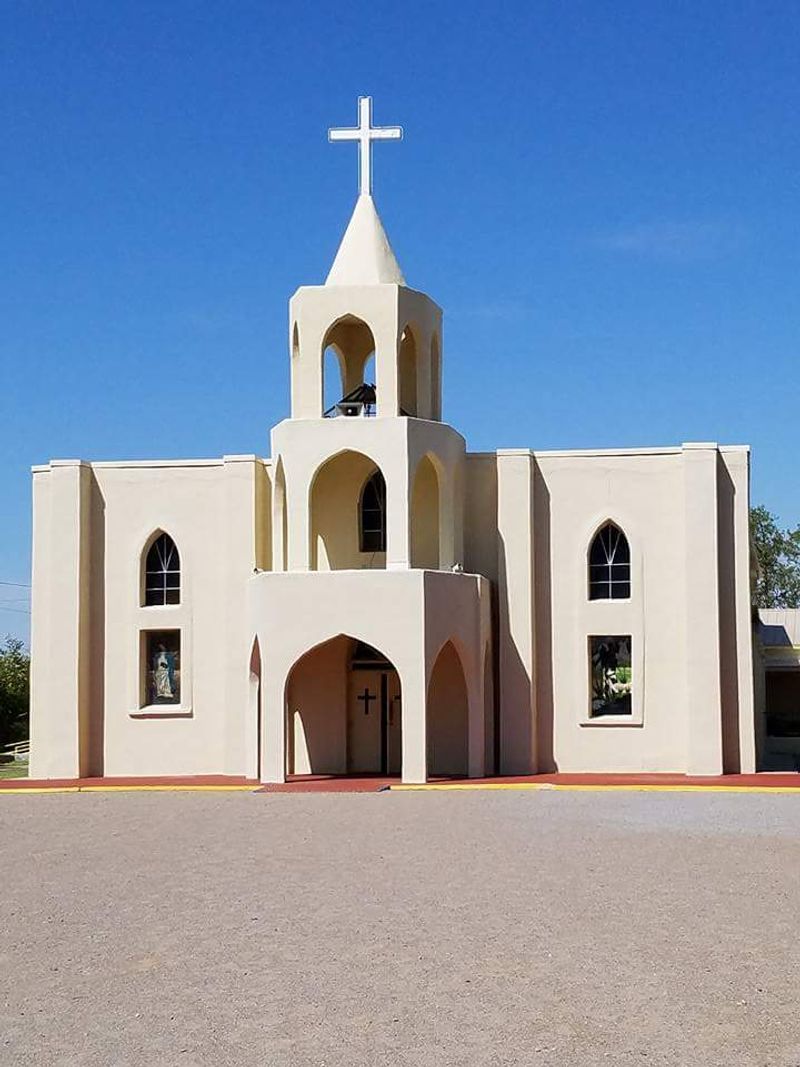
Tortugas Mountain rises just behind this parish, and the community gathered around it has kept its traditions alive for generations. The Shrine and Parish of Our Lady of Guadalupe sits at 3600 Paroquia St, Las Cruces, New Mexico 88001, serving the Tortugas Pueblo community.
History, culture, and Catholic faith braid together tightly here. Devotion to Our Lady of Guadalupe shapes the calendar, and families pass down practices that connect them directly to their ancestors.
More than a building where Mass happens, the church functions as the center of a distinct cultural identity. Generations have gathered in the same space to celebrate, mourn, and mark the milestones that make a community feel like family.
Visitors who stop by encounter something rarer than architecture: a living tradition still being practiced rather than remembered. The December celebrations honoring Our Lady draw the strongest turnout, and respect for local customs matters greatly during those days.
Southern New Mexico has no shortage of scenic drives, and the road toward Tortugas Mountain adds a quiet destination to the map. Desert light in the late afternoon paints the whole area in gold.
Community and devotion hold equal weight at this southern parish.
10. Our Lady Of Lourdes Shrine, Ohkay Owingeh
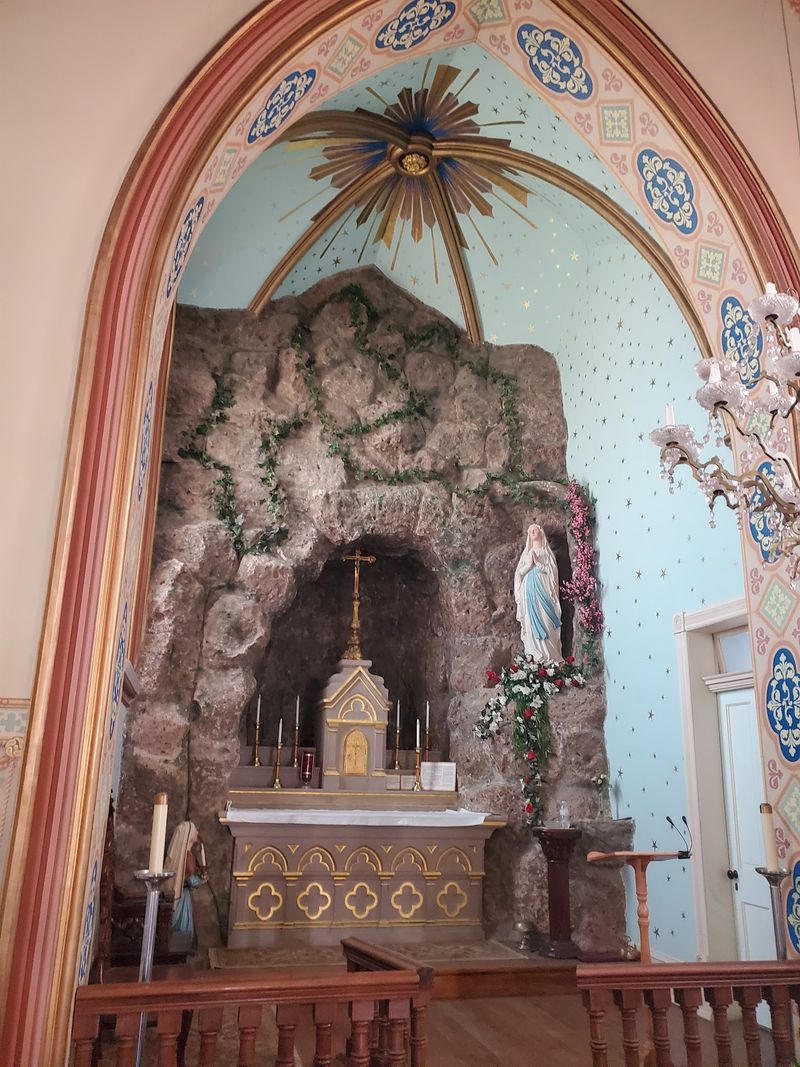
Lava rock walls. That alone makes this shrine one of the strangest and most striking buildings in the Southwest, since only a small number of structures in the whole country were built entirely from it.
Located at 237 Ohkay Bupingeh, Ohkay Owingeh, New Mexico 87566, the chapel follows a French Gothic design scaled down to one-fifth the size of the Sainte Chapelle in Paris. Architects Antoine and Projectus Mouly, known for their work on Santa Fe’s Cathedral Basilica of St. Francis, drew up the plans.
Father Camilo Seux, a French pastor, pushed the project forward, with construction beginning in the late 1880s and dedication following soon after. Original stained glass windows arrived from Clermont, France, and the golden stars and altar gold measure twenty-three carat.
A replica of the Lourdes grotto stands on the grounds, honoring the appearances of Mary to Saint Bernadette and giving pilgrims a place to pray.
Here is the detail that amazes me most: the building was never wired for electricity or natural gas, so the interior looks essentially as it did at dedication.
Candlelight and lava stone make a combination worth the northern detour.
11. Santuario De San Martin De Porres, Albuquerque
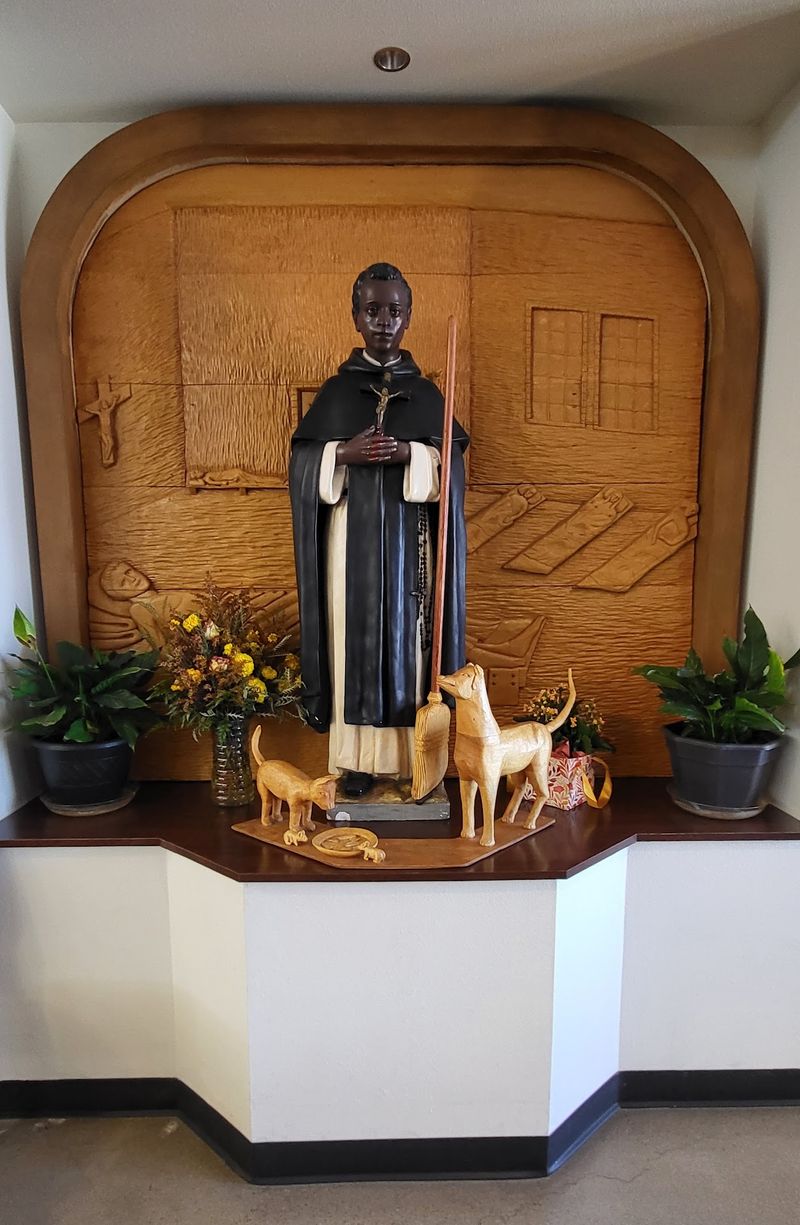
Not every meaningful stop needs centuries behind it. Santuario de San Martin de Porres serves the southwestern side of Albuquerque from 8301 Camino San Martin SW, New Mexico 87121, and it functions as a busy neighborhood anchor.
The name honors Saint Martin de Porres, remembered as a patron of social justice and racial harmony, and the choice of the word Santuario suggests a special dedication rather than an ordinary parish title.
Regular Masses, sacraments, and community events fill the weekly calendar. Families come for baptisms and quinceañeras, volunteers organize outreach, and the parking lot tends to fill on Sunday mornings.
Compared with the adobe missions and Gothic cathedrals earlier on this route, the setting feels contemporary and practical, which is exactly what makes it a useful contrast. Faith in New Mexico is not only historical, and stops like this one prove the point clearly.
The location works well for travelers heading toward the volcanoes on Albuquerque’s west side or looping back toward Interstate 25. Checking the parish schedule before arriving saves time, since quiet hours vary.
Ending a pilgrimage route at a working modern parish brings the whole trip full circle in a satisfying way.