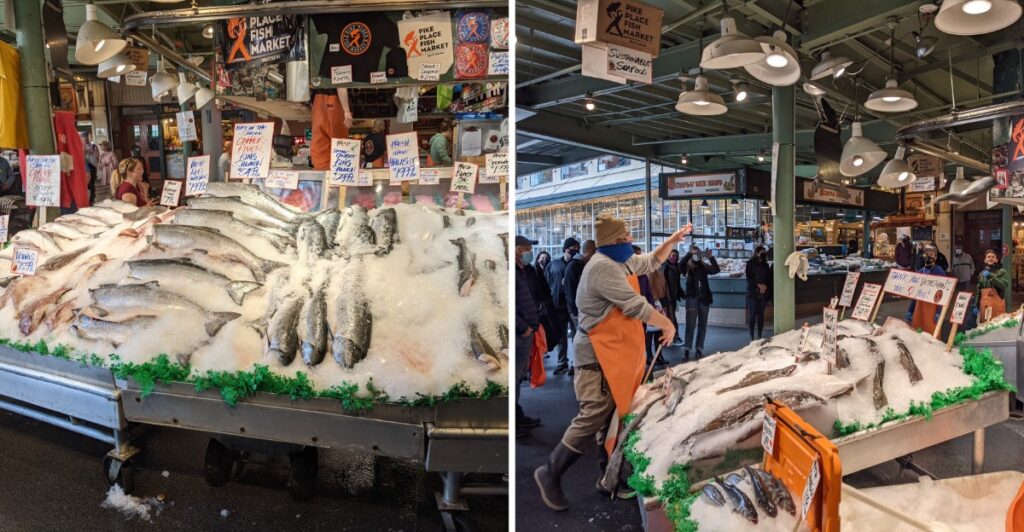
Lunch should not require a catcher’s mitt.
Here, it might help.
A salmon can leave the ice, sail over the counter, and land in another fishmonger’s hands before you have fully figured out what everyone is yelling about.
And no, there is no showtime.
This is a working seafood counter, so the famous toss happens when an order needs moving. Sometimes you catch it. Sometimes you wait.
Either way, Seattle gives grocery shopping a lot more action than usual.
You can hang back and watch, or step up and see what looks good enough to take home.
The selection changes, and the counter gets busy.
So keep your eyes up.
Around here, “catch of the day” can be a job description.
A Seafood Counter Beneath Seattle’s Famous Market Sign
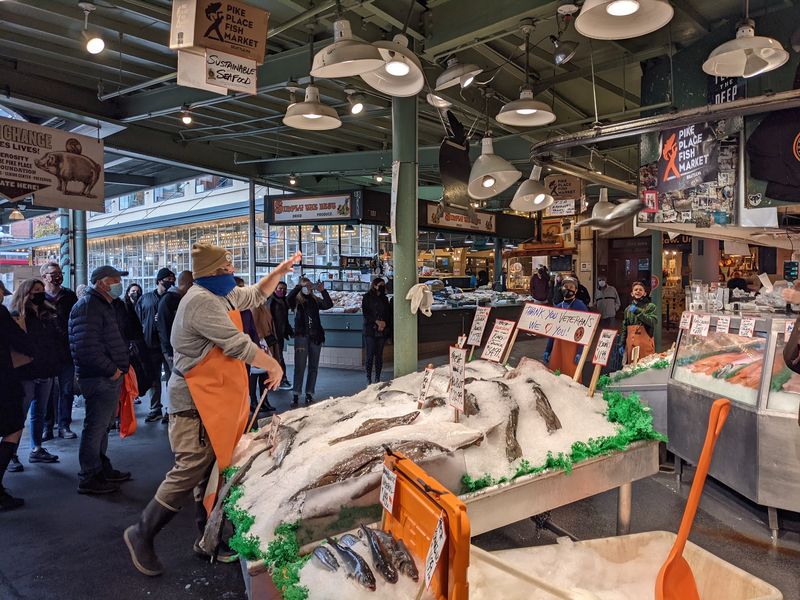
A shout carries across the aisle. One worker lifts a whole fish from the display, another raises both hands, and the catch happens behind the counter. It is a quick exchange, but the call-and-response gives nearby shoppers a chance to notice it.
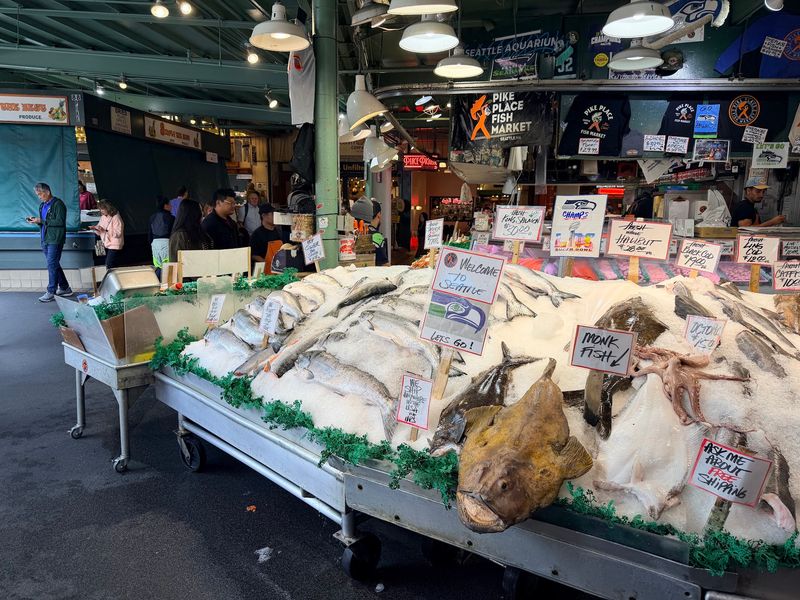
Pike Place Fish Market occupies a prominent position near the entrance to the larger public market. The familiar clock and sign above the market help orient you, while the seafood display provides an unmistakable landmark at street level.
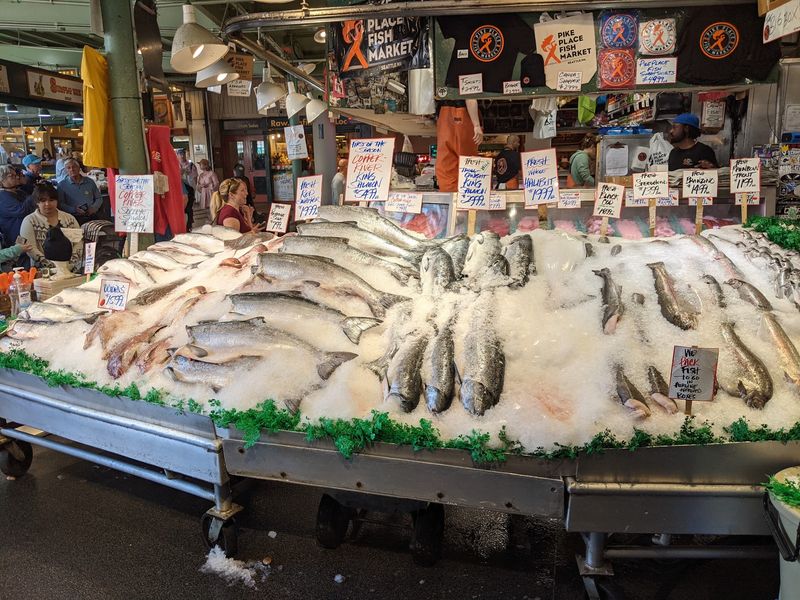
Whole fish rest on crushed ice beside other seafood available for purchase. The arrangement lets shoppers look over different species, compare sizes, and speak directly with the people preparing their orders.
Watching the tossing is free. You do not need a ticket or a guided tour to stand at the edge of the aisle, although you should leave space for customers placing orders and workers moving around the display.
Want a clear view? Start along the side of the counter rather than pressing into the middle of a gathering crowd. You may see the thrower and catcher from the same spot, with the fish crossing the space between them.
From A Working Fish Stall To A Seattle Tradition
Pike Place Market opened in 1907, and Pike Place Fish Market began operating there in 1930. The seafood stall has had several chapters since then, including decades under longtime owner John Yokoyama.
The practice of tossing fish developed during the business’s working history as a practical way to move seafood from the front display to the preparation area. It later became the gesture most closely associated with the counter.
In 1986, Yokoyama and his team put new emphasis on the customer experience and the way the crew worked together. The lively exchanges and coordinated handling of fish became recognizable features of the business.
Another change arrived in 2018, when four longtime fishmongers bought the market from Yokoyama. Jaison Scott, Ryan Reese, Sam Samson, and Anders Miller brought decades of combined experience to ownership of the shop.
For shoppers, the important thing is that this remains a place to buy seafood. The fish being passed overhead generally belongs to an actual customer order, and the crew still has to wrap or pack it after the catch.
The Split-Second Teamwork Behind Every Toss
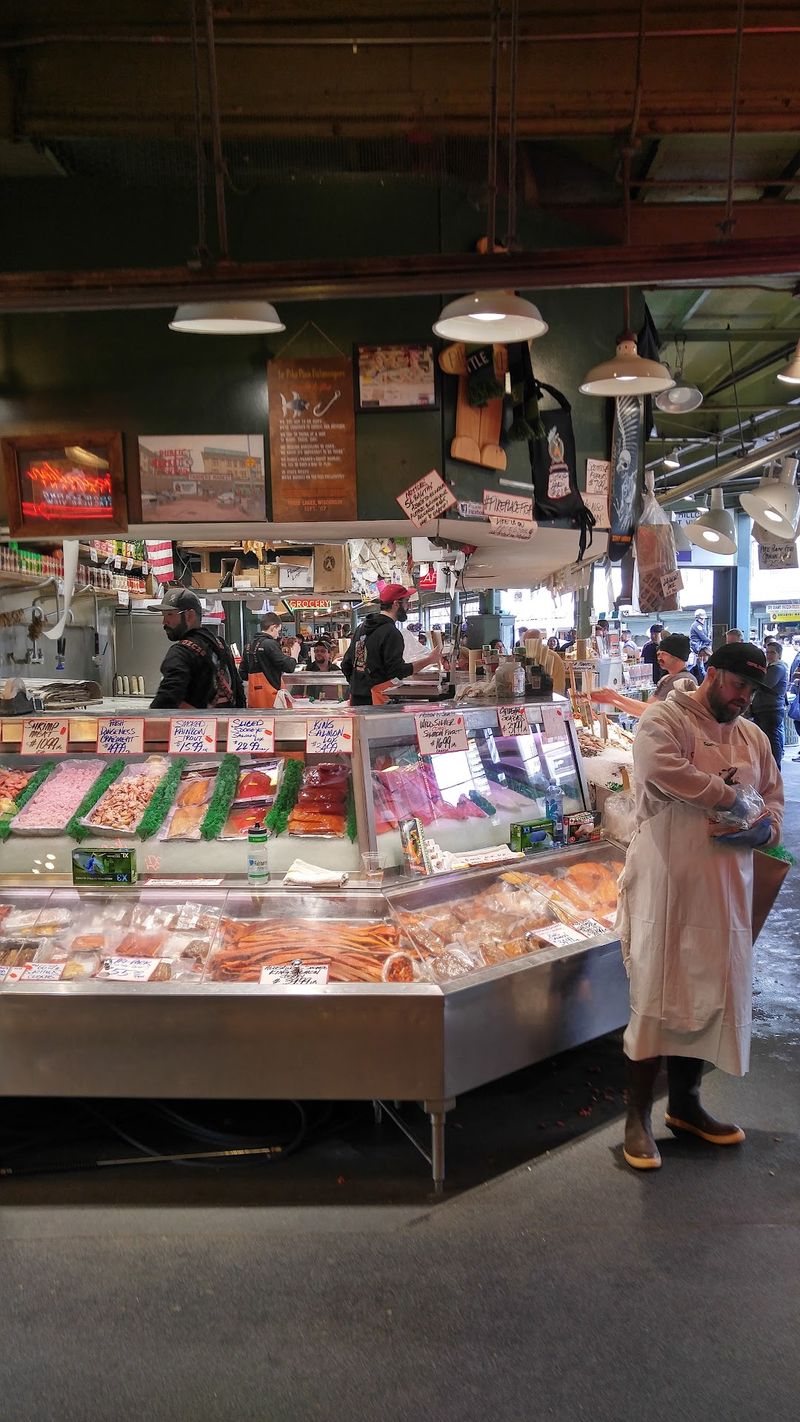
Watch the counter for a minute and you can begin to pick out the different jobs. One fishmonger helps a customer select seafood at the front. Another stands ready behind the display where orders are weighed, wrapped, or prepared for travel.
When a whole fish is ready to move, the person at the front calls out and sends it through the air. A teammate catches it, and the work continues on the other side.
The crew uses shouted calls and responses to communicate across a lively market aisle. That makes the handoff easier to follow even if you have never watched it before.
Some catches happen in a flash. Others involve a moment of conversation or a pause while the next order is sorted out. There is no need to keep your phone raised the entire time.
Stand where you are not blocking the counter, and listen for the call that comes before a throw. If you are visiting with children, help them identify the person sending the fish and the one waiting to catch it.
Keep hands, bags, and cameras clear of the workers’ space. The crew handles the seafood; spectators are there to watch.
Why The Fish Fly Instead Of Being Carried
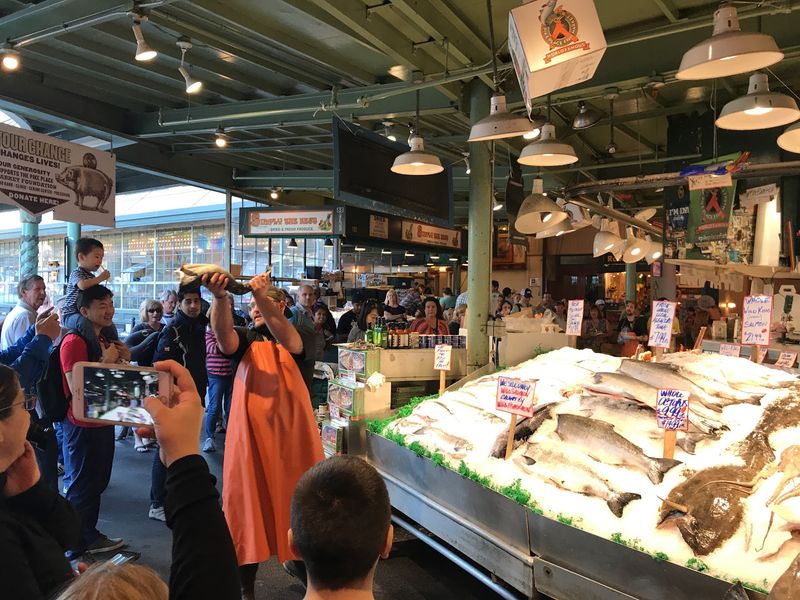
The flying seafood is real merchandise, not a plastic prop. Fishmongers move purchased whole fish from the ice display to the counter where orders can be finished and packaged.
At a busy stall, a toss can avoid a trip around the front display. It is a short route from one worker to another, provided both people are ready for the handoff.
The fish is caught by someone working behind the counter, rather than being thrown out toward the people watching. Stay beside the display rather than stepping into the space between the workers.
Not every purchase involves a flying fish. A customer might buy fillets, shellfish, or another item that can be handed over or packed without a dramatic exchange. Even whole-fish orders need to be handled according to the task at hand.
There is no set showtime to plan around. The tossing happens during ordinary business, as suitable orders come through. If you arrive between throws, take a look at the displays or speak with a fishmonger rather than expecting an immediate repeat.
Want to photograph a catch? Give yourself a little room and use a quick shutter setting. The movement lasts only a moment, and the surrounding counter is part of the scene.
Salmon, Crab, And Other Seafood On Ice
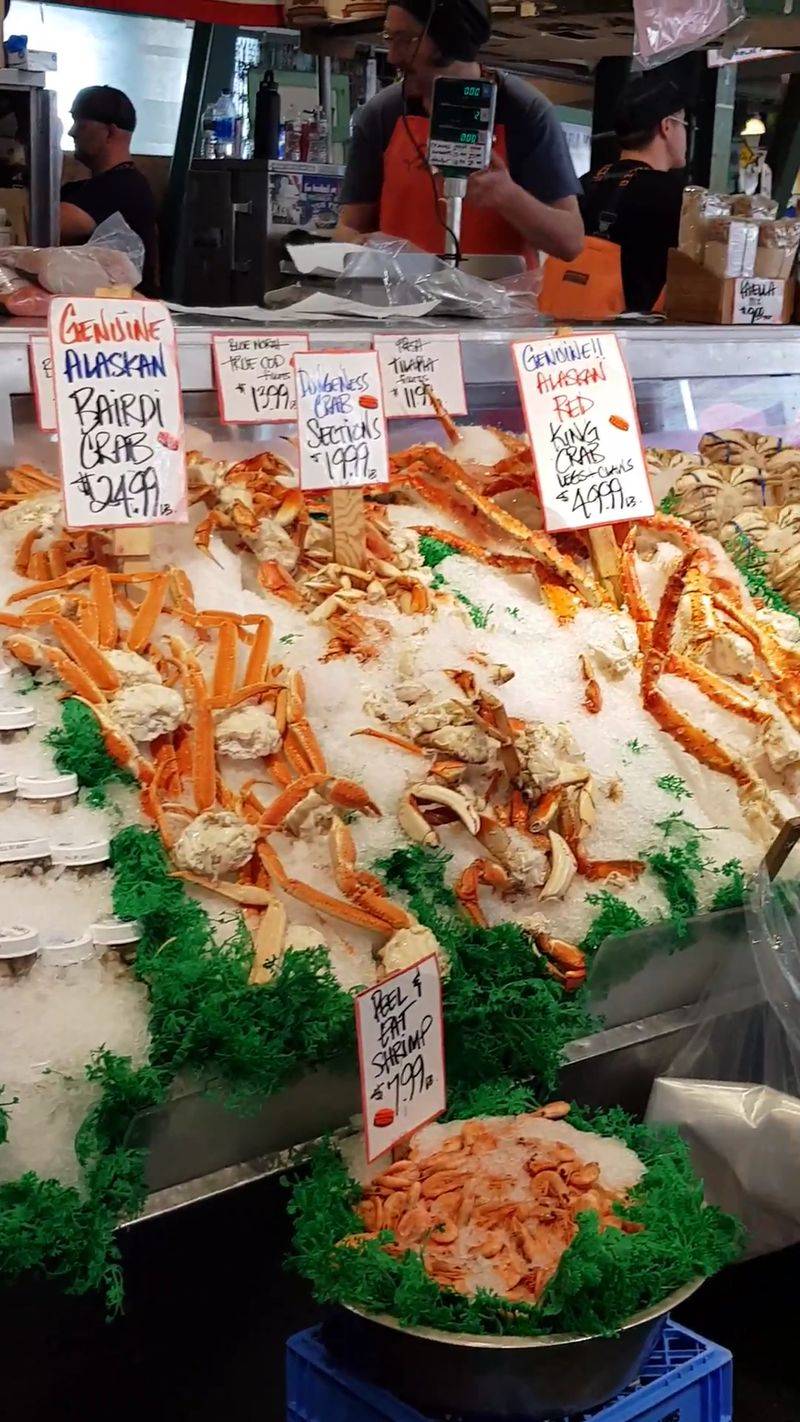
Salmon may be the best-known flying fish, but it is only one part of the selection. The shop sells a range of seafood, including Pacific salmon, halibut, and crab, with availability changing according to season and supply.
Dungeness crab is a regional specialty, while halibut offers a different choice for anyone thinking about a seafood dinner. You may also encounter other fish and shellfish depending on what is in stock.
Ask about the difference between salmon varieties if you are choosing fish to cook. The workers can help you compare options, discuss portion sizes, and decide what suits the meal you have in mind.
A whole fish makes a striking sight on the ice, but it might not be the most convenient purchase for a traveler. Fillets and other cuts can be easier to prepare, especially if your kitchen arrangements are limited.
The business offers nationwide shipping by next-day air, along with packing options for airline travel. Confirm the timing, cost, and delivery details before purchasing perishable seafood for a trip home.
Even if you are only browsing, take a moment to notice the range of sizes and shapes on the ice. It is a working display, so give buying customers first access to the counter.
Calls, Catching, And The Market Around You
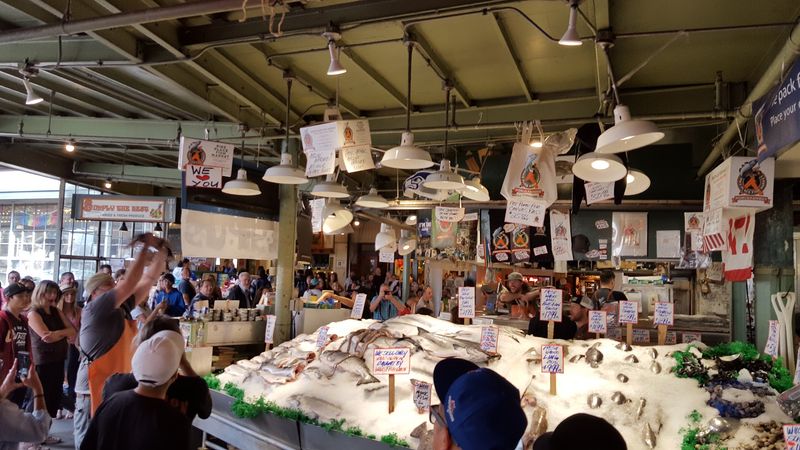
The fishmongers’ voices are only part of the soundscape. A few steps away, you may hear produce sellers talking with customers or notice people comparing bouquets at neighboring flower stalls.
The larger Pike Place Market combines fresh food with bakeries, crafts, small shops, and places to eat. It is easy to turn a stop at the fish counter into a longer walk through the market’s different levels.
The seafood stall can attract clusters of spectators, particularly during busier shopping periods. If the aisle feels crowded, move to the side and wait for room rather than leaning over someone’s shoulder.
A few minutes of watching can be enough to catch the rhythm: someone orders, a name or item is called out, and a fish moves toward the packing area. Other moments are quieter, with ordinary questions about seafood taking priority.
There is no need to manufacture a photo opportunity. The fishmongers have orders to complete, and a little space around the working counter makes things easier for everyone.
Once you have seen a toss, continue into the market for something to eat or a look at its flower and produce stalls. You can always pass the fish counter again on your way back.
When To Visit And How To Plan Your Stop
Morning can be a practical time to visit before the busiest part of the market day. Pike Place Market generally has lighter crowds before noon, although the number of people around the fish stall varies from one moment to the next.
Pike Place Fish Market operates daily from 7 a.m. to 5 p.m. The broader market has different hours for individual vendors, so a morning seafood visit does not guarantee that every neighboring shop will already be open.
For navigation, head to Pike Place Fish Market at 86 Pike Place, Seattle, WA 98101, near the market’s main entrance.
Comfortable shoes help on the sloping streets and across the market’s multiple levels. Seattle weather can change over the course of a visit, so a light layer is useful if you plan to explore beyond the covered stalls.
From October through March, vehicle access to Pike Place is restricted Friday through Sunday between 11 a.m. and 4 p.m., with exceptions for authorized vehicles. Consider the market parking garage if you’re driving.
Interested in buying seafood? Ask about packing and shipping before paying, particularly if your journey home involves a flight. If you just want to watch, step aside for customers and give the crew time to work.
The next salmon might fly as you arrive, or while you are deciding where to stand. Either way, there is more to see at this Seattle market than one well-timed catch.