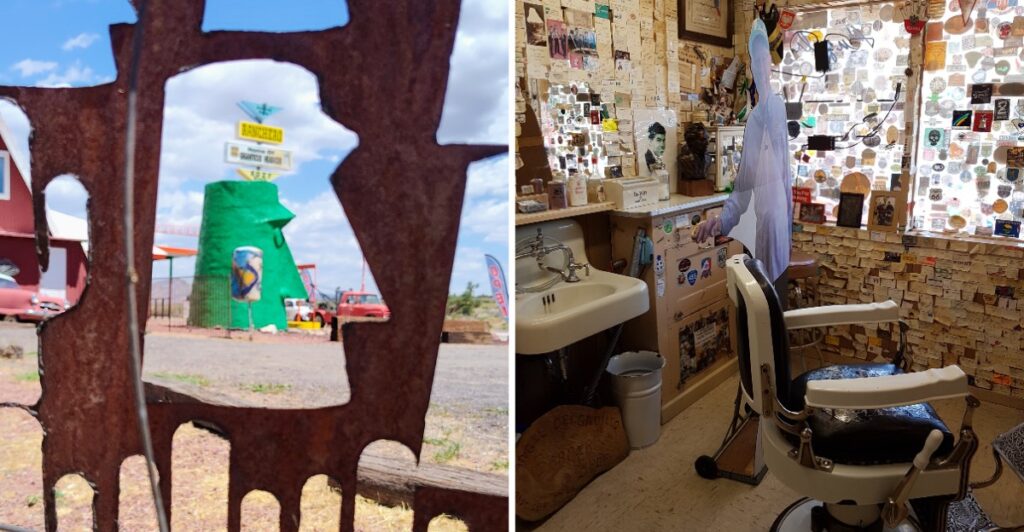
“We are not stopping again.”
Sure.
Then something weird appears beside the road and everybody in the car starts looking at everybody else.
Five minutes later, you are parked.
That happens a lot on Route 66.
In Arizona, the old highway is very good at turning curiosity into an unscheduled stop. You see something from the windshield and next thing you know, nobody is in much of a hurry anymore.
Even the road itself gets interesting once the mountains show up and those long desert miles start bending.
So yes, you can try to make good time.
You can also admit right now that the phrase “one quick stop” is going to be doing a lot of work today.
1. Wigwam Motel
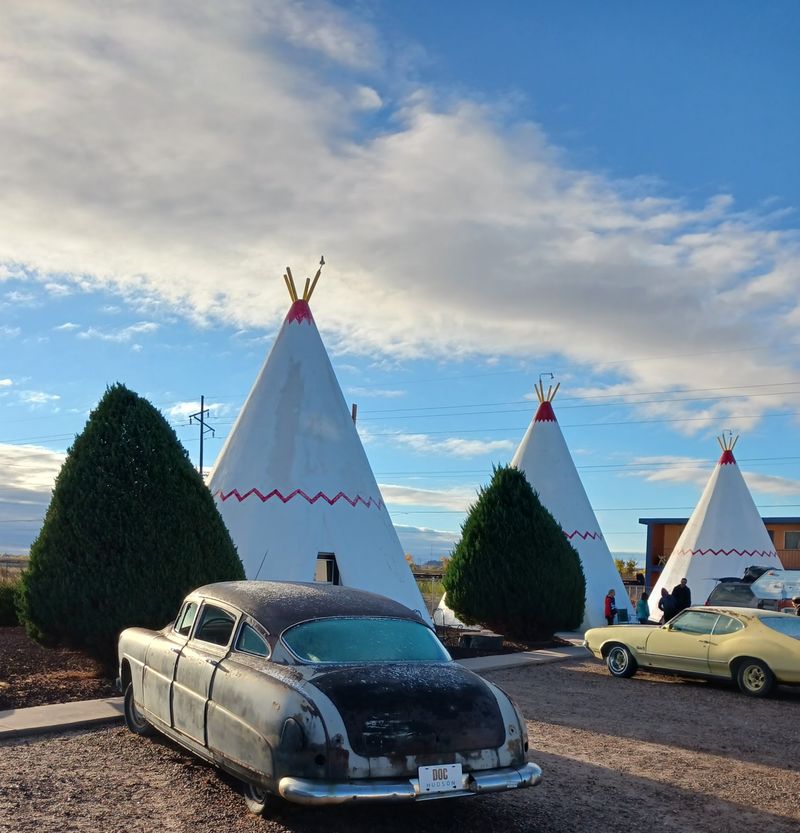
A row of pointed white rooms rises beside the road in Holbrook, with vintage cars parked outside as though their drivers have just checked in.
It is an unforgettable first look at a motel that takes the familiar roadside motor court and gives it an entirely different silhouette.
Those cone-shaped rooms are actually modeled on tipis, even though the property’s historic name uses the word “wigwam.”
Wigwam Village No. 6 opened in 1950. Local businessman Chester E. Lewis licensed the design associated with Frank Redford, and the result became part of a small chain of novelty motels.
Only three of the original villages survive. Fifteen individual sleeping units circle the office here, with a look that has changed remarkably little since the days when travelers unfolded paper maps across their dashboards.
If you decide to spend the night, expect a compact room rather than a resort-sized suite. Each unit has a private bathroom, and original handmade hickory furnishings remain an important part of the experience.
Air conditioning and other practical updates make the stay rather more comfortable than a full return to the 1950s would be.
You can appreciate the architecture from outside without booking a room, but be mindful that this remains a working motel and guests need their privacy.
Take time to notice how the parked cars and individual doorways create the feeling of a miniature village. It’s easy to imagine pulling up after a long day across northern Arizona. For an overnight stay, reserve ahead rather than counting on a vacancy when you arrive.
If you are only stopping for pictures, keep vehicles clear of room entrances and respect any on-site signs.
Address: 811 W. Hopi Drive, Holbrook, AZ 86025.
2. Standin’ On The Corner Park
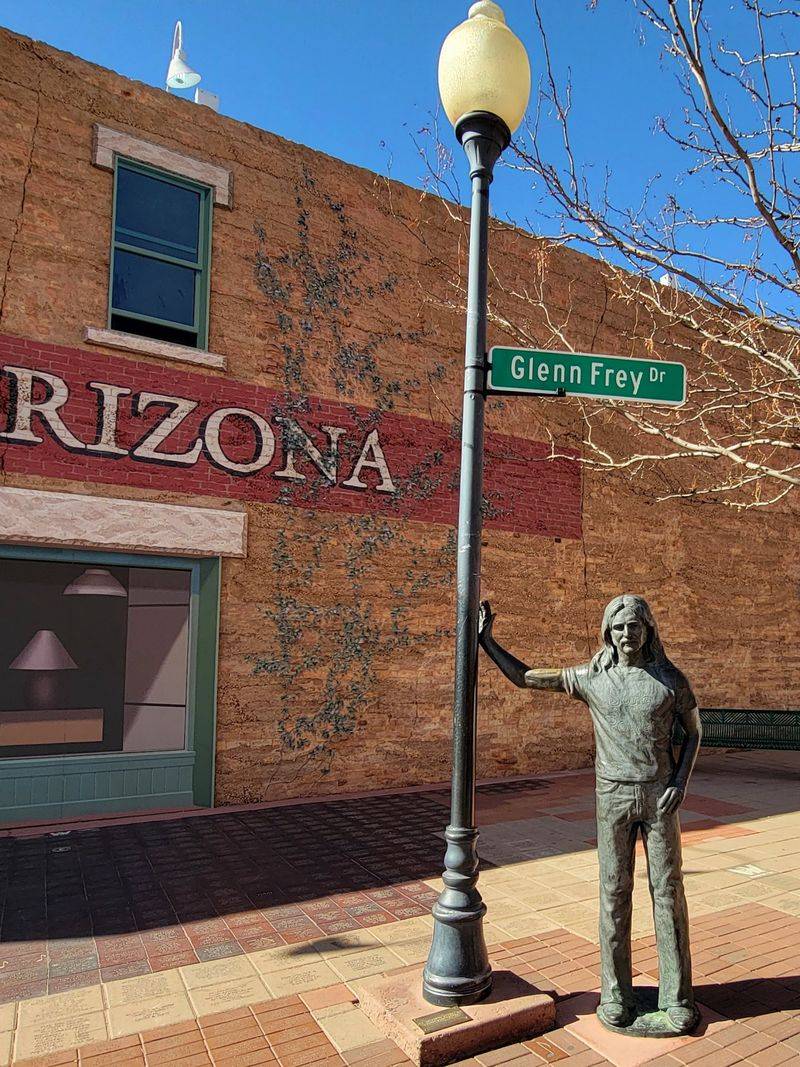
A bronze musician, a painted building facade, and a flatbed truck motif make an unlikely set of landmarks for a town square.
In Winslow, they come together around a musical reference that has followed the town for decades.
Even visitors who have never owned the record often recognize the idea of taking it easy on a corner in Arizona.
The park celebrates the lyric made famous by the Eagles’ song “Take It Easy,” written by Jackson Browne and Glenn Frey.
The surrounding mural and sculptures offer several places to pause, with details tucked into the artwork that are easy to miss if you simply jump out of the car, snap one picture, and leave.
Spend a few minutes looking at the windows and figures before picking a photo angle.
Standin’ on the Corner Park sits at a real downtown intersection, not in a roped-off theme park.
That is part of its appeal, but it also means traffic deserves your attention. Use the sidewalk, wait for safe crossings, and resist the temptation to pose in the street beside the Route 66 pavement marking.
A souvenir is much nicer without a near miss from a passing pickup.
Around the square, small businesses and storefronts make it easy to stretch the stop into a leisurely downtown wander. If you have time, take a short walk beyond the corner rather than treating Winslow as a single photo backdrop.
The town hosts a Standin’ on the Corner festival in September, so anyone visiting around that period should expect a livelier atmosphere and check the year’s schedule.
A quick visit can fit between longer drives, but this one rewards a slower pace and a look at the surrounding streets. Leave room for a coffee or snack before you return to the highway. You might find yourself humming on the way back to the car.
Location: East Second Street and North Kinsley Avenue, Winslow, AZ 86047.
3. Angel & Vilma Delgadillo’s Original Route 66 Gift Shop
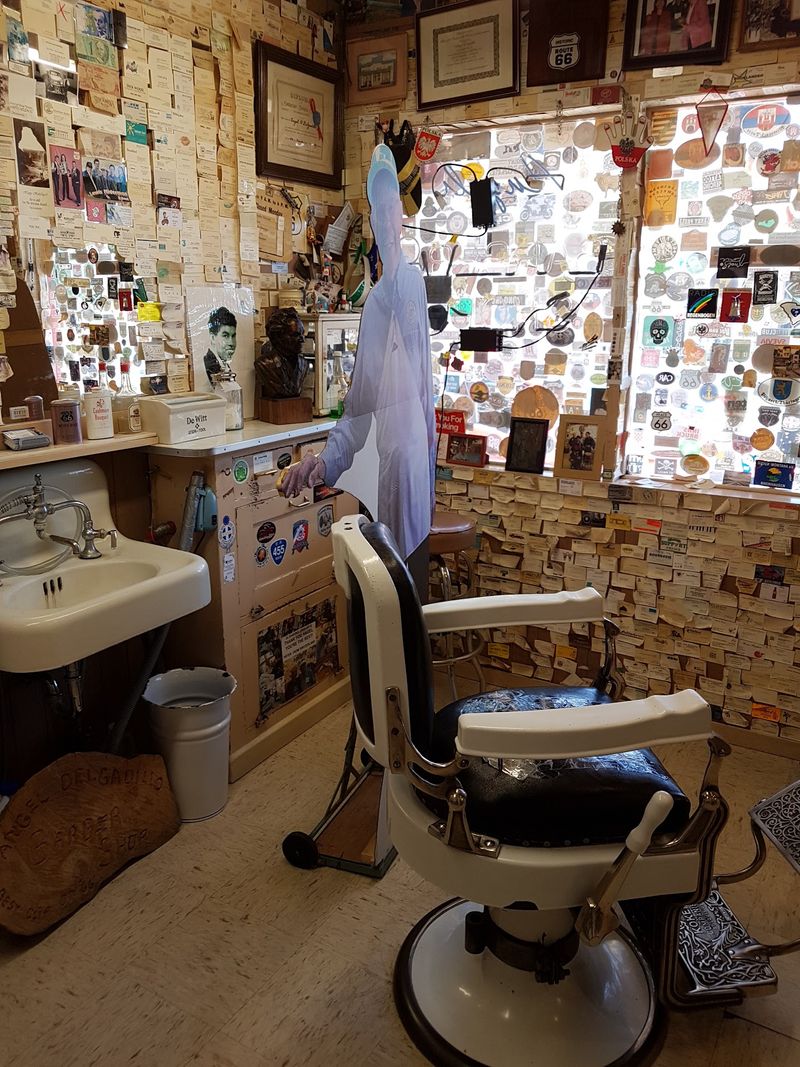
The shelves tell only half the story in this Seligman storefront. Behind the souvenirs is the former barbershop associated with Angel Delgadillo, whose campaign helped give Arizona’s old highway a second life.
Look past the T-shirts and maps and you’ll find a place where the history of a road is tied to the determination of the people who lived beside it.
When Interstate 40 bypassed Seligman in 1978, the passing traffic that sustained local businesses dwindled.
Delgadillo, a longtime barber, encouraged neighboring business owners and communities to work together rather than accept that the road had become irrelevant.
In 1987, he helped establish the Historic Route 66 Association of Arizona.
Later that year, the state designated the Seligman-to-Kingman stretch Historic Route 66, a milestone in the highway’s preservation movement.
The shop occupies the old barber and pool hall premises, and the barber chair remains a reminder that this was once an everyday service stop, not a place built from scratch for tourists.
Memorabilia, photographs, and visitors’ messages crowd the interior.
Give yourself time to examine them: each speaks to the remarkable reach of a road that once connected countless small businesses and family vacations.
You may hear Delgadillo called the “Guardian Angel of Route 66.” The nickname reflects his role in the road’s revival, but the achievement was collective, too. Neighbors, organizers, and travelers helped keep the cause going.
It is a useful thought to carry through Seligman, where several longstanding stops have their own versions of the same story.
This is a browsing stop rather than a museum requiring hours. Check the shop’s operating times before building a tight itinerary around it, and take care with any displays that are clearly part of the historical collection.
You’ll leave with a better understanding of why the highway still attracts attention today.
Address: 22265 W. Historic Route 66, Seligman, AZ 86337.
4. Delgadillo’s Snow Cap Drive-In
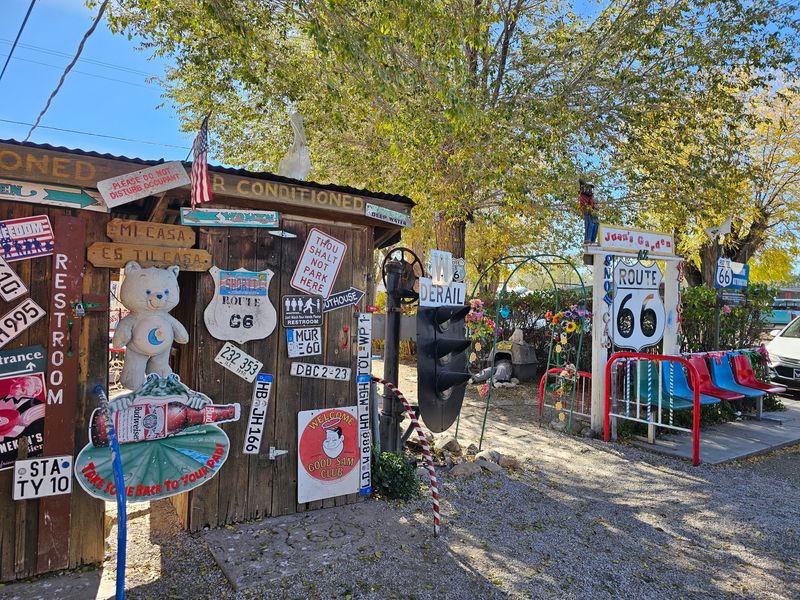
Across Seligman, roadside history takes a considerably sillier turn. Order at the counter and you may find yourself answering a question that sounds perfectly normal until it becomes a joke.
Pranks, playful signs, and an assortment of old vehicles are woven into the character of this modest drive-in.
Juan Delgadillo built the Snow Cap in 1953 using salvaged materials, creating a distinctive little food stop when Route 66 carried steady streams of motorists past town.
His brother Angel would later help lead the historic-highway movement, so the two neighboring family businesses offer different views of Seligman’s roadside past: one tells the preservation story, while this one serves lunch with a grin.
Burgers and cold treats are the natural order of business here. A milkshake can be especially appealing on a hot afternoon, and the counter staff may carry on the tradition of good-natured teasing as you place your order.
The routine is part of the experience, but there is no need to perform for it; a smile usually does the job.
Menus and availability can change, so let the current board guide your choice rather than arriving determined to order something you saw in an old photograph.
Outside, vintage cars, hand-painted details, and improvised decorations make the surroundings worth a look.
Some are weathered, some are deliberately ridiculous, and together they capture the era when roadside businesses competed for attention with unusual signs and a little theater.
Walk around the public areas rather than climbing onto the vehicles or treating displays as play equipment.
It’s sensible to allow extra time if several groups arrive at once. The Snow Cap isn’t meant to be a hurried fuel stop; the pleasure lies in seeing how far a simple lunch counter can stretch one running joke.
Pair it with the nearby gift shop, and you have a Seligman visit that feels varied without moving the car far.
Address: 301 W. Historic Route 66, Seligman, AZ 86337.
5. Hackberry General Store
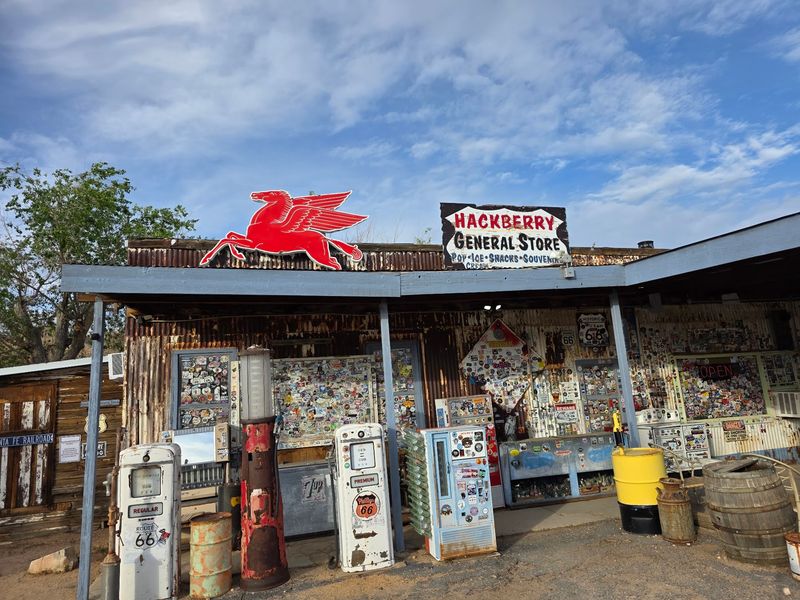
The first thing to notice may be the old gasoline pumps. Then your eye catches a shiny vintage car, a cluster of license plates, and signs that have clearly spent years in the desert sun.
Along a quieter stretch of Route 66, this collection of roadside objects practically asks you to slow down.
The Hackberry General Store preserves the look of a classic highway stop, though the present-day business is centered on memorabilia and souvenirs rather than filling a tank.
Its revival in the early 1990s helped establish this part of the route as a place to enjoy roadside Americana instead of simply passing through.
The surroundings are as much a part of the visit as the merchandise inside.
Take a circuit of the outdoor displays before you shop. The cars and pumps make useful reference points for photographs, and the mixture of polished and weathered objects shows how differently time treats metal under the Arizona sun.
The famous red Corvette is often associated with the property, but individual vehicles and display arrangements can change.
Think of the collection as a living roadside display, not a catalog of objects guaranteed to be in the same spot forever.
Indoors, Route 66 souvenirs mingle with vintage signs and motoring artifacts. You can browse books, magnets, and other keepsakes while taking a break from the drive.
Don’t assume every old-fashioned fixture still serves its original purpose; a display pump is not a working gas station, and a nostalgic counter is not a promise of full food service.
This stop is especially convenient when you’re exploring the open country between Seligman and Kingman.
Carry drinking water and confirm the store is open before counting on an indoor break.
The road feels expansive here, with plenty of sky and a steady reminder that small businesses once depended on every traveler who pulled in.
Address: 11255 E. Highway 66, Hackberry, AZ 86411.
6. Arizona Route 66 Museum
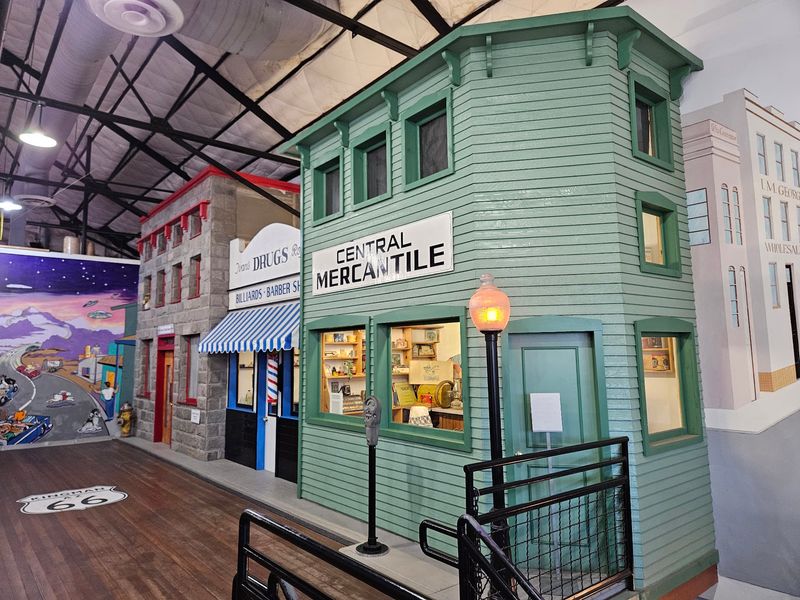
After miles of roadside signs and historic storefronts, a little context helps the scenery fall into place.
In Kingman, a former powerhouse provides it, with exhibits devoted to the people, vehicles, and changing fortunes of the Mother Road.
This is the stop to choose when someone in the car starts asking how the whole Route 66 story began.
The museum occupies the historic Powerhouse building, once linked to electricity generation for the surrounding area. Its displays reach beyond neon signs and souvenir culture, tracing earlier travel corridors and the highway’s role during the Dust Bowl migrations.
Photographs, vehicles, and recreated scenes help connect the road’s cheerful modern image with the very different reasons people traveled it in earlier decades.
As you explore, pay attention to how transportation reshaped communities. Cars altered where families stopped, where businesses opened, and how far a day’s journey could take them. Later, interstates redirected traffic away from many downtowns.
Those changes explain why towns such as Seligman had to work so hard to preserve their Route 66 identity.
The Arizona Route 66 Museum is run by the Mohave County Historical Society. Its admission arrangements can include access to other society museums, which makes it useful to check what’s covered if you plan a longer stay in Kingman.
Exhibits and galleries may be refreshed, particularly around the highway’s centennial, so allow the current presentation to guide your visit rather than relying on an older room-by-room description.
Budget about an hour if you like to read displays, or longer if you plan to see accompanying exhibitions.
You can combine the stop with a walk in historic downtown Kingman, where lunch and another look at the highway’s buildings provide a pleasant change of pace.
This is a practical place to reset before the more winding western mountain stretch.
Address: Powerhouse Visitor Center, 120 W Andy Devine Ave #2, Kingman, AZ 86401, United States.
7. Cool Springs Station
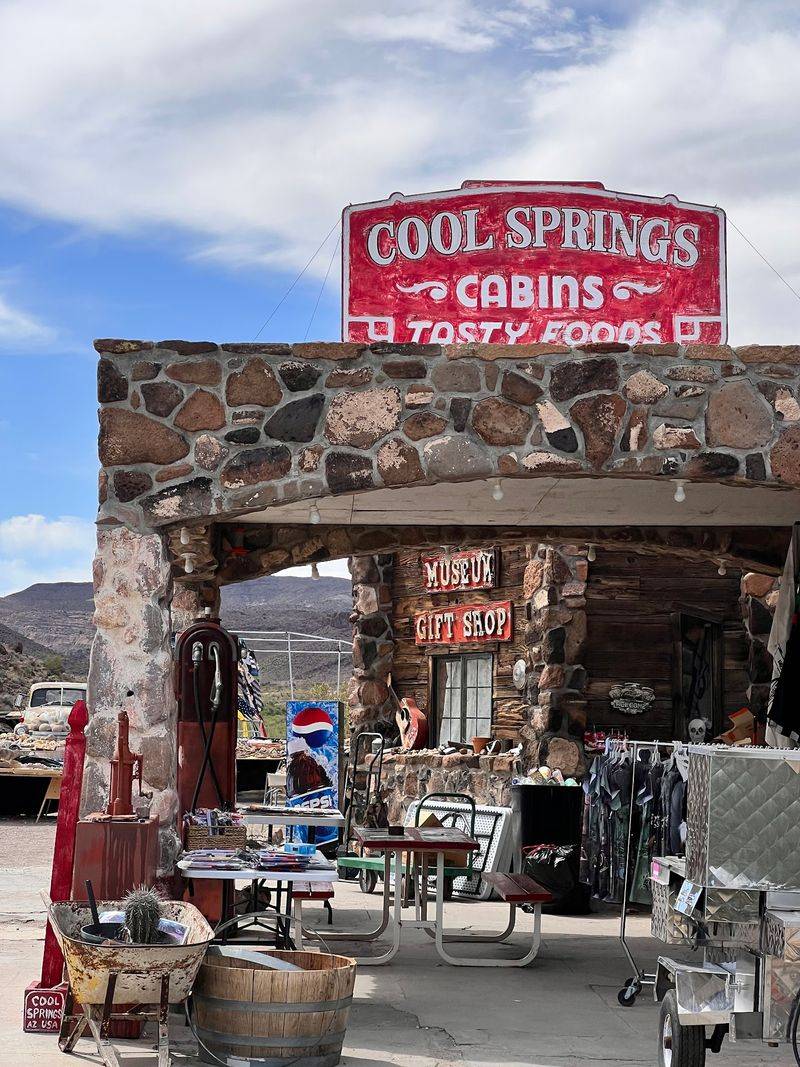
The road begins to feel different as the Black Mountains rise ahead. Low desert gives way to rockier slopes, and a small stone station appears beside the old alignment.
Pulling in here offers a look at the sort of service point that mattered a great deal when steep grades and remote roads demanded more planning from drivers.
Cool Springs began serving Route 66 motorists in the early decades of the highway. A later fire and years of abandonment left little of the original roadside complex intact.
The station was reconstructed in the early 2000s, recreating much of its historic appearance, so the building you see today is a revival rather than an untouched survivor from the 1920s.
That distinction doesn’t make the stop less interesting. The setting helps explain why people needed places like this, especially before dependable air conditioning, modern engines, and navigation apps made long drives less daunting.
Old-style pumps and a vintage sign set the scene against rugged hills.
Depending on the day’s operations, you may be able to browse a gift shop inside, but the exterior and surrounding scenery are reason enough for a short stop.
If you’re driving toward Oatman, use Cool Springs as a moment to consider the next part of your journey.
The old route climbs through tight bends and steep sections near Sitgreaves Pass.
A confident driver, sound brakes, daylight, and a reasonable pace matter more than any desire to rush from one attraction to another.
Larger vehicles should check route suitability before attempting the mountain crossing.
Pause for photographs only where parking is permitted, and don’t stand in the roadway to frame the station against the peaks.
There is plenty to enjoy without turning a scenic stop into an obstacle for approaching traffic.
The contrast between a modest building and the rough surrounding terrain gives this stretch its particular character.
Address: 8275 W. Oatman Road, Kingman, AZ 86413.
8. Oatman Hotel
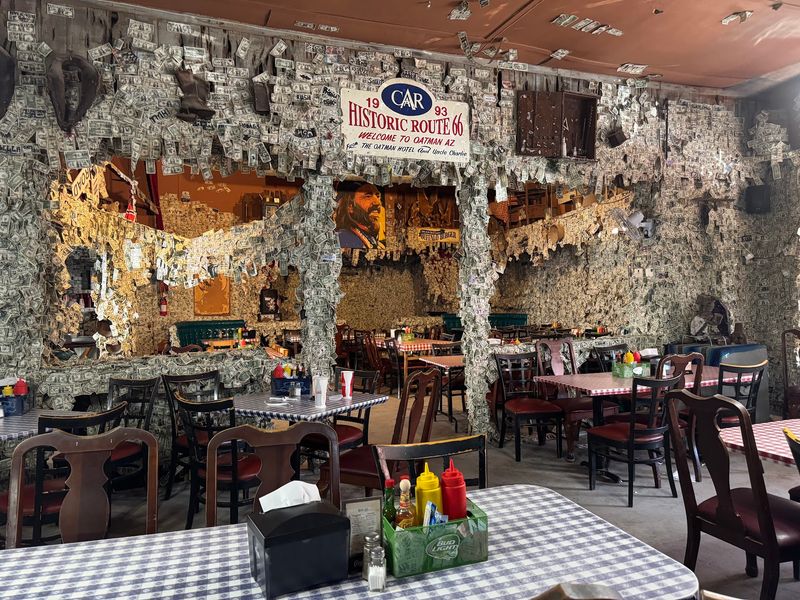
In Oatman, your first delay may come before you’ve even found a parking space. Wild burros sometimes wander onto Main Street, looking thoroughly unconcerned by the traffic they have interrupted.
Watch from a respectful distance and give them room; they’re living animals, not a roadside petting attraction.
Behind the bustle stands the Oatman Hotel, historically known as the Durlin Hotel.
The original hotel was established in 1902, but the present historic building reflects reconstruction after a destructive 1921 fire, with the rebuilt structure dating to 1924.
Its two-story adobe design is a surviving link to the settlement’s gold-mining years.
Although the name still says hotel, travelers should not expect to book an overnight room here.
Inside, signed dollar bills cover large areas of the walls and ceilings. It’s a curious record of passing generations and of the building’s long life as a gathering place.
Clark Gable and Carole Lombard are also associated with a stop here after their 1939 wedding in Kingman, a story that remains part of local lore.
Ask which public portions are open when you visit, especially if you’re hoping to see upstairs historic displays.
Main Street’s old-fashioned storefronts, narrow sidewalks, and mountain backdrop make a good setting for a slow walk. Keep an eye out for vehicles threading through town.
If an animal crosses your path, step aside calmly rather than trying to coax it closer for a photograph.
The Bureau of Land Management advises against feeding, touching, or approaching wild burros, including young ones; feeding can draw them onto roads and lead to dangerous encounters.
Oatman is most enjoyable when you leave time for its street scene, not just a hurried look at the hotel sign.
On busy days, allow for slow traffic and limited parking. Afterward, the mountain road demands your full attention again, so save the camera for the next safe pullout.
Address: 181 Main Street, Oatman, AZ 86433.
9. Giganticus Headicus
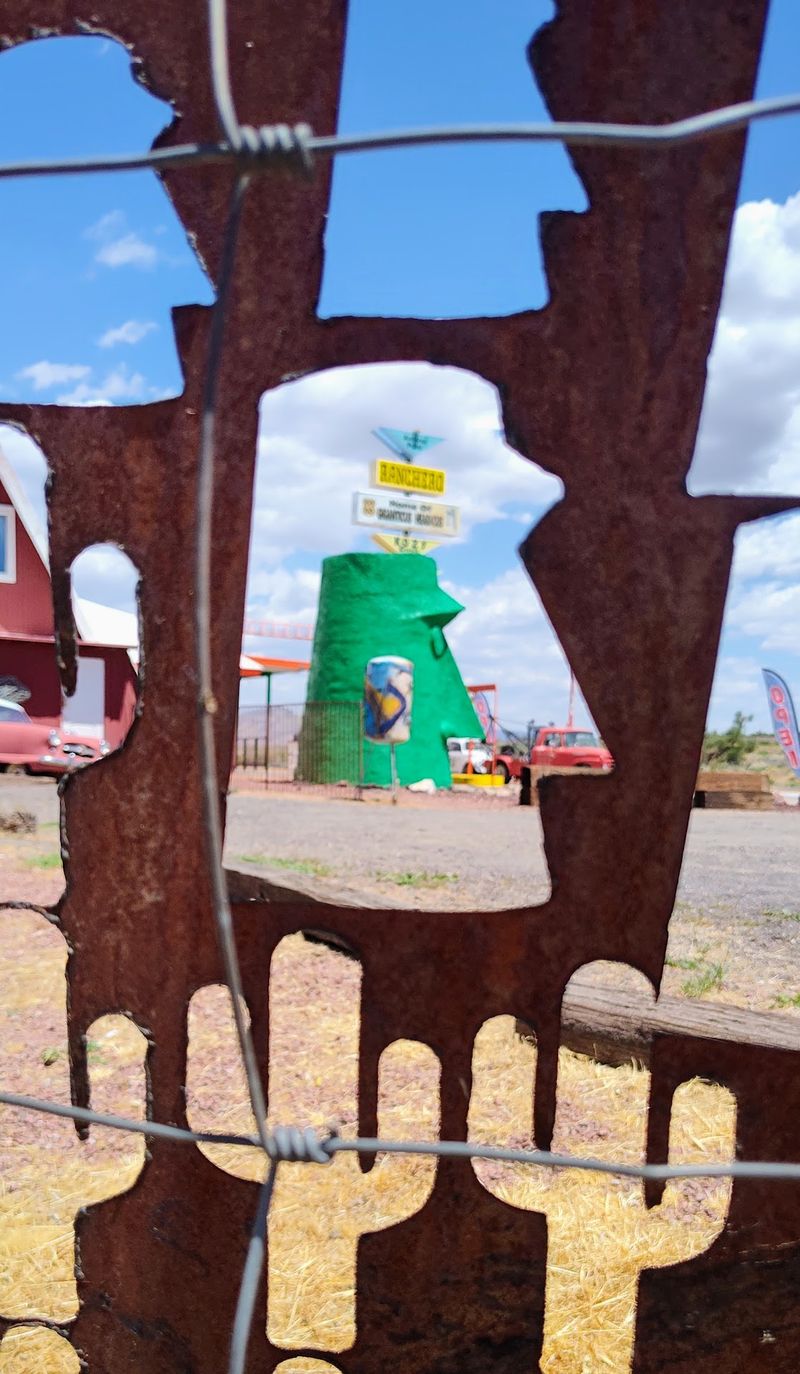
A giant green face is not the usual landmark you expect in the desert. Yet beside Route 66 near Antares, it rises above the roadside buildings with a stony expression and a name that sounds like a joke told in Latin.
Even among the highway’s eccentric attractions, this one is hard to confuse with anything else.
Giganticus Headicus was created in 2004 by artist Gregg Arnold. Standing roughly fourteen feet tall, the sculpture takes inspiration from monumental carved-head forms while embracing the playful roadside art tradition.
It has become an easy-to-recognize sign that you’re on the historic highway, even though it arrived long after Route 66 ceased to be an official federal highway.
Look around and you may notice other sculptural pieces and relics of the property’s earlier roadside uses.
The site has served different businesses over the years, and whether an adjacent shop is operating can vary.
Treat the giant head as the dependable attraction and any retail browsing as a bonus.
It’s not necessary to enter a building to appreciate the outdoor artwork from public areas.
For a photo, try including some of the surrounding desert rather than filling the entire frame with the sculpture. Its odd scale makes more sense when you can see the low buildings and big landscape around it.
Stand well away from the highway edge and use an appropriate place to park.
Arizona’s summer heat can make a five-minute stop surprisingly draining, so keep water handy even when the car remains close.
This is a short pause rather than a half-day destination, and that is precisely its role in a Route 66 itinerary.
After museums, vintage motels, and mining-town history, the face at Antares offers a change of pace.
Sometimes the road’s most memorable details come from someone deciding that an empty patch of desert needed a giant green head.
Address: 9855 AZ-66, Antares, AZ 86401.