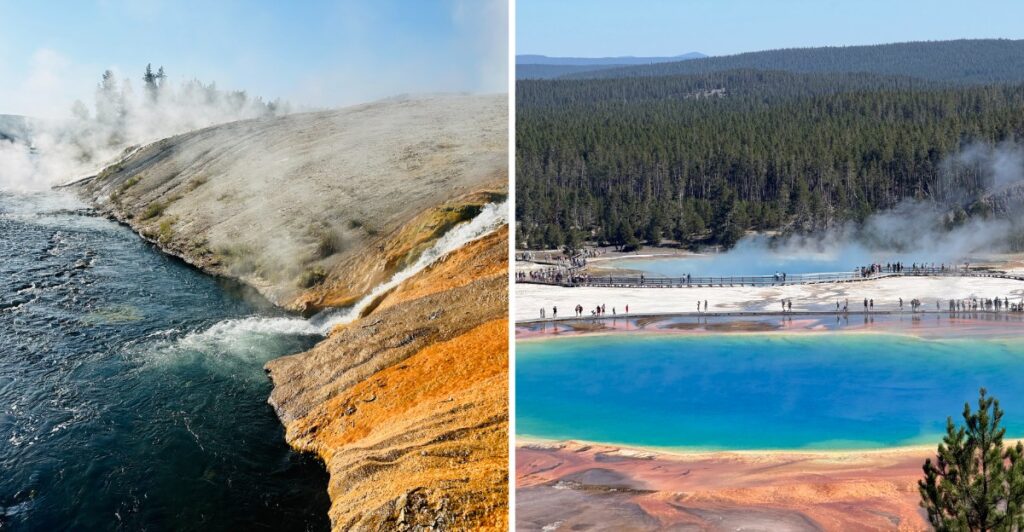
Your camera may look guilty after this one.
The colors are actually that bright.
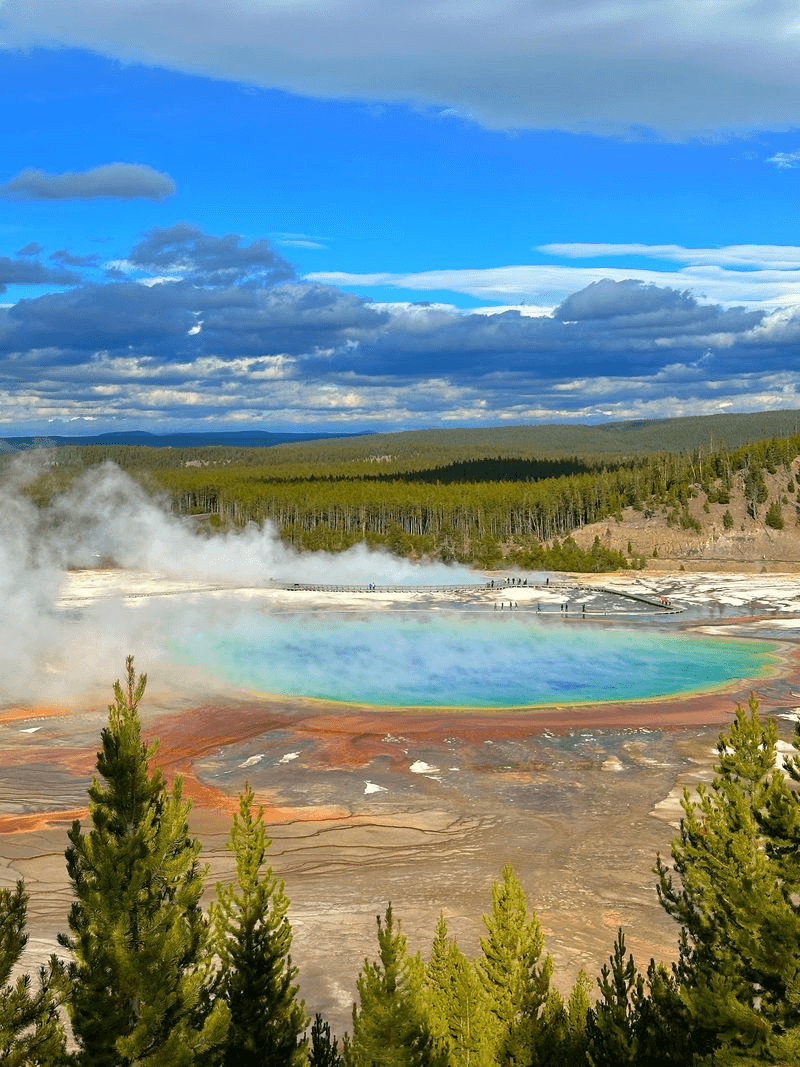
Deep blue sits at the center, while yellow and orange spread around the edges like somebody got carried away with the paint box. Steam keeps drifting across the surface, so the view never holds still for long.
Wyoming hides some very strange geology under all that color.
And the wild part?
Those shades are not there for decoration. There is real science behind why each band looks the way it does.
You can see the spring from ground level, then get a completely different perspective from higher up.
I’d want both.
Mostly because when nature starts using this many colors at once, one angle feels a little stingy.
This Spring Is Yellowstone’s Largest And Most Colorful Hot Spring
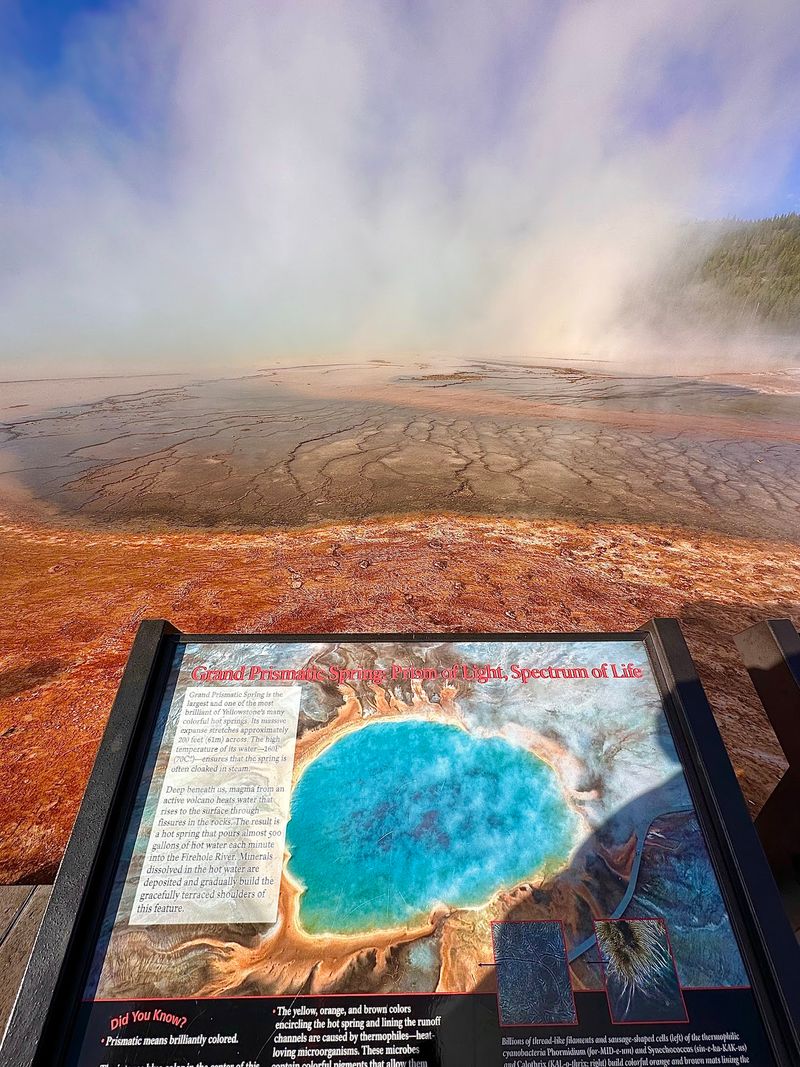
Grand Prismatic Spring has room to make an impression. It is Yellowstone’s largest hot spring and the largest in the United States, spreading across a broad section of Midway Geyser Basin.
Its depth exceeds 121 feet, with clear blue water at its center and wide bands of color around its edges.
The spring is not a swimming pool, of course. It is an active thermal feature, and its water is far too hot for entering or touching. You can admire it safely from the established boardwalk, where the scale becomes clear as you walk beside the steaming surface.
Look toward the middle first. Depending on the wind, you might see an expanse of brilliant blue or a curtain of steam sliding over it. At the edges, yellows and oranges spread into the shallower runoff areas.
The wider basin has more to see, too. Excelsior Geyser Crater sits nearby, and thermal water flows through channels across the pale ground.
For your visit, shoes with comfortable soles are more useful than fancy footwear. There is walking to do, and the best view may arrive just as a patch of steam lifts.
A Brilliant Blue Center Surrounded By Rings Of Rainbow Colors
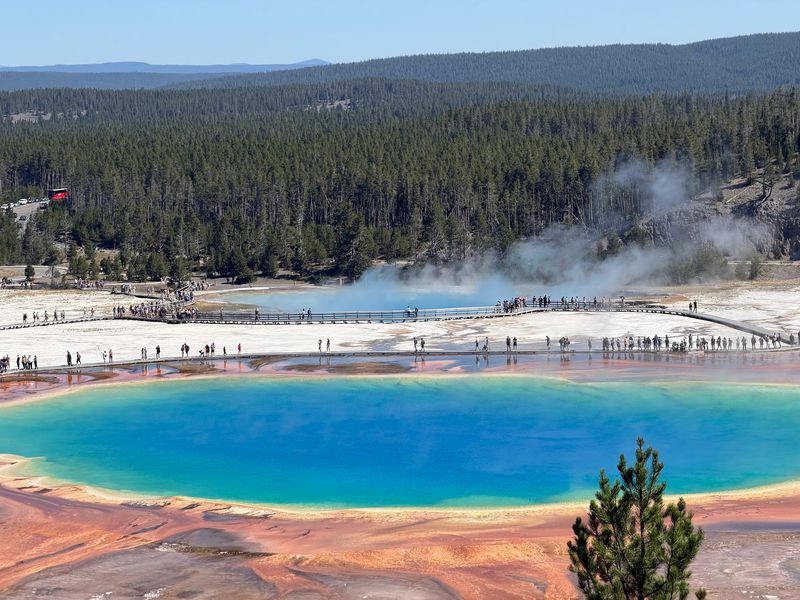
Start with that unusually blue center. The deep, clear water interacts with sunlight in a way that makes blue light especially visible. It is the same kind of optical effect that gives some other clear hot springs their striking blue appearance.
Follow the color outward and you will notice the palette change. Greenish areas lead toward yellow, orange, and brownish bands. The edges do not always form tidy circles, though.
Flowing water, changing conditions, and living microbial communities create irregular patterns that make the spring interesting from more than one angle.
Bright sunshine can reveal stronger color contrasts. Overcast skies may soften the view, while cool air often brings thicker steam. Neither kind of weather changes what is beneath the surface, but it can change how much you see at once.
Keep your camera ready without feeling obliged to photograph every second. Sometimes the best approach is to watch one patch of water until the vapor drifts away. If it closes in again, look toward the colorful edges or the neighboring basin features.
Leave room in your photographs for the steam, pale mineral ground, and nearby hills. They give the brilliant water a setting, rather than turning it into an abstract blue circle.
Heat-Loving Microorganisms Create Grand Prismatic Spring’s Incredible Colors
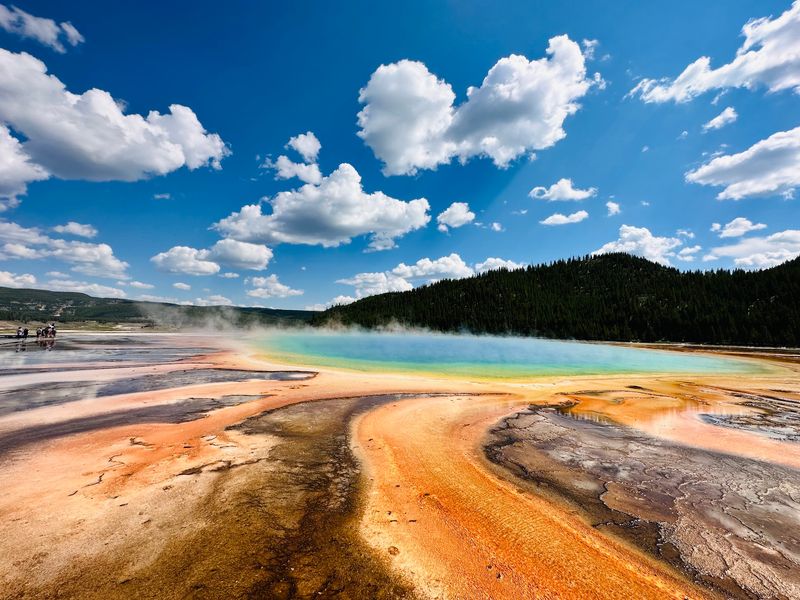
The outer colors come partly from tiny organisms called thermophiles, which thrive in conditions that would be too hot for most living things. In some parts of Yellowstone, large communities of these microorganisms form mats visible from the walking paths.
Different thermophiles favor different temperature ranges. As hot water moves away from the center of the spring and cools, the communities growing along its route change.
Their pigments contribute to the yellow, orange, and reddish-brown shades that surround the clearer blue water.
Look closely from the boardwalk and the colored areas appear less like painted stripes and more like layered, flowing patterns. Some bands narrow into channels.
Others spread across broad patches of ground, with small variations in shade that are easy to miss in a wide landscape photo.
Those mats are living communities, not decorations. Even a small footprint outside the marked path can affect fragile thermal ground and the organisms growing there.
The safest way to appreciate the detail is to leave everything undisturbed and use your eyes or a camera zoom.
Just remember that the colors have two different stories: sunlight creates the striking blue center, while heat-loving microorganisms help color the surrounding bands. That is quite a partnership for one landscape.
Yellowstone’s Underground Heat Powers This Massive Natural Wonder
The hot water has a long journey before it reaches the surface. Water moves underground, meets heat from Yellowstone’s geothermal system, and returns through openings in the rock. At Grand Prismatic Spring, that process feeds a broad, continuously steaming pool.
The steam is especially noticeable when the air turns cool. On a chilly morning, it can float across the boardwalk and briefly hide much of the spring. Warmer air may make the surface easier to see, although the wind can shift conditions at any time.
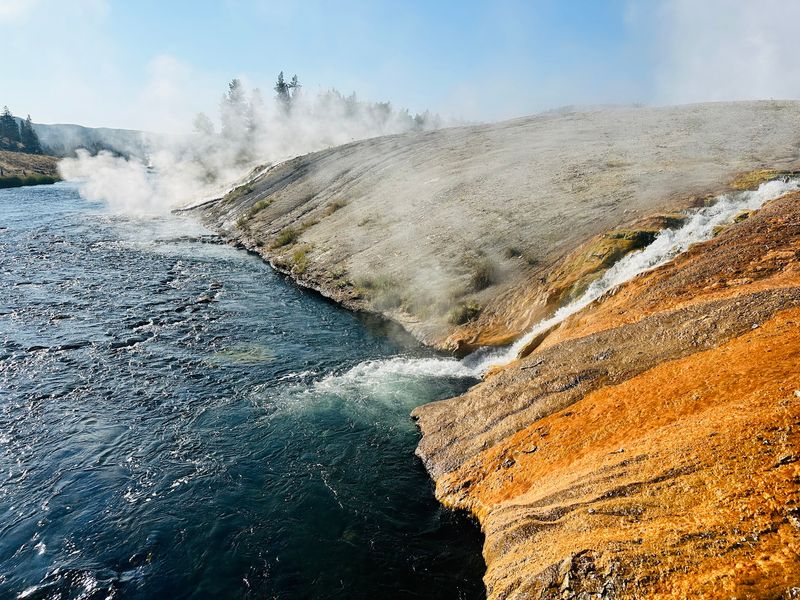
Nearby Excelsior Geyser Crater provides another glimpse of the basin’s activity. It releases thousands of gallons of hot water every minute, with runoff heading toward the Firehole River.
Its pale edges and rising vapor offer a different scene from Grand Prismatic’s bright rings.
Keep your distance from all thermal water, including the small runoff channels. Hot springs and the ground around them can be hazardous even when a surface looks firm. Never step beyond a boardwalk or marked trail, and keep children close throughout the basin.
You might be tempted to reach toward an unusual texture or colored stream. Resist that urge. The landscape is best enjoyed without touching any water, mineral deposit, or microbial mat.
Bring your curiosity, but keep your feet firmly where the path belongs.
The Midway Geyser Basin Boardwalk Brings Visitors Close To The Rainbow Waters
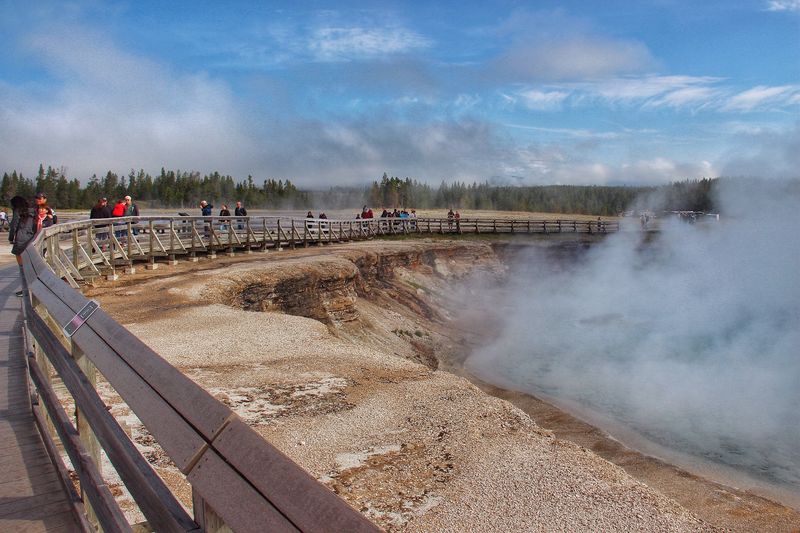
Midway Geyser Basin offers the closest established walking views of Grand Prismatic Spring. The boardwalk leads past Excelsior Geyser Crater and toward the famous blue center and colored runoff areas.
The viewpoint is low, so you will not see the full shape of the spring all at once. Steam may block part of it, and the far edge can disappear behind the curve of the terrain. That is normal for a ground-level visit, not a reason to skip the walk.
There is plenty to notice nearby: shifting vapor, pale mineral surfaces, and orange channels stretching away from the pool. Keep your attention on the walkway as you move, especially where visitors have stopped to take photographs.
Stay together if you are visiting with children. Yellowstone requires visitors to remain on boardwalks and designated trails in thermal areas, and children should stay close to an adult.
Pets are not permitted on thermal boardwalks, so arrange appropriate care before arriving with a dog.
Parking can be limited during busy periods. If the lot is full, continue safely and follow posted directions rather than stopping along the road. Build some flexibility into the day so a crowded arrival does not send you hurrying past the very feature you came to see.
The Fairy Falls Overlook Reveals Grand Prismatic Spring From Above
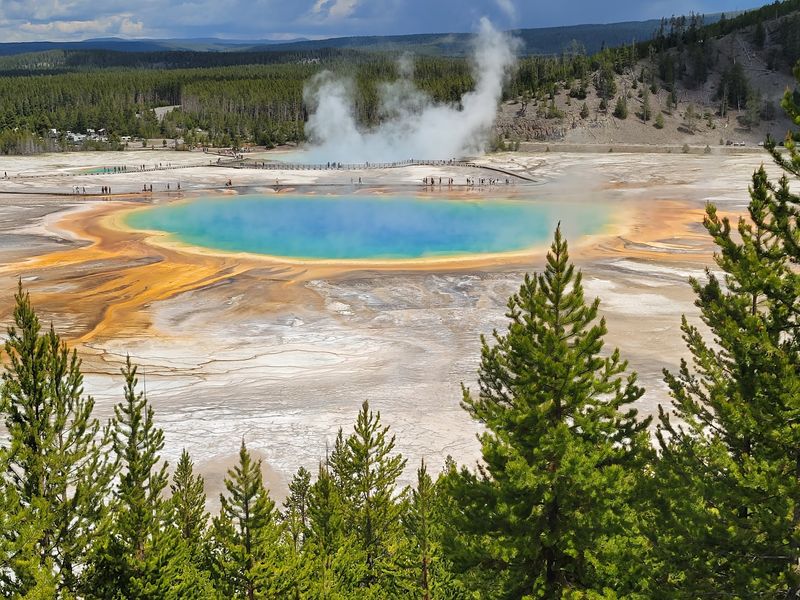
For the broad view of the colored rings, head to the Grand Prismatic Overlook Trail. The walk starts at the Fairy Falls Trailhead, south of Midway Geyser Basin, and follows a designated route up to a hillside viewpoint.
The round trip is about 1.2 miles, with approximately 105 feet of climbing on the way to the overlook. The route is an easy hike, but comfortable shoes and drinking water still make sense.
Here the shape of the spring becomes much easier to see. A deep-blue center sits inside bands of yellow, orange, and other warm shades. Steam may drift across the water, and the surrounding forest helps show just how large the basin is.
Warm, clear weather can make the colors easier to distinguish than a cold, steamy morning. Still, conditions can change, so stay flexible about your photo plans. The hillside is a viewpoint, not a place to leave the path in search of a different angle.
The parking area is separate from the Midway Geyser Basin boardwalk lot. If time permits, visit both spots: the boardwalk lets you observe the details at ground level, and the overlook reveals the overall shape.
Together they offer two distinct ways to appreciate the same remarkable spring.
Planning A 2027 Visit To Yellowstone’s Famous Rainbow Hot Spring
A little planning will help you make the most of a 2027 Yellowstone trip. Grand Prismatic Spring is in Midway Geyser Basin, about six miles north of the Old Faithful area.
The boardwalk and the Fairy Falls overlook use different parking areas, so allow time to reach each one separately.
Yellowstone’s road access is seasonal. Many park roads close to regular vehicles during winter, and trail access can also change with conditions. Check current roads, openings, and closures close to your travel date rather than relying on last year’s calendar.
If you have only a short visit, start with the Midway boardwalk. If you can spare extra time and the trail is open, add the overlook. For either option, bring water, comfortable walking shoes, and layers suitable for shifting mountain weather.
Summer can be busy, and parking is limited in both areas. An early start may help with scheduling, but cool mornings can produce heavier steam.
Admission to Yellowstone National Park is required, and entry arrangements may change before 2027. Look over the current park information before leaving, especially if you plan to combine the spring with Old Faithful or other geyser basins.
For navigation, head to Grand Prismatic Spring in Midway Geyser Basin along Grand Loop Road, Yellowstone National Park, Wyoming. Keep to the marked routes, give the colors time to appear between drifting clouds of steam, and enjoy the view.