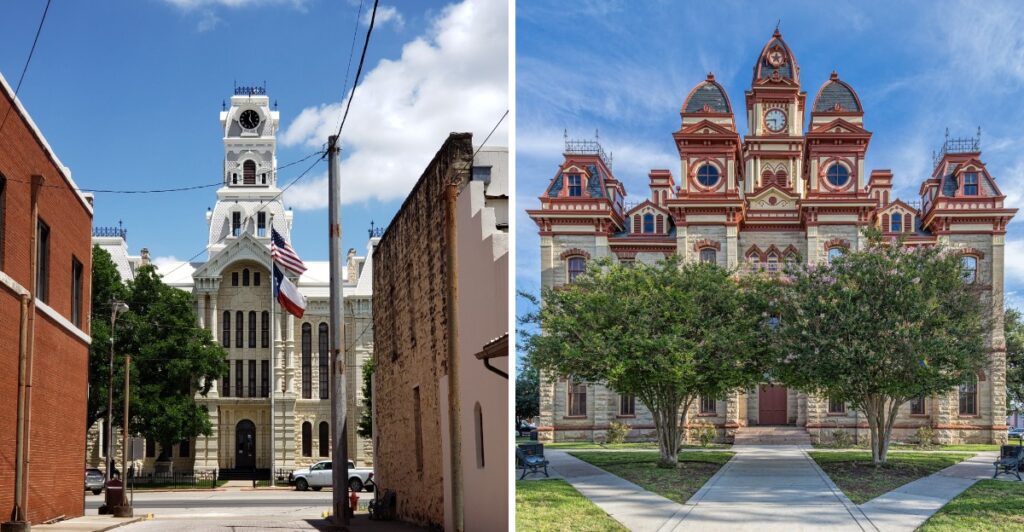
After a New Year’s Day fire tore through one small-town Texas courthouse, a country music star helped bring it back. A guitar helping rebuild a county seat is not a plot twist anyone saw coming.
The surprises keep stacking up, starting with carved stone faces that stare down at the sidewalk.
Hand-painted vault doors from 1891 still guard the records at one stop, while a town rallied to save its tornado-damaged clock tower.
These buildings still hold court, issue records, and anchor squares lined with shops and cafes. Stand at the bottom of the steps and look up, and you’ll feel a little small in the best way.
Texas built palaces for paperwork. Even a parking ticket feels important in a building like this.
1. Denton County Courthouse-on-the-Square Museum
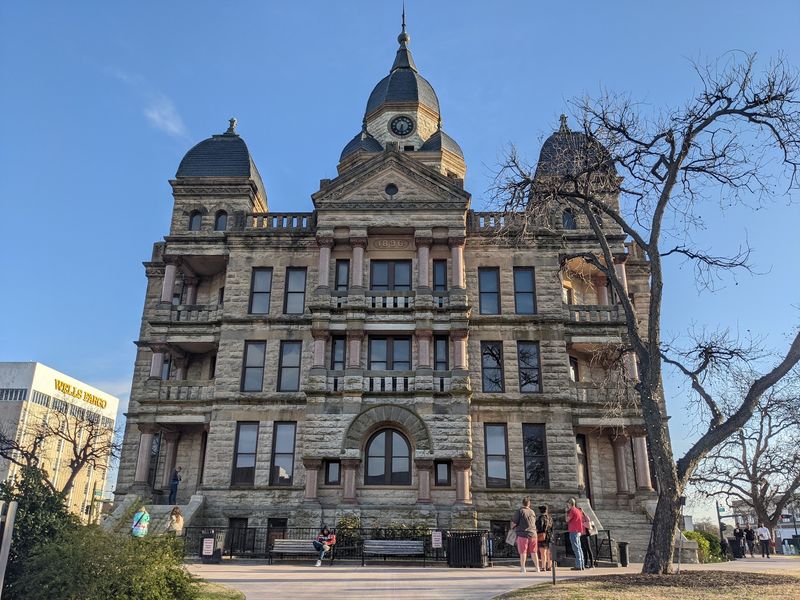
Most courthouses make you wait in line for paperwork, but this one hands you history instead. The old Denton County courthouse now works as a museum right in the middle of town.
Inside, exhibits trace the story of Denton County through objects, photos, and displays. You can learn a lot about the area in one easy visit.
The building itself is the real showstopper, though. Its stone walls, arches, and tower make the interior and exterior worth slow, careful looking.
Bring curious kids along, because the museum is a family-friendly stop. It also offers restrooms and free Wi-Fi, which helps on a long day of exploring.
Once you step back outside, the square takes over. Restaurants, coffee shops, ice cream, and shaved ice line the blocks around the courthouse.
Book lovers can poke around a used bookstore nearby. There is also a candy store paired with a comic shop, which feels like a dream for younger visitors.
Spring and summer bring extra energy to the lawn and streets. Car shows, rallies, outdoor movies, and dog-friendly events pop up during the warmer months.
Plan your visit around the museum schedule. It opens weekdays and Saturdays but stays closed on Sundays.
Arrive early, tour the exhibits, and then grab a snack on the square. That simple plan turns a short stop into a full Texas afternoon.
Address: 110 W Hickory St, Denton, TX 76201
2. Wise County Courthouse
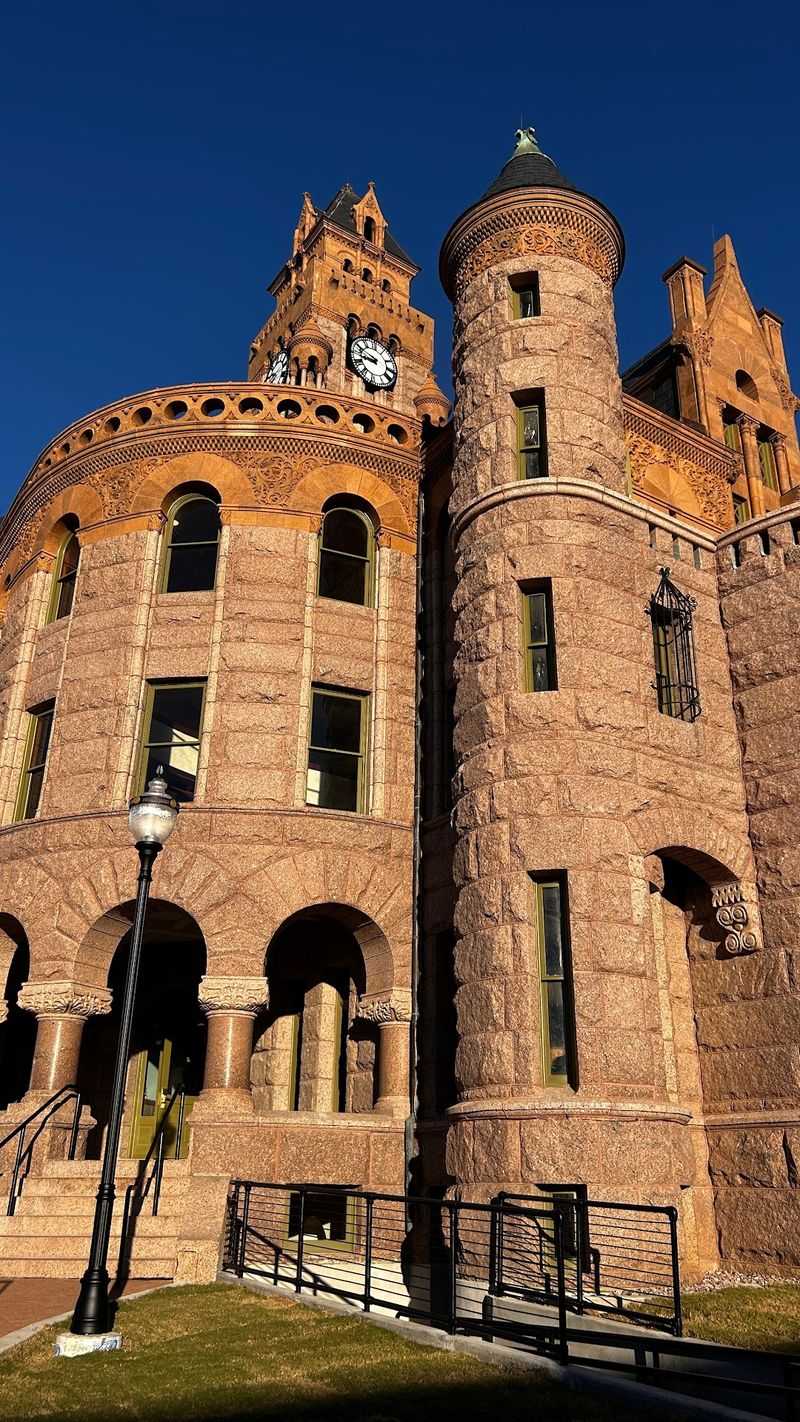
Decatur did not build a courthouse so much as a stone castle with a filing system. The Wise County Courthouse sits right at the heart of the town square.
Its design comes from the Romanesque Revival style, known for heavy stone and rounded arches. The look feels sturdy, bold, and a little dramatic in the best way.
Many people count it among the most beautiful courthouses in Texas. Once you see the towers and carved details, that praise makes sense.
Inside, the building carries the same sense of elegance. Visitors often describe the experience as stepping back into an earlier, grander era.
Remember that this is still an operating county courthouse. Real county business happens here during the week.
The courthouse offices open Monday through Friday at 8 a.m. That early opening makes it easy to explore the courthouse before spending time around Decatur’s historic square.
On-site parking makes visiting fairly simple. You can park, stretch your legs, and circle the building at your own pace.
Look up as you walk around the outside. The rooflines, arches, and window patterns change from angle to angle.
Decatur sits northwest of the Dallas-Fort Worth area. It makes a fine stop on a North Texas road trip full of small-town squares.
Address: 101 N Trinity St, Decatur, TX 76234
3. Ellis County Courthouse
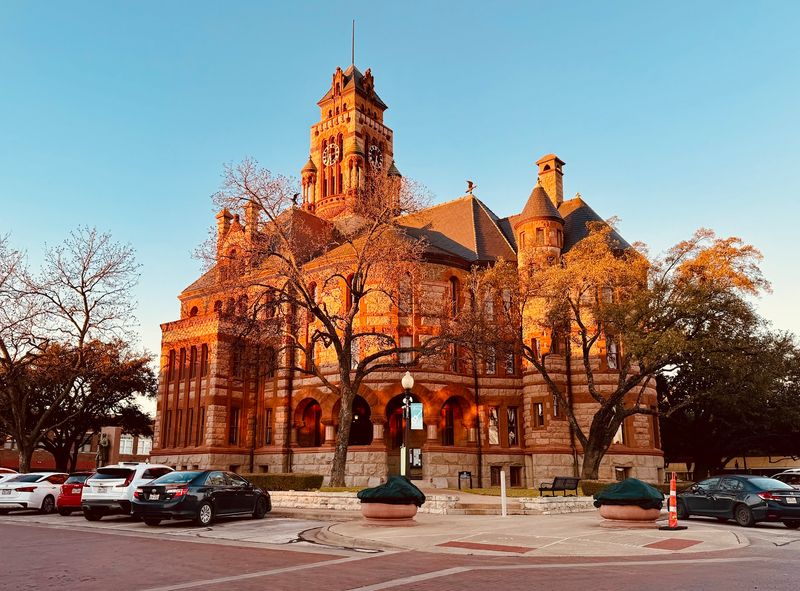
Carved faces watch over Waxahachie, and they’ve been doing it since the 1890s. European stonemasons sculpted those faces into the walls of the Ellis County Courthouse.
The building ranks among the most photographed structures in Texas. Its cornerstone went down on July 4, 1895, and the courthouse opened in 1897.
Architect J. Riely Gordon designed it in the Richardsonian Romanesque Revival style. He used red sandstone along with pink and gray granite.
Four arched entry porches welcome you from each side. The main entrances line up with true north, south, east, and west.
A central square tower rises above fancy gabled dormers and corner turrets. Count the little pointed roofs and see how long you last.
Gordon also planned an open central space reaching up toward the clock tower. It worked like a natural chimney, pulling hot air up and out.
That was clever cooling long before air conditioning showed up. Texas summers clearly inspired some smart thinking.
Downtown Waxahachie is often called the Gingerbread City. Antique shops and specialty stores fill the blocks around the square.
Bring a good camera and comfortable shoes. You’ll want close shots of the stone faces and wide shots of the whole tower.
Address: 139 W Main St, Waxahachie, TX 75165
4. Parker County Courthouse
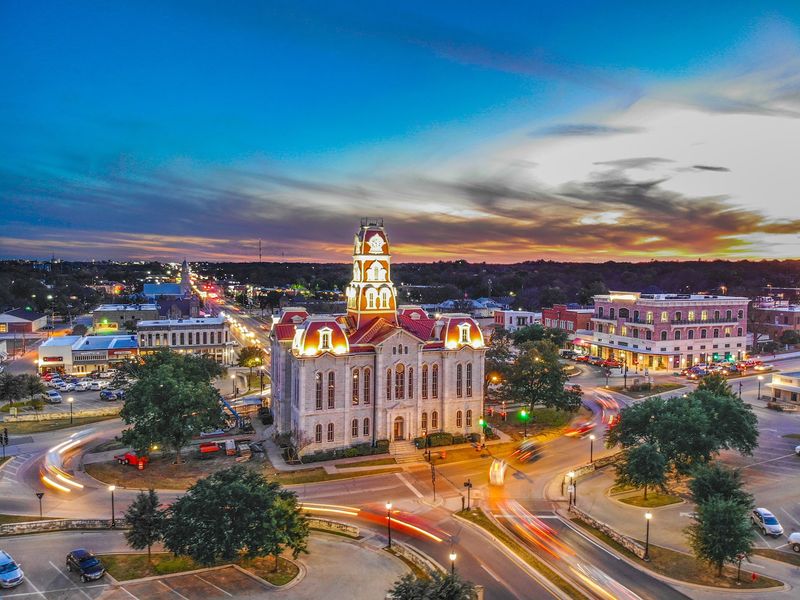
Some buildings get a street address, but this one gets the whole square. Its address is simply 1 Courthouse Square, which tells you exactly who runs downtown Weatherford.
The Parker County Courthouse is a restored 19th-century landmark. Its stonework and tall tower rise above the surrounding streets like a proud grandparent.
Restoration brought the old details back into sharp focus. You can spot careful craftsmanship from the base of the walls up to the top of the tower.
Here’s a fun twist for history fans. The building still holds an active courtroom, so it works as hard today as it did long ago.
That means you should be respectful during business hours. Court staff and visitors are there for real cases, not just photos.
The best views often come from the sidewalks across the street. Walk a full lap around the square to see each side of the building.
Morning light makes the stone glow nicely for pictures. Late afternoon can add soft shadows to the windows and trim.
The courthouse keeps weekday hours and closes on weekends. If you want a peek inside, plan a Monday through Friday trip.
Weatherford makes an easy day trip from the Fort Worth area. Pair your courthouse stroll with lunch downtown for a relaxed outing.
Address: 1 Courthouse Sq, Weatherford, TX 76086
5. Hood County Courthouse
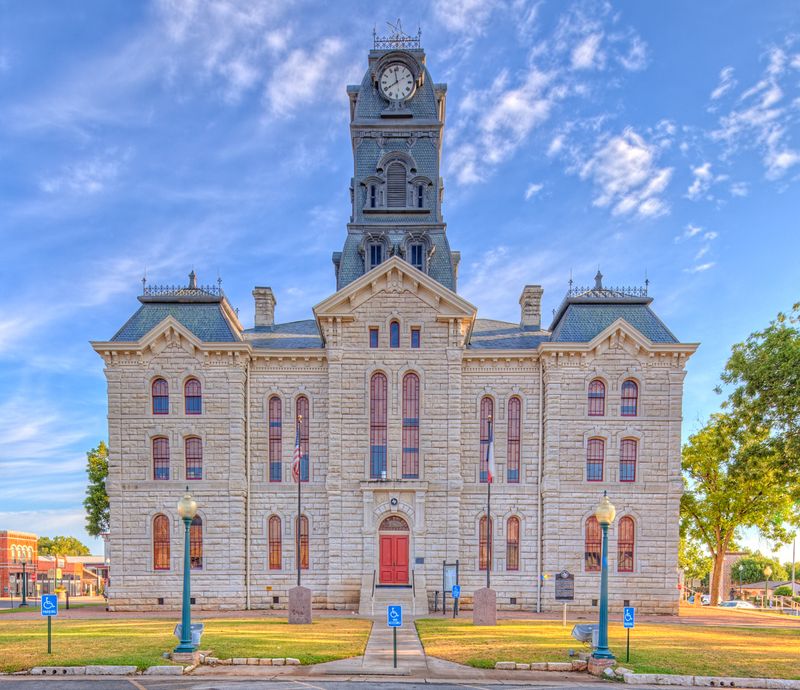
A 1968 tornado slammed the clock tower here, but Granbury refused to let it stay broken. A grassroots effort led to its restoration.
That community spirit fits the building perfectly. The Hood County Courthouse was finished between 1890 and 1891.
W.C. Dodson designed it in the French Second Empire style. Builders used native Brazos limestone for the walls.
A three-story clock tower rises from a fancy mansard roof. Ornamental sheet metal decorates the tower and cornice.
The front is split into neat sections, including an entry pavilion and end pavilions. That layout gives the building balance from every side.
Inside, a real treat waits for detail lovers. Five original vault doors and two safes from 1891 remain, covered in hand-painted designs.
Who knew a vault door could be art? Those painted panels prove that even storage got the fancy treatment back then.
The square around it is a National Historic District. It’s known as one of the most complete 19th-century courthouse squares in Texas.
One and two-story limestone buildings line the streets in matching style. Strolling here feels like flipping through an old photo album.
Address: 100 E Pearl St, Granbury, TX 76048
6. Fayette County Courthouse
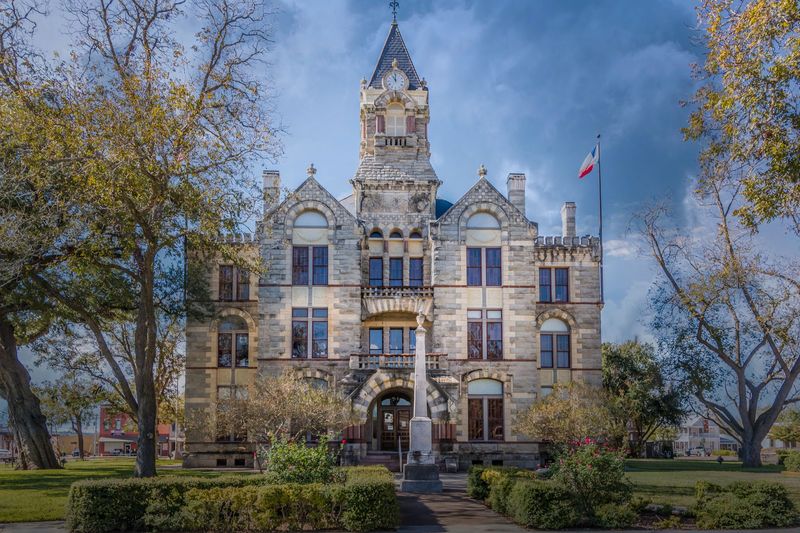
Granite and limestone from Texas came together in 1891 to build La Grange a seriously handsome courthouse. The result still anchors the town square today.
J. Riely Gordon, the same architect behind Waxahachie’s showpiece, designed this one too. You can see his love for bold stone and big arches.
The Romanesque Revival style gives the building a solid, steady look. Thick walls and rounded openings make it feel built to last centuries.
Color plays a big role here. The mix of stone tones creates bands and patterns across the walls.
Stand back from the building for the best view. The tower and rooflines look most impressive from across the street.
This remains an active county courthouse. Visitors should keep quiet voices and respect people handling official business.
The building opens on weekdays and closes on weekends. Restrooms are available inside during open hours.
La Grange sits along the Colorado River between Austin and Houston. That location makes it an easy stop on a Central Texas drive.
Take time to walk around the square after your visit. The courthouse looks a little different from each corner, so every lap feels fresh.
Address: 151 N Washington St, La Grange, TX 78945
7. Caldwell County Courthouse
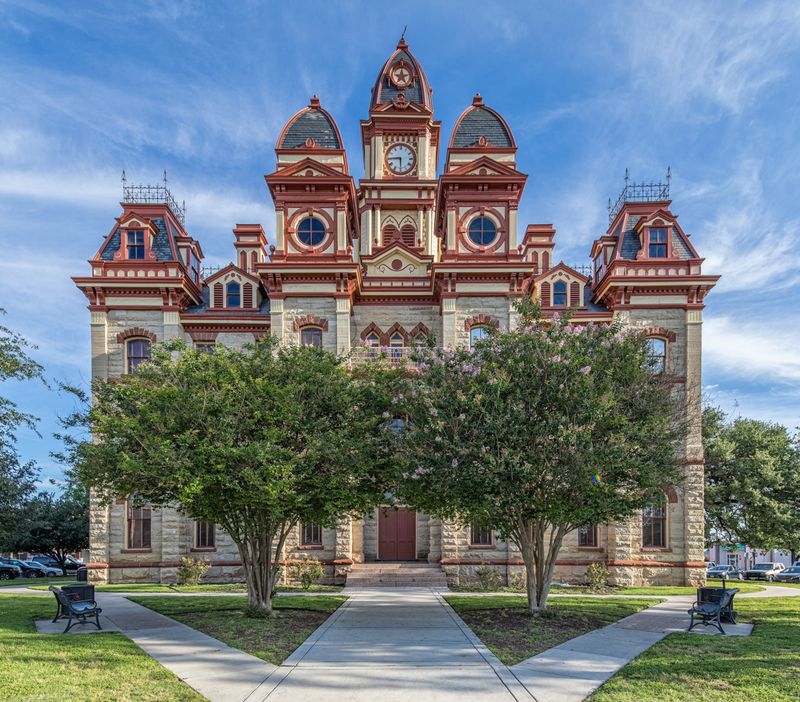
Lockhart’s courthouse has a twin, and it lives about two hours south. Its design is nearly identical to the Goliad County Courthouse.
The courthouse’s design is often credited to Henri E.M. Guidon, though some historical sources attribute it to architect Alfred Giles.
Workers finished the building between 1893 and 1894.
Pale limestone covers the outside, with red sandstone trim adding sharp contrast. The combo looks a bit like a fancy layered cake.
Second Empire style shows up in the mansard-roofed towers on each corner. More towers frame the north and south entrances.
The center tower holds a four-faced Seth Thomas clock. It also houses a bell weighing about 900 pounds.
Back in the day, this courthouse came with electricity. That was a big deal for a county building in the 1890s.
A restoration in 1999 and 2000 helped keep the landmark in great shape. It still houses county offices today.
The surrounding historic district is packed with late 19th-century commercial buildings. It’s considered one of the finest courthouse square districts in Texas.
Parking is easy, with a free lot and free street spots around the square. Take a slow lap and admire the old storefronts after you see the clock.
Address: 110 S Main St #201, Lockhart, TX 78644
8. Williamson County Courthouse
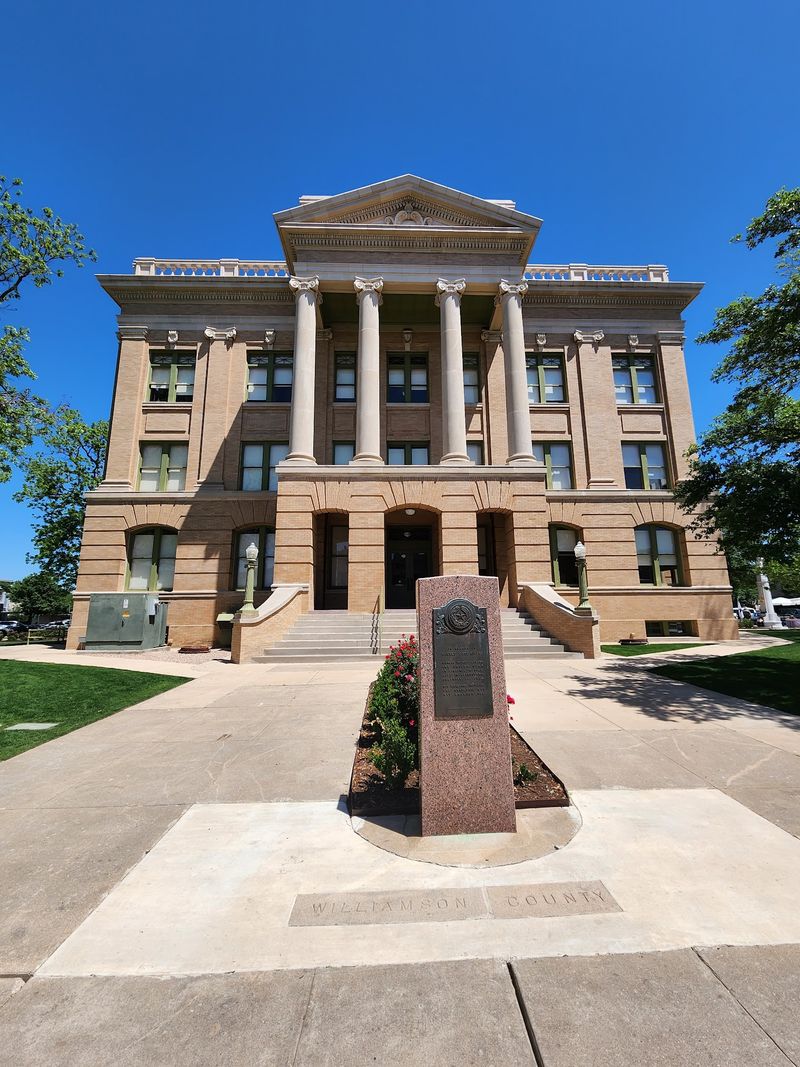
Over two thousand custom terra cotta pieces went into bringing this beauty back. The 2007 restoration recreated details lost during a 1960s makeover.
Georgetown’s courthouse was completed in 1911. The Austin firm Charles H. Page and Brother designed it in Classical Revival, or Beaux-Arts, style.
Buff brick forms the main walls. Terra cotta and limestone details dress it up like a building headed to a formal dinner.
Now look up at the top. A patinated copper dome holds a four-faced clock and a statue of Themis, the goddess of divine law.
She has stood watch over the square for decades. Not a bad job title, honestly.
The courthouse anchors the Williamson County Courthouse Historic District. That district is known for its intact Victorian commercial buildings.
Independent stores, boutiques, restaurants, and a theater surround the square. You could easily spend a whole afternoon here.
Georgetown also calls itself the Red Poppy Capital of Texas. Red poppies bloom around town in spring.
The courthouse is open weekdays, and a free parking lot helps. Visit in spring if you can, and catch the poppies plus the dome in one trip.
Address: 710 S Main St, Georgetown, TX 78626
9. Lavaca County Courthouse
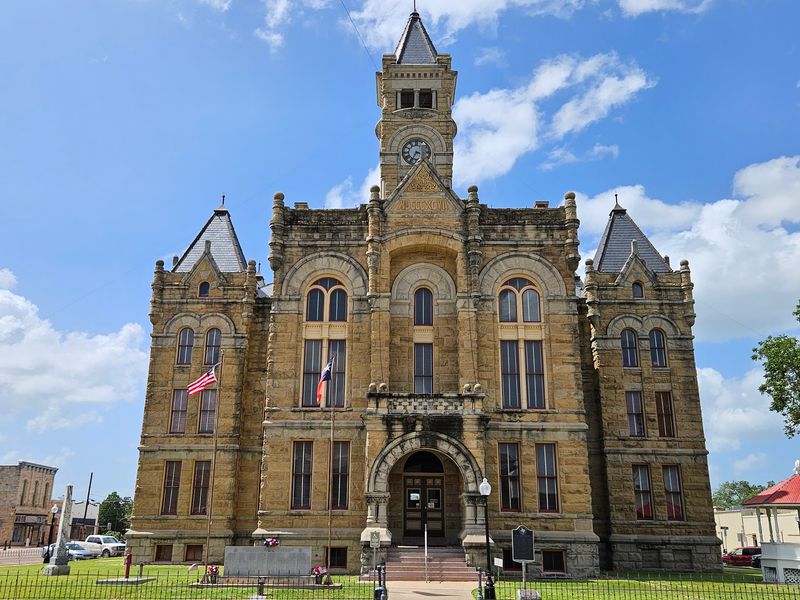
Hallettsville borrowed a little style from Pittsburgh, and it paid off. This courthouse was strongly influenced by H.H. Richardson’s Allegheny County Courthouse.
Eugene T. Heiner designed the Lavaca County version. Construction wrapped up between 1897 and 1899.
The three-story building uses yellow and gray limestone. Its Richardsonian Romanesque look feels heavy, strong, and very grand.
A tall central clock tower rises above the square. Below it, a central entry porch sits between square towers.
Steep pyramidal slate roofs cap those towers. Dormers and a hipped roof add even more shape to the skyline.
The floor plan forms a cross shape. That design lets the building show off impressive faces in several directions.
Plan a holiday trip if you love sparkle. Each Christmas season, hundreds of white lights cover the courthouse for the Festival of Lights.
The glow makes the square look like a storybook scene. It’s a great excuse for an evening stroll with family.
Antique shops and local eateries surround the courthouse year-round. Browse a few stores, grab a bite, then circle back for one more look at that tower.
Address: 109 N La Grange St, Hallettsville, TX 77964
10. Hill County Courthouse
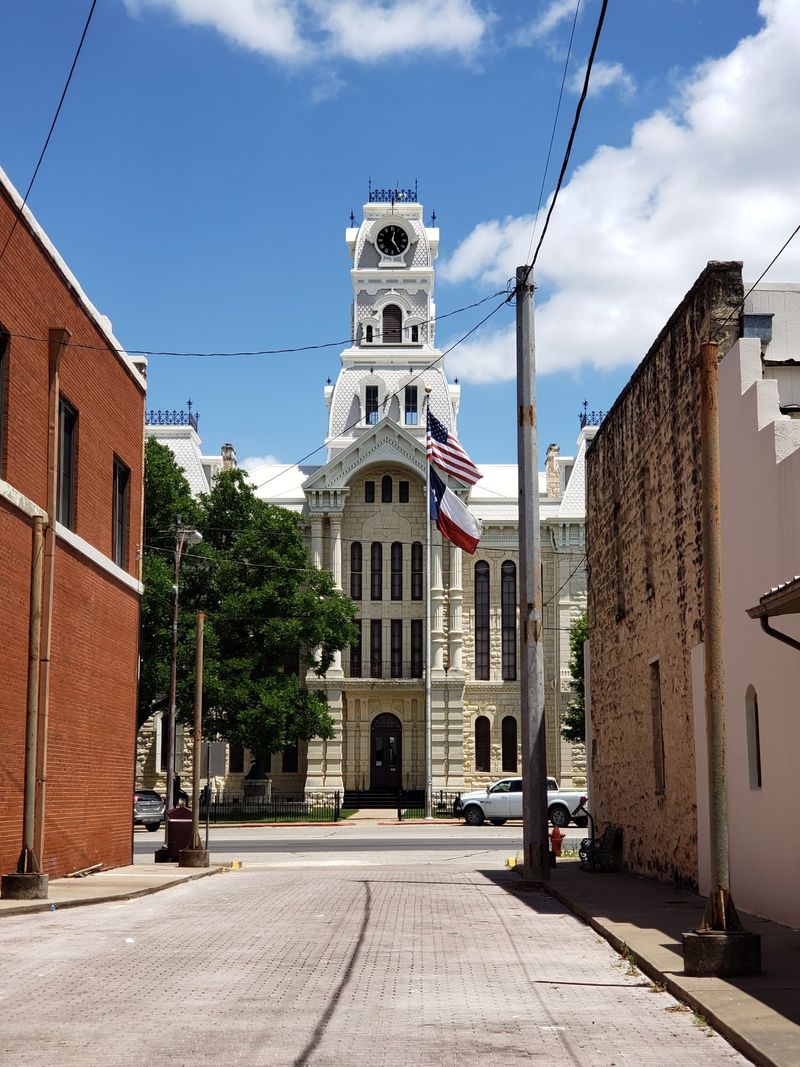
Willie Nelson helped bring this courthouse back to life, and that alone earns it a spot on any road trip. A fire badly damaged it on New Year’s Day in 1993.
The Hill County native held a benefit concert to support the rebuilding. Restoration finished a few years later, and the landmark reopened.
The original building dates to 1890. W.C. Dodson designed it in the Second Empire style.
Limestone walls give it a soft, pale glow in sunlight. A tall central tower pokes high into the sky above Hillsboro.
Mansard roofs and decorative trim show off classic Victorian flair. The details reward anyone willing to stop and stare a while.
The courthouse still serves Hill County as its official seat. Business hours run Monday through Friday.
Restrooms are available while the building is open. Weekend visitors can still enjoy the outside views from the square.
Hillsboro sits right along Interstate 35 between Dallas and Waco. That makes it one of the easiest detours in Texas for courthouse fans.
Pull off the highway, walk the square, and look up at that tower. A building saved by a community and a country song deserves a few minutes of your time.
Address: 1 N Waco St, Hillsboro, TX 76645