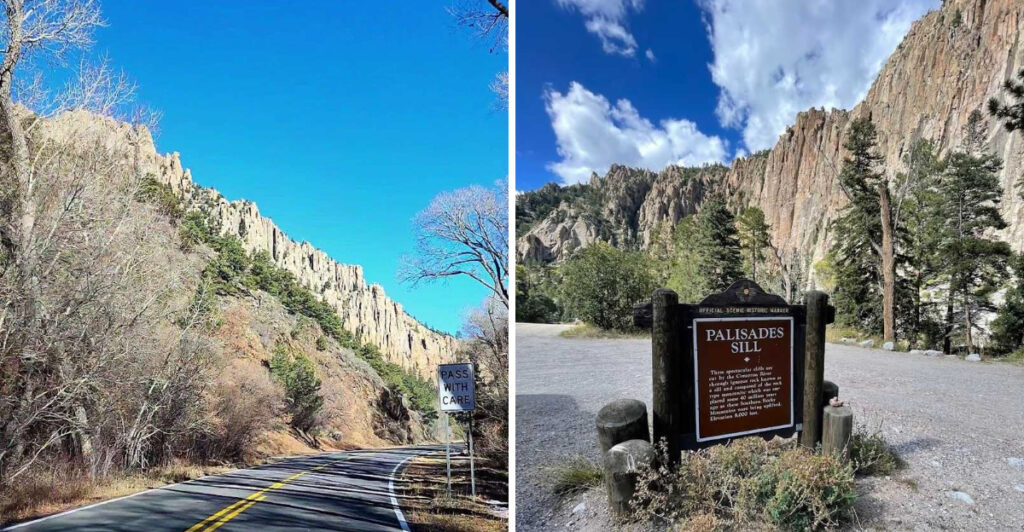
You know those road trips where one curve suddenly makes everyone in the car go quiet? This canyon stop does exactly that.
One minute, you are following a mountain highway through tall rock walls. The next, a massive cliff face is staring back at you like it has been waiting millions of years for your reaction.
In a way, it has. This formation began around 25 to 40 million years ago, when magma moved between older rock layers, cooled below the surface, and slowly fractured into the chunky wall you see today.
It is science, but it feels more like a movie scene when you are standing under it. The stop is simple too.
Pull in and look up. That is the whole plan, and it works.
In northern New Mexico, this quick roadside break turns a regular drive into a story people retell before the day is even over.
Towering Cliffs Above The Canyon Road
Some roadside pulls feel like afterthoughts, but this one stops you cold the moment those cliffs fill your windshield.
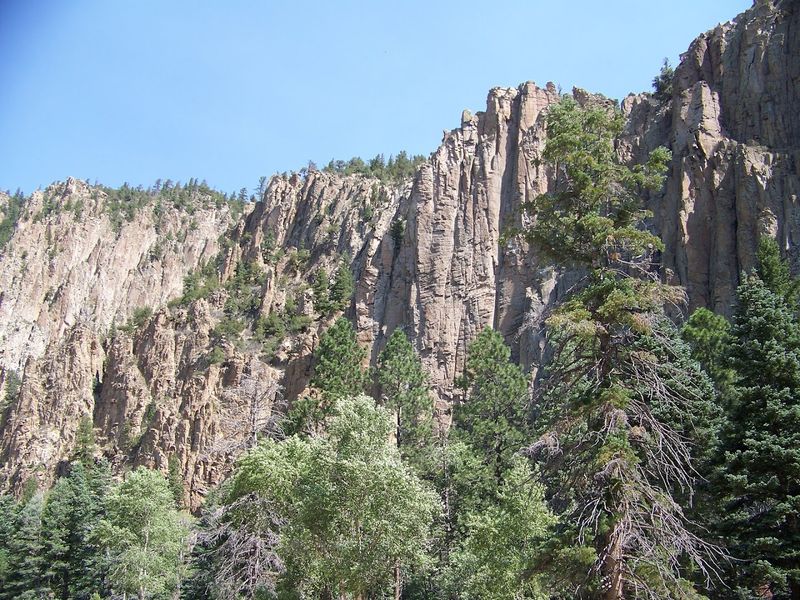
The Palisades Sill rises between 300 and 400 feet above the canyon floor, and the sheer vertical scale of the rock face hits differently when you are standing at its base looking straight up.
The cliffs are composed of fine-grained porphyritic dacite, which means you can spot visible crystals embedded in a smoother matrix if you look closely at the exposed surfaces.
Geologists also refer to the rock as monzonite or biotite-diorite porphyry, and each name hints at a slightly different mineral story locked inside those ancient walls.
As the intrusive magma cooled millions of years ago, it contracted and fractured perpendicular to its cooling surfaces, which is exactly why the cliff face looks so blocky and castle-like today.
Visitors have compared the crenellated top edge to the battlements of an old fortress, and once you see it, that image is impossible to unsee.
You will find this geological masterpiece at the Palisades Sill Historic Marker, Cimarron Canyon State Park, 28869 US-64, Eagle Nest, NM 87718.
River Views Beneath Ancient Rock Walls
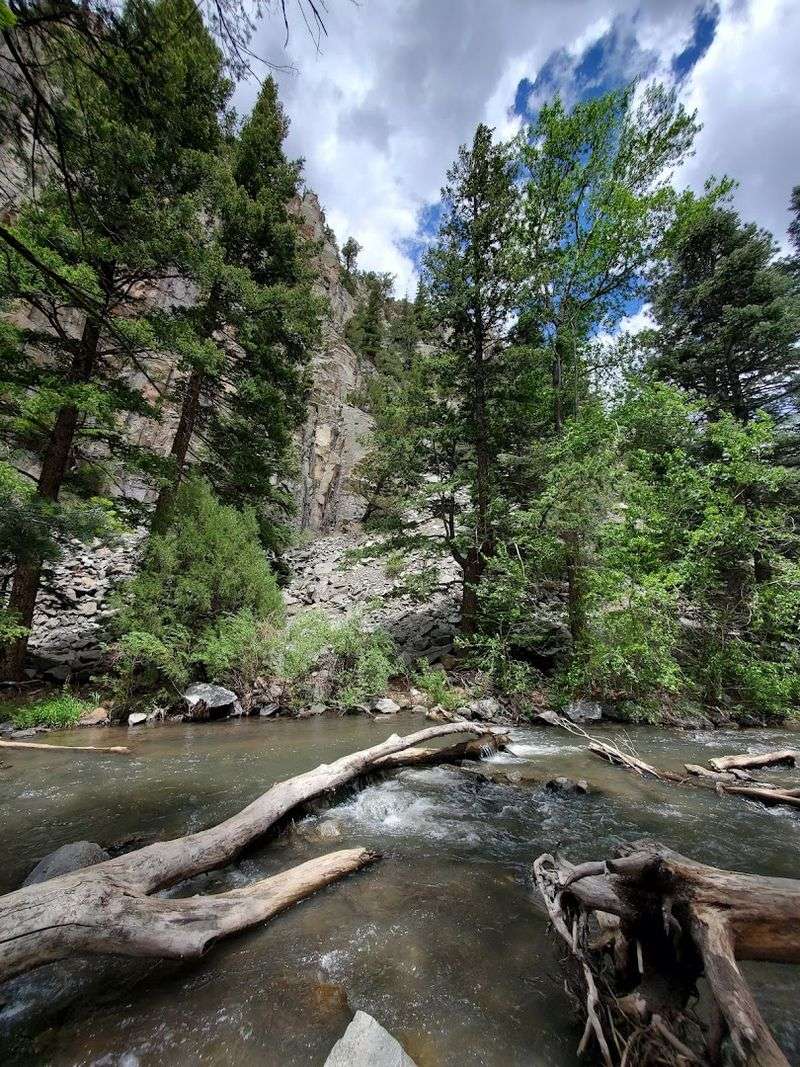
Right below those jaw-dropping cliffs, the Cimarron River moves quietly through the canyon, and the combination of rushing water and ancient stone creates a scene that feels almost impossibly peaceful.
The river has been carving through this canyon for millions of years, and the Palisades Sill cliffs are largely a product of that patient, relentless erosion working against the hard igneous rock.
Trout fishing is a genuine highlight along this stretch, with rainbow and German brown trout stocked in the narrow, cold river, making it a favorite among anglers who know exactly where to look.
The Cimarron is narrow here, so fishing spots feel intimate rather than crowded, and the sound of the current moving over rounded stones adds to the overall calm of the stop.
Even if fishing is not your plan, simply sitting near the water while those massive walls loom overhead is a restorative experience that requires zero equipment and zero expertise.
New Mexico has no shortage of dramatic river corridors, but few pair geology this ancient with water this accessible from a roadside pull-off.
The river view alone justifies the stop on any mountain drive.
A Quiet Pull-Off With Massive Views
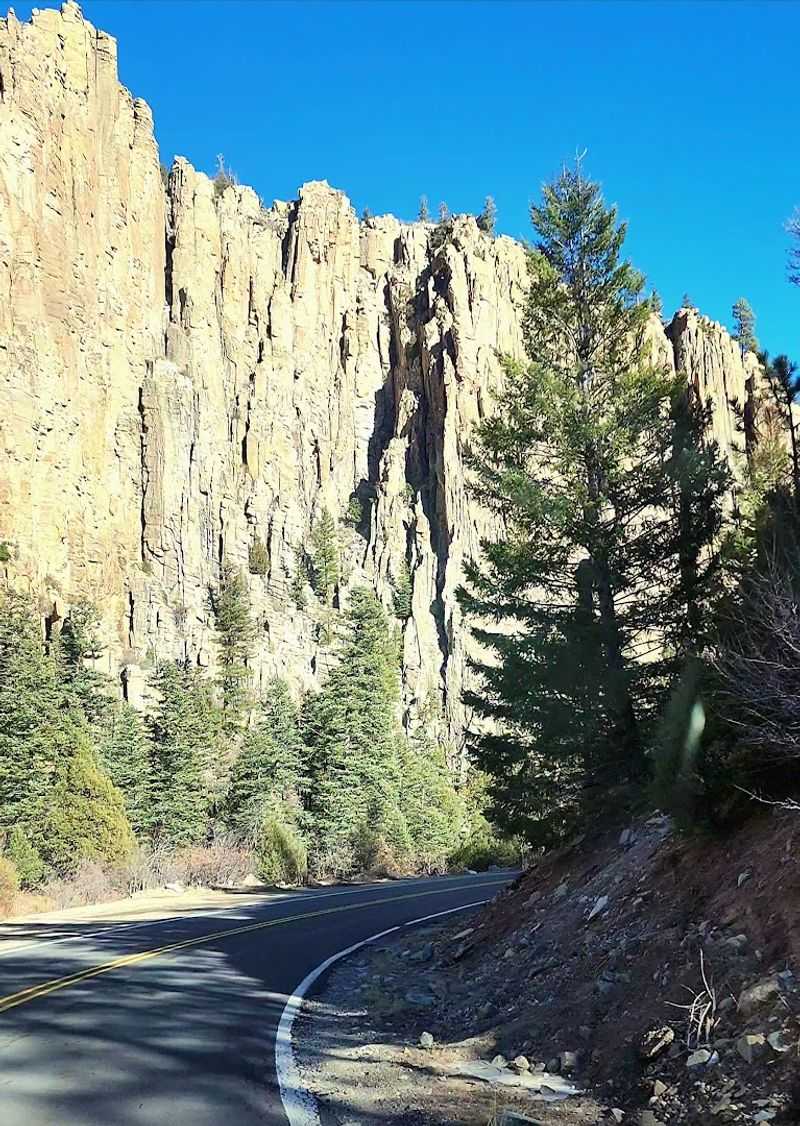
Not every spectacular viewpoint comes with convenient parking, but this one actually does, and that practical detail matters more than people admit.
A large parking lot sits across the highway from the main cliff face, giving drivers a safe and easy place to stop without squeezing onto a narrow shoulder or blocking traffic.
Restroom facilities are available on-site, which transforms a quick glance into a genuine break, especially welcome if you have been driving the mountain roads for a while without a stop.
The pull-off is positioned so that even before you step out of the car, the view through the windshield already earns its keep, with the full height of the Palisades framing the horizon ahead.
Once outside, the scale becomes even more real as the canyon walls seem to press closer and the forest floor opens up toward the river.
Families, solo travelers, and road-trip groups all find this stop easy to navigate, and the short walk from the parking area to the cliff base is manageable for most visitors.
A well-placed pull-off like this one quietly makes a great view into a great memory.
Jagged Stone Rising From The Forest
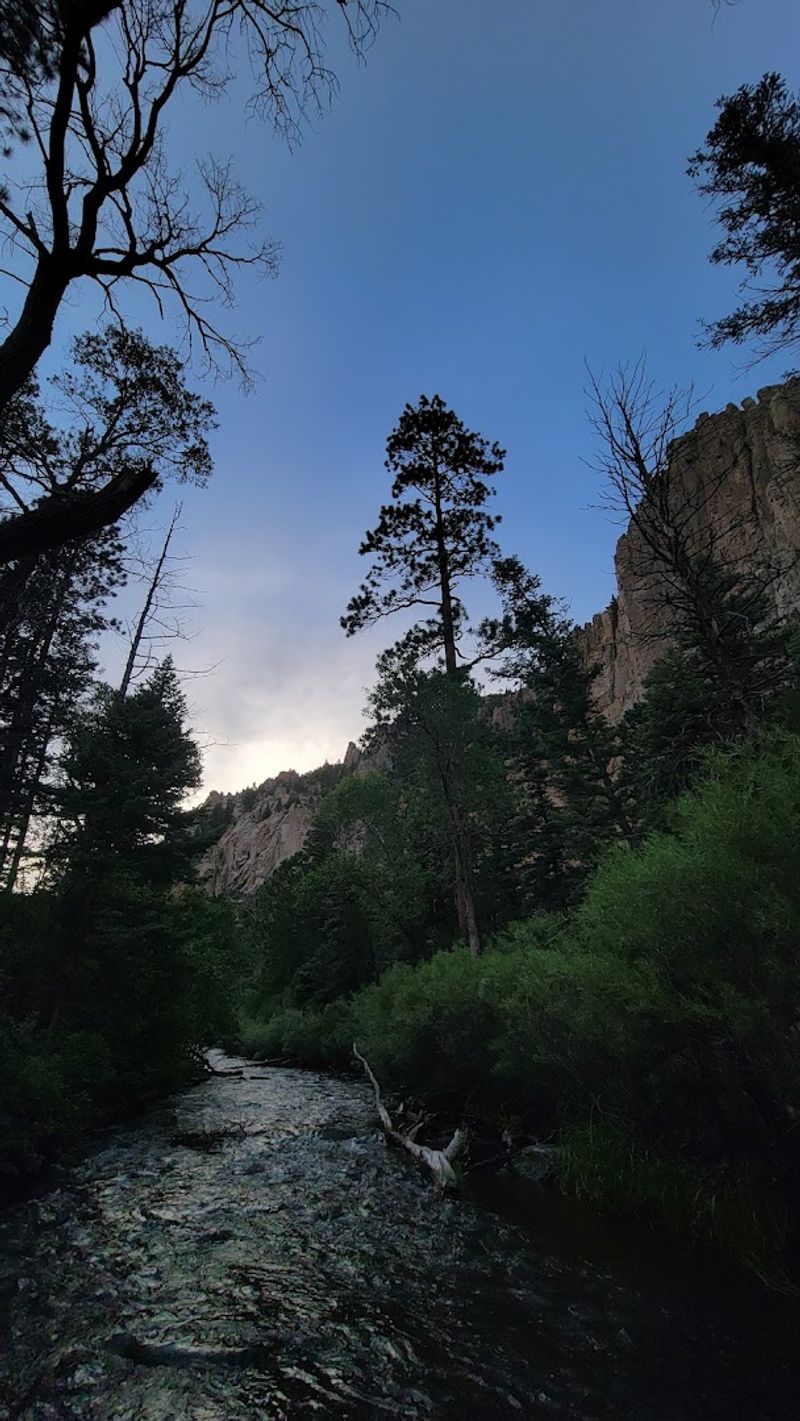
Walk toward the base of the formation and the forest suddenly parts to reveal rock that looks like it was stacked by something far older and more patient than anything human hands could manage.
The Palisades Sill formed during the Tertiary period, somewhere between 25 and 40 million years ago, when magma intruded horizontally between existing layers of sedimentary and metamorphic rock rather than punching straight through them.
That horizontal intrusion is what makes this an igneous sill rather than a dike, and the distinction matters because it explains the flat-topped, layered look of the upper cliff profile.
As the magma cooled and solidified, it contracted and cracked in patterns perpendicular to the cooling surfaces, producing the sharp, angular blocks and columns that now define the cliff face.
The surrounding forest of pine and mixed conifers creates a vivid contrast with the pale gray and tan rock above, making photographs from this angle look almost too dramatic to be real.
New Mexico geology is famously complex, but few spots make that complexity so visually immediate and accessible without a single textbook in sight.
The jagged skyline above the trees here is one you will keep thinking about long after the drive is done.
Golden Light On The Canyon Walls
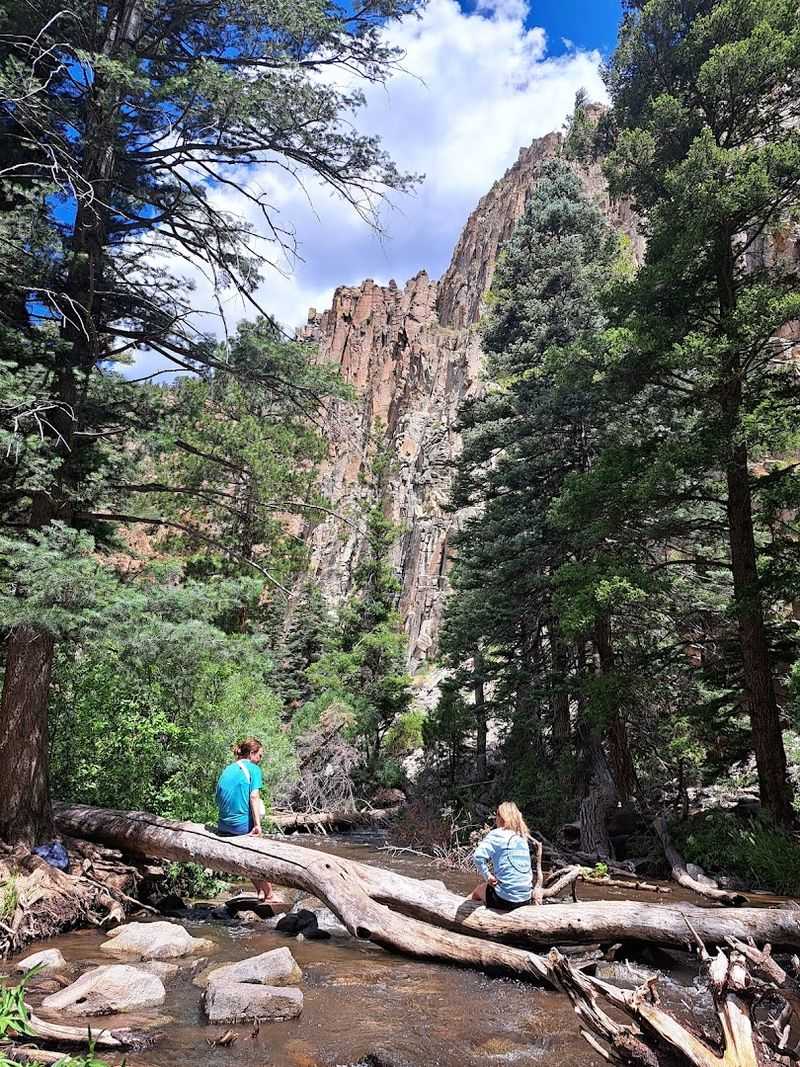
Timing your visit to catch the late afternoon sun on these cliffs is one of the quieter tips that regulars pass along without making a big deal of it.
When the light drops low and hits the canyon walls at an angle, the pale dacite rock warms to shades of amber and rust that no midday photo can replicate.
The texture of the fractured rock becomes far more pronounced in angled light, with every crack and crystal catching shadow in a way that makes the cliff look almost three-dimensional against the sky.
Morning light from the east works well too, bouncing off the river surface and throwing soft reflections up toward the lower sections of the formation.
Photographers who have visited multiple times tend to agree that the canyon walls reward patience, and that the difference between a flat snapshot and a genuinely stunning image often comes down to waiting an extra hour.
The Cimarron Canyon is oriented in a way that gives you usable golden-hour light during both morning and evening, depending on which direction you are traveling along US-64.
Good light here does not just improve a photo; it changes the entire mood of the stop.
A Scenic Stop With Wild Geology
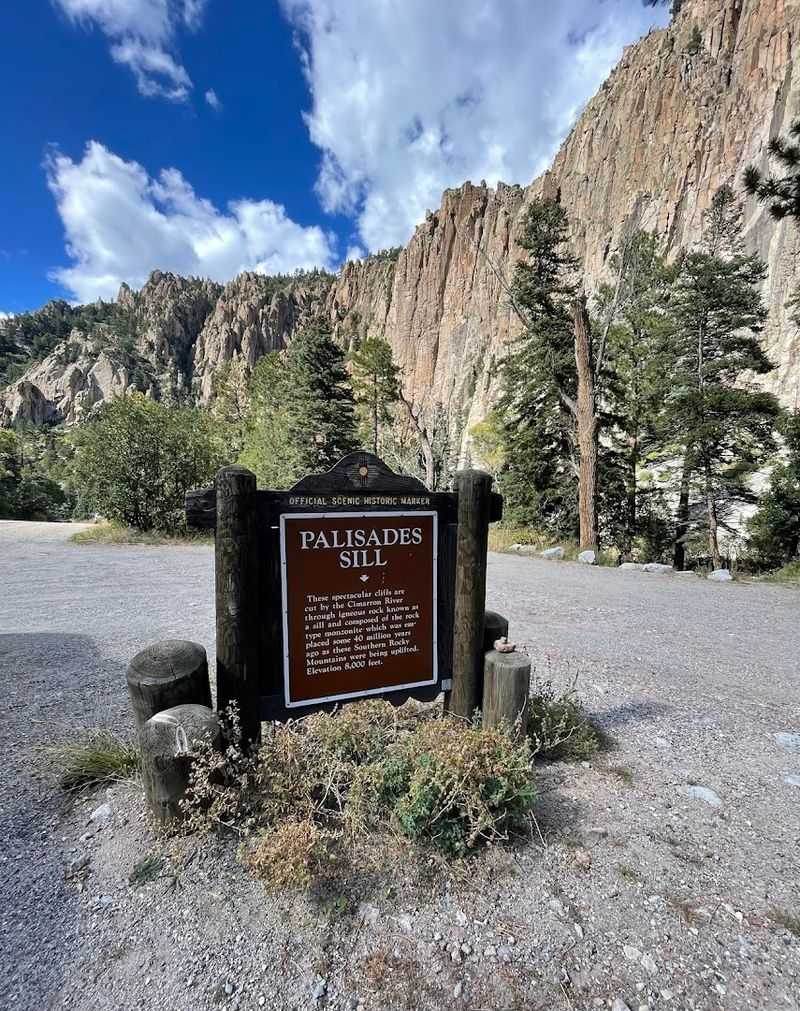
The historic marker at this stop does more than just name the formation; it gives you a quick crash course in geology that actually makes the view more interesting, not less.
Cimarron Canyon itself preserves nearly two billion years of geologic history, with ancient Proterozoic rocks found to the south and younger Tertiary rocks to the north, divided by the Fowler Pass fault running through the canyon.
That fault line is not just a scientific detail but a genuine boundary between two completely different chapters of Earth history, and the Palisades Sill sits right in the middle of that story.
The sill is widely considered the crown jewel of Cimarron Canyon State Park, which stretches for eight miles through the Colin Neblett Wildlife Area and draws visitors for its trout fishing, wildlife, and hiking opportunities.
Reading the marker and then looking up at the cliffs creates a satisfying loop where information and experience reinforce each other in a way that most roadside stops never achieve.
New Mexico has plenty of scenic drives, but very few include a geology lesson this well delivered and this dramatically illustrated by the landscape itself.
Wild geology has rarely felt this welcoming to a curious passerby.
Rocky Views Along The Mountain Highway
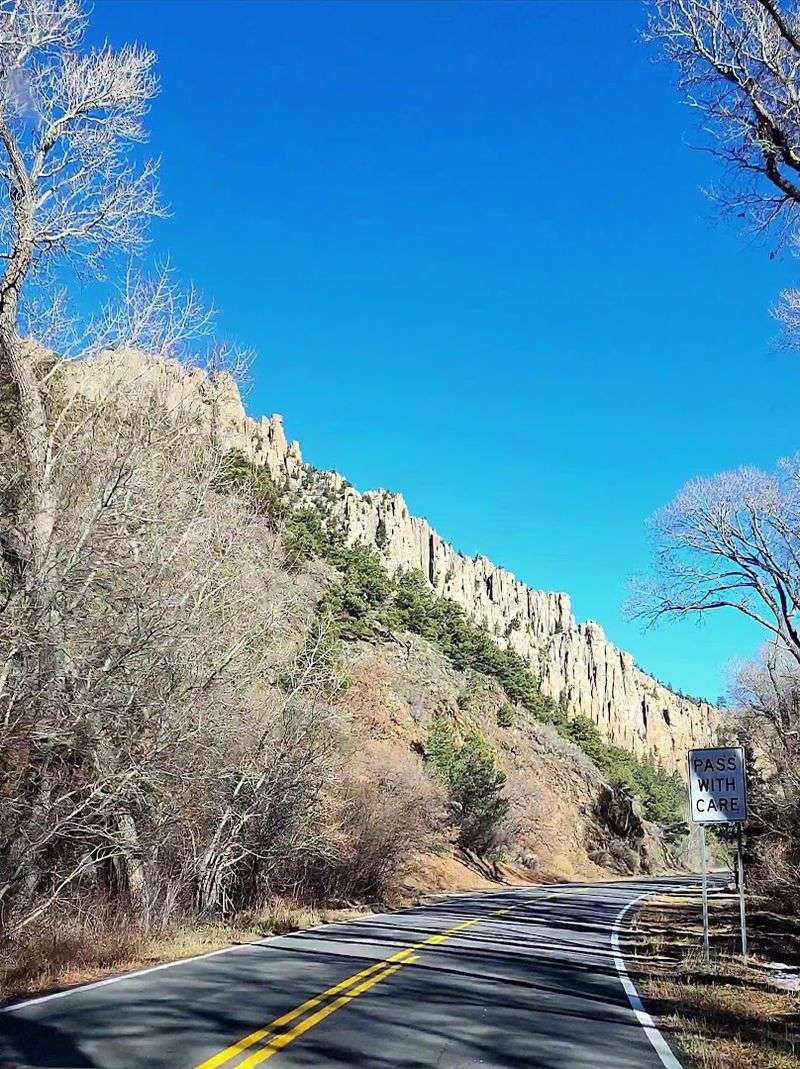
Driving US-64 through Cimarron Canyon is one of those road experiences that earns its reputation simply by delivering what it promises at every bend.
The highway runs between Eagle Nest and Cimarron in northern New Mexico, threading through a narrow canyon corridor where the rock walls close in on both sides and the sky shrinks to a ribbon above.
The Palisades Sill appears suddenly on the right side of the road when traveling west, and the visual impact of those cliffs appearing at highway speed is genuinely startling in the best possible way.
Even drivers who have made this trip before tend to slow down at this section, partly out of caution and partly because the view demands a moment of attention.
The highway itself is well-maintained and accessible, making the canyon route a practical alternative to busier interstates while also delivering scenery that no interstate could ever match.
Wildlife sightings along this stretch are common, with deer, elk, and various bird species often visible from the road, adding another layer of interest to the drive.
Every mile of this mountain highway earns its keep, but the Palisades section is the undisputed high point.
Hidden Corners Beneath The Palisades
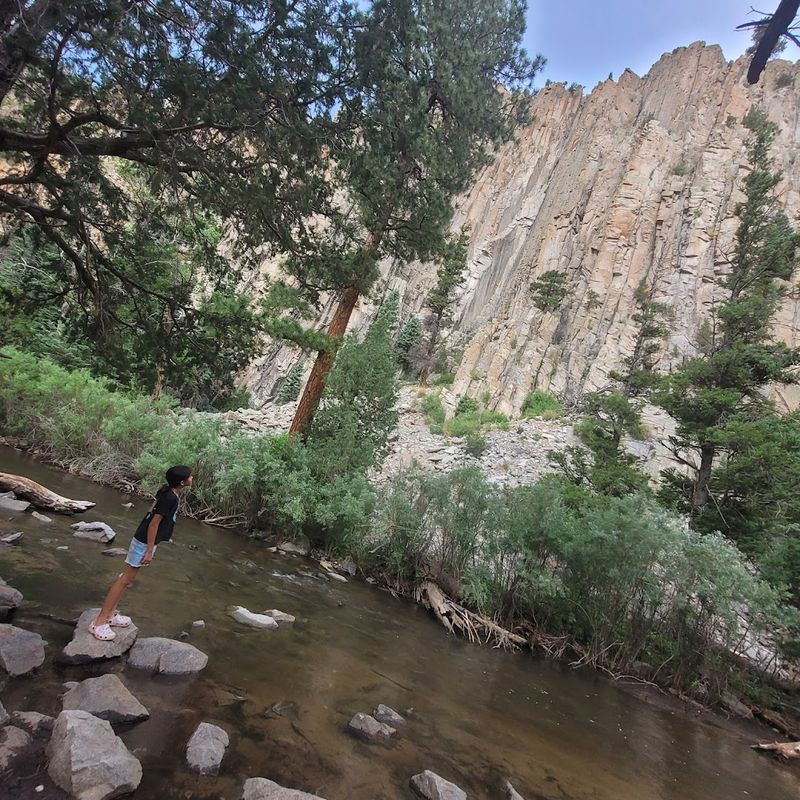
Most visitors stop, look up, take a photo, and move on, but the ones who wander a little closer to the base of the cliffs tend to find details that the highway view completely hides.
Boulders that have broken away from the main formation over thousands of years litter the canyon floor, each one a portable chunk of the same porphyritic dacite that makes up the towering walls above.
Up close, the crystal texture of the rock becomes visible without any special equipment, and the color variation in the stone tells a subtle story about mineral content and cooling history that the cliff face alone cannot convey.
Short trails and informal paths near the pull-off area allow visitors to stretch their legs and get genuinely close to the formation without any technical hiking skills required.
The canyon floor also offers shaded spots where the temperature drops noticeably compared to the open highway, making a longer break feel refreshing rather than just convenient.
Wildlife and birdsong fill the quiet corners here, and the combination of geology, river, forest, and sky creates a sensory experience that photographs simply cannot fully capture.
New Mexico rewards the curious, and the hidden corners beneath the Palisades are proof of that every single time.