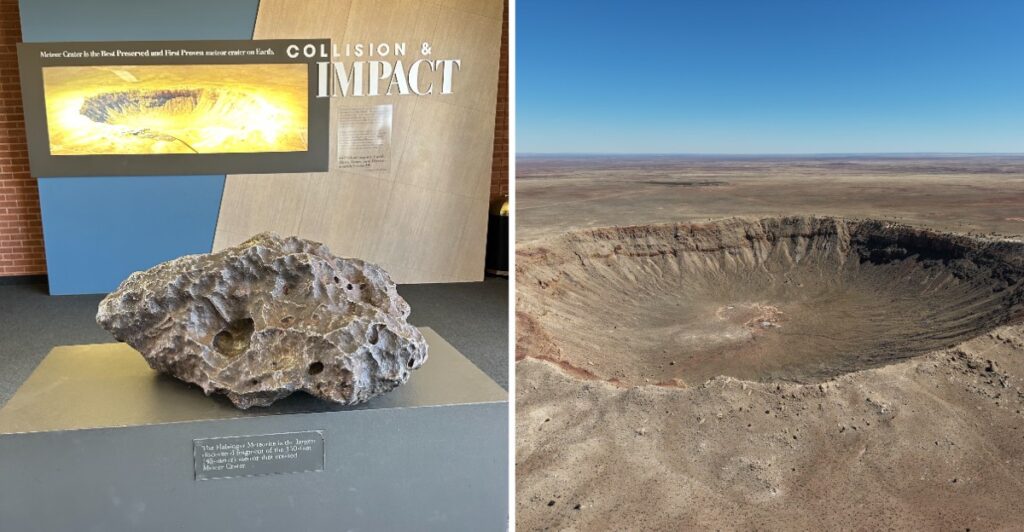
Space really did leave a dent here.
And once you are standing near the rim, the desert starts looking a lot less ordinary.
Something happened on this stretch of the Colorado Plateau thousands of years ago that changed the landscape in a spectacularly permanent way.
What came afterward turned this Arizona site into much more than an unusual view.
Its story eventually caught the attention of scientists and became connected to some surprisingly big moments in exploration.
That is where things get wonderfully strange.
Inside, you can start piecing together what happened and why this enormous mark in the desert became so important.
Then comes the part I would save for last.
Walk outside.
Head toward the rim and try not to peek too early.
Because some places are much more fun when the first reaction is simply:
Wait. That did what?
A Meteorite Formed The Crater About 50,000 Years Ago
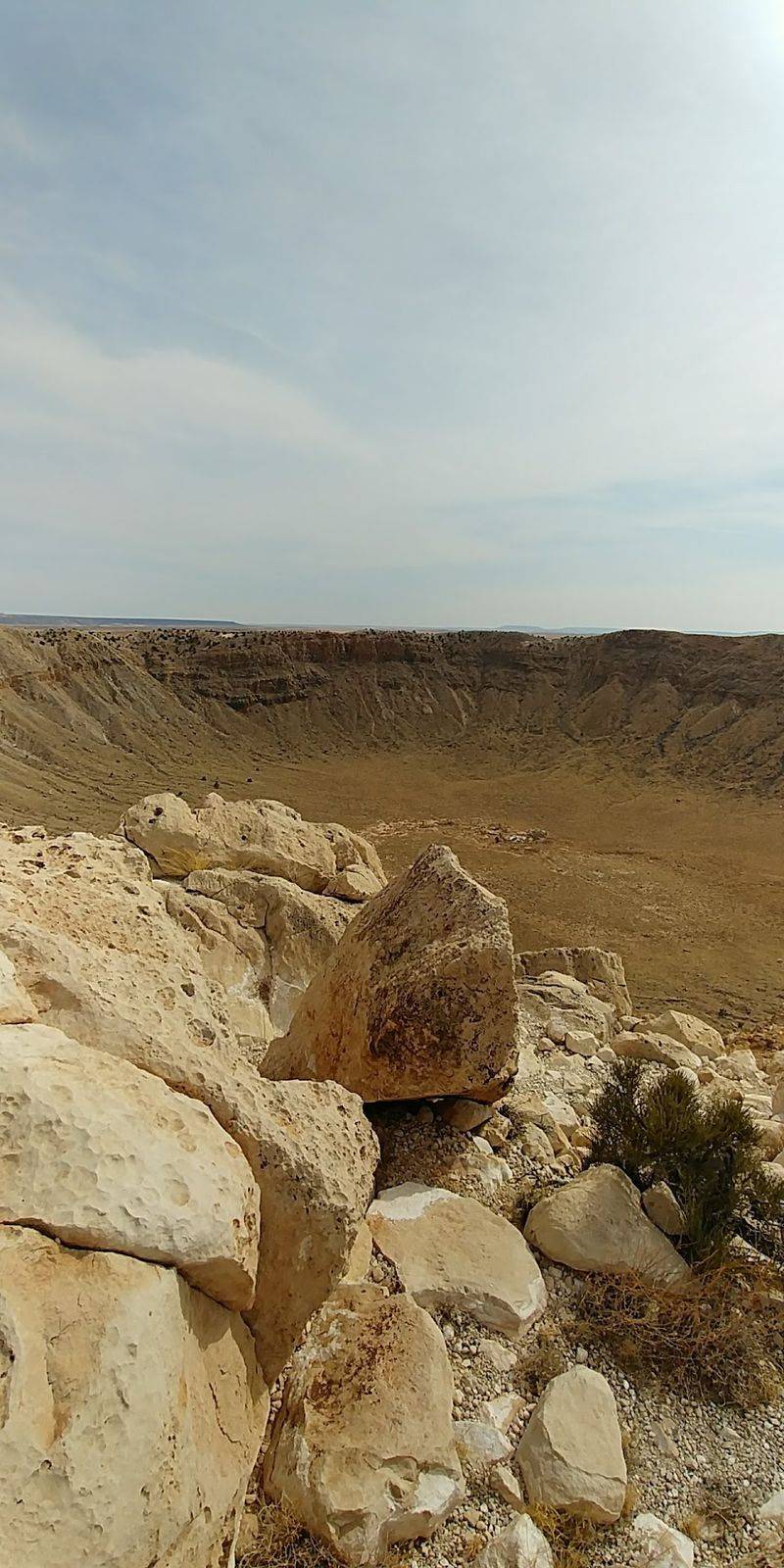
About 50,000 years ago, an iron-nickel meteorite struck northern Arizona at enormous speed.
The impact happened on relatively flat ground, but the energy released in a few seconds changed the landscape permanently. Rock was shattered, excavated, and thrown outward as the crater opened across the desert.
The meteorite itself was much smaller than the cavity it created. Its speed turned that compact mass of metal into an impact powerful enough to move an extraordinary amount of rock.
The result is what scientists often call Barringer Crater, while most travelers know it simply as Meteor Crater.
Those two names refer to the same site.
The crater is one of the best-preserved impact structures on Earth, which is one reason it became so useful to geologists later.
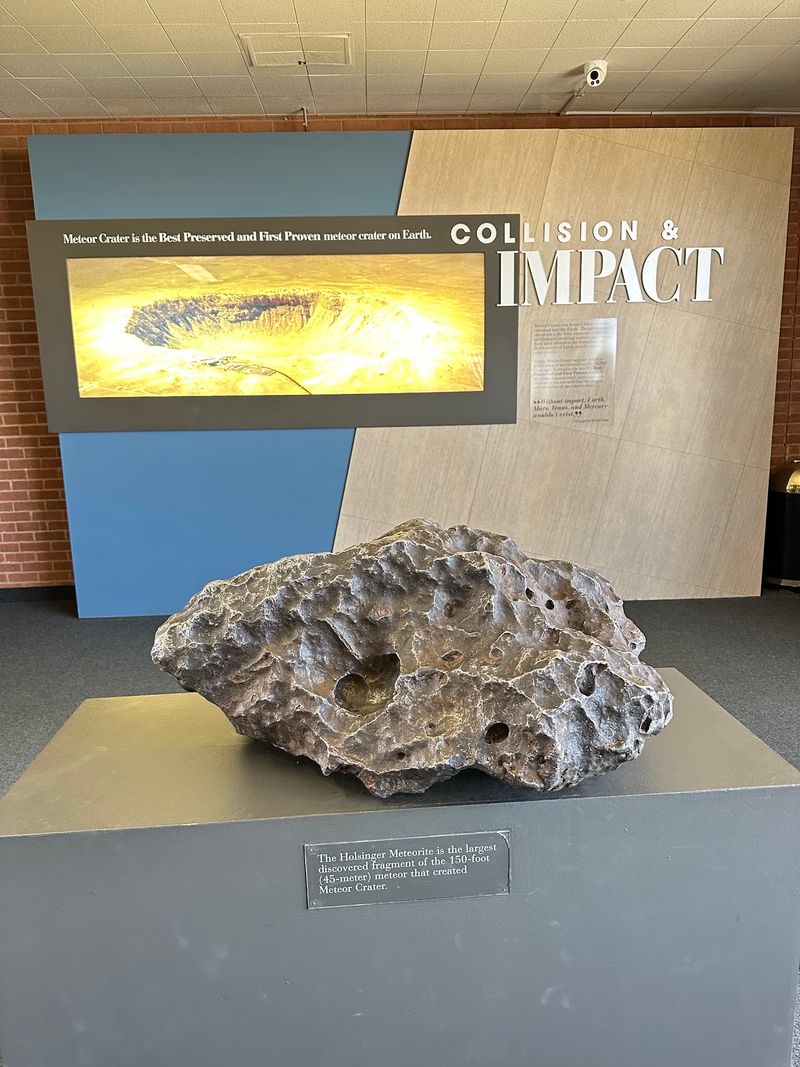
Before heading to the rim, stop at the Discovery Center and look for the Holsinger Meteorite. The 1,406-pound fragment is the largest meteorite piece recovered from the site and gives the impact story a physical scale you can stand beside.
The fragment gives the impact story a tangible scale.
The Impact Left A Scar More Than 4,000 Feet Across
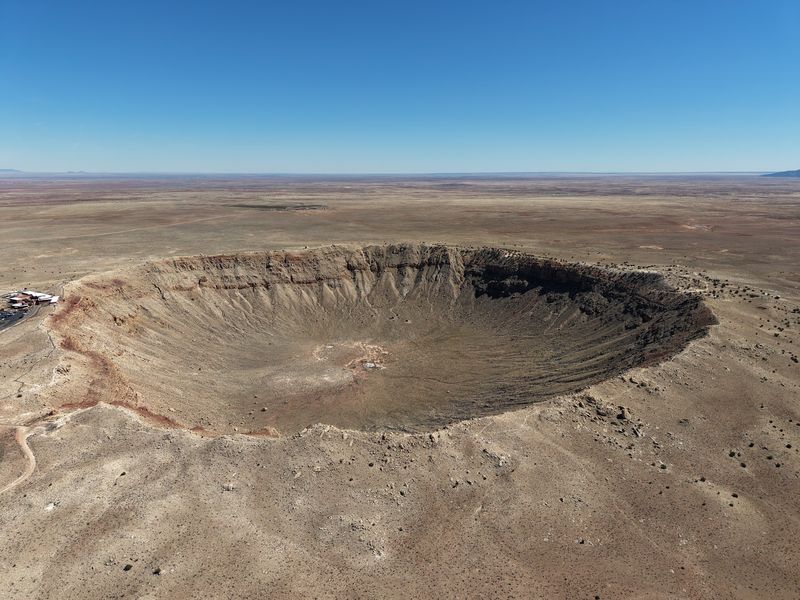
Meteor Crater stretches more than 4,000 feet across and measures roughly 2.4 miles around the rim.
Right after the impact, the crater was about 700 feet deep. Erosion and sediment gradually changed the interior, so the floor now sits much higher than it did immediately after the collision.
The impact excavated an enormous volume of rock, with estimates around 175 million tons thrown from the forming crater.
That material did not simply disappear. Some of it landed outside the rim as ejecta, while other layers were uplifted, folded, and overturned by the force of the blast.
Those details are easier to understand once you start looking across the rim instead of only down into the center.
The opposite side can seem deceptively close until you use familiar objects, structures, or observation equipment to judge the distance.
A wide camera setting helps if you want the whole crater in one frame, while the viewpoints reveal different sections of the rim and floor.
Walk from one viewing area to another and the proportions shift. One angle emphasizes the width, another the depth, and another the raised rim around the edge.
Scientists Used The Site To Understand Impact Geology
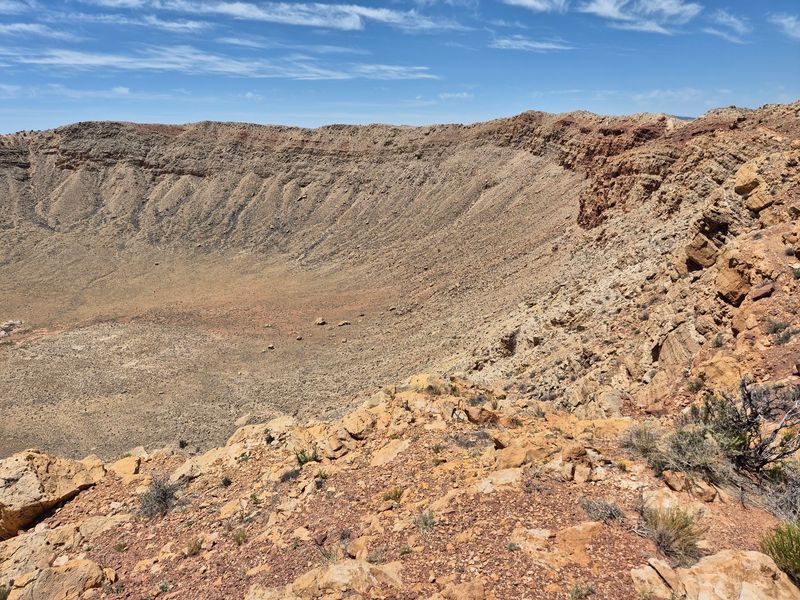
Meteor Crater played a major role in changing how scientists interpreted circular depressions on Earth and elsewhere.
For years, impact craters were not always recognized for what they were. Volcanic explanations were once proposed for Meteor Crater, even though the surrounding geology did not fit that idea particularly well.
Geologist Eugene Shoemaker helped establish the impact origin through detailed field research.
The crater preserved several clues that mattered.
Rock layers around the rim were uplifted and overturned. Shattered material spread beyond the crater. Impact-related structures could be studied directly in exposed rock.
Those features gave geologists a field example of what a high-energy collision does to the ground.
The desert setting helped preserve the crater well enough for those structures to remain visible.
That became useful far beyond Arizona. Similar impact features could be compared with craters on the Moon and other planetary surfaces.
Inside the Discovery Center, exhibits explain the impact process, meteorites, and the crater’s scientific history before you step outside.
Learn what an overturned bed or ejecta deposit means indoors, then look for the same features in the landscape.
Those same features can then be picked out from the rim and surrounding exhibits.
Apollo Astronauts Trained Here Before Going To The Moon
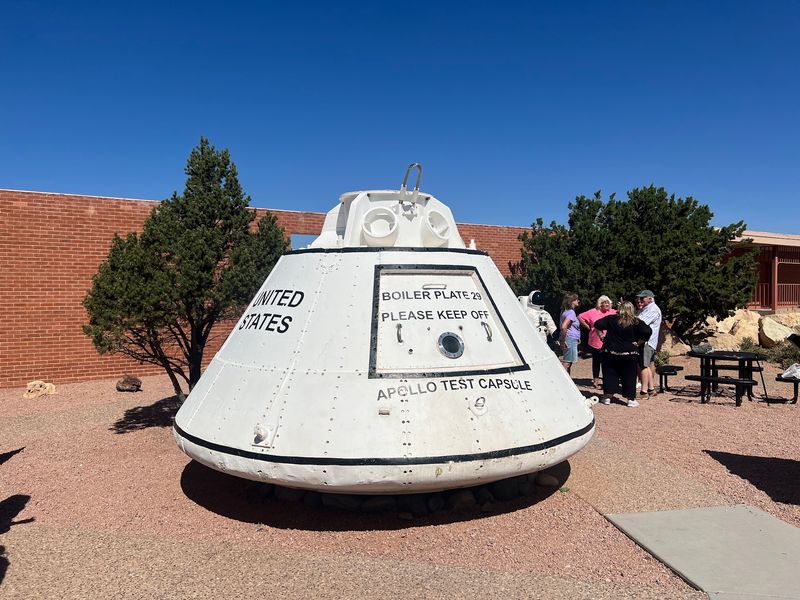
During the Apollo era, Meteor Crater became a practical training ground for astronauts preparing to work on the lunar surface.
NASA astronauts visited the site during the 1960s to learn how to recognize impact-related geology in the field.
That mattered because the Moon is covered with craters, and astronauts needed to do more than simply collect rocks.
They had to identify useful samples, describe what they were seeing, understand how rock units related to one another, and communicate those observations clearly while working against a limited surface schedule.
Meteor Crater offered a real impact structure where those skills could be practiced.
Training included studying ejecta deposits, overturned beds, fallback material, and the relationships between different rock units around the crater.
A documented 1965 field exercise brought a group of Apollo astronauts to the site with Gene Shoemaker and other geologists for hands-on instruction.
The work was part geology lesson, part field discipline.
Astronauts practiced noticing small differences in rock, organizing observations, and describing the terrain in a way that could be useful to scientists.
The same crater you see from the rim also served as a classroom for people preparing to interpret another world.
Gene Shoemaker Helped Turn The Crater Into An Apollo Field Classroom
Gene Shoemaker sits at the center of the crater’s connection to both impact science and astronaut training.
His work helped demonstrate that Meteor Crater formed through a meteorite impact rather than volcanic activity, and that expertise made the site especially useful when NASA began preparing astronauts for lunar fieldwork.
Shoemaker was deeply involved in teaching astronauts how to think like field geologists.
That meant slowing down enough to observe relationships between rocks instead of simply picking up the most unusual specimen nearby.
During training at Meteor Crater, astronauts learned to identify features connected to impact excavation, map what they saw, and describe the order and position of rock units.
Those skills helped astronauts document samples and their geological context during lunar surface work.
On the Moon, a sample without context could tell scientists much less than a sample connected to a clearly described location and surrounding geology.
Shoemaker’s training helped build that habit of observation.
The crater also gave astronauts a place to practice in terrain formed by the same broad process responsible for many lunar features.
You can borrow a small part of that approach on your own visit.
Pick one exposed layer or feature from a viewpoint, follow it with your eyes, and notice how its position changes around the crater.
You do not need a geology degree to start seeing patterns.
The Rim Still Reveals The Scale Of The Ancient Impact
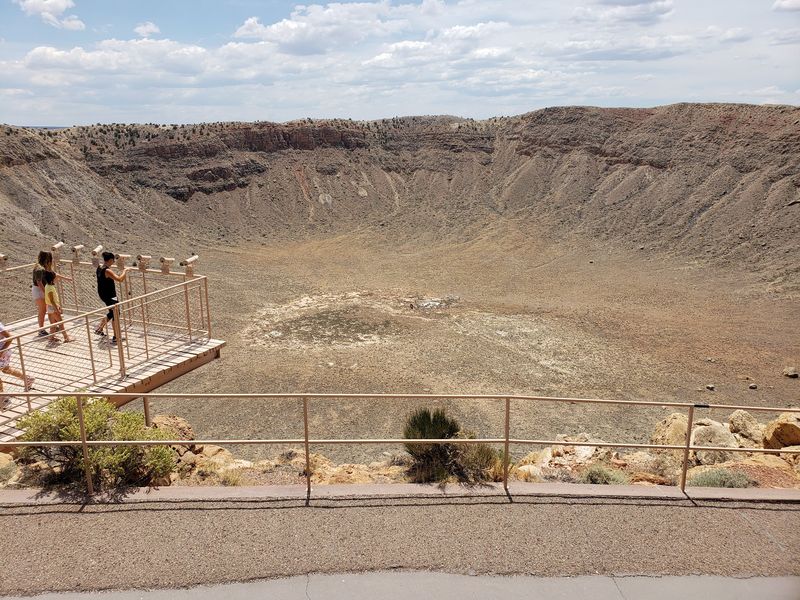
From the rim, the crater floor sits hundreds of feet below a broad ring of uplifted rock.
Several viewpoints let you see the structure from slightly different angles, while guided rim tours add more detail about the impact, exposed geology, and Apollo training history.
The guided rim experience currently runs about 35 to 40 minutes and is included with admission.
Outdoor conditions can change quickly in northern Arizona, so practical planning matters.
Bring water, sunscreen, and a layer for wind or cooler temperatures. The elevation and open exposure can make the rim feel different from the parking area only a short distance away.
If outdoor access is limited by weather, the indoor attractions still give you plenty of context before or after the viewpoints.
The COLLISION! 4D Theater presents the impact story in a more immersive format, while the Discovery Center and Space Museum cover meteorites, planetary science, and exploration.
The 4D Theater is wheelchair accessible, and elevator access is part of the guided-rim experience.
Floor tours into the crater are currently paused for trail restoration, so plan around the rim rather than expecting to descend to the crater floor.
Visitors Can Explore The Science From Several Viewing Areas
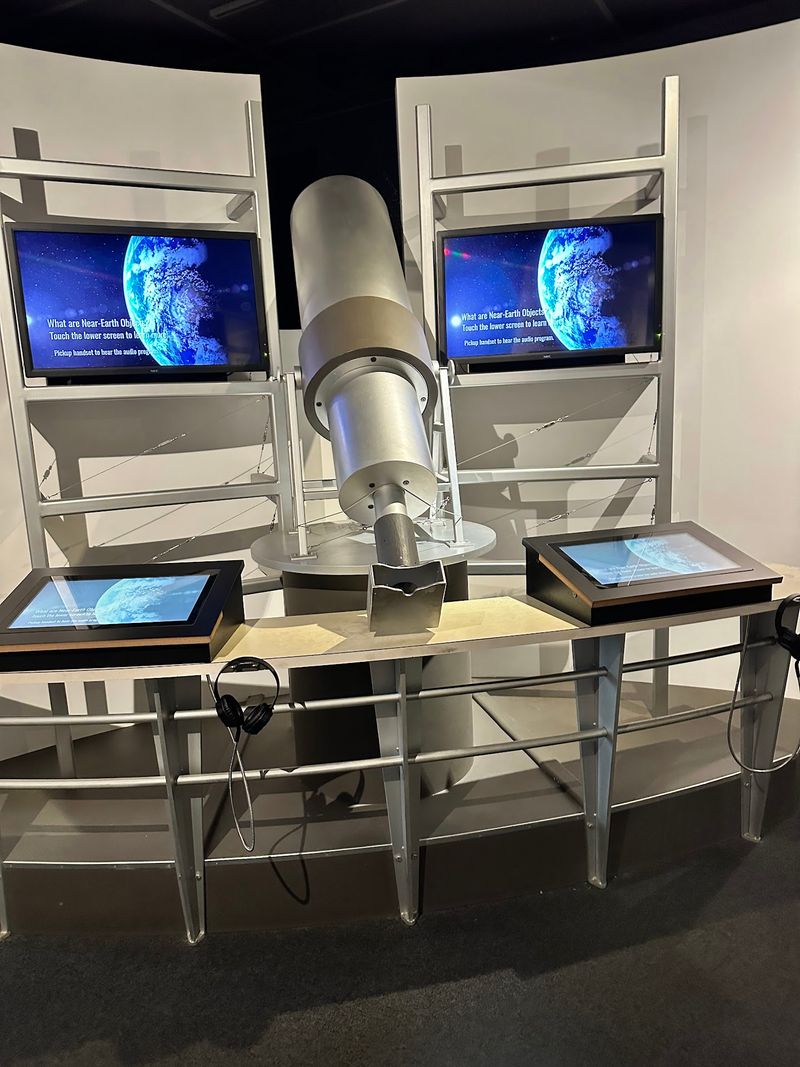
A visit can move between indoor exhibits and outdoor viewpoints without turning into an all-day expedition.
The Discovery Center and Space Museum cover the crater’s formation, meteorites, space exploration, and the scientific work connected to the site.
The Blast Zone gives younger visitors a more hands-on area, while the COLLISION! 4D Theater adds a short immersive experience centered on the impact.
Outside, multiple viewing areas open onto the crater from different positions along the developed rim.
Guided rim tours add another layer if you want the geology explained while you are looking directly at it.
The Holsinger Meteorite, lookout points, Apollo-related displays, and space exhibits make it easy to divide the visit between science and scenery instead of choosing one or the other.
Meteor Crater Natural Landmark is at Interstate 40, Exit 233, Winslow, AZ 86047.
Current daily hours are 8 a.m. to 5 p.m., with holiday exceptions, so checking the schedule before a long drive is sensible.
The site also has a gift and mineral shop and food service for visitors.
Driving from Flagstaff, the interstate turnoff keeps the stop straightforward for a northern Arizona road trip.
Start indoors if you want the geology first. Head to the rim first if the weather is clear.
Either way, the same impact story follows you from the meteorite fragment to the edge of the crater.