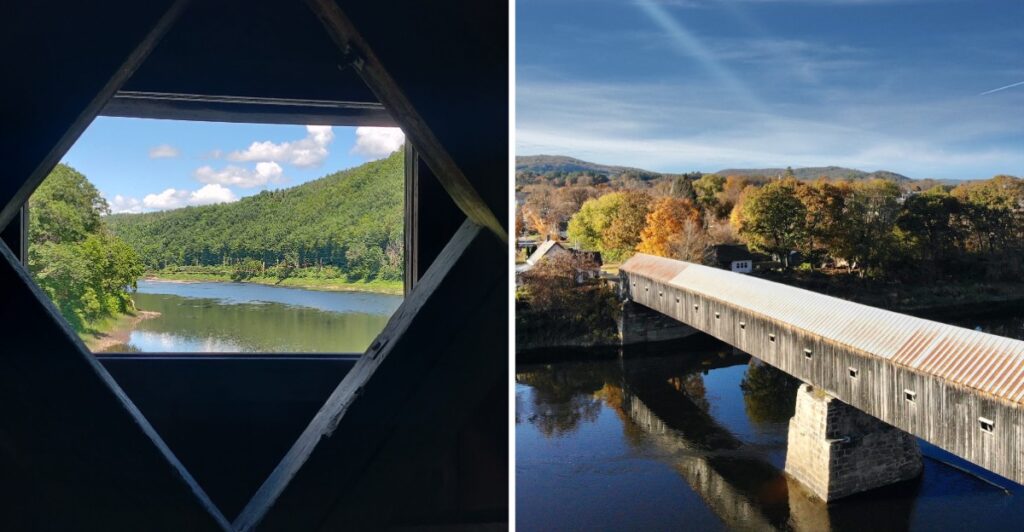
Crossing a state line usually takes a sign.
Here, it takes a 19th-century wooden bridge.
Cars still roll through this covered crossing, even though travelers have used it since 1866. That makes the trip over the Connecticut River feel pleasantly out of step with modern driving.
The roadway narrows. Timber closes in around you. Before long, Vermont is behind you and New Hampshire is ahead.
The bridge has weathered floods, repairs, and generations of changing traffic without becoming a display piece.
It still has an actual job.
Drive through first, then step outside and look back from the riverbank.
That is when its length really sinks in.
Most historic bridges ask you to admire them.
This one still expects you to use it.
Cars Still Cross A Bridge Built In 1866
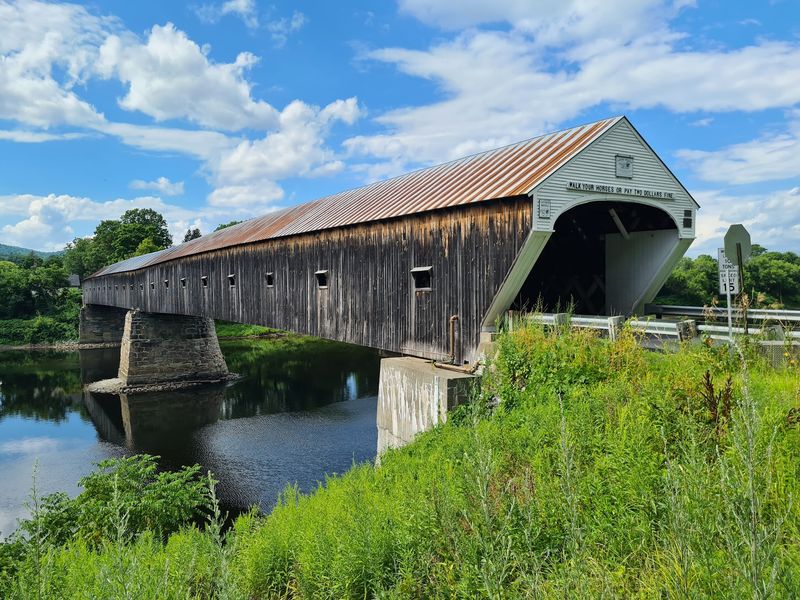
The current Cornish-Windsor Covered Bridge opened to traffic in 1866. That alone makes an ordinary drive across the Connecticut River feel a little unusual.
The bridge was built for horses, wagons, and nineteenth-century travel, yet automobiles still use the same crossing between Cornish and Windsor.
The bridge carries two-way traffic, so drivers can meet an oncoming vehicle inside the covered structure. Its roadway is about 19 feet 6 inches wide, which gives the interior a much closer feel than a modern highway bridge.
Take the crossing slowly and keep attention on the lane rather than trying to study every timber while moving. The crisscrossing structural members are easier to notice once your eyes adjust to the darker interior.
The bridge has not simply survived untouched since the nineteenth century. By the 1980s, structural deterioration had become serious enough that the crossing closed to traffic in 1987. A major rehabilitation followed, and the bridge reopened in December 1989.
That work allowed the historic crossing to continue serving modern vehicles while retaining the character that makes it recognizable.
The result is an uncommon kind of landmark. You do not have to stand outside a fence to experience it. The bridge still does the job it was built to do.
Vermont And New Hampshire Meet Across The River
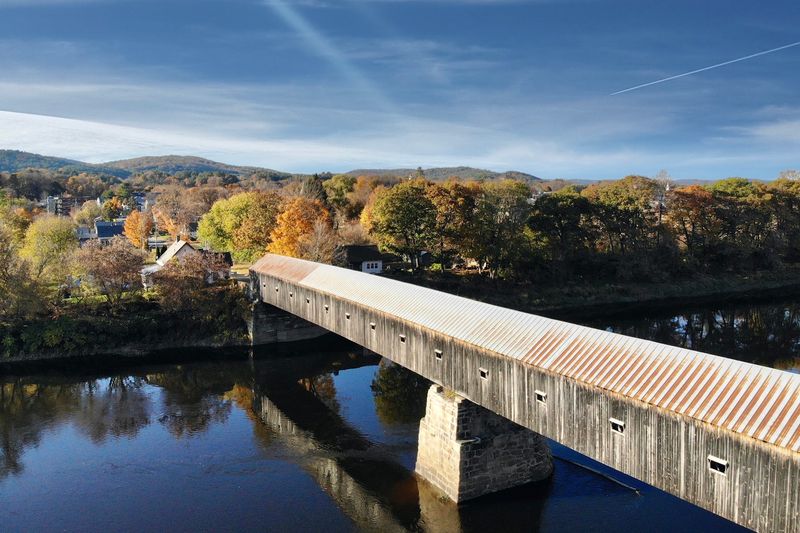
The Connecticut River separates the two towns, with Windsor on the Vermont side and Cornish on the New Hampshire side. The covered bridge provides a direct connection between them, turning a short local drive into an interstate crossing.
That state-line moment happens inside a structure made largely from timber rather than concrete and steel. Enter from Windsor, and you emerge in Cornish. Reverse the trip, and Vermont waits at the other end.
For nearby residents, the bridge remains transportation infrastructure rather than simply a scenic stop. New Hampshire transportation records continue to classify it as an active bridge carrying regular traffic.
That everyday use gives the crossing its distinctive rhythm. Cars enter, headlights appear in the darker interior, tires move over the wooden deck, and traffic continues into the opposite town.
The two sides also make it easy to extend the trip. Windsor has a compact historic center, while Cornish is home to Saint-Gaudens National Historical Park, preserving the home, studios, and grounds associated with sculptor Augustus Saint-Gaudens.
There is no need to rush from one state to the other. Cross once, explore whichever side comes next, and save the return trip for another look at the bridge from the opposite direction.
Nearly 450 Feet Of Covered Bridge Stretch Across The Connecticut
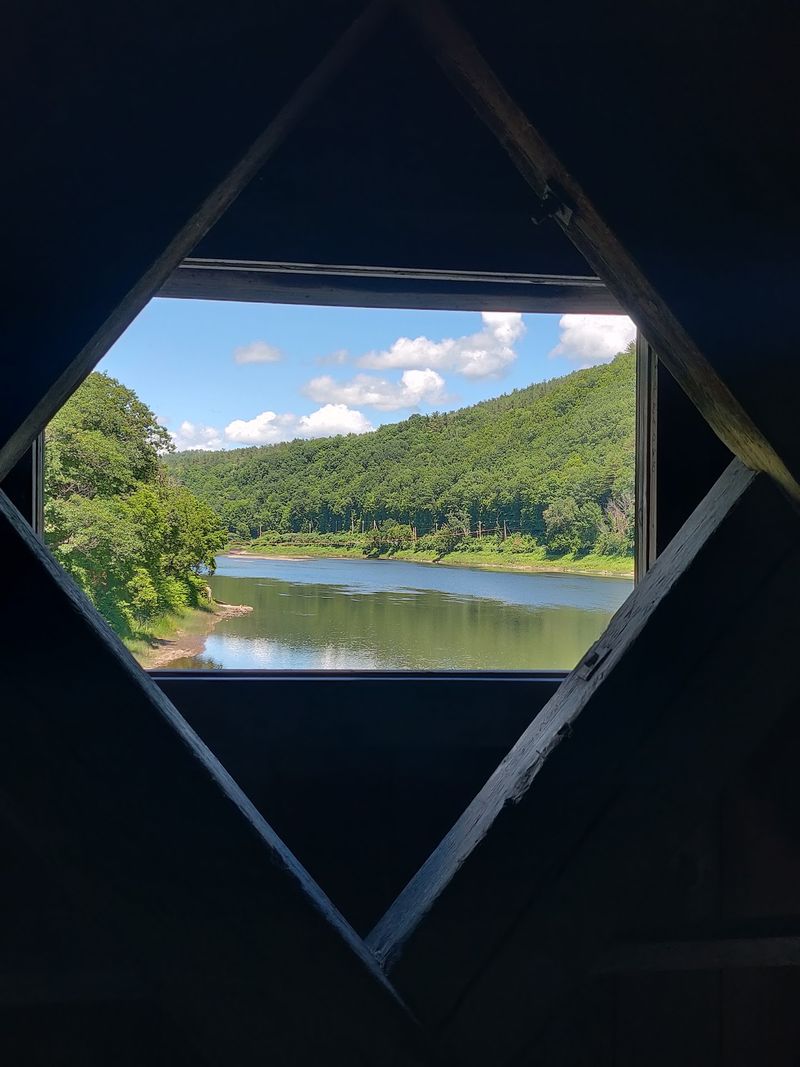
The bridge measures about 449 feet 5 inches long in current New Hampshire bridge records.
Two covered spans carry the roadway across the river, making the structure long enough that entering it feels more like driving into a wooden corridor than passing beneath a short roof.
Its structural system is based on the Town lattice truss. Instead of one simple row of vertical supports, diagonal timbers cross one another in a repeating lattice pattern along the sides.
James Tasker and Bela Fletcher built the bridge in 1866, adapting the Town lattice design with heavier timbers. The structure was first framed in a meadow near the crossing before being placed at the river.
The bridge is also recognized for its engineering history. The American Society of Civil Engineers designated it a National Historic Civil Engineering Landmark in 1970, and it is listed on the National Register of Historic Places.
Claims about covered-bridge length can get confusing because bridges are measured and categorized in different ways.
What remains clear is impressive enough: Cornish-Windsor is an exceptionally long surviving wooden covered bridge, and its two-span configuration continues to carry daily automobile traffic.
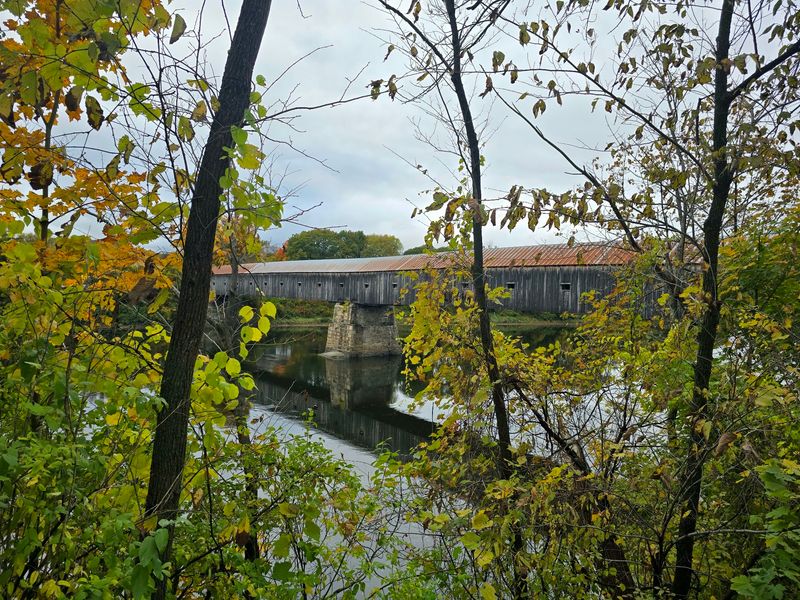
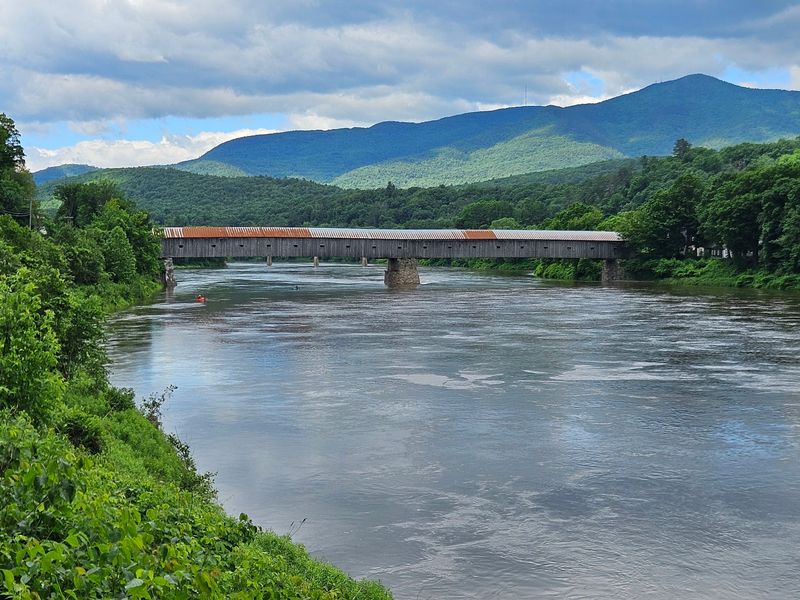
Seeing the entire roofline from outside gives those numbers some perspective. From inside, the bridge feels long. From the riverbank, it looks even longer.
Modern Vehicles Still Have To Respect Old Dimensions
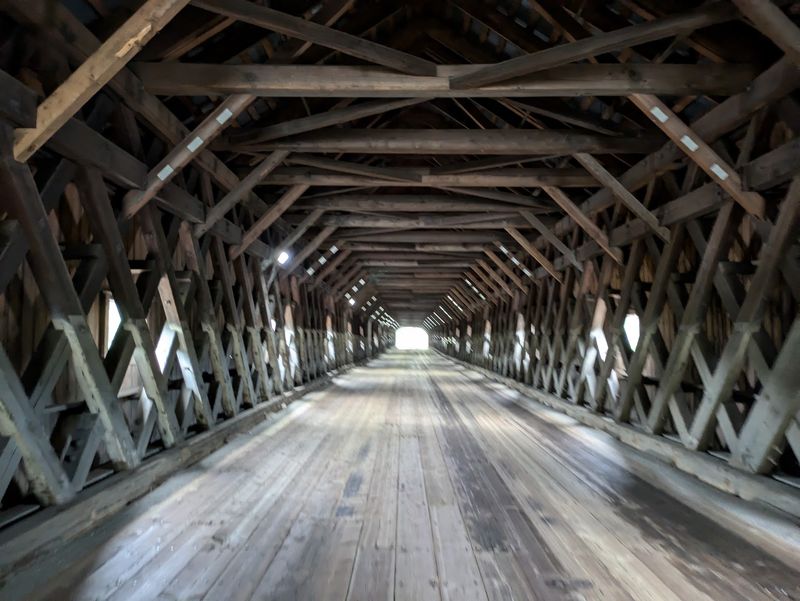
Historic character comes with practical limits. The Cornish-Windsor bridge has a roadway width of about 19 feet 6 inches and a maximum vertical clearance of 12 feet 9 inches.
It is also posted for a 10-ton weight limit. That means the crossing is suitable for ordinary passenger traffic but not every large vehicle on the road.
Anyone traveling in a tall RV, heavy truck, large bus, or oversized camper should check vehicle dimensions and weight before approaching the bridge. Guessing beneath a timber portal is not a good travel strategy.
Passenger-car drivers have fewer calculations to make, but the interior still calls for patience. Two-way traffic fits through the bridge, though the space can feel tight when another vehicle approaches.
There is no separate pedestrian walkway, so anyone viewing the bridge should stay alert to moving traffic.
If the goal is photography or a longer look at the structure, finding a safe legal place outside the roadway is a better option than lingering inside.
The drive itself is simple. Slow down, stay aware of oncoming traffic, clear the bridge, and save the sightseeing for after the car is out of the travel lane.
Three Earlier Bridges Came Before The One Standing Today
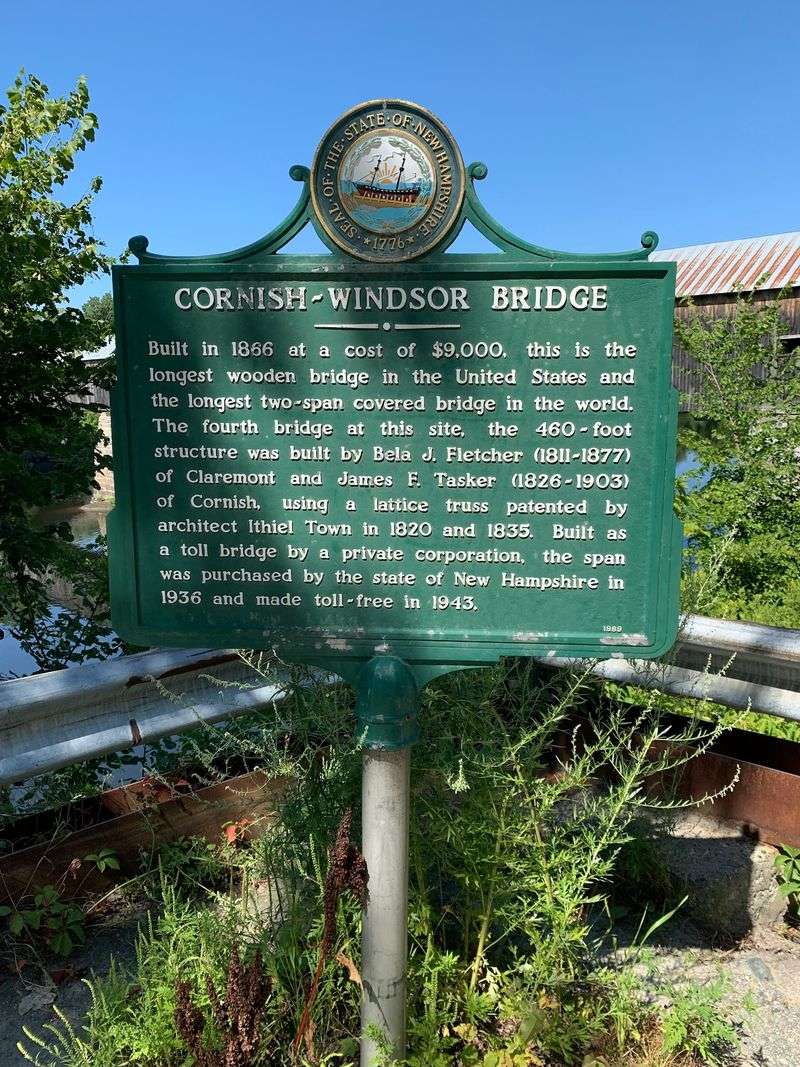
The 1866 bridge was not the first attempt to connect these riverbanks. Earlier bridges occupied the crossing before the current structure, and floods repeatedly forced the communities to start over.
The first bridge at the site was built in 1796. Additional crossings followed during the nineteenth century as earlier structures were lost to the Connecticut River.
After the bridge immediately preceding the present one was washed away, James Tasker of Cornish and Bela Fletcher of Claremont received the contract to construct a replacement in April 1866.
Construction took roughly seven months, and the new covered bridge opened later that year.
For decades, crossing it was not free. The bridge was originally operated as a private toll bridge. New Hampshire eventually purchased it during the 1930s, and toll collection ended in 1943.
Repairs continued as the structure aged. Flood and ice damage required attention in the twentieth century, and worsening deterioration ultimately led to the 1987 closure.
The rehabilitation completed in 1989 strengthened the bridge for continued limited vehicular use. The project replaced and reinforced important structural components while preserving the historic covered form.
That long sequence of rebuilding and repair explains why the bridge remains useful today.
The Bridge Is Easy To Add To A Connecticut River Drive
The crossing itself does not require tickets, reservations, or an admission fee. It is a public roadway, so the simplest visit is also the most natural one: approach in a suitable vehicle and drive across.
On the New Hampshire side, the bridge is reached from Cornish Toll Bridge Road, Cornish, NH 03745, directly across the Connecticut River from Windsor.
Before entering, check that the vehicle falls within the posted height and weight limits. Ordinary passenger cars have little trouble with those restrictions, while larger vehicles may need another river crossing.
Once across, resist the temptation to stop where traffic needs to move. The bridge is still working infrastructure, and safe viewing depends on using legal parking areas away from the travel lane.
Timing can change the scenery around it. Summer fills the riverbanks with green, while fall adds the familiar New England mix of red, orange, and gold around the dark wooden roof.
Winter creates an entirely different look, especially when bare branches open views toward the river and snow brightens the banks.
A bridge this visually distinctive can easily become the main stop, but it also works well as one piece of a longer Connecticut River drive. Windsor and Cornish provide enough nearby history to keep the car parked for a while on either side.
More Than A Century Later The Bridge Still Has A Job
The most interesting detail about Cornish-Windsor is not simply its age. It is the fact that the bridge still performs its original basic function.
Transportation has changed enormously since 1866. Horse-drawn traffic gave way to automobiles, road standards changed, and modern bridges became wider, heavier, and faster.
Cornish-Windsor adapted without turning into a static exhibit.
The inscription associated with the bridge’s older traffic rules, warning travelers to walk their horses or pay a fine, belongs to a transportation world far removed from modern cars. Yet the basic act of crossing the river has stayed the same.
Today, drivers still enter one town, pass through the covered wooden structure, and emerge in another state.
That continuity gives the bridge more personality than a landmark preserved only for viewing. Its engineering history, unusual length, Town lattice construction, and nineteenth-century origins all matter, but daily traffic keeps the story connected to the present.
Take the first crossing slowly enough to appreciate the interior without holding up traffic. Then find a safe viewpoint outside and look back across the river.
From there, the bridge stops feeling like a wooden tunnel and becomes what it really is: a long working link between two New England communities, still doing the same essential job generations after its first travelers crossed.