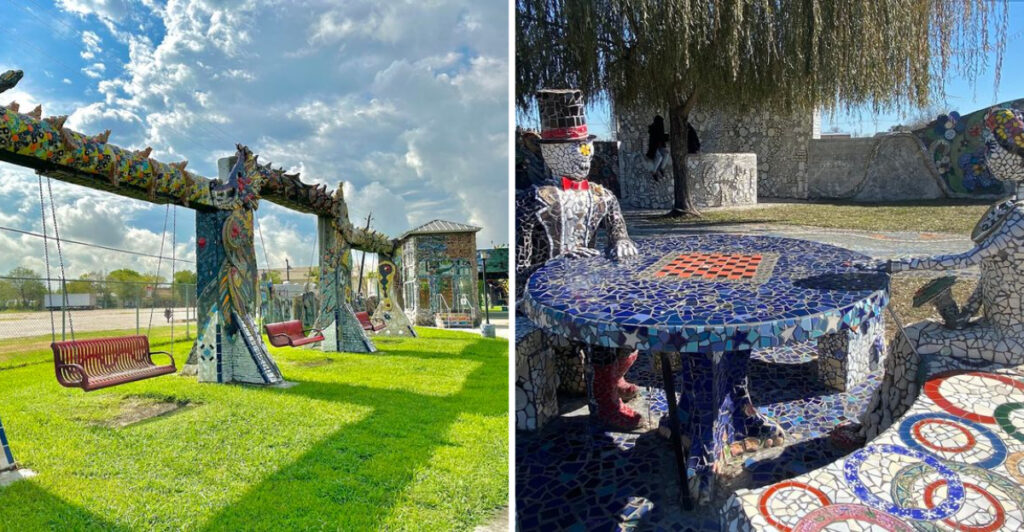
This Houston art park gives broken dishes a second career and somehow makes your junk drawer look lazy.
Here, scraps steal the spotlight. You walk through the artwork, sit beside it, and keep noticing details that make you stop mid-sentence. Texas clearly decided ordinary park rules needed a creative rewrite.
You do not need an art degree to enjoy the joke. An old key gets promoted to public art, and a cracked teacup lands a better role than most actors.
Even the sidewalk joins the exhibition instead of staying in its lane.
The park is free and packed with enough surprises to keep your camera busy. Texas sunshine handles the special effects, while every broken piece proves that “useless” may simply mean “waiting for a better idea.”
It leaves you wondering: which forgotten object in your own home is waiting for an artistic comeback?
Broken Dishes Have Never Looked This Well Put Together

A cracked saucer usually signals cleanup duty. Here, it may become a feather, scale, flower petal, eye, or glittering piece of an entirely new creature.
Visionary artist and builder Dan Phillips worked with the late Stephanie Smither to design the park in memory of her husband, John H. Smither.
Stephanie and John supported and collected self-taught art, and the project grew from that shared appreciation for creativity outside traditional galleries.
Construction began in 2010, with artists and community members helping shape an outdoor space where discarded materials could earn far more interesting second careers.
Look closely and you may recognize bottle caps, broken mirrors, shells, ceramic fragments, tiles, stones, and ordinary household objects pressed into the designs.
The materials stay recognizable enough to trigger small discoveries, yet the larger images pull them into something more ambitious.
Nothing requires you to understand a technique before enjoying the result. Start with the giant shapes, then lean closer and let the fragments explain how they got there.
That combination changes how you explore. A quick glance shows color; another minute reveals the strange little ingredients holding it together. You may arrive to admire mosaics and leave mentally apologizing to every chipped plate you ever threw away.
The Memory Wall Turns 400 Feet Into A Community Scrapbook
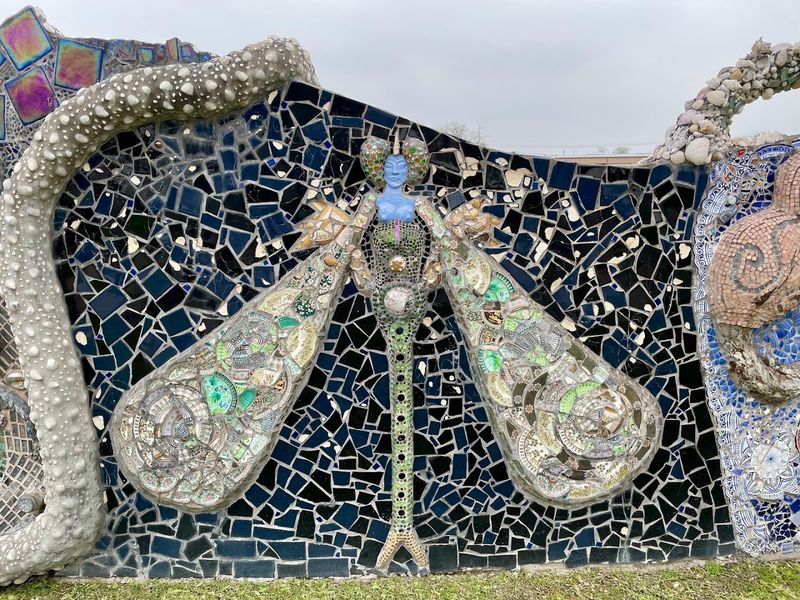
Four hundred feet is a long way for a wall to hold your attention, but the Memory Wall has sixty different reasons to slow you down. Its panels stretch along the park, each shaped by a separate artistic idea, memory, tribute, or personal obsession.
Artists from Houston and beyond have contributed sections honoring loved ones, animals, favorite destinations, and moments that mattered to them.
Some panels leap forward with bold figures and bright colors. Others reward a quieter inspection, using small objects and subtle details to carry the story.
The wall was the first major element built here, and it still functions like the park’s visual backbone. You can move panel by panel, studying the shifts in subject, texture, and technique without encountering one dominant style.
The variety makes the entire structure read less like a formal monument and more like a giant scrapbook that forgot how to close.
You may spot a detail that means nothing to the person beside you and everything to the artist who placed it. That private connection gives the wall its unusual emotional pull.
You will find Smither Park at 2441 Munger Street, Houston, Texas, where the wall has plenty to say before you reach the far end. Take your time; four hundred feet should never be speed-read.
Every Walkway Gives Your Camera A New Assignment
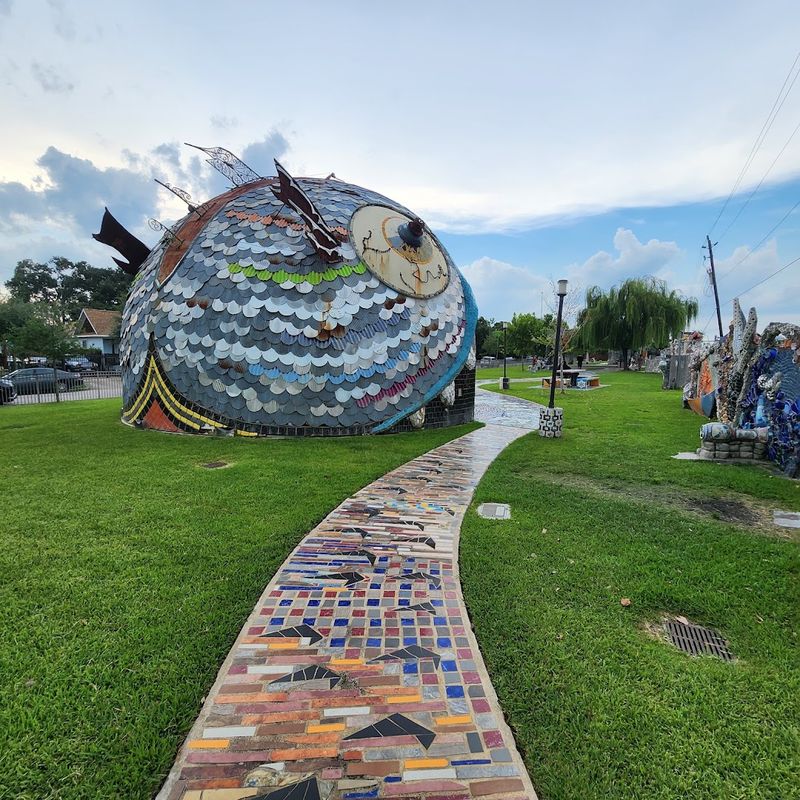
Most parks tell you to keep your eyes on the horizon. This one keeps stealing them back toward your shoes.
Mosaic paths wind through the grounds, extending the art beyond the walls and structures.
Patterns change as you move, shifting between geometric arrangements, curling lines, playful figures, and unexpected fragments that make an ordinary walkway look like it dressed for a parade.
Photography becomes its own small experiment. Point your camera straight down and the path flattens into a detailed pattern. A lowered camera angle, not the design itself, creates that perspective.
The paths also connect the installations without giving your eyes a break. Just when you finish studying a wall, the ground slides another design beneath your feet.
Comfortable shoes are a sensible choice when the route itself keeps demanding your attention. Arriving early can also give you softer light and more breathing room before the day gathers momentum, although the mosaics do not exactly become shy later.
At this park, watching your step is not a warning. It is the main attraction, and the ground is fully aware of its good side.
Hundreds Of Artists Made Uniformity Miss The Invitation
Imagine inviting hundreds of creative minds to one half-acre canvas and expecting them to agree. Thankfully, nobody made that mistake.
More than 300 artists have contributed to the park’s evolving collection, including practicing artists and community members exploring mosaic work.
Their approaches differ wildly, which explains why one area may feature orderly patterns while the next erupts into animals, faces, abstract forms, and found objects with no interest in behaving alike.
The larger installations include the Vinson & Elkins Pavilion, the Lindley Fish Amphitheater, the Burguires, Hinton & Mathre Swings, the Marilyn Oshman Meditation Garden, and a tower containing a kinetic sculpture by Houston artist Smitty Regula.
Each structure performs a practical or gathering function while carrying the same mosaic spirit as the walls and paths.
That range prevents the park from slipping into visual repetition. You can cross several yards and meet a completely different sense of humor, color palette, or storytelling style.
The result works like a visual conversation in which every participant arrived with different materials, stories, and volume settings. You will not leave remembering one perfect style. You will remember the cheerful refusal to pick one.
Matching is overrated when the whole neighborhood brought glue.
Fish, Tigers And Fantastic Figures Hide In The Details
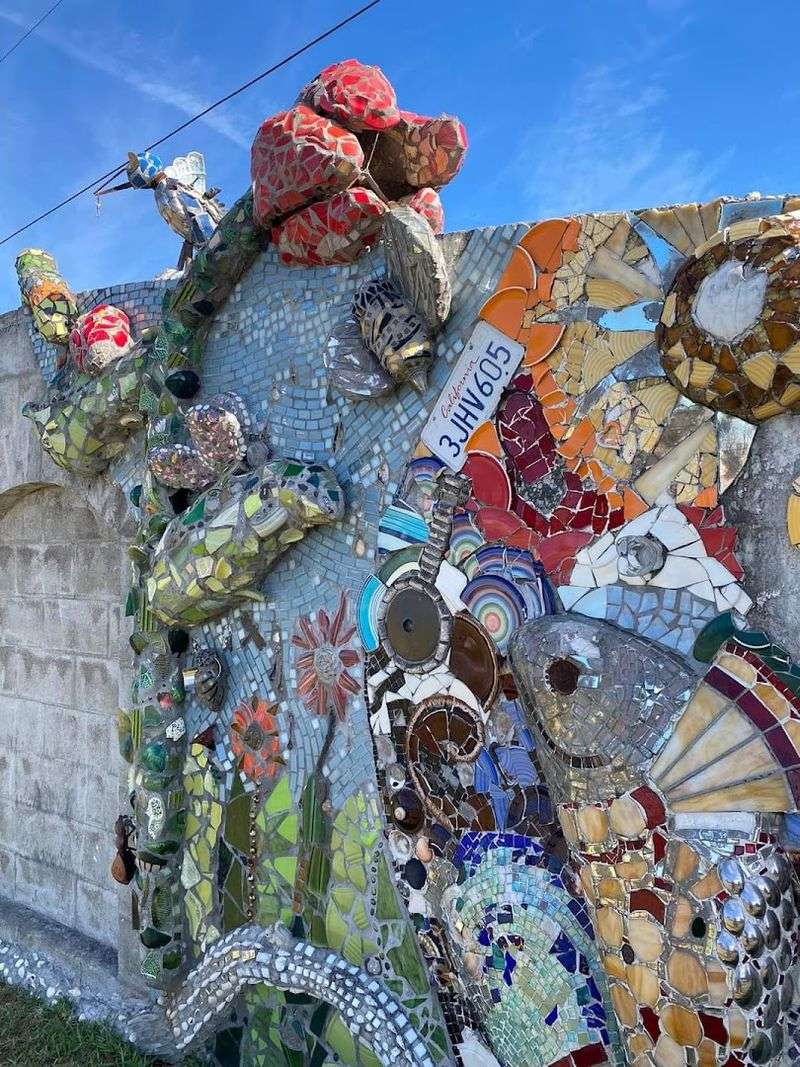
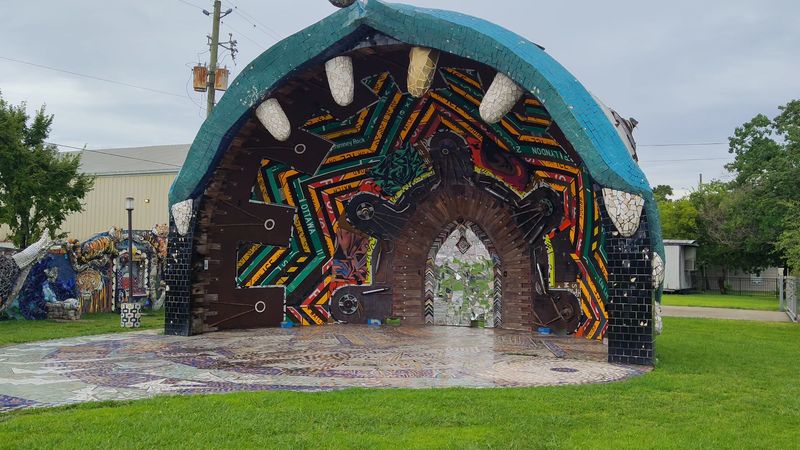
A fish mouth large enough to host a performance is a strong clue that ordinary garden decoration lost the argument here.
The Lindley Fish Amphitheater pushes the aquatic theme into architecture, surrounding its stage area with mosaic patterns and fish-inspired forms.
Elsewhere, animals, human figures, plants, and fantasy shapes emerge from walls built with ceramic pieces, mirrors, glass, shells, and repurposed objects.
These creations work at two distances. Stand back and you see a tiger, bird, fish, or strange character claiming part of the landscape. Move closer and the figure breaks into plates, beads, caps, tiles, and tiny surprises that once had completely unrelated jobs.
The creature hunt can become surprisingly competitive. You may point out a fish, only for someone else to discover three birds, a face, and a tiny bottle cap you somehow missed.
Children can search for animals while adults inspect the craftsmanship, giving families an easy way to explore without turning the visit into an art lecture. The park invites curiosity before explanation, and that is often the better order.
Pick a favorite creature if you can. Just remember that the tiger may be made of dinnerware, so staring contests could become awkward around lunchtime.
Swings And A Pavilion Put The Art To Work
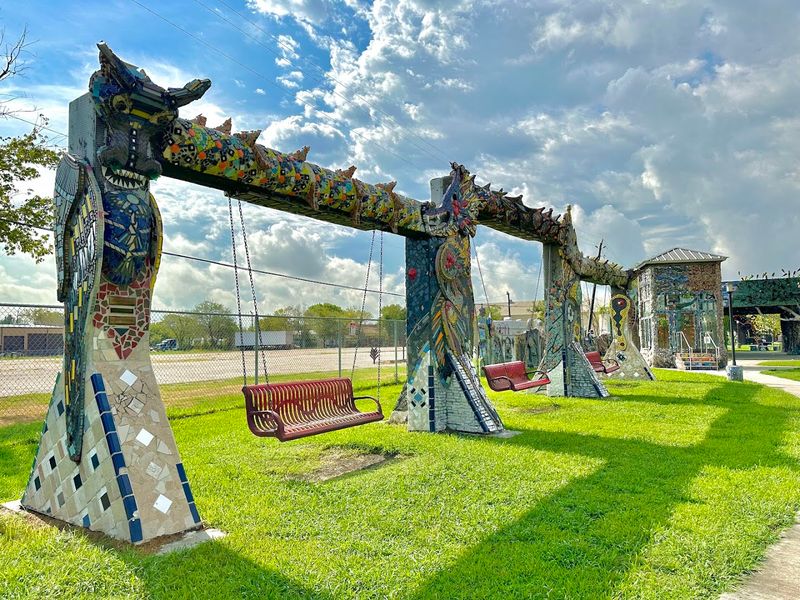
Museum rules usually begin with “do not touch.” This park occasionally answers with “have a seat.”
The mosaic-covered swings turn functional equipment into part of the exhibition, while the Vinson & Elkins Pavilion offers shade beneath another elaborate surface.
The Lindley Fish Amphitheater hosts performances and gatherings, proving that the artwork can frame community activity rather than waiting quietly for admiration.
A calmer pause comes through the Marilyn Oshman Meditation Garden, which balances the busier colors and playful figures elsewhere.
Nearby, Smitty Regula’s kinetic sculpture adds movement overhead, giving the collection an element that refuses to stay frozen for the camera.
Even an ordinary break keeps you involved with the artwork. Sit beneath the pavilion or settle near the stage, and another arrangement of glass, tile, and found objects starts competing for attention.
You are not limited to standing behind a line and nodding thoughtfully. You can sit, swing, gather, watch a performance, or simply rest while mosaic details continue working on your peripheral vision.
The benches, pavilion, swings, and stage do not merely hold people. They hold their own in the photo department, which is more than most park furniture can say.
A Saturday Visit May Catch The Park Mid-Creation
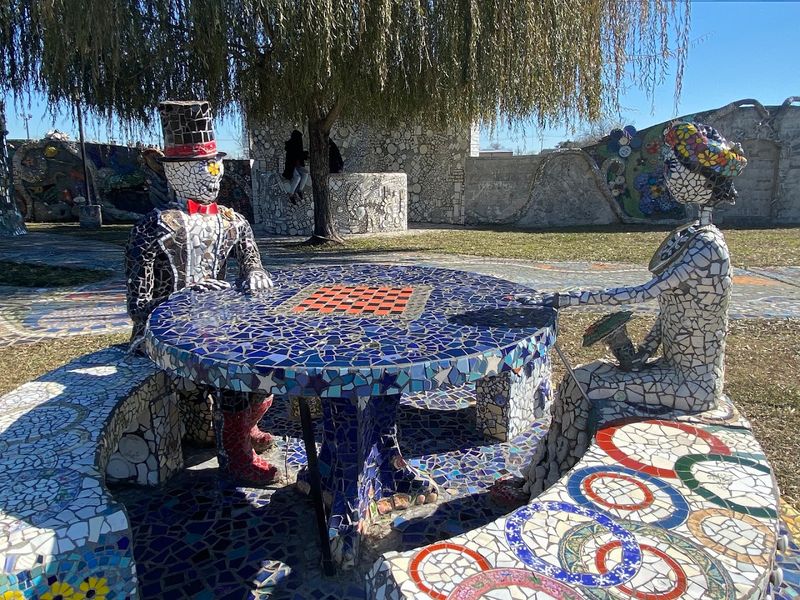
Finished art can impress you, but wet mortar raises the stakes. On some Saturdays, weather permitting, artists work on ongoing mosaic projects while visitors watch the pieces take shape.
Seeing the process explains why even a small section can require serious patience. Each fragment must be selected, positioned, and pressed into place before thousands of individual choices finally read as one image.
A surface that looked playfully chaotic five minutes earlier starts revealing the careful work beneath the fun.
The park remains a living gallery rather than a sealed collection. New contributions and unfinished sections allow the space to change over time, giving repeat visitors a reason to scan for additions instead of retracing the exact same experience.
Watching an artist work also changes how you see the finished sections. After that, every smooth curve and crowded animal looks less accidental and far more stubbornly earned.
Smither Park is open daily from dawn until dusk, and admission is free. Event schedules and artist activity can vary, so a calm walk remains worthwhile even when no one is actively setting tiles.
You may come to admire the finished mosaics and catch tomorrow’s photo backdrop still taking shape. When watching glue dry becomes the highlight of an afternoon, how could you resist seeing what Smither Park creates next?