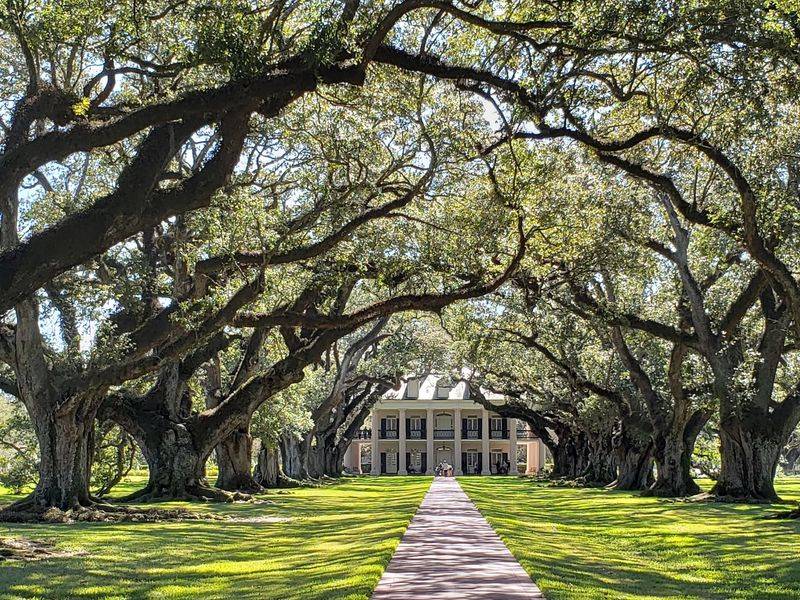
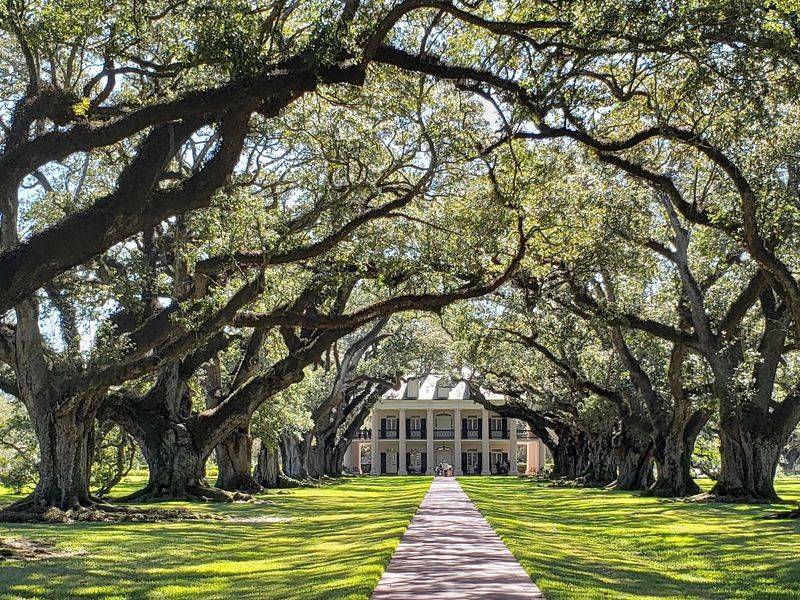
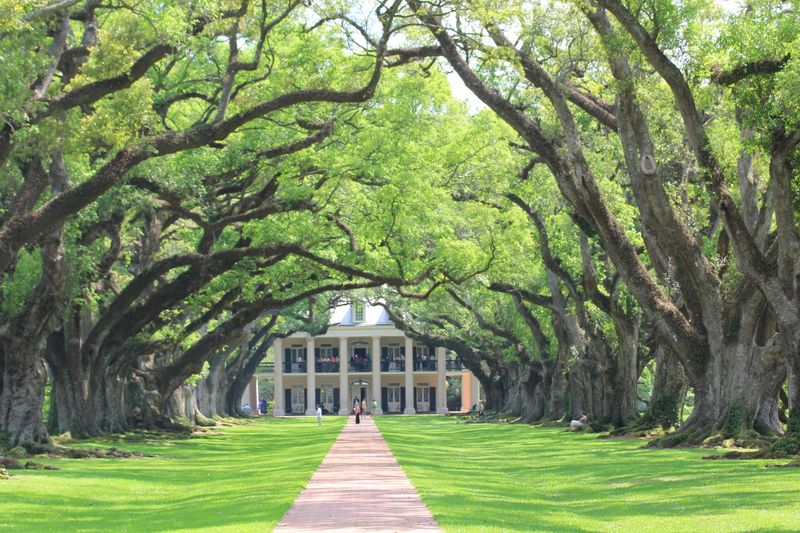
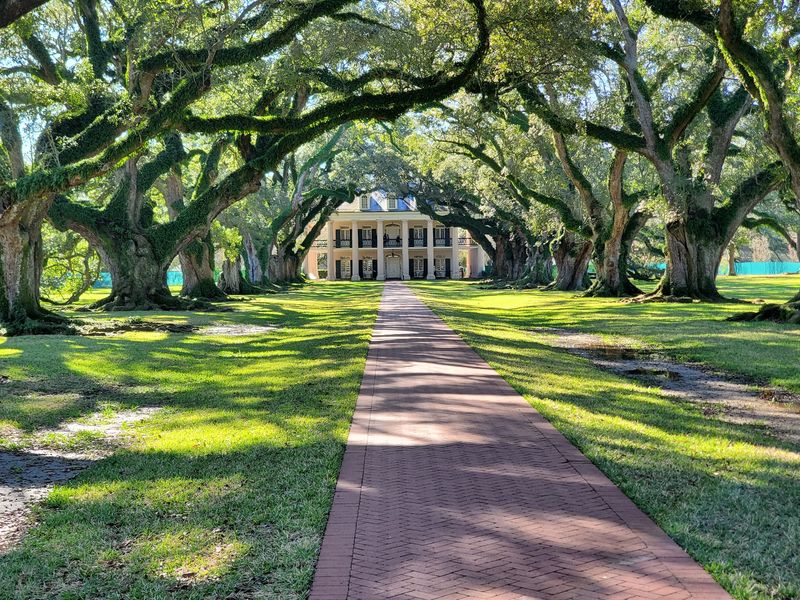
Twenty-eight live oaks stand in two straight rows on the west bank of the Mississippi River, and they have been growing there far longer than the big white house they lead to. At Oak Alley Plantation in Vacherie, those trees form a shaded path about a quarter-mile long, from River Road to the front steps.
The alley is famous for its beauty, but the site also tells a harder story about the enslaved people whose work built and ran this sugar plantation. Walking under those branches means taking in both stories at once.
A Sugar Plantation On The West Bank In Vacherie
Find 3645 LA-18 on a map and you land on the west bank of the Mississippi in St. James Parish, right along the Great River Road. Oak Alley Plantation sits between the levee and the cane fields, about an hour’s drive from New Orleans according to many visitors.
Today the property operates as a history museum run by the nonprofit Oak Alley Foundation. It interprets a former sugar plantation, with exhibits on local history, sugarcane cultivation, and slavery, plus guided tours of the main house.
The grounds are designated a National Historic Landmark, a status granted in 1974.
Travelers coming from the city often note how the scenery shifts along the way. Cypress stands give way to open marsh, then to wide fields waiting on the next crop, with other plantation houses dotting the road before Oak Alley comes into view.
The layout follows the old Louisiana colonial pattern. The Big House sits closest to the river, and the working buildings, quarters for enslaved workers, and the sugar operation spread out behind it toward the fields.
Understanding that arrangement helps a visitor read the place correctly, since the most photographed part of the property is only the front edge of a much larger working landscape.
Twenty-Eight Live Oaks Older Than The House
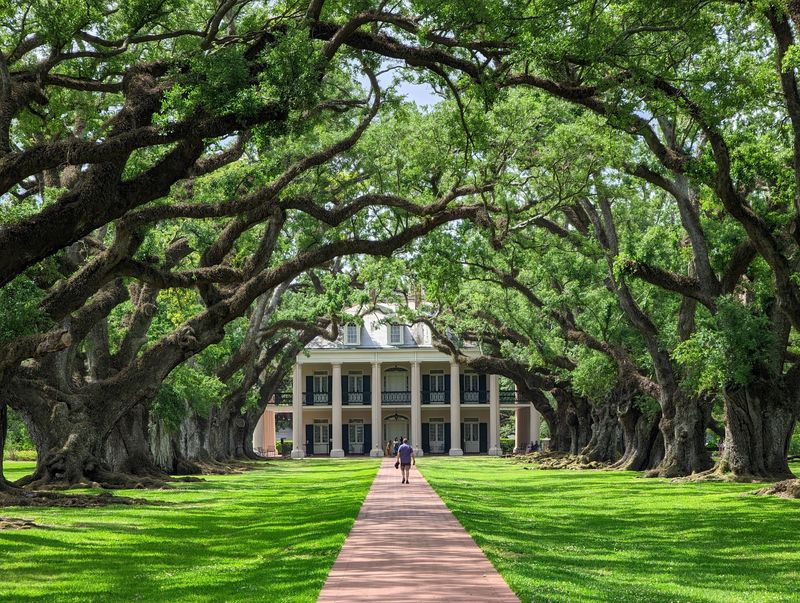
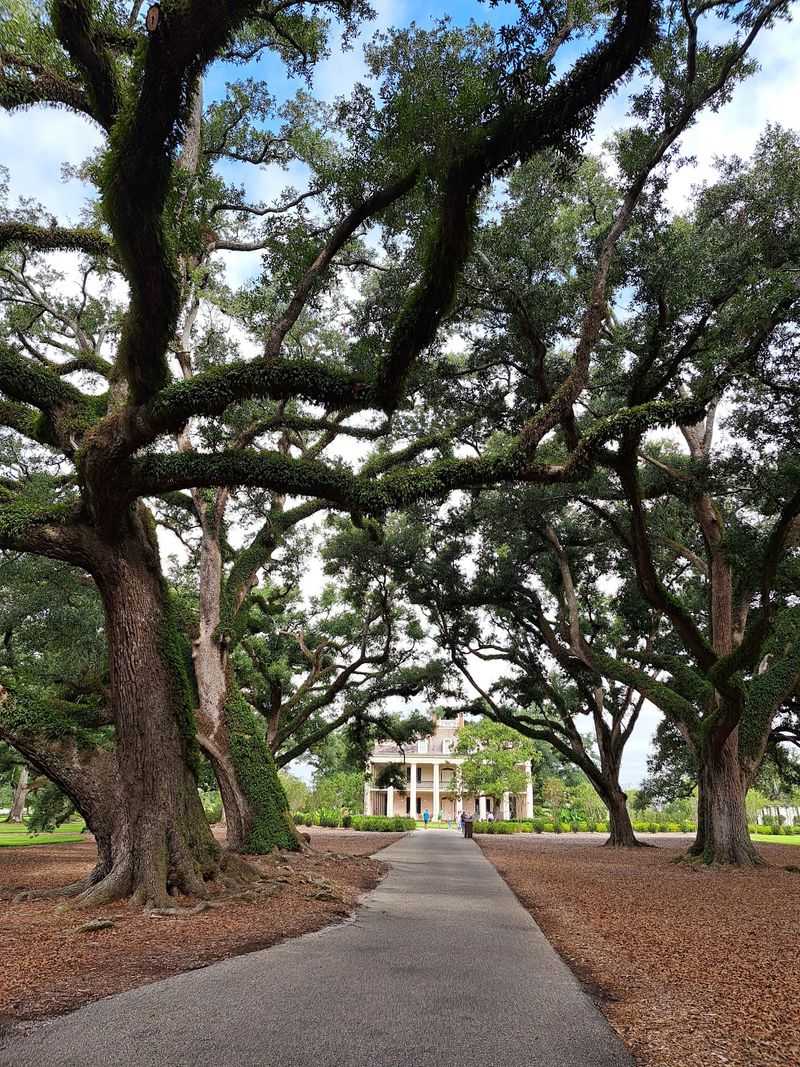
Count them and you get fourteen on each side. The Southern live oaks at Oak Alley stretch roughly 800 feet from the river side of the property to the mansion, and estimates put their age somewhere between 225 and 300 years, with some research suggesting they could be older still.
Nobody knows for certain who planted them. Accounts point to an unnamed French settler in the early 1700s, or possibly Michel Arceneaux around 1704.
Later landscaping, including work by enslaved laborers who transplanted mature oaks, shaped the alley into the form visitors see now.
The measurements are the kind that make people stop and stare. Some trees reach a girth of 31 feet, a height of 71 feet, and a crown spread of about 150 feet.
Several limbs have grown so heavy they bend down and rest near the ground, a common sign of a very old live oak.
Louisiana law protects these trees, and the shade they throw is real relief on a summer afternoon. Plenty of visitors admit they came mostly for the oaks, and the walk beneath them tends to be the first thing people mention afterward.
From Bon Sejour To A Name Coined By Riverboat Captains
Before anyone called it Oak Alley, the land went by Bon Sejour, roughly a pleasant stay. Sugar planter Valcour Aime, often remembered as the King of Sugar, is linked to the property’s early years, though sources give different dates for when he acquired it.
The house itself came from his brother-in-law, Jacques Telesphore Roman. Roman took over the property in 1836, and construction on the mansion began in 1837 and finished in 1839.
Accounts suggest he hoped the estate would appeal to his wife, Celina Pilie, who was used to life in New Orleans.
Her father, architect Joseph Pilie, is believed to have designed the house. The Roman family then ran it as a working sugar plantation, and the scale of that operation depended entirely on enslaved labor.
Here is a fun bit of river history. The Oak Alley name reportedly came from riverboat captains, who kept referring to the place by its striking tree-lined approach as they passed on the Mississippi.
The nickname stuck so firmly that it eventually replaced Bon Sejour altogether. Few Louisiana landmarks can say their name was chosen by the people steaming past rather than the people living there.
Columns That Match The Trees
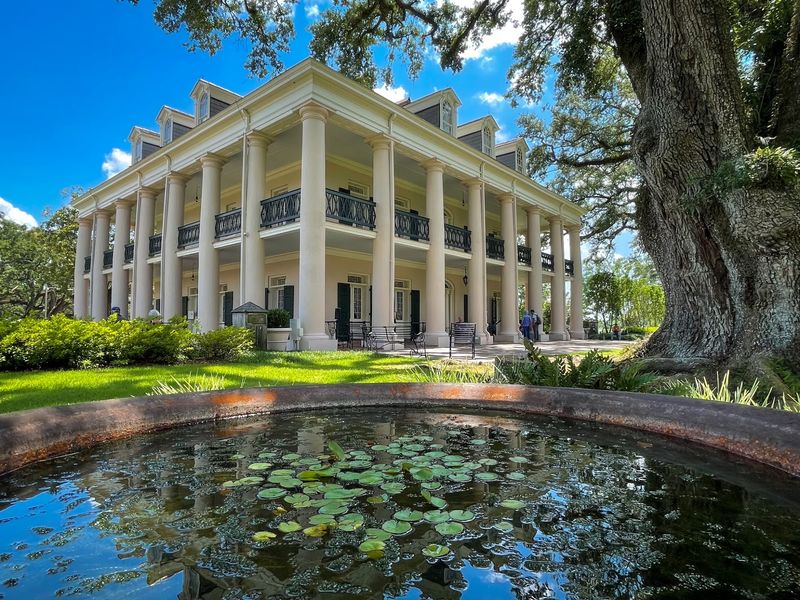
Stand at the end of the alley and count again. The mansion is wrapped on all four sides by 28 colossal Doric columns, the same number as the oaks outside, and that symmetry is widely credited to the architect’s attention to the trees already growing there.
The Greek Revival style was popular in the antebellum South for its classical proportions and commanding look. Here it also had practical work to do.
Brick walls about 16 inches thick, finished with plaster, helped hold cooler air inside during brutal Louisiana summers.
Airflow was planned carefully as well. French doors line up on opposite sides of the house, a central hall runs through it, and high ceilings let heat rise away from the rooms.
The wide galleries shade the walls from direct sun, which anyone who has stood on a porch along River Road in August will appreciate.
From the front steps, the view runs straight back down the alley toward the levee. That sightline was the whole point.
The house and the trees were meant to be seen as a single composition, and nearly two centuries later the arrangement still reads that way from either end.
The Enslaved Community At The Center Of The Story
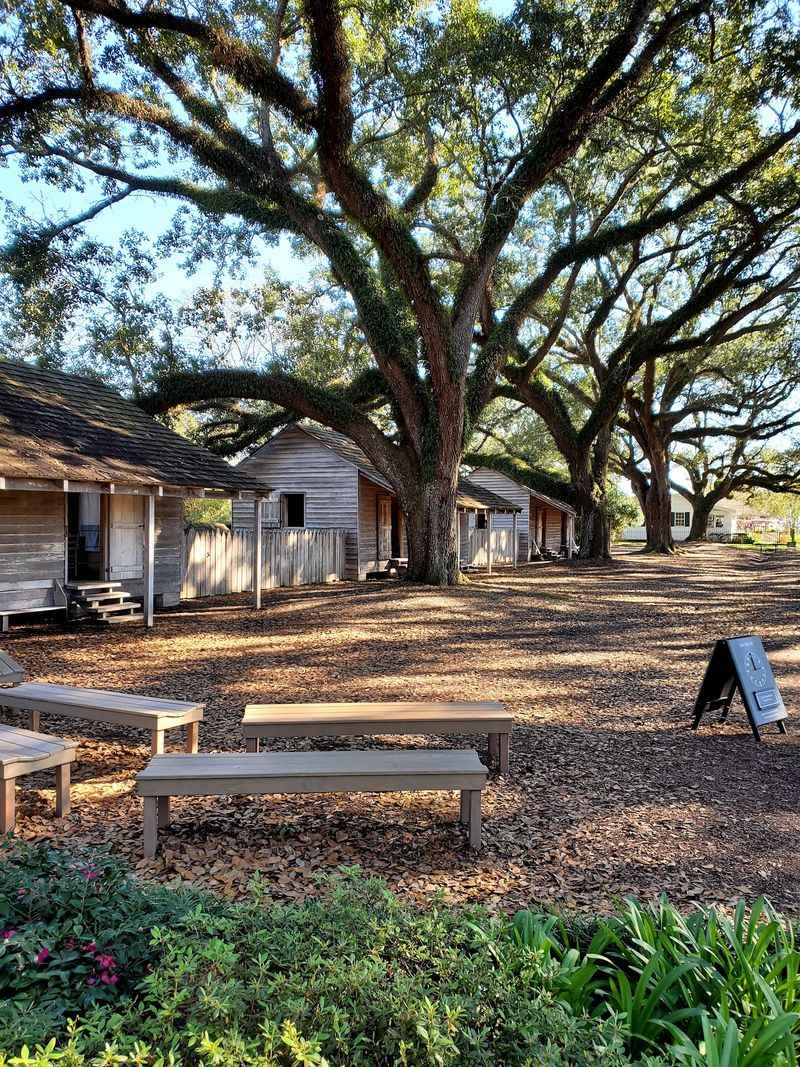
Behind the pretty postcard view stood the people who made the plantation run. Oak Alley typically held an average of 110 to 120 enslaved people, and at times more than 200, working in the cane fields, on levees and roads, in the woodlots, in machine repair, and inside the Big House.
Harvest season, known as the grinding, pushed shifts up to 18 hours until the cane was cut and processed. Domestic workers cooked, cleaned, and cared for the Roman children, and their presence in the house also served as a display of the family’s wealth.
The reconstructed cabins, rebuilt in the 1990s on their original footprints, now hold the Slavery at Oak Alley exhibit. Visitors describe displays of shackles and irons, detailed panels on living conditions, and a wall listing the names of the enslaved people held here.
The Foundation maintains a database meant to remember each person individually.
Reactions vary. Many visitors call the exhibits honest, frank, and respectful, while a few wish they went deeper into individual lives.
Either way, this is the section of the property that stays with people, and it deserves unhurried time.
Antoine And The Paper Shell Pecan
Crack a pecan with your bare hands and you owe a small debt to a man named Antoine. An enslaved gardener at Oak Alley, Antoine successfully grafted pecan trees in 1846 and 1847, producing a paper shell variety thin enough to open without tools.
That achievement mattered well beyond the property line. Grafting allowed growers to reproduce a desirable tree reliably, and Antoine’s work stands as a pioneering moment in American pecan cultivation.
His innovation is one of the reasons cited in Oak Alley’s National Historic Landmark designation, alongside the architecture and landscape.
His story also complicates the usual way plantations get remembered. The credit for skill and invention here belongs to a man who was held in bondage and never profited from what he created, and the site now presents his work as part of the enslaved community’s history rather than a footnote to the owners.
Keep that in mind at the gift shop. Visitors regularly mention the pralines made and sold here, calling them a highlight.
It makes a quiet connection, picking up a Louisiana pecan candy at the same place where a skilled gardener helped change how the nut was grown.
Decline, The Stewarts, And A Foundation For The Public
After the Civil War and emancipation, the economics of plantation life collapsed, and Oak Alley drifted through a long rough patch. The property changed hands numerous times between 1866 and 1925, with stretches of neglect along the way.
Then came Andrew and Josephine Stewart. Andrew bought the place in 1925 as a gift for Josephine, and the couple restored the house and grounds with architect Richard Koch overseeing the work.
Josephine, raised on a Texas cattle ranch, first ran Oak Alley as a cattle operation because a virus had hurt sugarcane in the early 1900s, then brought cane back in the 1960s.
She was the last owner to live at Oak Alley. In 1972 she created the Oak Alley Foundation, a nonprofit charged with preserving the house and grounds for public education and cultural benefit, and the property later opened to visitors.
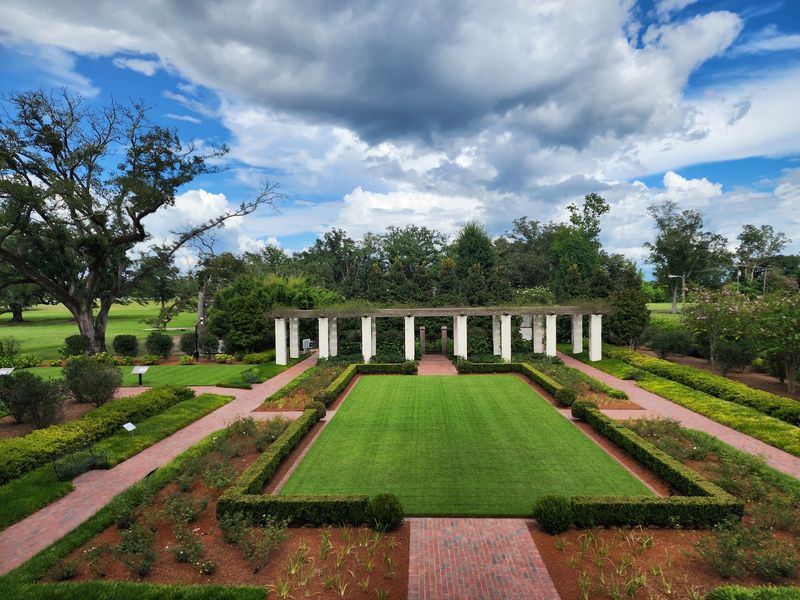
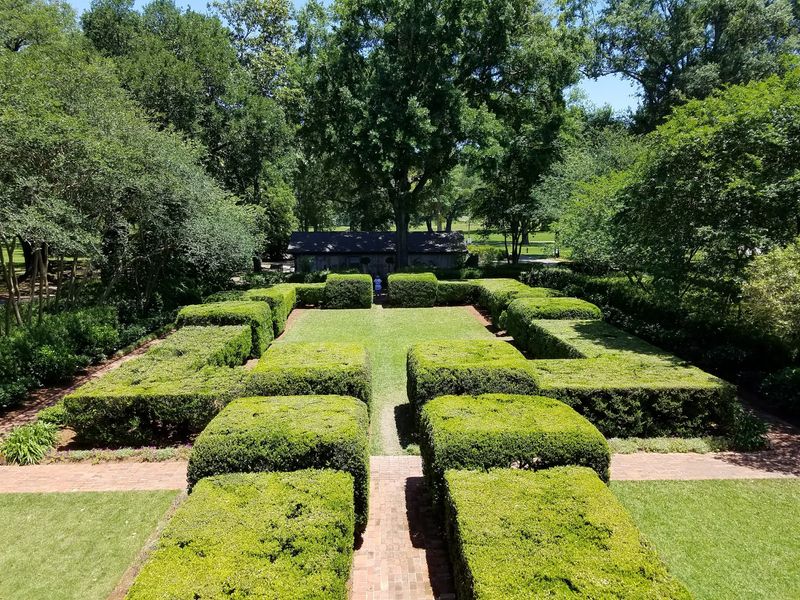
Her era left its marks on the landscape too. The grounds include a 1920s formal garden and an 1830s-style kitchen garden, with camellias, crepe myrtles, azaleas, and magnolias around the house.
The Stewart family graveyard sits on the property, near the Roman family tomb, as a quiet reminder of the families who lived here.
Tours, Exhibits, And The Pace Of A Visit
Give yourself at least two hours, and closer to four if you like to read every panel. Most of the visit is self-guided on the grounds, with the guided Big House tour leaving roughly every 15 minutes.
Inside the mansion, visitors report about 20 to 30 minutes covering six rooms and the balcony, focused on the Roman family and period furnishings. Photography is not allowed in the house, a rule staff enforce firmly.
Guides draw mixed but mostly warm notes, with many praised as knowledgeable and a few described as scripted.
Outside, the Sugarcane Theater shows a film and a three-dimensional map of the Roman family holdings, explaining how cane was grown and processed. There is also a working blacksmith shop with the original forge, plus the East and West Gardens reflecting 1840s and 1930s styles.
Film and game fans show up too. Visitors point out that the house appears as the model for Braithwaite Manor in Red Dead Redemption 2, and that the grounds hosted a Beyonce music video shoot.
Families with toddlers have found it manageable, since the grounds are open and the house tour stays short. A cafe serves lunch, and new restrooms near the ticket booth draw compliments.
Hours, Tickets, And Timing Before You Drive Out
Doors open at 8:30 AM every day of the week, and the site closes at 4:45 PM. Ticket sales stop around 4:30 PM, and at least one visitor noticed exhibits starting to close even earlier, so an afternoon arrival leaves little breathing room.
Budget accordingly, since visitors frequently describe admission as pricey for both guided and self-guided visits. Reports differ on whether the house tour comes bundled with admission or costs extra, so check current options at oakalleyplantation.org or call 225-265-2151 before going.
Tickets can be bought ahead online or at the entrance.
Mornings bring thinner crowds and milder weather, a tip that comes up often. July is hot but quiet, which some photographers treat as a bonus.
Spring shows off the gardens, and early summer brings the magnolias into bloom.
Picture the ending of a good visit here: one last slow walk back down the alley, the house growing smaller behind you and the levee rising ahead. Those 28 oaks were already old when the Romans built their columns to match them, and they will likely outlast everyone walking beneath them today.
Plan for enough time to read the names in the cabins, too.