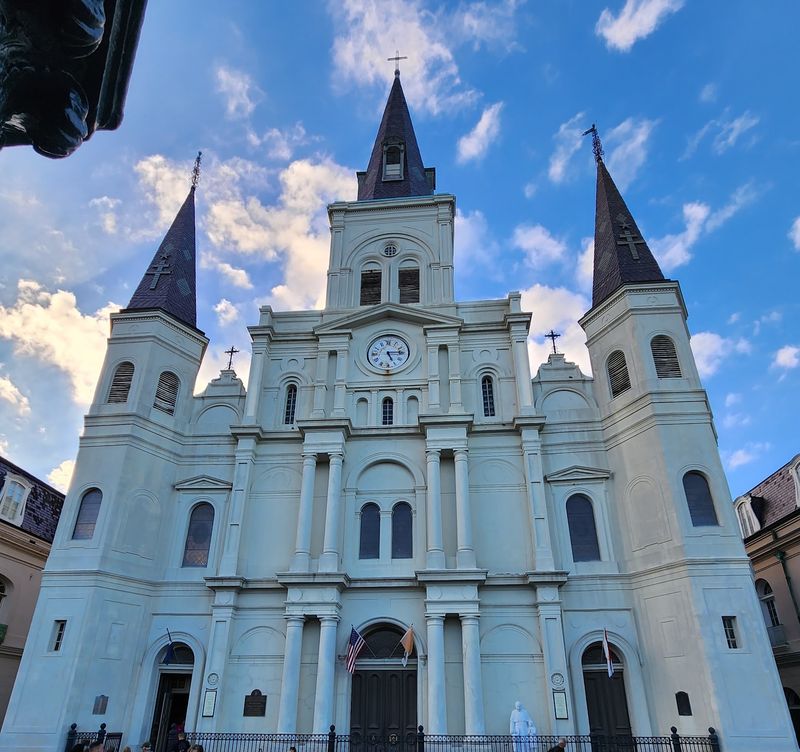
Look toward the back of Jackson Square in New Orleans and you cannot miss the three white spires rising above the French Quarter. That is St. Louis Cathedral, the oldest cathedral in continuous use in the country, tracing its roots to the city’s founding in 1718.
The building you see today is actually the third church on this exact spot, rebuilt after fire and collapse. It still holds daily Mass while crowds photograph it from the plaza just steps away.
Where The Cathedral Stands In The French Quarter
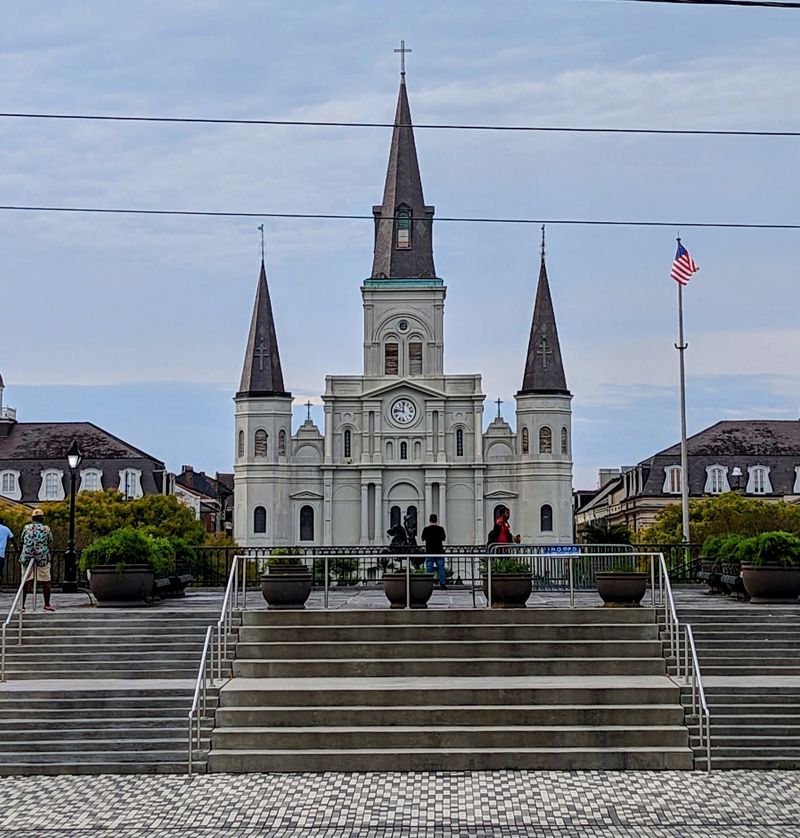
Face Jackson Square from the river side and the cathedral sits dead center, framed by the pedestrian plaza and the old buildings that surround it. The address, 615 Pere Antoine Alley, tucks the entrance along a narrow lane beside the main façade in the heart of the French Quarter.
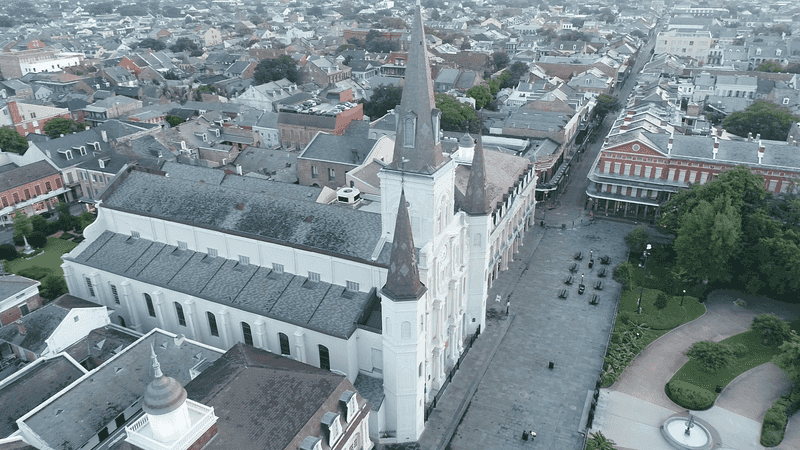
Two historic structures flank it: the Cabildo on one side and the Presbytère on the other. Together the three buildings form one of the most recognizable stretches of architecture in the city, and the cathedral is the tall centerpiece that ties them together.
Officially it carries the name Cathedral-Basilica of Saint Louis, King of France, honoring King Louis IX. It serves as the seat of the Archdiocese of New Orleans, so this is a working church rather than a preserved relic.
Visitors often describe the square as one of the calmest spots in the Quarter, a place to sit, take photos, and watch the spires against the sky. That mix of active faith and open public space gives the location its particular pull.
The Wooden Church That Started It All In 1718
The story begins the same year New Orleans did. In 1718, colonists raised a basic wooden church on this site to serve the French Catholic settlement that needed a place to gather and pray.
French Royal Engineer Adrien de Pauger designed the early structure, which was notable for using brick made locally, among the first buildings in the young city to do so. Simple as it was, it marked the square as sacred ground from the start.
The early building did not last long against the weather. A hurricane damaged the first version in 1722, pushing the colony toward something sturdier and more permanent.
A more substantial brick and timber church went up beginning in 1725 and was finished by 1727. During construction, worshippers made do with temporary spaces, including a barracks, until the new church was dedicated on Christmas Eve of 1727.
That 1727 church stood for decades and became a familiar fixture on the town square, setting the pattern for a spiritual anchor that generations of the city would come to expect at this exact spot.
The Great Fire Of 1788 And The Spanish Rebuild
Good Friday of 1788 brought disaster. The Great New Orleans Fire swept through the city on March 21, consuming hundreds of buildings, including the 1727 church that had stood for sixty years.
New Orleans was under Spanish rule at the time, and rebuilding fell to the community. Don Andrés Almonester y Roxas, a wealthy Spanish philanthropist and notary, stepped forward to finance an entirely new church on the ashes of the old one.
Construction moved steadily once the cornerstone was laid in 1789, and the building reached completion in 1794. The Spanish-era design leaned Renaissance in style and featured octagonal bell towers, a look quite different from what stands today.
An important milestone arrived mid-project. In 1793, Saint Louis Church was elevated to cathedral rank, becoming the See of the Diocese of New Orleans and cementing its status among the oldest cathedrals in the country.
Fire threatened again in December 1794, when a second major blaze tore through the city. This time the newly finished cathedral was narrowly spared, surviving to serve the growing congregation for the next several decades.
The 1850s Rebuild That Created Today’s Cathedral
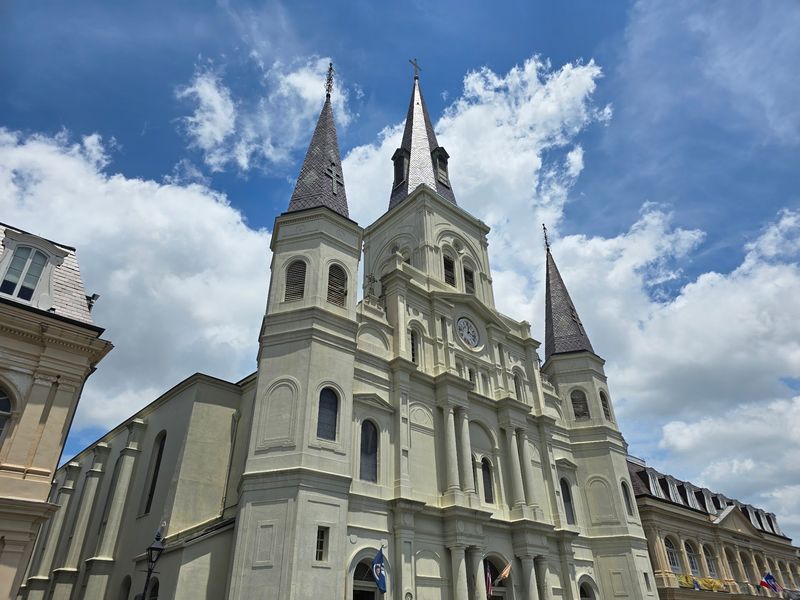
Most of what visitors admire now dates to a dramatic mid-century overhaul. By the 1830s the Spanish-era cathedral was showing its age, and church wardens wanted to enlarge it for a swelling congregation.
French-born architect J.N.B. de Pouilly drew up the reconstruction, and work began in 1849. The plan promised a grander building, but the process nearly ended in ruin.
In January 1850, the central tower collapsed during construction, taking down parts of the roof and walls with it. The failure was severe enough that crews demolished almost all of the 1794 structure, leaving only its foundation and portions of the front wall.
The present church rose from that setback and was completed around 1851. Its design blends several styles at once, mixing Spanish Colonial, Greek Revival, Gothic, and French Neo-Gothic touches into the silhouette people recognize today.
One survivor made the jump between eras. The bell from the 1819 tower, named Victoire in honor of the 1815 Battle of New Orleans, was salvaged and installed in the new building, where it still hangs.
Three Spires And A Symmetrical White Façade
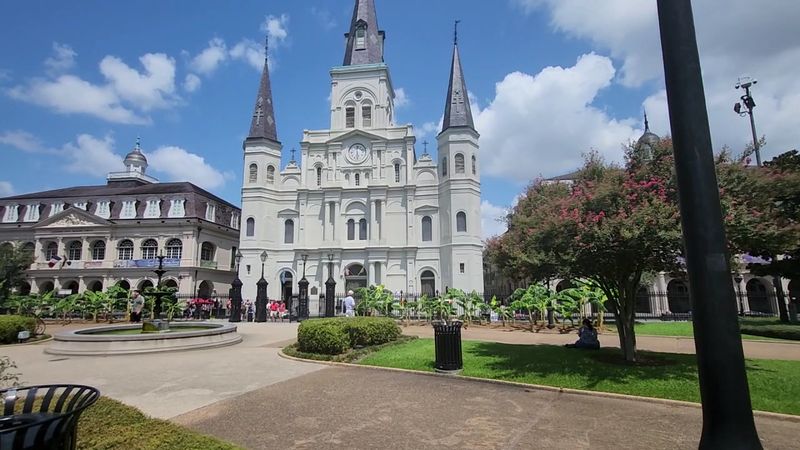
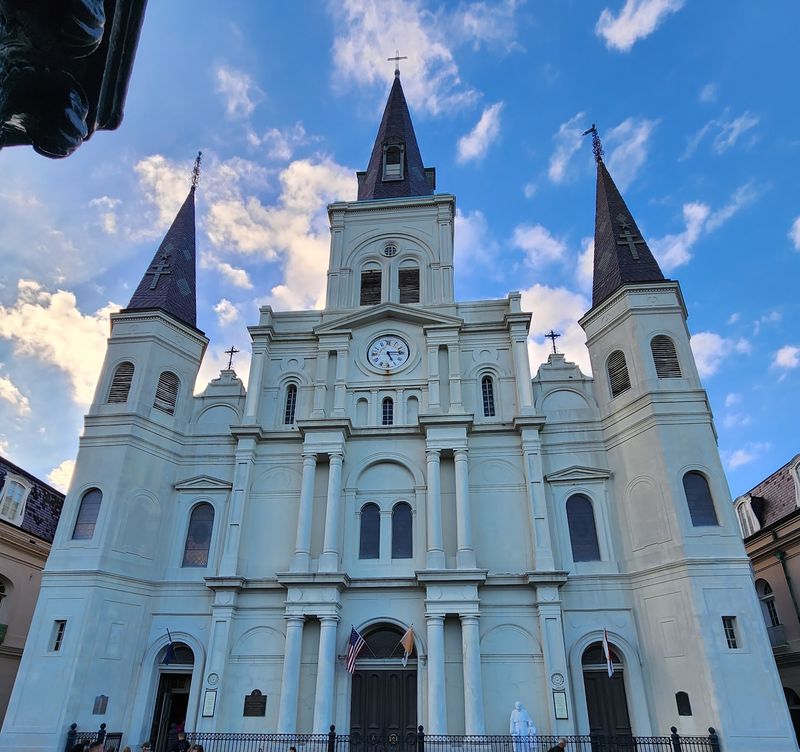
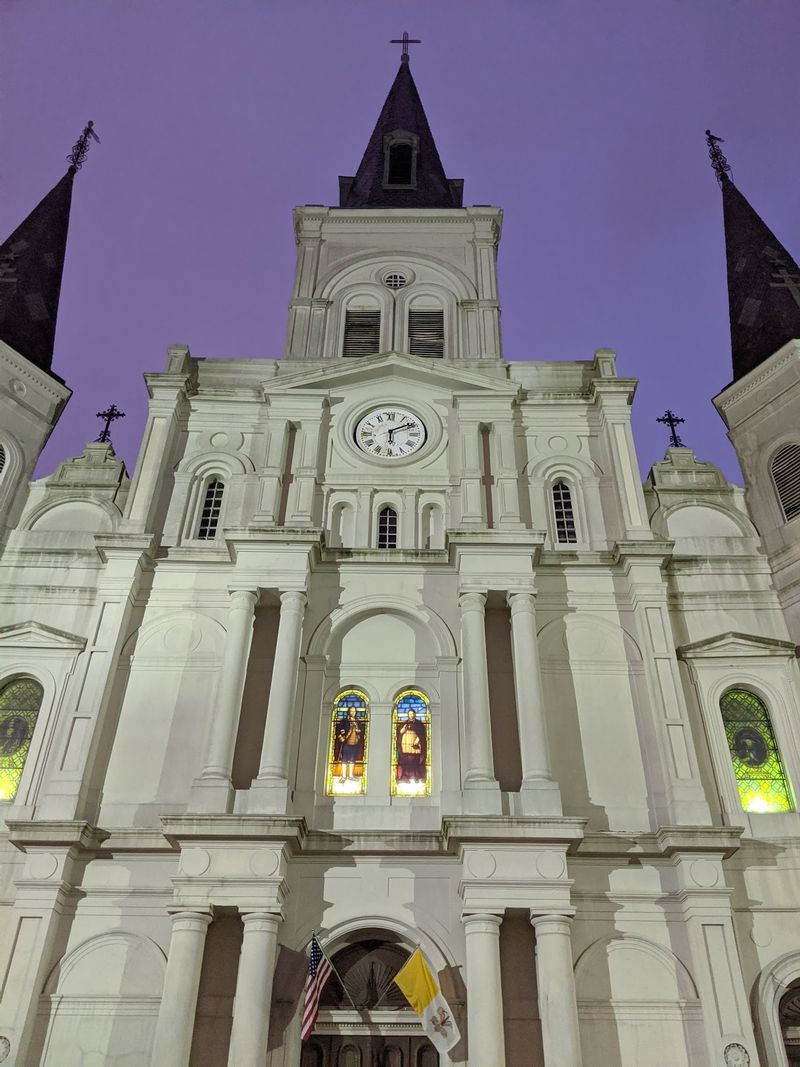
The exterior is the image the whole city is known for. A towering central spire stands between two smaller ones, giving the cathedral a symmetrical front that opens directly onto the pedestrian plaza.
White stucco covers the walls, and three arched doorways line the entrance, drawing the eye up toward those points against the sky. The look pulls from a sophisticated mix of Spanish Colonial, French Neo-Gothic, Greek Revival, and Renaissance motifs.
Visitors from California have noted that the Spanish Missions back home, some of the oldest buildings they know, simply do not compare to the scale and detail here. That reaction speaks to how commanding the front feels up close.
The tall white spires make it one of the most photographed structures in New Orleans, and the open square in front leaves plenty of room to frame a shot. Morning light and evening glow both flatter the stucco in different ways.
For anyone tracing the building’s layered history, the façade is where all those centuries of rebuilding finally settled into a single, unmistakable outline.
Stained Glass, Frescoes, And A Marble Altar Inside
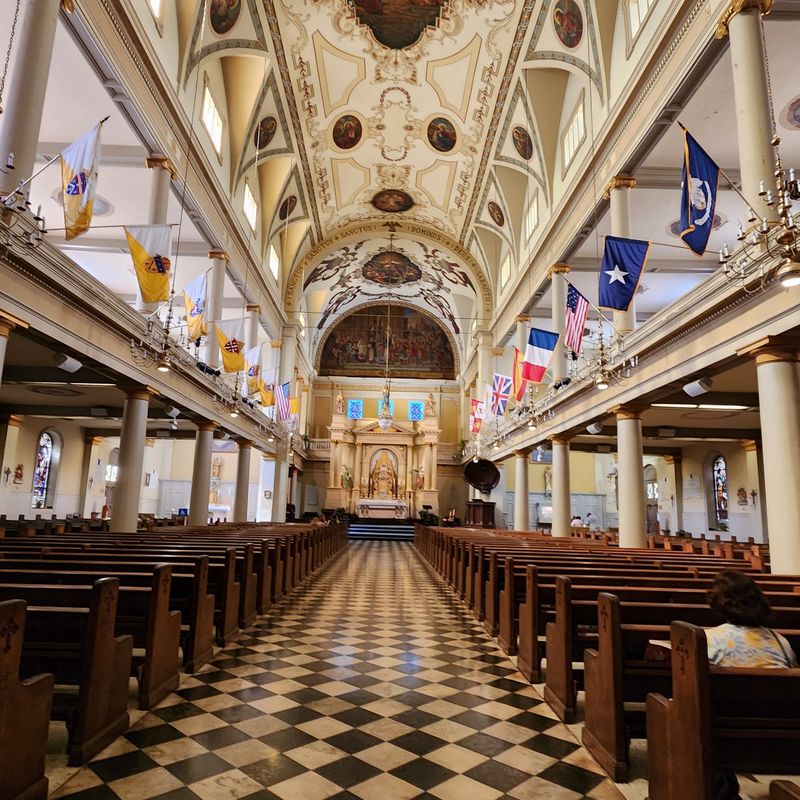
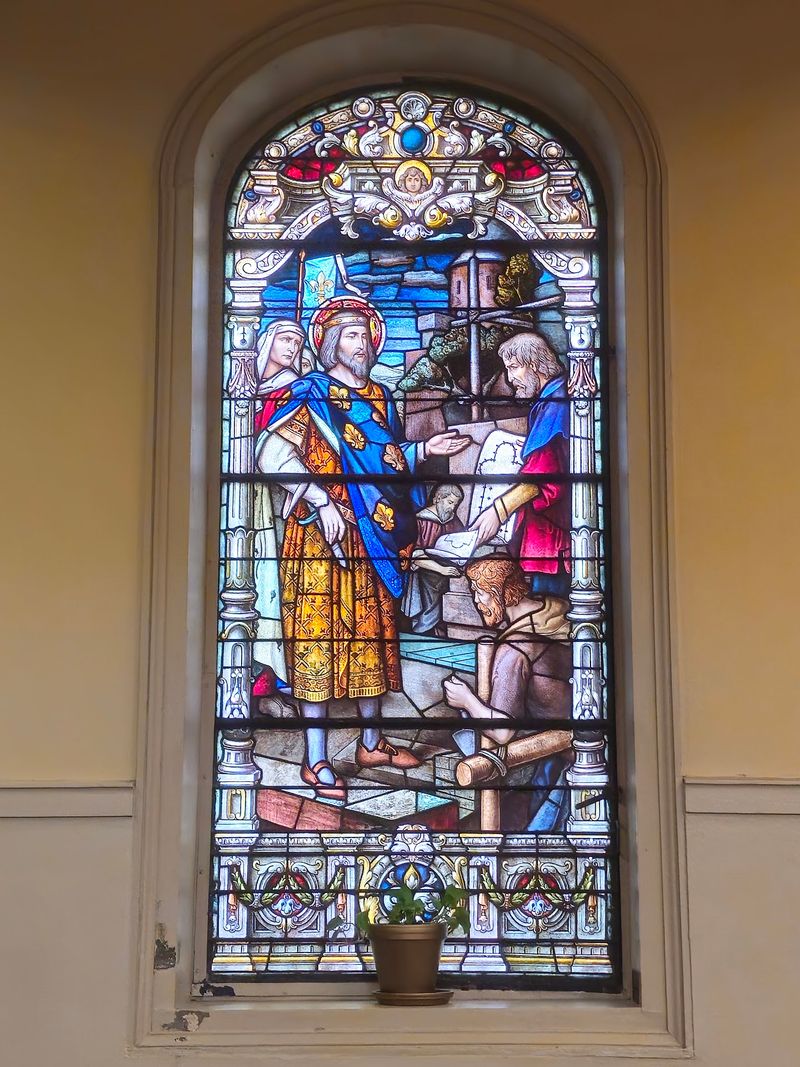
Step through the doors and the detail multiplies. Stained-glass windows run the length of the nave, many of them depicting Saint Louis himself, so a quick read on King Louis IX beforehand adds real context to what you are seeing.
Overhead, frescoes cover the ceiling with painted scenes, and the whole interior carries the weight of its history. Visitors describe the artwork as moving and the space as remarkably well preserved.
At the front sits a grand Rococo-style altar made of white marble and finished in gilt, the focal point that anchors the sanctuary. One visitor who returned as a confirmed Catholic called the interior art comparable to the great old churches of Europe.
The choir draws its own praise, with people describing the sound as heavenly during services. Even those who arrive purely to look tend to stay longer than they planned.
A book and gift shop sits near the entrance, offering keepsakes and a copy of an illuminated Bible among the artifacts on display. Together the windows, ceiling, and altar make the interior every bit as memorable as the famous exterior.
A Front-Row Seat To New Orleans History
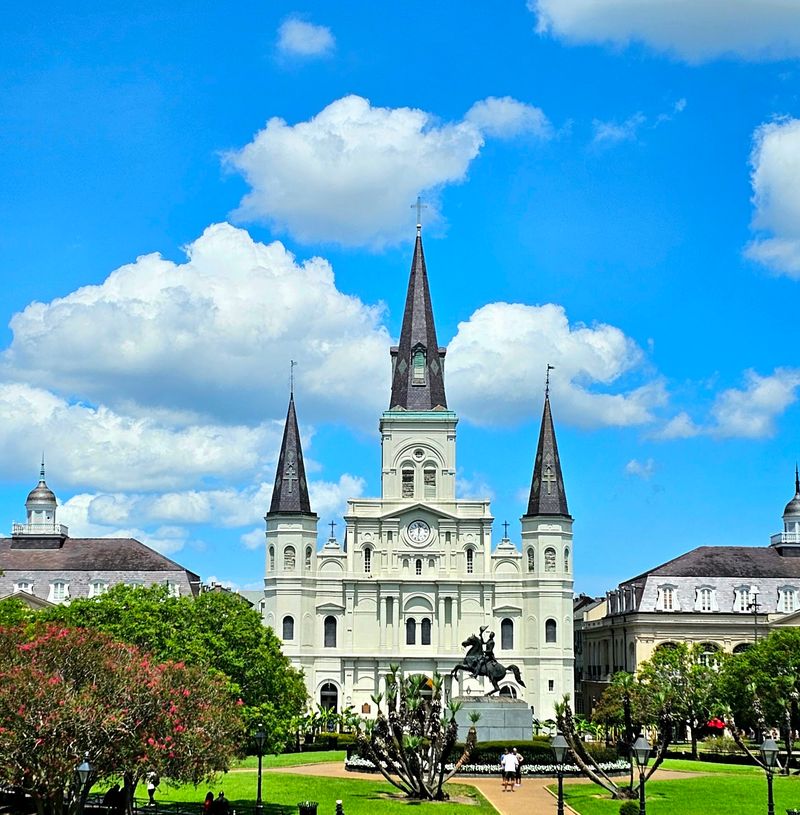
Few buildings have watched more of the city’s turning points. In 1803, the Louisiana Purchase ceremony unfolded just steps away in what is now Jackson Square, with the cathedral looming over the proceedings.
It also figured into the lead-up to the Battle of New Orleans in 1815, when prayers were offered as the city braced for conflict. The bell named Victoire, installed in 1819, was cast to commemorate the outcome of that battle.
The Civil War brought a different chapter. After Union forces captured New Orleans in 1861, they put the cathedral to use as both a barracks and a hospital, a reminder that the building has served the city in more than one way.
Its place in the wider Catholic world grew too. In 1964, Pope Paul VI elevated it to the rank of Minor Basilica, recognizing its age, beauty, and pastoral role.
Then in September 1987, Pope John Paul II visited and prayed before the statue of Our Lady of Prompt Succor. The plaza out front was renamed Place John Paul II in his honor after that visit.
Still A Working Church At The Heart Of The City
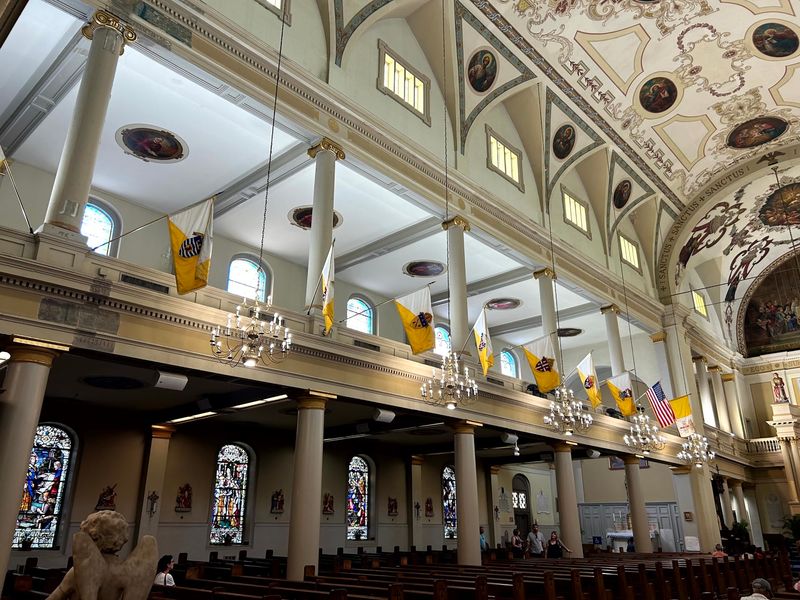
For all its fame as a landmark, the cathedral has never stopped doing its actual job. It remains the seat of the Archdiocese of New Orleans and holds daily Mass, along with weddings and other services.
That living function is part of what visitors notice. People describe attending Mass in the historic sanctuary as meaningful, and services are open to everyone who walks in.
Because it is active, timing matters. One common piece of advice from visitors is to avoid arriving right at noon when Mass is starting, then return later to explore respectfully once services have ended.
Inside, many stop to light a candle for remembrance or simply sit and reflect. Several describe the atmosphere as a calm escape from the busy energy of the French Quarter just outside the doors.
The building marks itself as America’s oldest continuously active Catholic cathedral community, established in 1718. That continuity, rather than any single feature, is what keeps drawing people back through the same doors that colonists once used.
Concerts, Mardi Gras, And Holiday Traditions
The cathedral’s calendar reaches well beyond regular services. It hosts annual concerts and events, especially around the holidays, and some visitors have happened upon free performances during their stop.
Mardi Gras season pulls the building into the celebration too. Certain parades set off from its vicinity, and it serves as the site of the city’s long-running traditional St. Anne’s parade.
Evening spectacle sometimes joins the mix. During a recent Super Bowl week, a light show played across the façade every thirty minutes into the night, and visitors enjoyed watching the community gather in the square to take it in.
That blend of sacred and civic life is what makes the setting feel so central. One moment it is a quiet place to reflect, and the next it is the backdrop for music, projections, or a passing parade.
The open plaza out front is what makes all of it possible, giving crowds room to gather without crowding the doors. Whether the draw is a holiday concert or a light display, the spires end up at the center of the scene.
Planning Your Visit: Hours, Cost, And Getting There
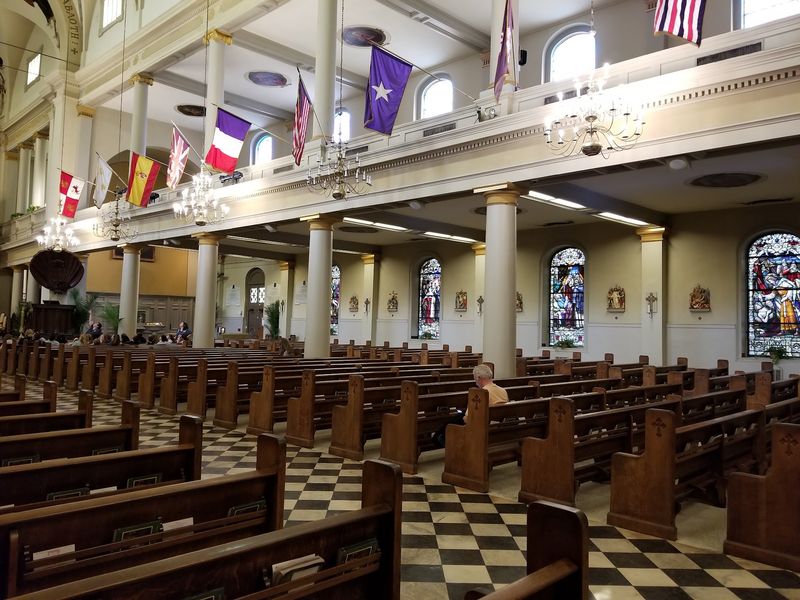
Getting in is refreshingly simple. There is no charge to view the interior, and the cathedral is open for self-guided visits when services are not in progress, with guided tours also offered.
Hours run from 9:30 AM to 4 PM Monday through Saturday, with Sunday opening a little earlier at 9 AM. Since Mass can interrupt visiting hours, planning around midday helps you avoid arriving mid-service.
The entrance sits at 615 Pere Antoine Alley, the narrow lane beside the main façade. Parking in the French Quarter is famously tight, so many people arrive on foot after exploring the surrounding streets.
A small book and gift shop near the entrance offers keepsakes, though one visitor felt strongly that retail belonged elsewhere. The phone line, +1 504-525-9585, and the official website can confirm current details before you go.
Worth knowing ahead of time: a significant, multi-year restoration is underway, and visitors have mentioned construction affecting the grounds. Amenities are limited during the work, so set expectations accordingly and check the latest updates.
Restoration Work And The Road Ahead
Centuries of use and a challenging environment have finally caught up with the old walls. The cathedral is facing major restoration needs, including cracks in the foundation caused by the settling of soft New Orleans soil.
The list runs long. Crews are tackling extensive work on the stained-glass windows, waterproofing for the exterior, and repairs to the historic bells, all while the building keeps functioning as an active church.
Visitors have picked up on the scope firsthand. Some were told that two years of renovations were set to begin, and one even noted the building still lacks indoor plumbing at this stage.
To fund the effort, the cathedral and the Archdiocese of New Orleans launched a multi-million dollar campaign through a group dedicated to preserving the structure. The goal is to keep this continuously active landmark standing for future generations.
For all the scaffolding and expense, the appeal has not faded. People still describe the upkeep as a constant work in progress and encourage others to visit anyway, because the spires over Jackson Square remain the same landmark colonists first raised here three centuries ago.