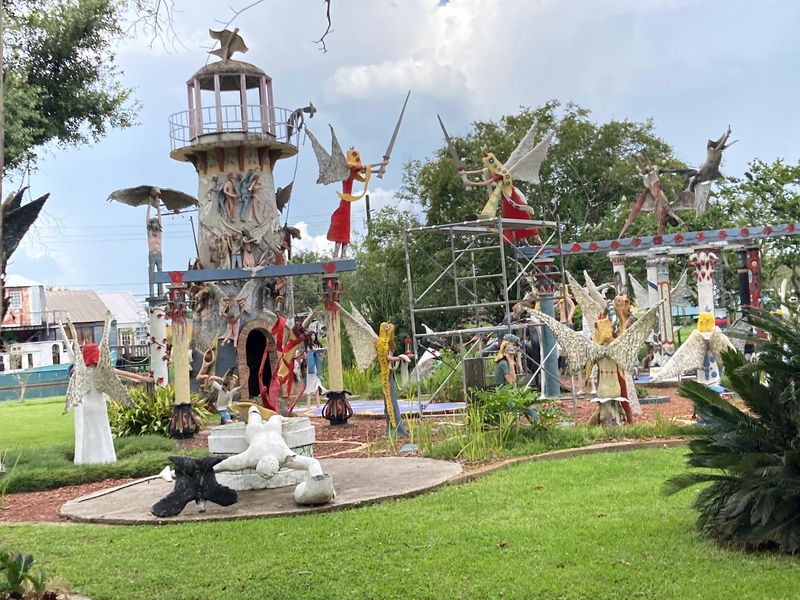
On a small lot beside Bayou Petit Caillou, more than 100 concrete figures stand in the grass, and one of them keeps showing up again and again: the man who made them. Kenny Hill, a bricklayer, spent roughly a decade in the 1990s shaping angels, soldiers, cowboys, and versions of himself, then topped it all with a 45-foot brick lighthouse.
Around 2000, he walked away and never came back to finish the story. Today the Chauvin Sculpture Garden is free to visit, and it remains one of the strangest, most moving places you can find at the end of a bayou road.
A Concrete Crowd On Bayou Petit Caillou
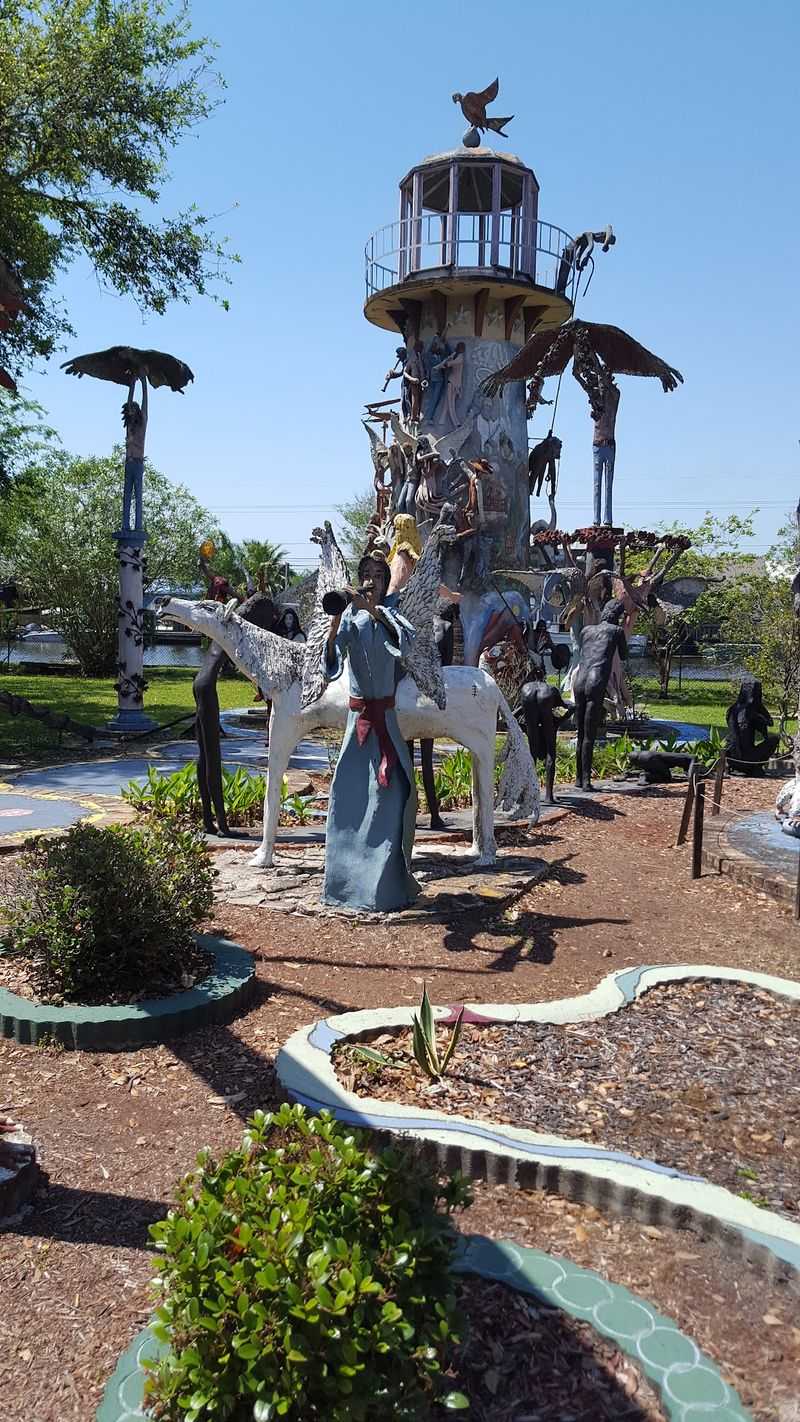
Drive south from Houma on the road that follows Bayou Petit Caillou, and the houses, docks, and shrimp boats start to crowd closer to the water. Then, at 5337 Bayouside Drive in Chauvin, the yard on your side of the road suddenly fills with people who never move.
That is the Chauvin Sculpture Garden, a self-taught folk art site built by Kenny Hill on his own property. Figures made of concrete, many painted in bright colors, stand, kneel, climb, and reach toward the sky.
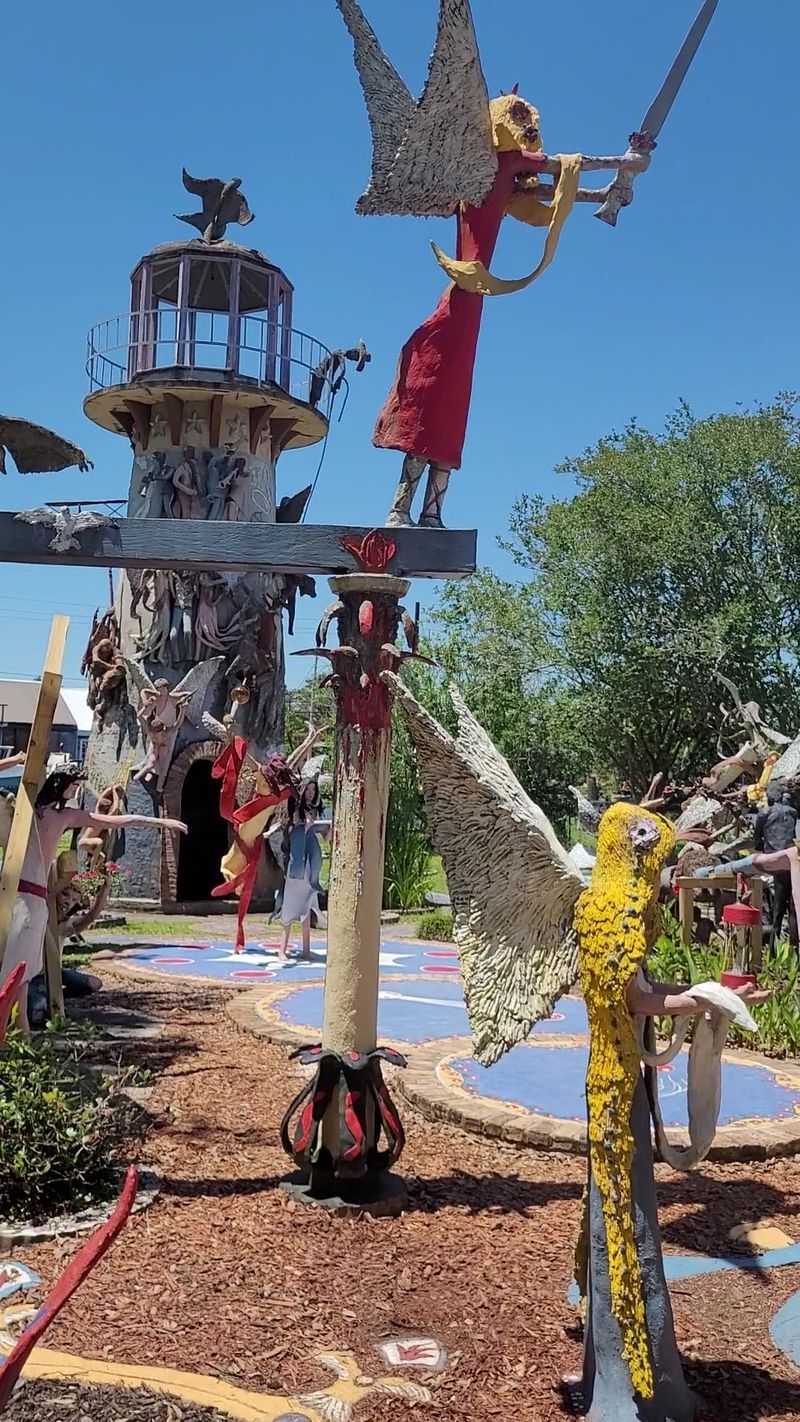
Angels hover near soldiers. Children gather near cowboys.
Biblical figures share space with a man who looks a lot like the artist.
At the center rises a brick lighthouse about 45 feet tall, built from roughly 7,000 bricks. It pulls the eye no matter where you stand, and it gives the whole garden a kind of anchor.
The site is small, and several visitors mention it covers less ground than they expected. What it lacks in acreage, it makes up for in density.
Nearly every surface holds a face, a gesture, or a painted detail. Nicholls State University now cares for the garden, and admission is free, which makes it an easy stop for anyone already heading down the bayou toward Cocodrie.
Kenny Hill, The Bricklayer Who Kept To Himself
Very little about Kenny Hill fits the usual picture of an artist. He worked as a bricklayer, and accounts describe him as a Vietnam veteran who began sculpting on a vacant lot in Chauvin in the late 1980s.
His most intense stretch of building came through the 1990s.
He was not trying to attract an audience. Hill kept his work private and, by most accounts, kept himself private too.
One visitor who watched him work on the lighthouse years ago recalls asking to take photographs. He agreed, with one condition: no pictures of him.
That detail says a lot. Here was a man who would sculpt himself dozens of times in concrete yet did not want a camera pointed at his face.
The garden became the place where he could say what he apparently did not say out loud.
His skill as a mason shows everywhere. Brick and concrete were his working materials, and he handled them with a craftsman’s patience, layering forms and adding small details that reward close looking.
No formal art training, no gallery plan, no marketing. Just a man, a lot along the bayou, and years of mixing concrete.
That quiet origin is part of why the finished place feels so personal.
Falling, Struggling, And Lifted By Angels
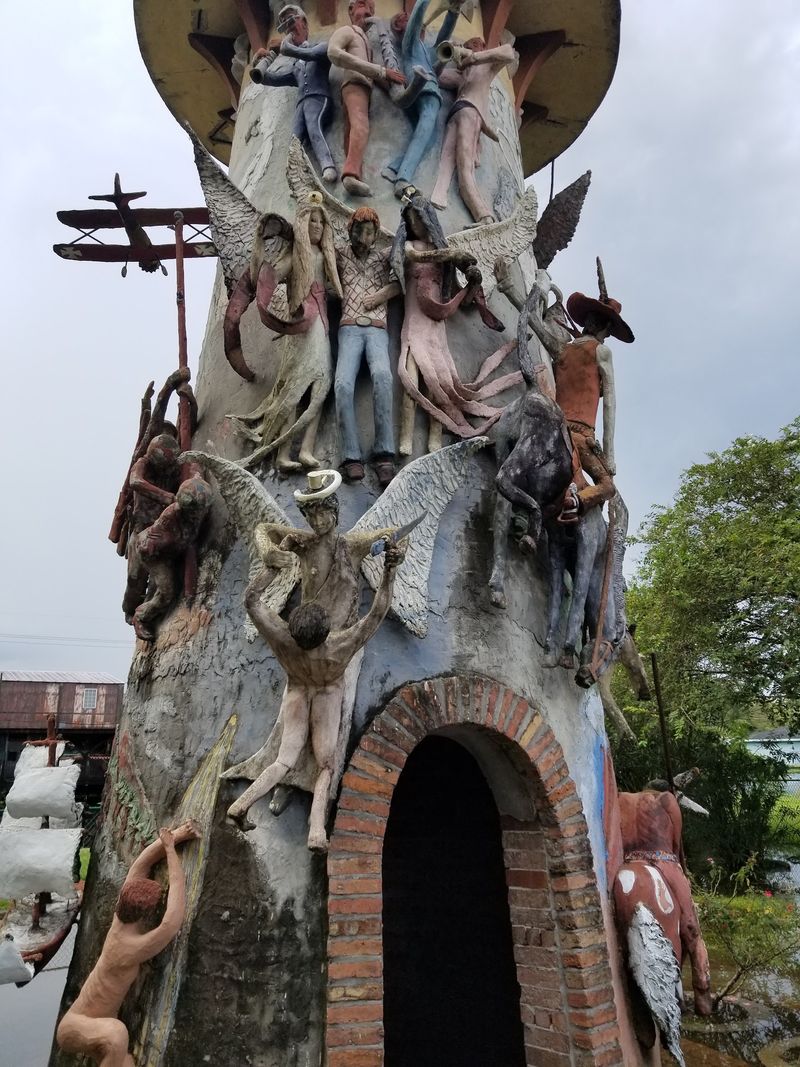
Look long enough and a storyline starts to appear. The figure of Hill turns up in scene after scene, and he is rarely comfortable.
In some sculptures he seems to be falling. In others he appears to struggle.
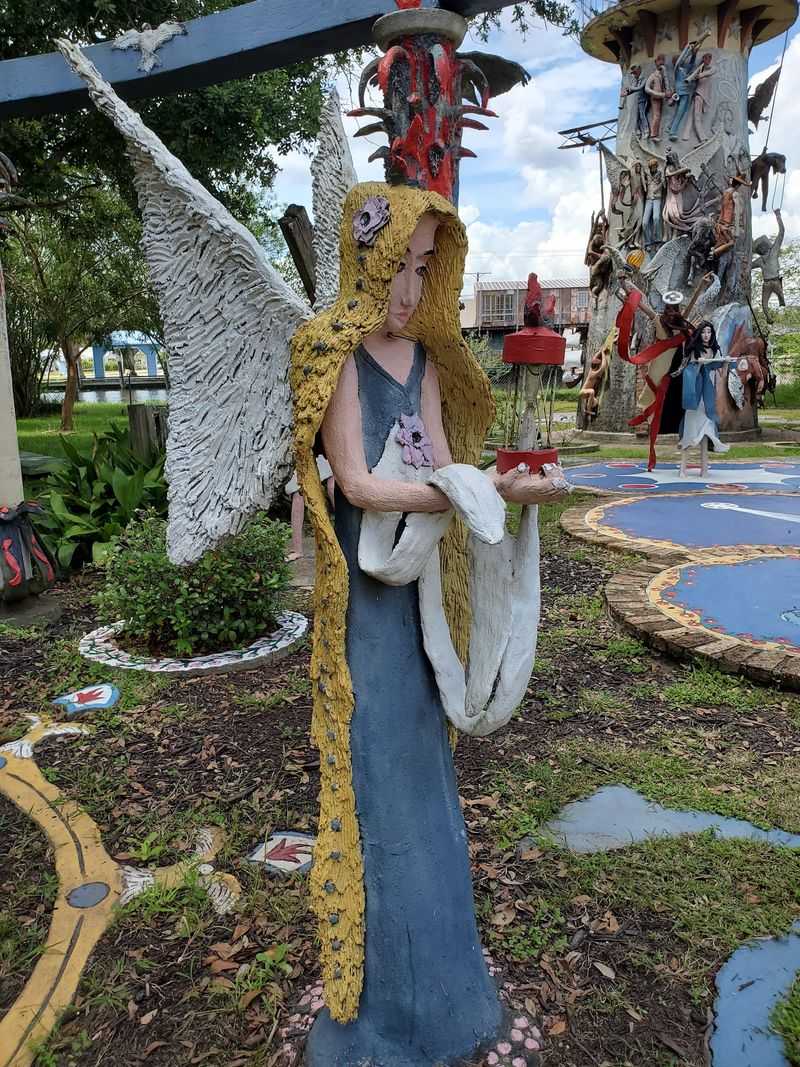
In several, angels hold him up.
Many observers read the garden as a spiritual journey, and that interpretation fits what you see. Religious imagery runs heavy throughout, with biblical figures and winged messengers placed alongside everyday people.
The self-portraits read like chapters in a private conversation between a man and his faith.
Hill never left a written guide, so much of the meaning stays open. Visitors often say the garden can be understood in many different ways, and a few describe it as a little unsettling, sensing inner conflict in the expressions.
Others find it hopeful, focusing on the angels doing the lifting.
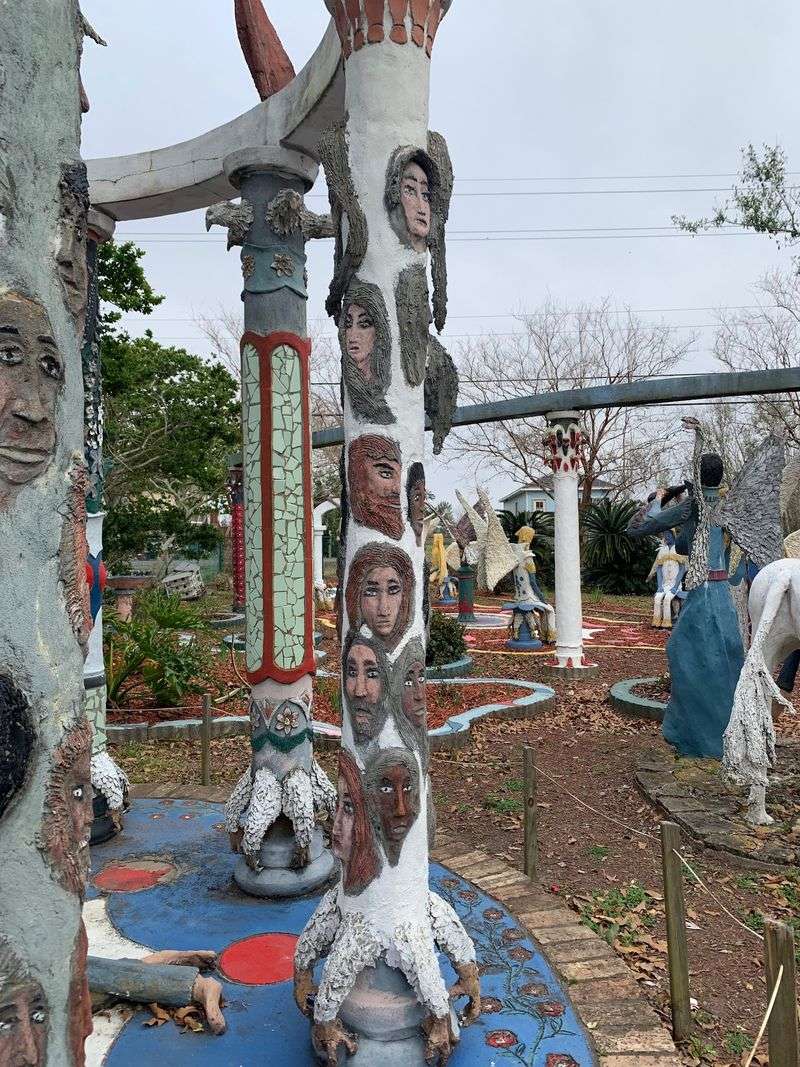
Both reactions make sense. The faces are raw and exaggerated, with wide eyes and strained mouths that do not try to be pretty.
Walking through, you may find yourself piecing together an order, deciding which scene came first and which came last. The artist leaves that work to you, and that open ending is exactly what keeps people thinking about the garden long after they drive away.
The 45-Foot Lighthouse At The Center
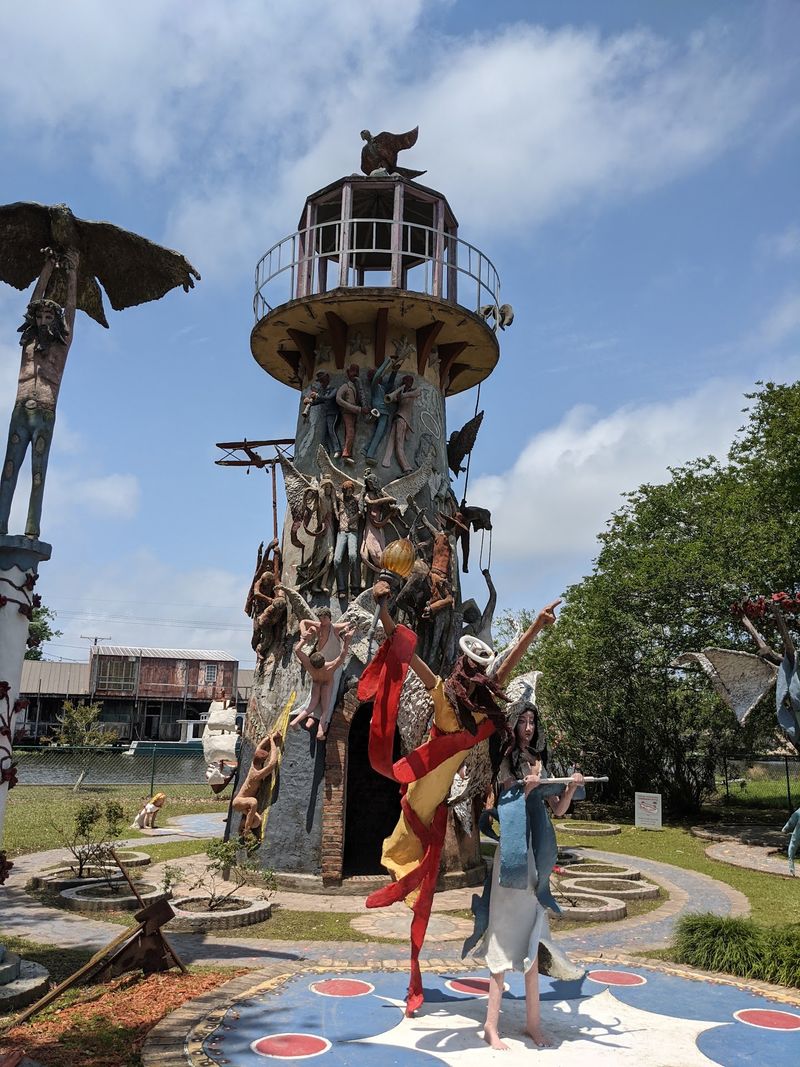
Seven thousand bricks. That is roughly what went into the lighthouse Hill built at the heart of his garden, and it rises about 45 feet over the surrounding figures.
For a bricklayer, it was a natural centerpiece, a chance to show what his trade could do at full scale. For everyone else, it is the landmark you spot from the road before you have even parked.
Lighthouses carry obvious meaning along the coast, where they guide boats home through darkness and bad weather. Placed in a garden filled with spiritual imagery, the tower easily reads as a symbol of guidance or salvation, though Hill never explained it himself.
Figures are arranged around and on the structure, adding to the sense that everything in the yard is moving toward it.
The overall layout supports that feeling. One visitor describes the garden as circular, with paths and sculptures drawing people toward the middle.
Standing at the base and looking up, the tower seems to collect the whole story in one place.
Bring a phone with a wide-angle setting if you want to fit it into a single frame. The height, the brickwork, and the small figures around it are hard to capture all at once, and most people end up walking a full loop around it.
Soldiers, Cowboys, Children, And Saints
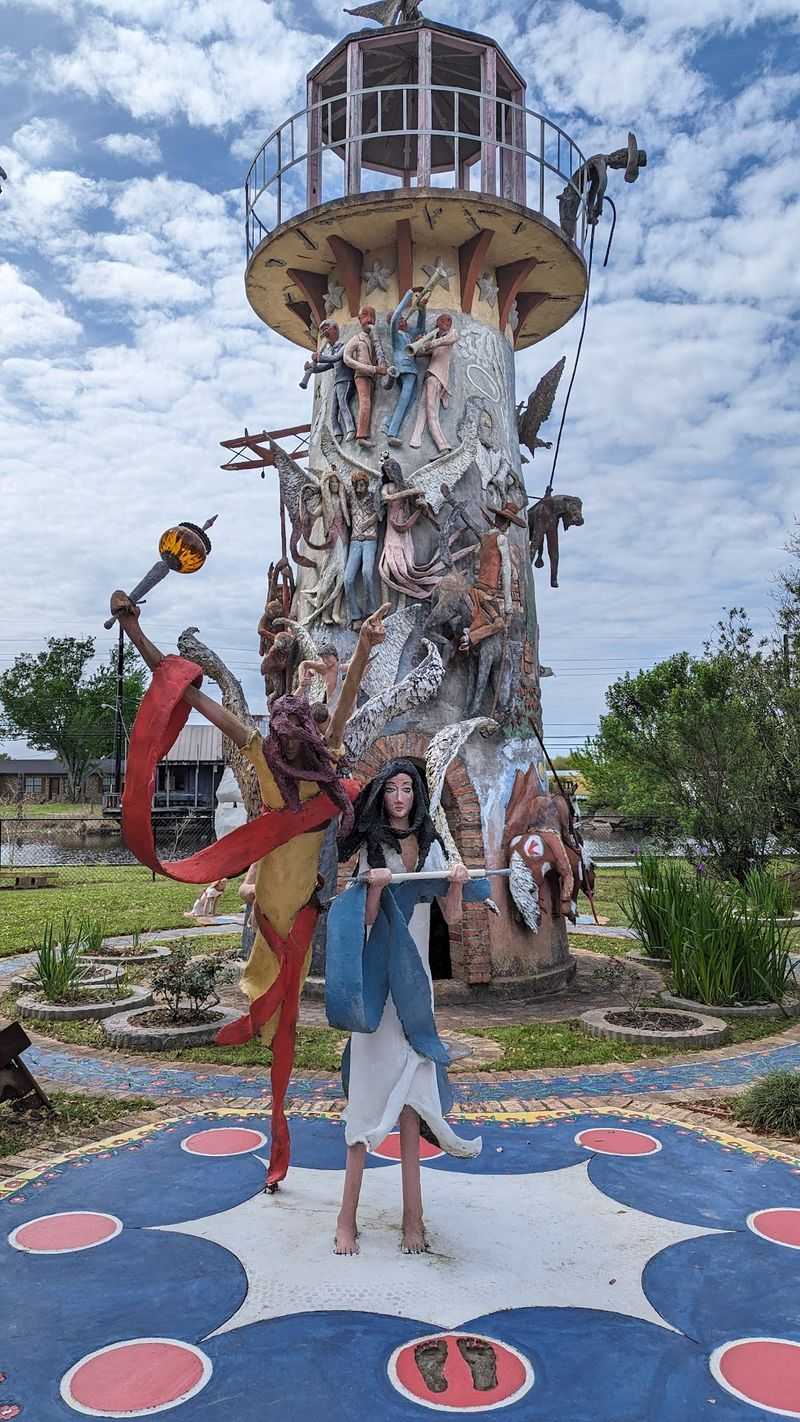
Count the characters and the cast gets surprisingly wide. Beyond the angels and self-portraits, Hill shaped soldiers, cowboys, children, and religious figures, placing them close enough together that they seem to share one crowded world.
The soldiers carry extra weight given accounts of Hill’s own service in Vietnam. It is tempting to connect the dots, and many people do, though the artist left no explanation of who each figure represents.
The cowboys add an unexpected note, a bit of American folklore dropped into a South Louisiana yard.
Children appear too, small and earnest, sometimes near protective figures. Then come the saints and biblical scenes that give the garden its strongest spiritual thread.
One recent visitor compared the look to early 2000s claymation, and it is not a bad description. The proportions are exaggerated, the paint is bold, and the faces have a handmade quality that feels closer to a storybook than a museum.
The mix is what makes a slow walk worthwhile. You might spend a minute on a dramatic angel, then notice a tiny figure tucked below it that you missed entirely.
Visitors regularly mention how many small details there are, and it takes more than one pass to catch even half of them.
Why Hill Left Around 2000
Around the year 2000, Kenny Hill left the property and did not return. He had not finished explaining his work, and he never came back to do so.
That departure changed how people experience the garden. What might have been a charming roadside yard became something more mysterious.
Visitors often describe the site as leaving more questions than answers, and a few admit they have become hooked on the legend of the man behind it. One wondered aloud where the artist went.
It is fair to leave the details there. Reliable public information about Hill’s life after Chauvin is thin, and guessing does him no favors.
What remains verifiable is the work itself, standing where he put it.
The absence does shape the mood. Without the artist around to guide or explain, every visitor becomes an interpreter.
The self-portraits of struggle and rescue take on added weight when you know their maker simply stepped away.
For a while the future of the site was uncertain. One visitor credits a man who rescued the garden from the bulldozer and helped lay the groundwork for its preservation.
That effort bridged the gap between an abandoned yard and the protected public site you can walk through today.
Nicholls State University Steps In
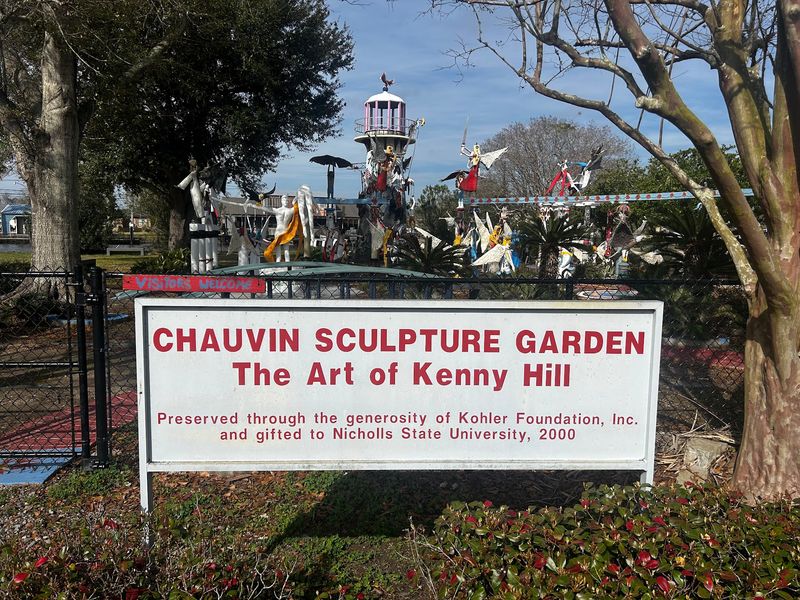
Preservation work does not happen by accident, especially with outdoor concrete sitting on the Gulf Coast. Nicholls State University, based up the road in Thibodaux, has taken responsibility for caring for the garden and keeping it free and open to the public.
That role goes beyond mowing grass. Weather and time wear on painted concrete, and storms have left their mark.
A few years ago, visitors noted restoration work underway after storm damage, with some pieces clearly in need of repair. More recent visitors describe the grounds as well maintained.
The university connection also brings people to the site. An Art Studio on the property typically opens on weekends, and past visitors recall a student or staff member on hand answering questions and sharing the backstory.
Guided tours have been offered on weekends as well.
Information posted at the entrance helps set the scene before you walk in. Several visitors found it genuinely useful, since knowing a bit about Hill makes the sculptures easier to read.
Without that stewardship, a site like this could easily crumble or disappear. Instead, it has become a teaching space, a small public art site, and a reason for students and travelers alike to head down the bayou.
Shrimp Boats And The Road Down The Bayou
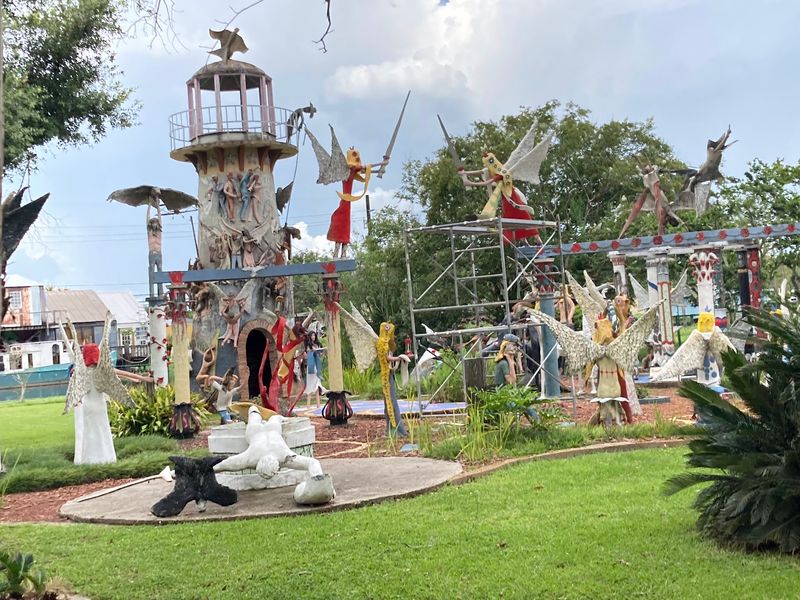
Half the experience happens before you park. The drive to Chauvin follows the water, and shrimp boats line the bayou as you go, making the trip feel like part of the garden’s story rather than a trip to get there.
Visitors regularly mention that bayou setting. The surroundings are working waterfront, not scenery staged for tourists.
Boats come and go, nets hang to dry, and the rhythm of fishing life frames the sculptures from every direction.
That backdrop matters. Hill built his garden in the middle of a real community along Bayou Petit Caillou, and the figures seem more grounded because of it.
A lighthouse makes a different kind of sense when actual boats sit within view.
Chauvin sits in Terrebonne Parish, south of Houma, and the drive rewards anyone who enjoys the slower pace of bayou country. Pair it with lunch at a nearby spot, as some visitors suggest, and it becomes a comfortable half-day outing.
Keep an eye on the side of the road as you get close. The garden is right along Bayouside Drive, and the lighthouse gives it away.
Several visitors simply parked along the road and walked in, which seems to be the usual approach here.
Folk Art Festival And The Blessing Of The Fleet
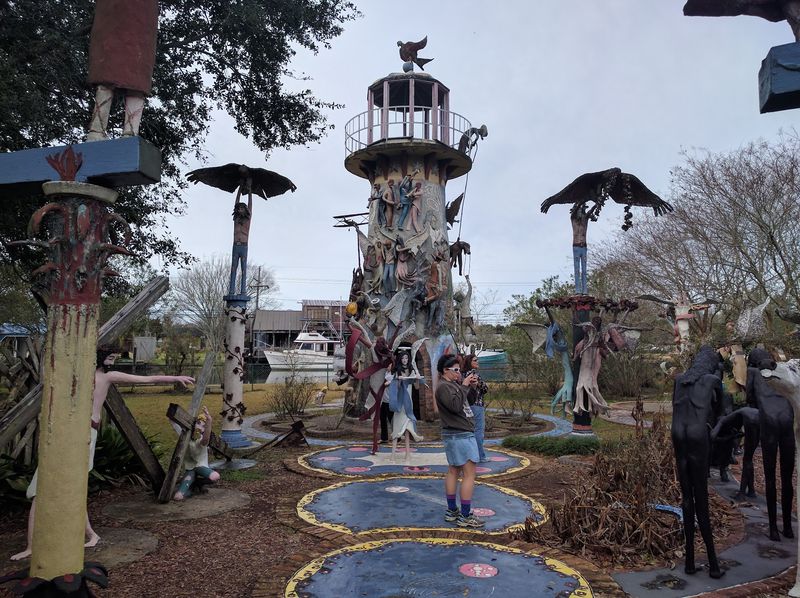
Once a year, the quiet garden fills with music. The annual Folk Art Festival often lines up with Chauvin’s Blessing of the Fleet, when local shrimp boats pass along the bayou to be blessed for the season.
The timing is hard to beat. You can stand among Hill’s angels while decorated boats glide past on the water, a pairing of faith traditions that feels right for this particular spot.
Past festivals have included Cajun music, a snowball trailer, a Vietnamese food truck, and several arts and crafts booths. Other local folk artists sometimes show their work too, turning the event into a wider celebration of homegrown creativity.
Visitors who have attended describe it as relaxed and enjoyable, a good day to wander, eat, and listen. One recalls the Sunday blessing as especially beautiful.
If you have flexibility, planning around the festival gives you the busiest and most social version of the garden. It is a very different experience from a quiet weekday visit, with more people, more sound, and plenty to eat.
Check with the garden or Nicholls State before you go, since dates depend on the fleet blessing schedule and can shift from year to year.
Benches, Picnics, And Room To Think
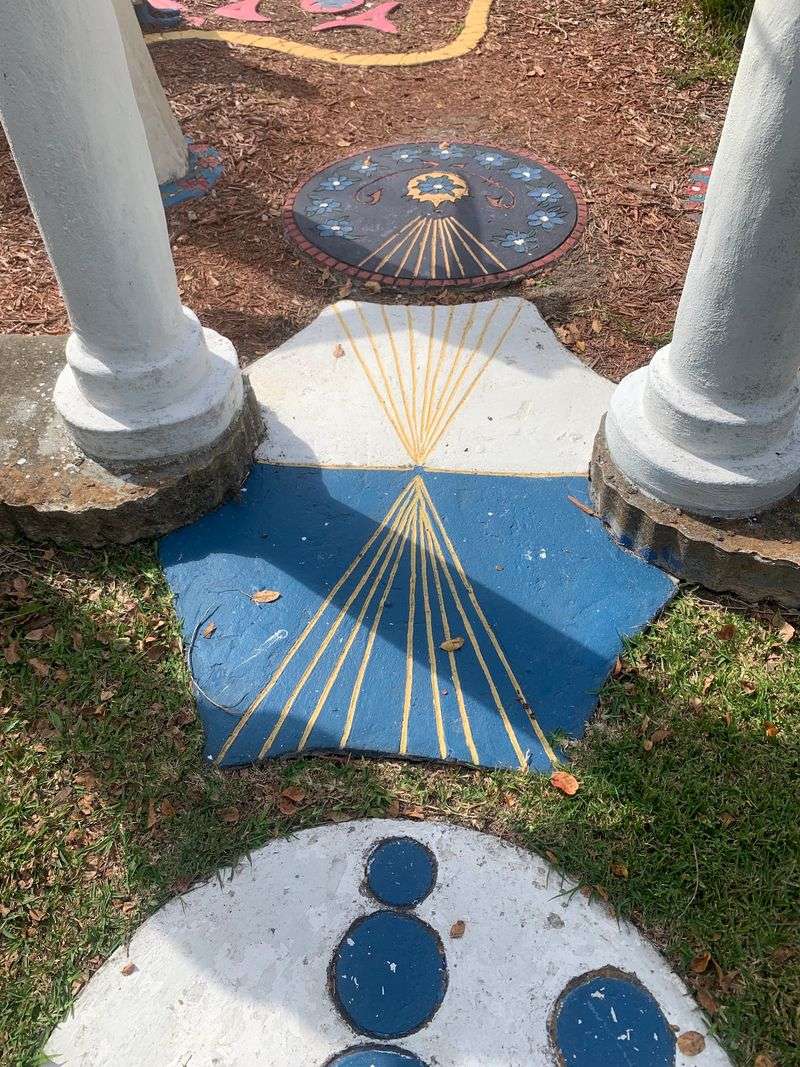
Quiet is the default setting here. On most days the garden stays calm, and visitors describe it as peaceful, a place to sit and take in the details rather than rush through.
Benches are placed around the grounds, which helps. Many of the sculptures reward a slow look, and having a seat lets you study the faces, the gestures, and the way the pieces relate to one another.
One visitor went on a Saturday and found it not very busy at all.
Some families make an afternoon of it. More than one visitor mentions bringing a small picnic and eating under a tree in the garden.
It is an easy way to stretch a short stop into a longer visit.
The atmosphere suits people who like to reflect. With so much spiritual imagery and so much left unexplained, the garden tends to prompt conversation, especially among groups trying to decide what each scene means.
Children often enjoy the bright colors and storybook quality, and one visitor said walking in felt like entering a fairy tale. Parents might want to prepare kids for a few of the more intense expressions, since some figures show real struggle.
Most visitors, though, leave describing the space as calm, thoughtful, and a little magical.
Hours, Admission, And Planning Your Stop
Good news first: it costs nothing. Admission to the Chauvin Sculpture Garden is free, supported by Nicholls State University’s preservation work.
Current listings show the garden open daily from 8 a.m. to 5 p.m., seven days a week. Older accounts describe dawn-to-dusk access, so it makes sense to plan within the posted hours to be safe.
The Art Studio is typically open on weekends, and weekend visits have historically been the best bet for guided tours or a staff member on site.
The address is 5337 Bayouside Drive, Chauvin, LA 70344. For questions about tours, events, or festival dates, the listed phone number is 985-594-2546.
Plan on roughly an hour, depending on how closely you look. The grounds are compact, so it is not a full-day destination by itself.
Pairing it with lunch nearby or a longer drive toward the coast makes the trip feel complete.
Wear comfortable shoes and bring water, especially in summer when the South Louisiana heat settles over the bayou. Sunscreen helps too, since much of the garden is open to the sky.
Read the information at the entrance before wandering in, because a little background makes the sculptures far easier to understand.
A Small Yard That Stays With You
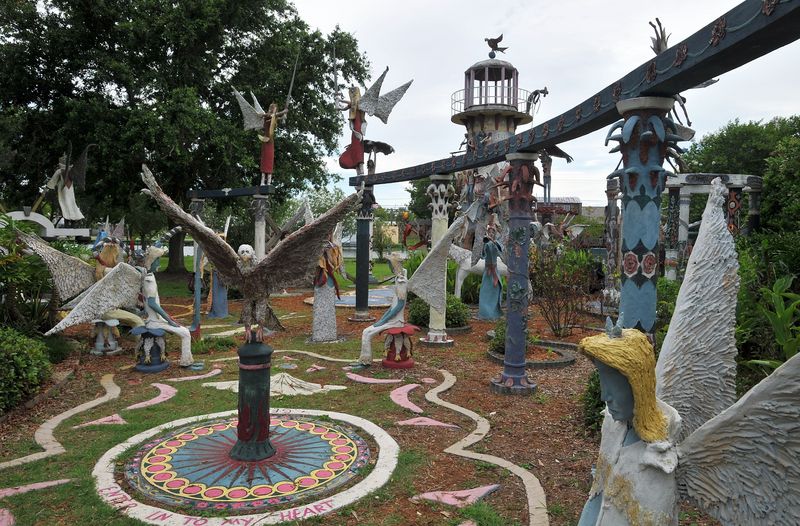
Some places impress by size. This one works the other way, packing an entire inner life into a bayou-side lot you can walk in a few minutes.
Not everyone falls for it. A few visitors say it was smaller than expected, and one suggested stopping if you are nearby rather than making a special trip.
That is a fair expectation to set. It is a compact folk art site, not a sprawling park.
Still, many people leave talking about it for days. They mention the lighthouse, the angels, the self-portraits, and the unanswered questions about the man who made them.
One visitor called it humbling to wander through and reflect on Hill’s work.
What lingers is the honesty. Kenny Hill did not build this for applause.
He built it with bricks and concrete, one figure at a time, and then he left it behind for others to find.
If the drive down Bayou Petit Caillou appeals to you, the garden gives that drive a destination worth remembering. Come for an hour, sit on a bench, and watch the boats slip past the lighthouse.
Somewhere in that crowd of concrete, an angel is still lifting a tired man toward the sky.