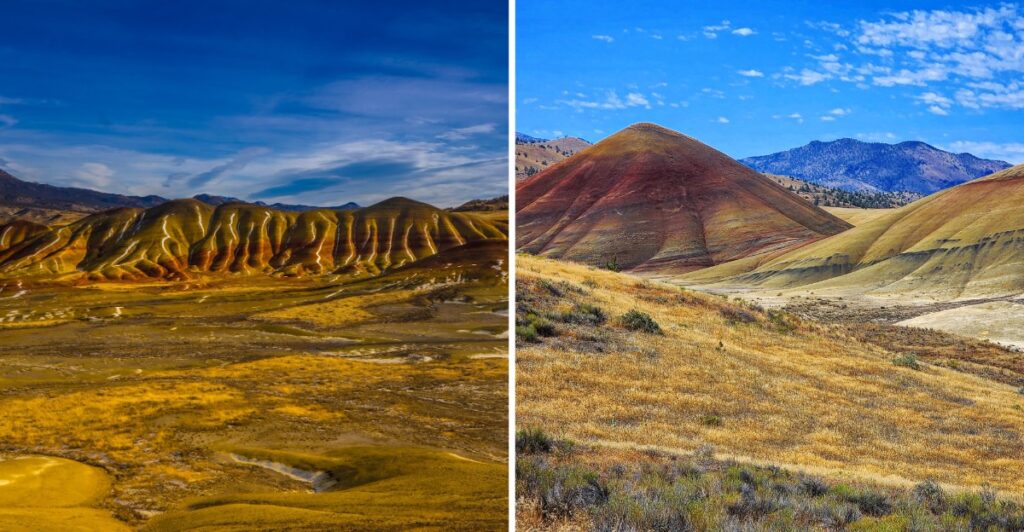
No, somebody did not turn the saturation all the way up.
Those stripes are real.
Red, gold, yellow, and black sweep across rounded hills that look almost painted. The colors come from ancient soil layers, so this Oregon landscape has been in the works for millions of years.
The view changes with the light, too.
Clouds soften the colors. Sunshine makes the bands stand out. Rain can deepen them even more.
You do not need a major hike to see it all.
Short paths bring you close to the hills, while higher viewpoints open up the whole basin.
The ground is fragile, so the trails keep you at a respectful distance.
And really, when nature spends millions of years getting the color palette right, adding a filter afterward feels a little unnecessary.
Stripes Of Red, Gold And Black That Look Hand Painted
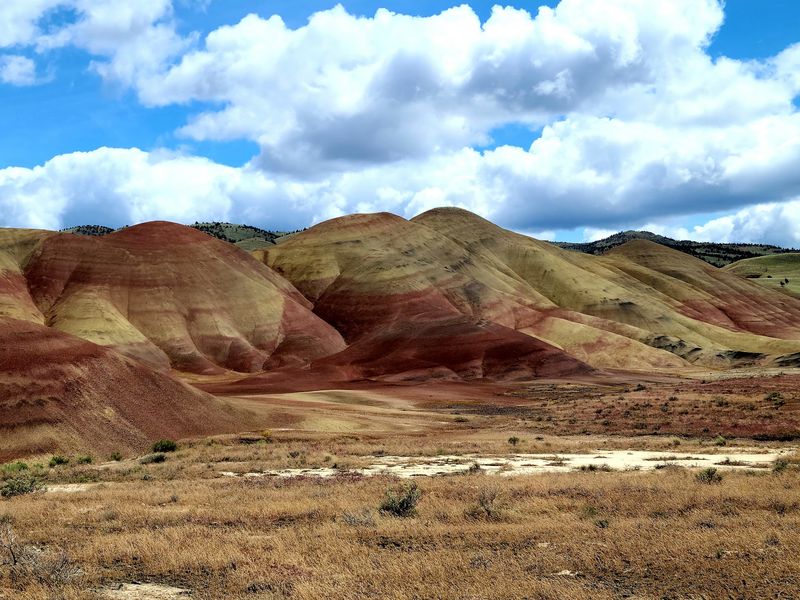
Crayons have plenty of colors, but the Painted Hills have an advantage: their stripes extend across entire slopes.
Rounded mounds carry layers of red, ochre, yellow, and tan, with darker bands threading through the brighter shades.
Depending on where you stand, several colors may appear together on a single hill.
The bare surfaces make those patterns especially easy to see. Much of the terrain has little vegetation, although sagebrush and grasses grow around the formations and on neighboring ground. From a distance, the hills seem almost smooth.
Look more closely from the trail, and you’ll notice cracked, finely textured surfaces.
The colors don’t follow a perfectly regular pattern. One mound may have a broad red section, while another shows thinner bands of yellow and dark brown. Take a moment at each viewpoint to compare the layers rather than rushing to the next trailhead.
If you’re traveling with children, invite them to spot different shades or trace the visible lines with their eyes. There’s no need to step onto the hills for a closer inspection.
Even a footprint can damage the fragile surface, and the marked trails provide clear views without disturbing it.
A Time Machine Made Of Clay And Ancient Climates
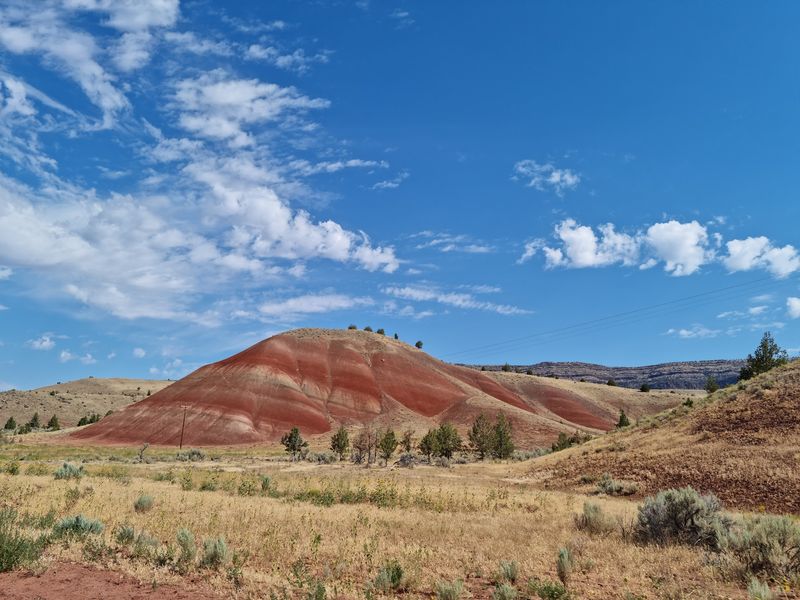
The stripes are more than an unusual color combination. They preserve evidence of environments that existed millions of years before the high desert took on its present appearance.
Ancient volcanic material weathered into soils under changing climatic conditions. Some periods were warmer and wetter than central Oregon is today.
As those soils formed and changed, minerals and chemical processes helped produce the varied reds, yellows, and darker tones now exposed on the hillsides.
Iron compounds play an important role in the colors. Different conditions during soil formation affected how those compounds changed, leaving contrasts that are visible in the exposed layers.
Rather than representing fresh paint on the rock, the bands record long periods of geological change.
The wider John Day Fossil Beds region is known for its fossil record, including ancient plants and animals.
Plant fossils associated with the Painted Hills area’s geological deposits help researchers understand vegetation and climates from roughly 30 to 39 million years ago.
You won’t need to hunt for fossils on the trails, and collecting or digging for them is prohibited throughout the monument.
Along the trail, you can connect the bands of color with the ancient soils and changing climates that produced them.
Sunlight And Rain Keep Rewriting The Color Palette
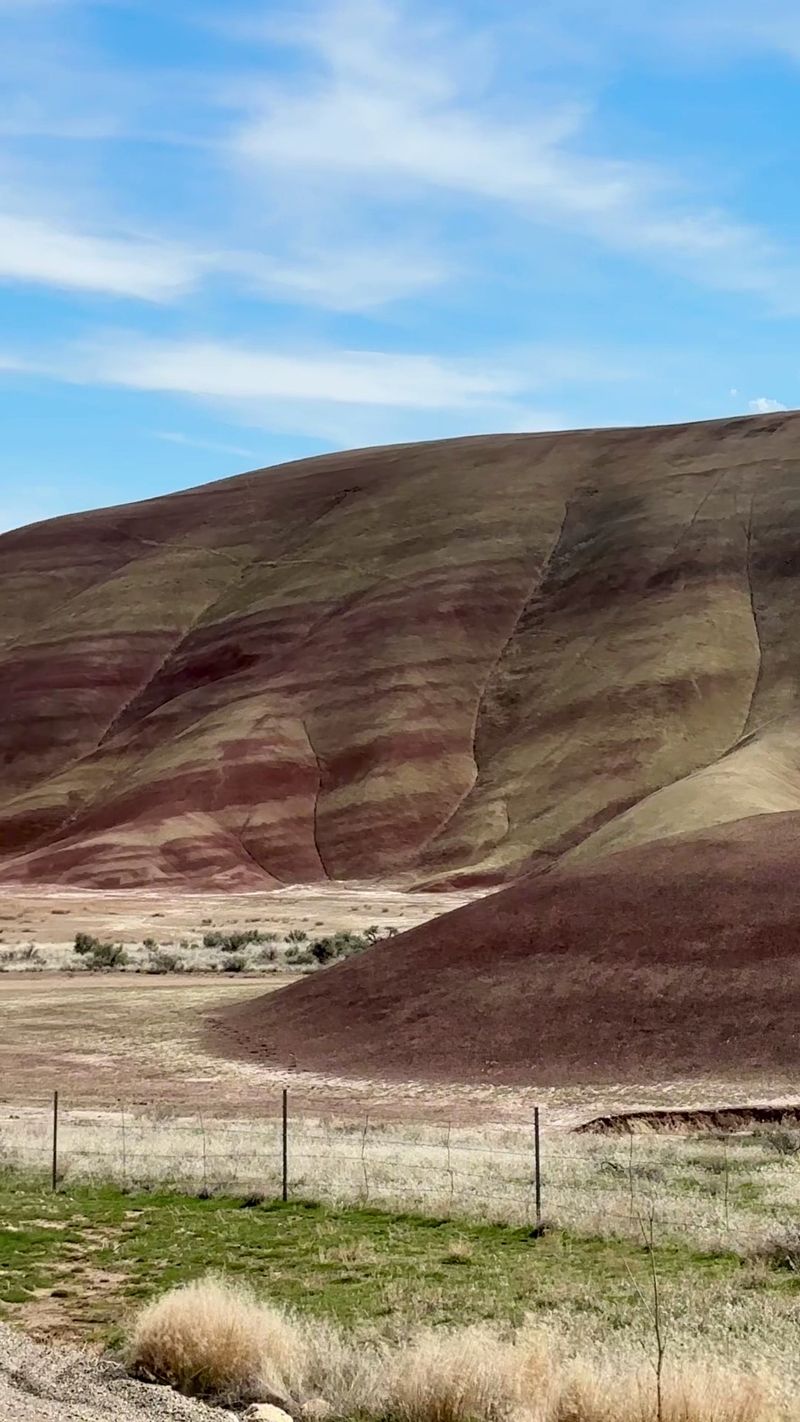
The hills don’t change their actual pigment every afternoon, but changing light can make them appear noticeably different. Cloud shadows move across the ridges, strong sun brings out some contrasts, and softer light may emphasize others.
Early and late in the day, lower sunlight can accentuate the contours of the rounded slopes. Red bands may seem richer beside pale yellow layers, while shadows settle into the shallow channels between mounds.
Under overcast skies, the colors often appear more subdued and evenly lit.
Rain adds another variable. Moisture can darken the exposed clay-rich surfaces, bringing greater contrast to some of the bands. Wet conditions also make unpaved trails muddy, and the hills themselves remain strictly off limits to foot traffic.
Choose shoes that can handle damp dirt, and leave extra time for a slower walk if the trail surface is slick. There is no advantage to stepping beyond the marked path for a different angle, even when a patch of red looks particularly bright.
If clouds arrive instead, enjoy the softer view. The hills offer plenty to examine without requiring a perfect forecast.
Volcanic Ash Gave The Landscape Its Soft, Rounded Shapes
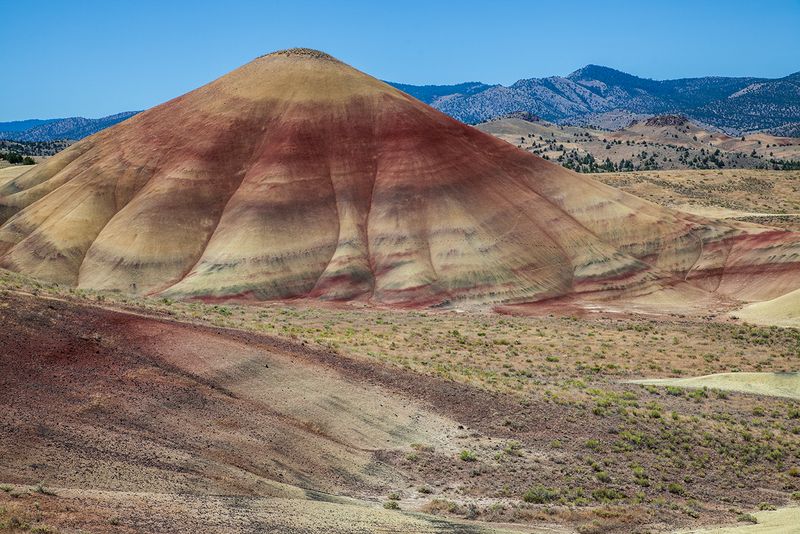
Those gentle curves began with a much rougher geological story. Volcanic eruptions in the region deposited ash and other material long before today’s hills took shape.
Over extended periods, that material weathered, altered, and contributed to the development of ancient soils.
Water and chemical processes gradually changed the deposits. Later erosion exposed them, removing softer material and leaving the rounded mounds and shallow channels that define the Painted Hills today.
The result is a landscape with few sharp edges and plenty of flowing lines.
Although the hills may look sturdy from the road, the exposed surfaces are easily damaged. Walking across them can leave marks that persist long after a visit. That is why staying on signed trails and boardwalks matters so much here.
You can see plenty of detail without touching the soil. From designated paths, look for small cracks, changing textures, and narrow color bands that wrap around the slopes.
The combination of smooth shapes and fine surface patterns makes the geology interesting at several scales.
A useful approach is to choose one mound, follow a colored band across it with your eyes, and see where that layer disappears beneath another slope.
Panoramic Views From The Painted Hills Overlook
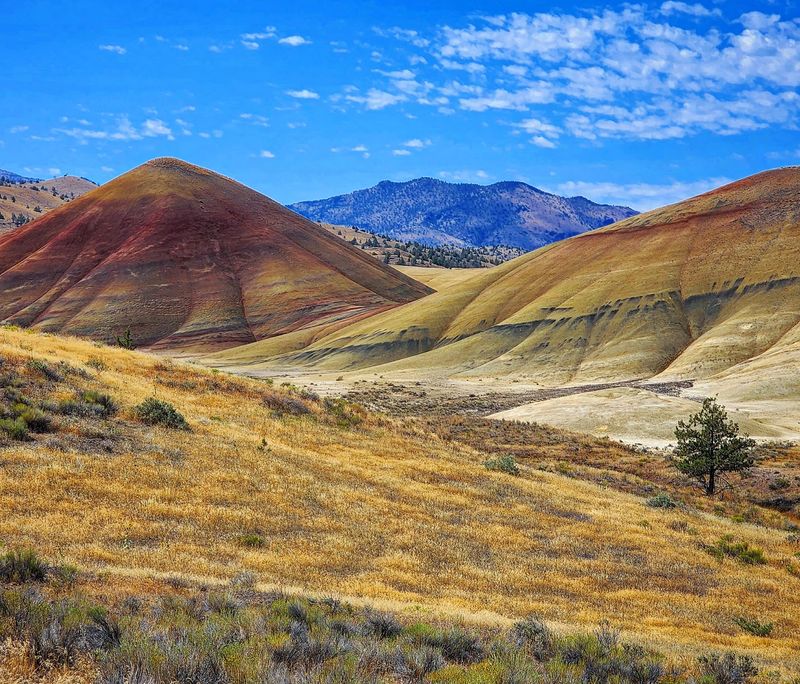
Want a broad view without committing to a strenuous hike? Start with the Painted Hills Overlook Trail. This half-mile round-trip walk follows the edge of the colorful landscape and provides several places to take in the striped hills.
The route is short, but it’s still an outdoor trail, so pay attention to the surface and wear comfortable shoes. Along the way, the mounds spread across the basin in overlapping bands, with sagebrush-covered terrain around them.
For a more demanding option, the Carroll Rim Trail begins across the road from the overlook area. The round-trip hike is about 1.6 miles and climbs more than 400 feet, providing a higher perspective over the basin.
It’s a different outing from the easy overlook walk, especially during warm weather.
There is limited shade along these trails. Bring drinking water, a hat, and sun protection, and consider the day’s temperature before choosing the climb. Wind and muddy conditions can also affect the steeper route.
If you’d rather conserve your energy for several stops, stick with the overlook and continue to the shorter trails elsewhere in the unit. You can cover a good range of scenery without tackling every hillside on foot.
Boardwalk Wandering Along The Painted Cove Trail
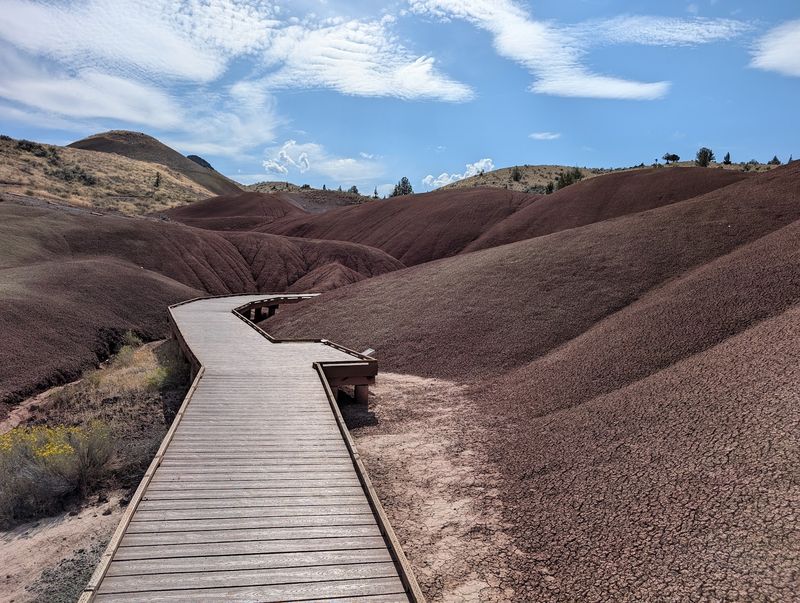
Painted Cove offers a closer look at the formations without putting their delicate surfaces at risk. The quarter-mile trail includes a boardwalk that passes beside vivid red and yellow mounds, making the details easier to inspect from a designated route.
The color bands stand out at close range. Small cracks spread across sections of the clay-rich surface, and narrow seams of lighter material interrupt the larger red areas. Look along the sides of the mounds to see how the layers bend and follow their rounded shapes.
The raised walkway does more than provide a convenient route. It keeps shoes off ground that can be permanently marked by footsteps. Remain on the boardwalk and signed trail even if another angle looks tempting.
The soil is part of the monument’s protected landscape, not a surface for scrambling or shortcuts.
This is a practical stop if you prefer shorter walks or are traveling with someone who wants to see the colors without a long climb.
Include a little of the boardwalk or nearby sagebrush in your picture to show just how close the colorful mounds are.
Golden Hour Brings Out The Boldest Hues
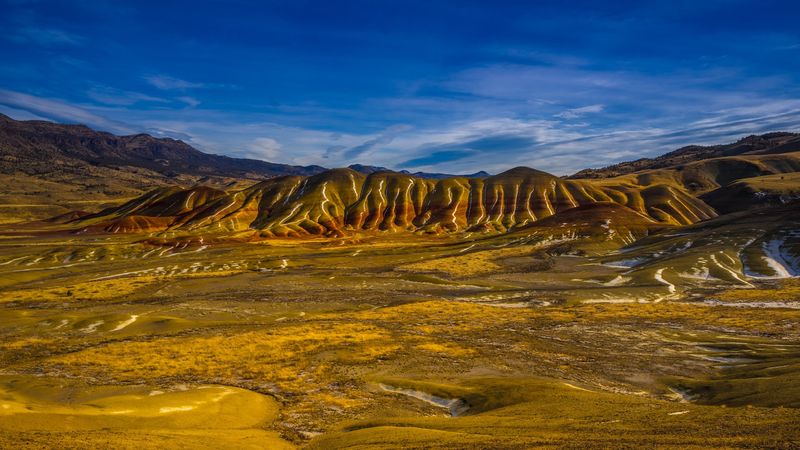
Late afternoon is a good time to see the Painted Hills in angled sunlight. As the sun moves lower, shadows lengthen along the ridges and the exposed bands can look more distinct.
A sunset visit requires some planning. The Painted Hills Unit sits in a rural part of central Oregon, and cellular reception can be unreliable. Download your map before leaving town, confirm the route, and avoid relying on a live navigation connection for the return drive.
Roads within the unit include unpaved sections, so adjust your speed to the surface and watch for changing conditions after rain.
The picnic area offers a useful place for a break, with restrooms available nearby. Bring water and snacks because there isn’t a visitor center or restaurant inside the unit.
For navigation, the Painted Hills Unit is at 37375 Bear Creek Road, Mitchell, OR 97750. Once you arrive, follow the signs for individual trailheads rather than assuming all the viewpoints share one parking area.
Choose a viewpoint you can reach comfortably, especially if daylight is fading. Pack a layer for cooler evening temperatures, keep to the marked paths, and leave yourself enough light for the drive out.
Watching the shadows move across the hills is a fine way to finish a day in Oregon’s high desert.