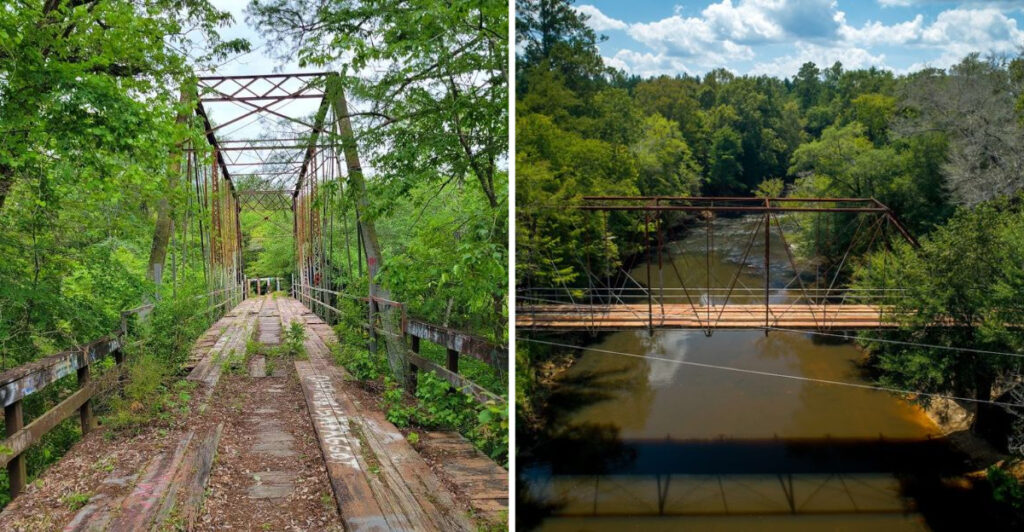
Bridges usually help you leave somewhere. This one makes you stop, stare, and wonder who gave iron permission to look so dramatic.
Mississippi hides the answer beyond a rural road, a ribbon of trees, and enough silence to make your car radio feel overdressed.
Then the truss appears.
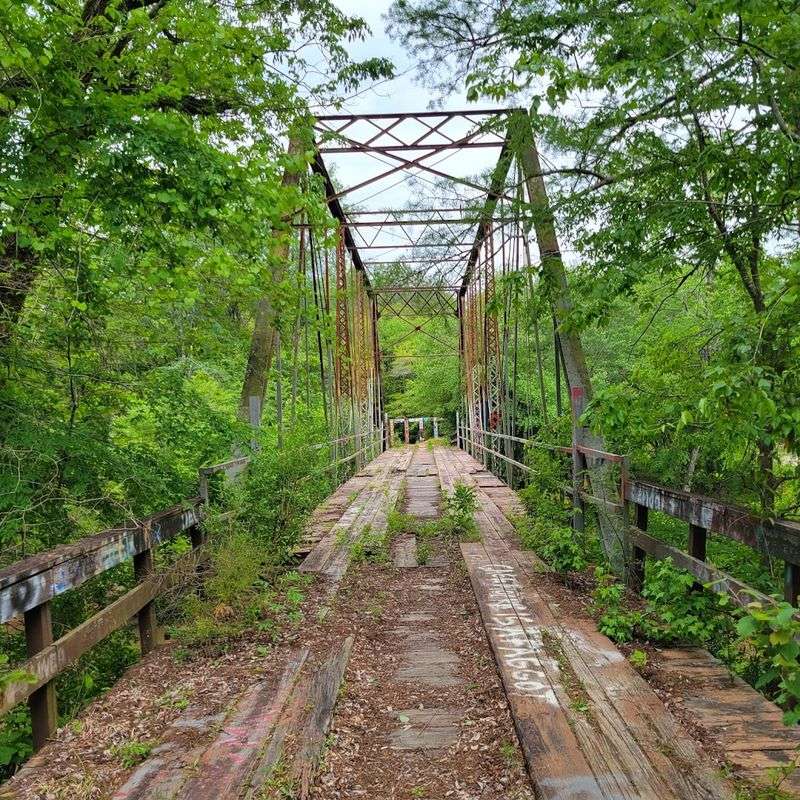
It rises above the Chunky River like a giant geometry lesson that skipped retirement. Rust colors the beams. Wooden decking shows its age.
The whole structure looks ready to tell you a story, provided you respect the barricades and keep your feet off the failed span.
Mississippi history supplies the verified chapters. Local folklore handles the late-night embellishments.
You can admire the engineering and let the river provide the soundtrack.
The bridge is closed, but your curiosity may cross the entire century before lunch is over.
The Back Road Saves Its Best Surprise For The River
The first part of the trip looks determined to keep the ending secret.
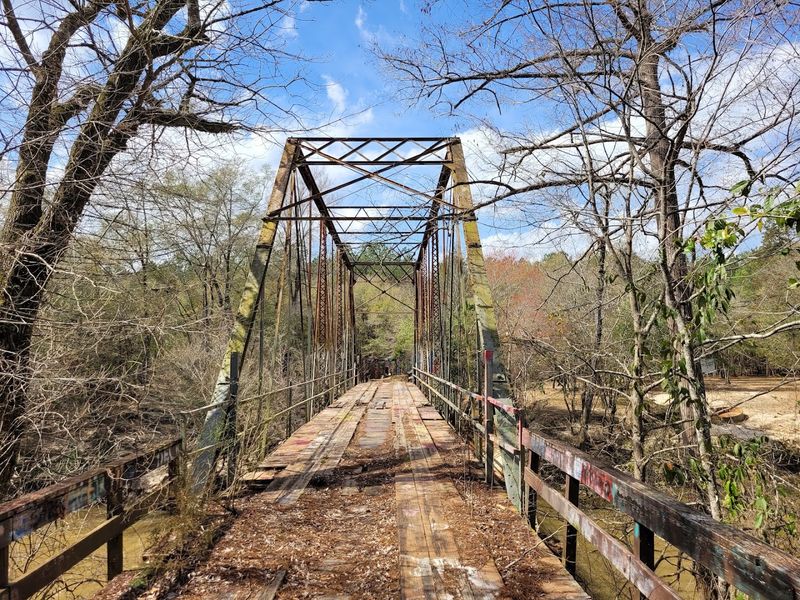
Trees crowd the roadside, farmland opens and closes between bends, and the Chunky River stays out of sight until the iron frame finally interrupts the green. You do not get a grand entrance sign or a polished visitor center.
You get a rural road, a historic structure, and the sudden urge to slow down.
That restraint suits the bridge. Its weathered truss does not need neon arrows. The tall metal frame creates its own landmark the moment it appears through the trees.
The surrounding landscape also changes how you see it. In a city, an old bridge might compete with buildings, traffic, and signs. Here, the geometry stands against sky, leaves, and riverbank.
You notice every diagonal brace. You notice the narrow deck. You notice how confidently engineers once trusted iron, pins, and careful calculations.
The road spends miles acting casual. The bridge handles the reveal like it rehearsed all week.
The 1901 Span Waits South Of Meehan
Old iron has an address, although it prefers directions with a little patience.
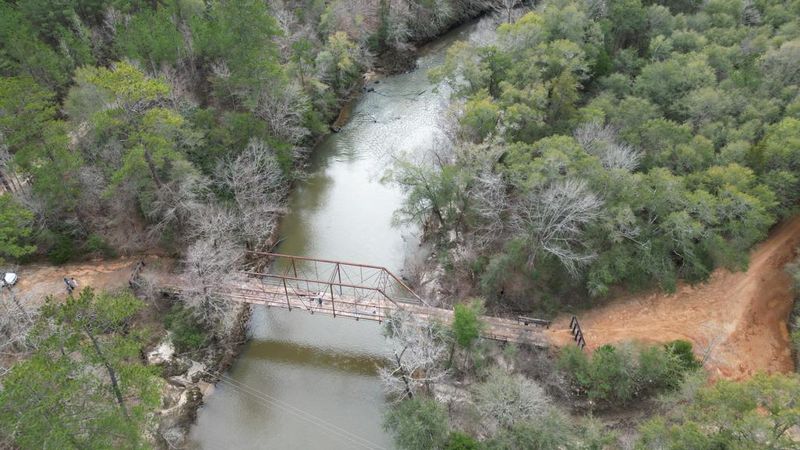
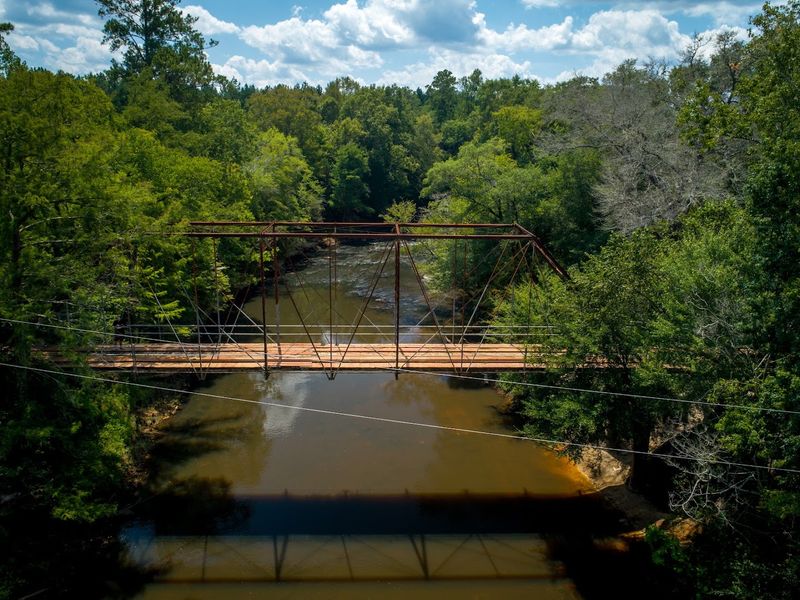
Stuckey’s Bridge crosses the Chunky River on Stuckey Bridge Road near Meridian, Mississippi, about six miles south of Meehan in Lauderdale County. State records place it on a county road in a rural section of the river corridor rather than at a staffed attraction.
The current bridge was built in 1901. It measures 112 feet long and 13.6 feet wide, dimensions that feel especially narrow when you imagine wagons and early automobiles sharing the wooden deck.
One through-truss span carries the structure across the water. The metal framework rises above the roadway, creating the tunnel-like silhouette that gives old truss bridges so much visual character.
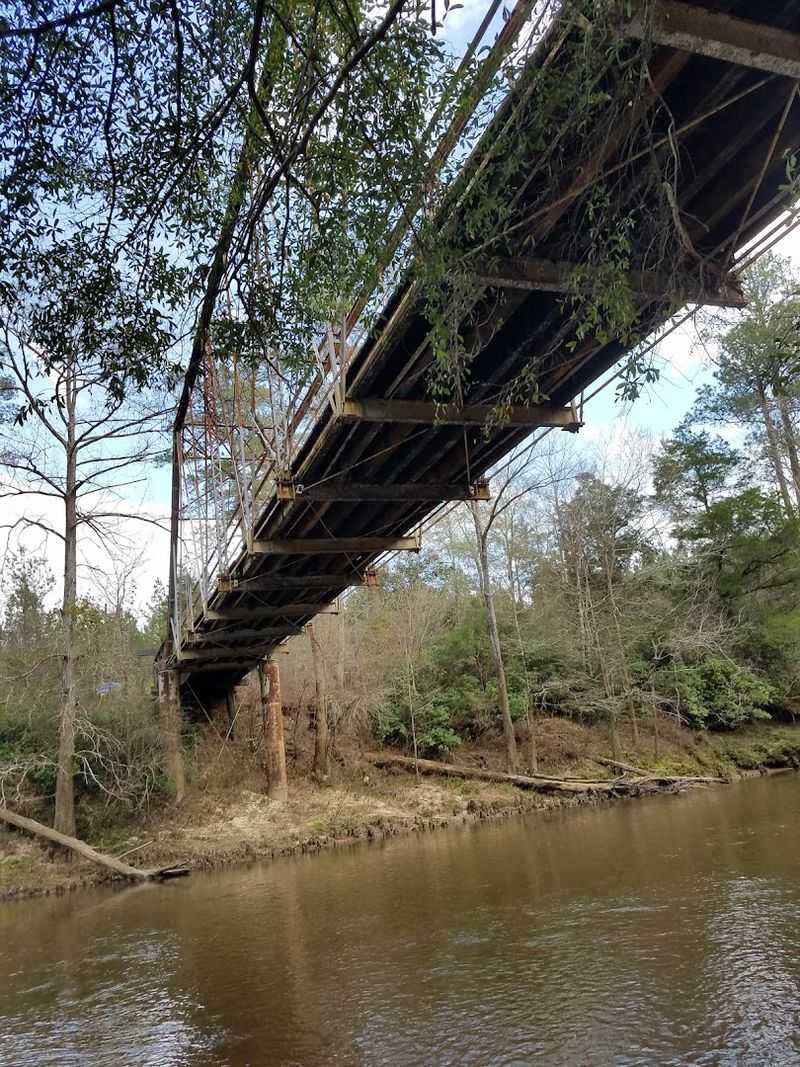
Concrete-filled metal caissons support the span below. Above them, channels, plates, eye-bars, pins, and diagonal members work together in a design that still makes bridge historians pause.
You may arrive expecting a simple old crossing. The first look makes 112 feet feel much larger.
A Virginia Company Built A Mississippi Original
The builder arrived from another state and left behind something Mississippi could not duplicate.
Virginia Bridge and Iron Company of Roanoke constructed the span in 1901. Firms like it supplied metal bridges across wide territories, manufacturing components and assembling crossings wherever counties needed stronger transportation links.
That system required precision long before computer models could check every connection. Pieces had to arrive correctly fabricated, fit together on site, and carry traffic across a river for years.
Stuckey’s Bridge uses pinned connections, a common approach for metal trusses of its era. Pins joined major members and allowed builders to assemble the framework from prepared pieces with impressive accuracy.
Those connections also make the structure readable when you look closely. Large junctions show where tension and compression members meet, turning engineering forces you cannot see into a pattern your eyes can follow across the span.
Picture the job site without modern cranes, paved access, or a delivery app announcing the next iron beam. Crews still had to move heavy components into rural Lauderdale County and raise the structure above flowing water.
More than a century later, the bridge remains recognizable as their work.
The Truss Design Declines Every Easy Label
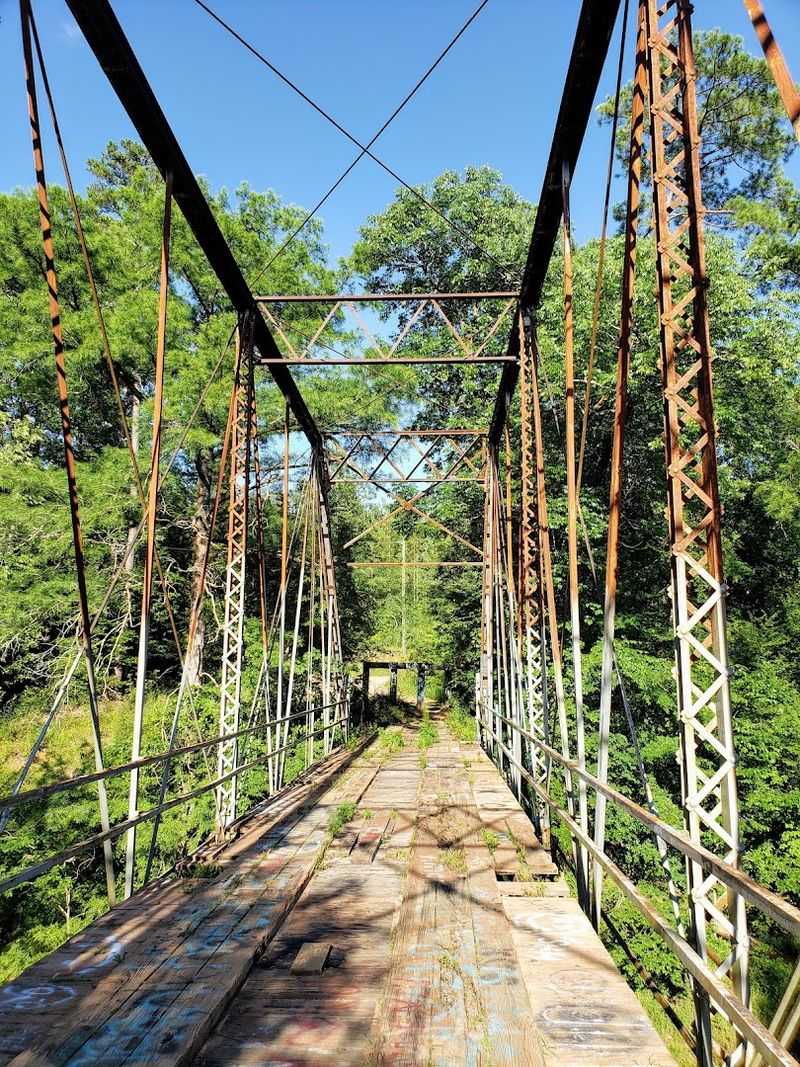
Bridge historians like categories. This span looked at the filing cabinet and chose mischief.
Mississippi’s historic bridge survey found that the design fits no established type neatly. Its arrangement shows strong influence from both Fink and Stearns trusses, yet the complete structure does not settle comfortably into either family.
That mixture is visible in the unusual web of vertical and diagonal members above the deck. The pattern feels more intricate than the familiar triangles seen on many later through trusses.
You do not need an engineering degree to enjoy the puzzle. Stand back and follow one beam with your eyes. It meets another, changes direction, and joins a network that carried loads toward the supports.
The survey identified Stuckey’s Bridge as the only known Mississippi example of its design. Researchers also found no similar examples in bridge surveys from Georgia, Ohio, or Virginia at the time of the nomination.
A bridge only 112 feet long managed to create a national-level scavenger hunt. Apparently, even iron enjoys being difficult to classify.
Two Historic Designations Recognized The Rare Span
The bridge earned paperwork almost as impressive as its ironwork.
Mississippi designated Stuckey’s Bridge a state landmark on August 4, 1987. The National Register of Historic Places followed on November 16, 1988, listing it through the Historic Bridges of Mississippi nomination.
Those dates arrived decades after the bridge stopped being new, when preservationists were documenting older metal spans before replacement erased more of them.
Its importance rests on engineering and transportation history. The bridge represents an uncommon truss solution, a surviving product of an important bridge-building firm, and a piece of the road network that once connected rural communities.
National Register status recognizes historic value, but it does not turn the site into a staffed museum or promise public amenities. It also does not require a property to be open for unrestricted public access.
You should expect the bridge and landscape, not restrooms, lighting, or a gift counter selling tiny steel trusses.
Lauderdale County owns the span, while the state and national listings record why its engineering deserves attention beyond the county line.
The recognition protects the story on paper. The rusted frame does the convincing in person.
The Closed Bridge Is Not Asking For A Test Drive
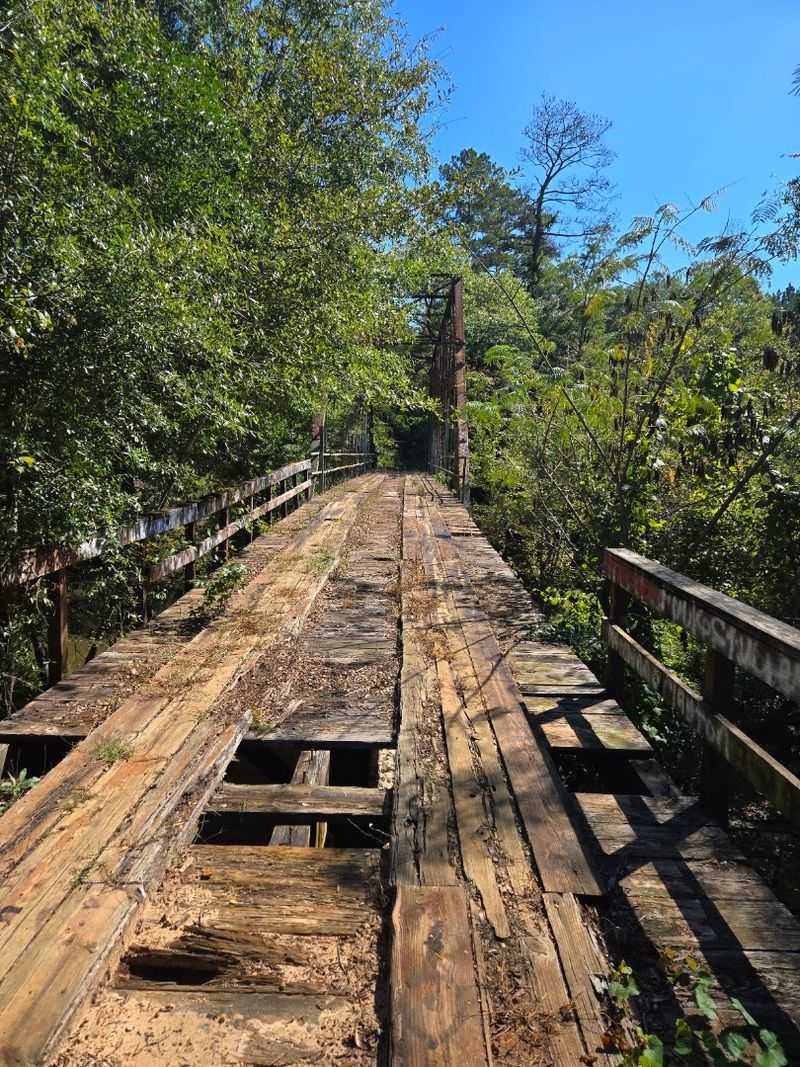
Here is the rule with no wiggle room: the bridge is closed to all traffic.
A Lauderdale County inspection record dated 2025 rated the deck, superstructure, and substructure in failed condition. Barricades are not decorative suggestions, and the wooden deck should not become part of your adventure plan.
Stay outside closed areas and view the span from a lawful, stable position. Do not drive onto it, climb the truss, step around barriers, or treat damaged boards like a balance challenge created for social media.
The bridge can still reward a careful visit. Its outline, iron connections, setting, and river crossing remain visible without putting your weight on a structure officially listed in failed condition.
Daylight makes road conditions and barriers easier to read. Dry weather also helps on rural approaches that may become muddy or slick after rain.
You came to appreciate a survivor, not audition to become part of its repair estimate. Let the camera cross the distance. Keep the rest of you on reliable ground.
Local Folklore Gave The Crossing A Second Life
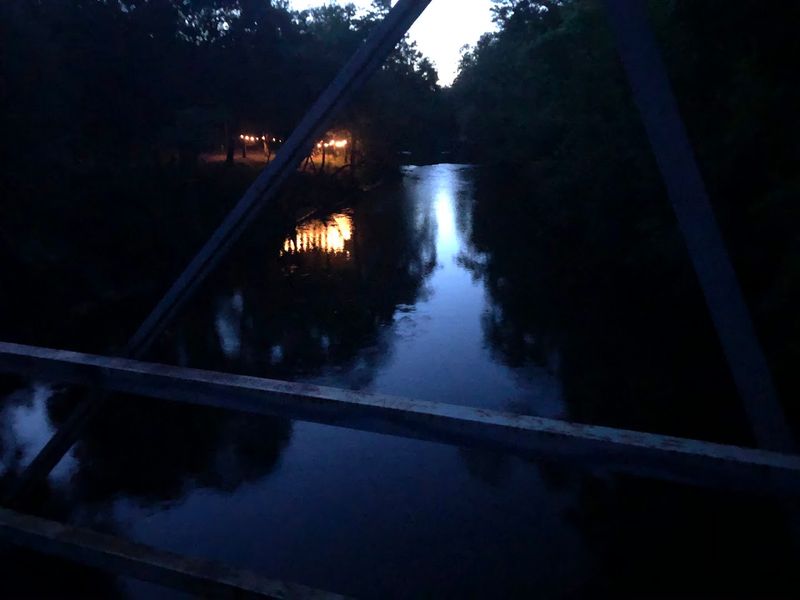
Local folklore ties the crossing to a shadowy figure known as Old Man Stuckey. In the most familiar version, he kept an inn near the Chunky River and welcomed travelers who never made it much farther down the road.
Then come the after-dark tales.
Local stories mention strange sounds, lights, and figures near the bridge after dark. Some say a figure appears near the riverbank before vanishing into the darkness.
Official historic records confirm none of those events. They document the bridge’s age, builder, unusual design, ownership, and historic status, while the darker story survives through local voices rather than written evidence.
Perhaps that uncertainty is exactly why the legend endures.
An old iron bridge, an isolated river, and a story repeated for generations can make ordinary sounds seem unfamiliar. Water shifts beneath the trees. Branches move without warning.
The metal frame creaks as the evening cools.
You do not need to visit after dark to understand why people still tell the tale. Stand near the Chunky River in daylight, look through the weathered iron, and imagine how different the crossing must appear once the sun disappears.
Daylight Lets The Real History Steal The Ending
Remove every spooky flourish and the bridge still wins the trip.
You have a 1901 metal span built by a Virginia company, supported above the Chunky River, shaped by an uncommon truss idea, and recognized at both state and national levels.
You also have the visible evidence of time. Rust traces the framework. The deck shows why closure became necessary.
Trees frame a transportation structure from an era when counties relied on specialized bridge firms and pinned iron members.
That contrast makes the site memorable. The bridge is historically important, visually striking, and no longer capable of serving its original job safely.
Its story now comes from observation rather than crossing. You look, photograph, compare the members, and imagine the traffic that once passed between the trusses.
Then the river keeps moving beneath a bridge that cannot.
History does not always need a restored paint job or a dramatic legend.
Sometimes it needs daylight, distance, and someone willing to notice why the old iron was special in the first place.