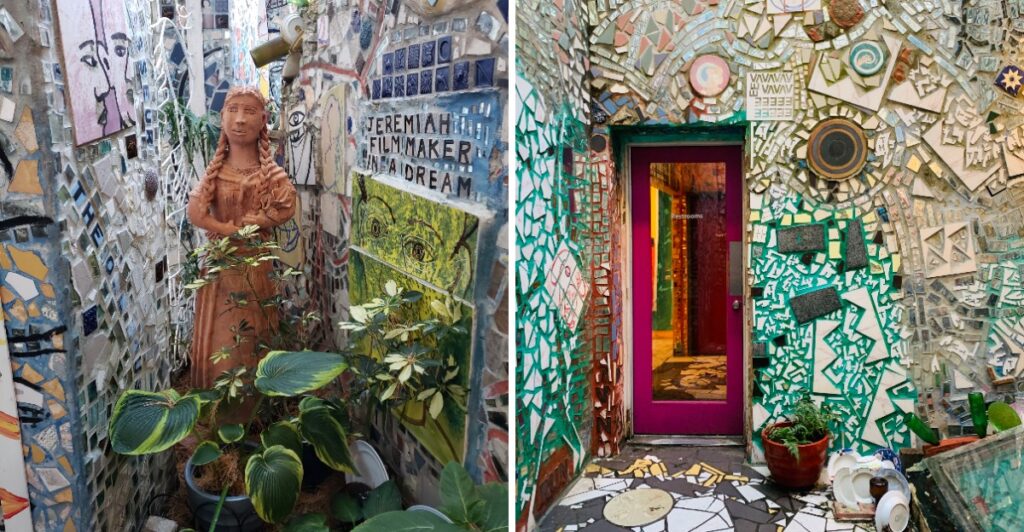
Bicycle wheels, glass bottles, and mirror shards are cemented into the walls of a maze that fills half a city block. Even the stairs got the mosaic treatment.
One artist spent 14 years digging tunnels and building grottos here by hand. Broken folk art from Mexico, Peru, and beyond is pressed into the cement too, and honestly, my inner magpie is already pacing.
You move through narrow passages where nearly every surface glitters back at you. Your own reflection pops up in a hundred tiny mirrors, and I vote delightful over dizzying.
This corner of Pennsylvania almost lost it all in 2004, until neighbors stepped in to save it.
Those devoted neighbors deserve a medal, because the city block got to keep its sparkle.
One Man Spent 14 Years Tiling This Maze By Hand
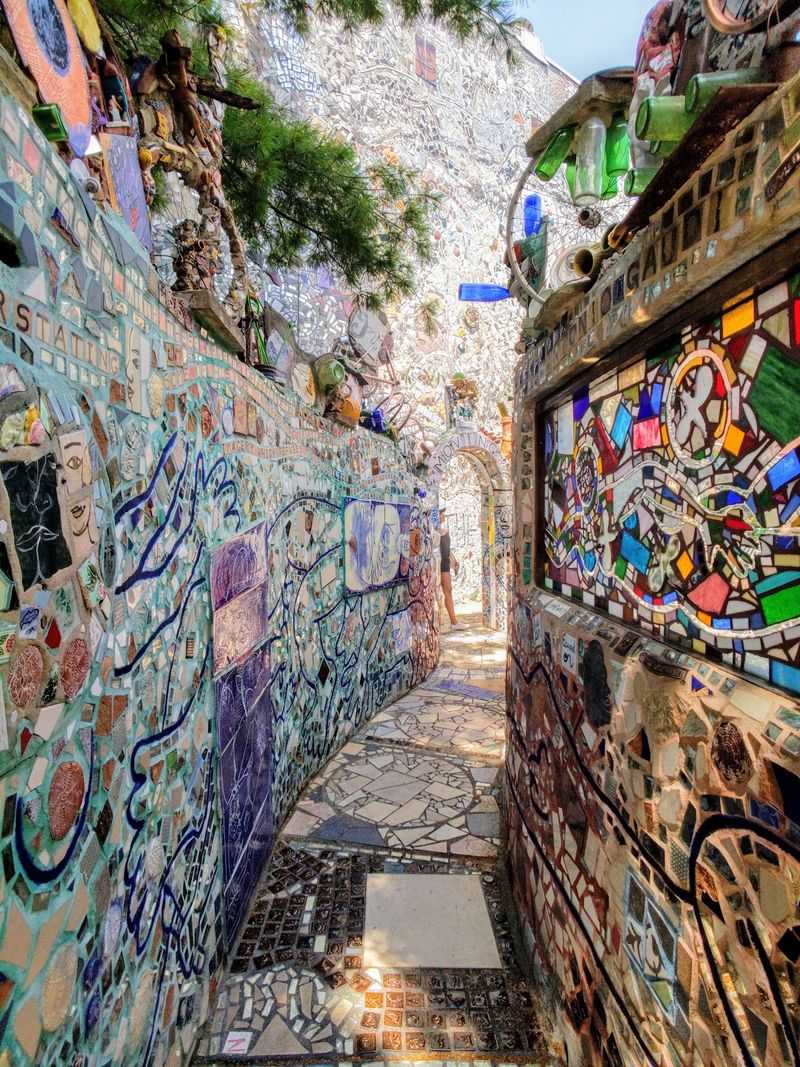
Philadelphia’s Magic Gardens started as two empty lots next to an artist’s studio.
Isaiah Zagar began working on them in 1994, and he did not exactly ease into it.
First he built a massive fence to protect the space. Then he spent 14 years digging tunnels, shaping grottos, and tiling every surface he could reach.
The result is a mixed-media environment spread across three city lots. It’s one of Zagar’s best-known works, which says a lot about a man who covered over 200 public walls in Philadelphia.
Calling it a museum feels almost too tidy. It’s more like a walk-through art piece where the walls, floors, and stairs all join the show.
Today a nonprofit preserves and explains his work at the site and around South Street. A preservation team even adds new artwork as older pieces wear down or break.
That means the place is still growing in small ways. Nothing here is frozen behind glass, and that’s part of the thrill.
Give yourself time to wander slowly. Rushing through a project that took 14 years to build would be a little rude.
Your Recycling Bin Never Looked This Good
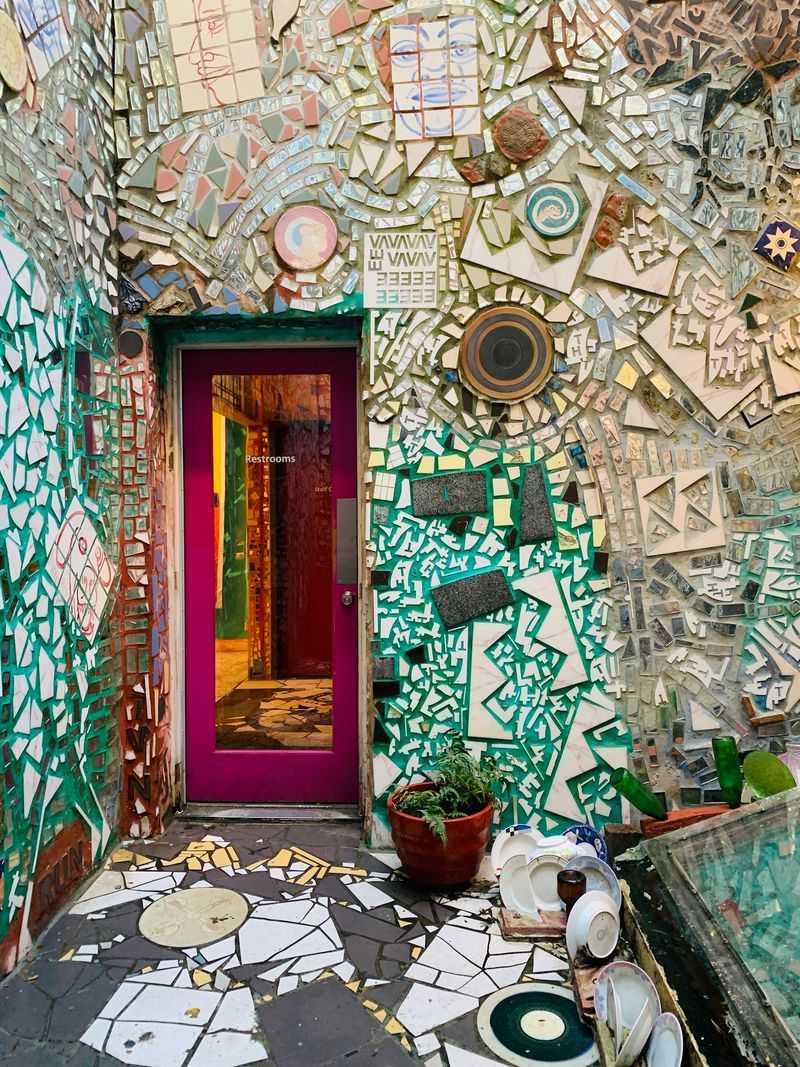
Bicycle wheels. Glass bottles, mirror shards, ceramic fragments, and handmade tiles all show up in the walls here.
Zagar turned everyday leftovers into shimmering surfaces. Pieces of international folk art got pressed into the cement too.
His approach is often called the Zagar Method, and it was gloriously loose. He’d stick tiles and mirrors in place first without fussing over strict color or shape rules.
He also left clear gaps between the pieces on purpose. After about 24 hours, he filled those gaps with a sand and cement grout to lock everything in.
That two-step process explains why the walls feel so lively and textured. Nothing lines up perfectly, and your eyes keep jumping from one surprise to the next.
Try playing a little game while you walk. Pick one object, like a bottle or a wheel, and count how many times you spot it.
You’ll lose count fast. The mirrors also bounce your own reflection back at you, so you become part of the artwork for a second.
My honest take is that this is the best argument for saving broken stuff. Your junk drawer may never forgive you.
Look Closer, Because The Walls Are Telling Stories
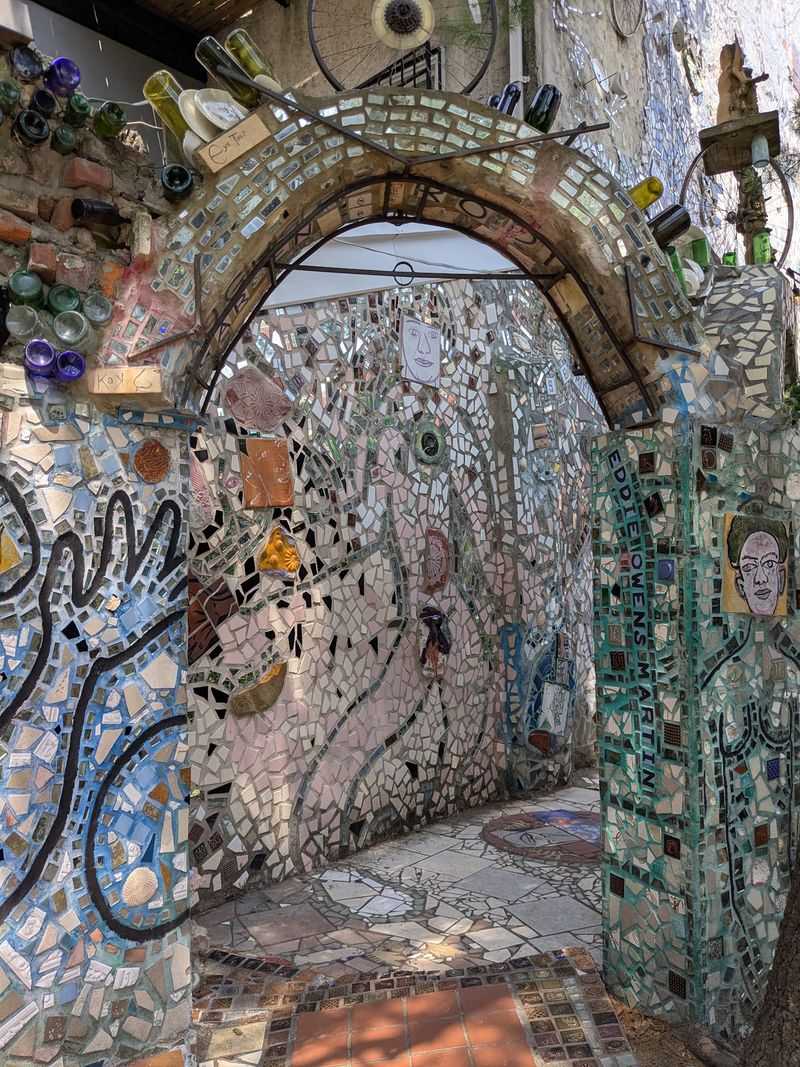
Somewhere in all that sparkle, there’s a diary. Philadelphia’s Magic Gardens works like a personal journal of Zagar’s life, written in tile instead of ink.
Words and playful images point to his wife, Julia, and their sons, Ezekiel and Jeremiah. Family shows up again and again if you slow down enough to read the walls.
Bigger ideas are worked in, too. You’ll find tributes to Las Pozas, the Day of the Dead, and Philadelphia’s dance community.
Some pieces reflect world events, including the airplanes of 9/11. Those moments sit right beside cheerful images, which gives the space surprising depth.
Words are scattered across many surfaces as well. Reading them feels a bit like eavesdropping on the artist’s thoughts.
The whole place works like a puzzle with no instruction sheet. The more time you spend, the more names, faces, and symbols start popping out.
A scavenger hunt is available for both indoor and outdoor areas, and it’s a smart way to hunt for details. It gives younger visitors a goal beyond snapping photos.
Bring patience and a curious eye. This is one place where staring at a wall counts as a great use of your afternoon.
Neighbors Stepped Up When The Whole Thing Nearly Vanished
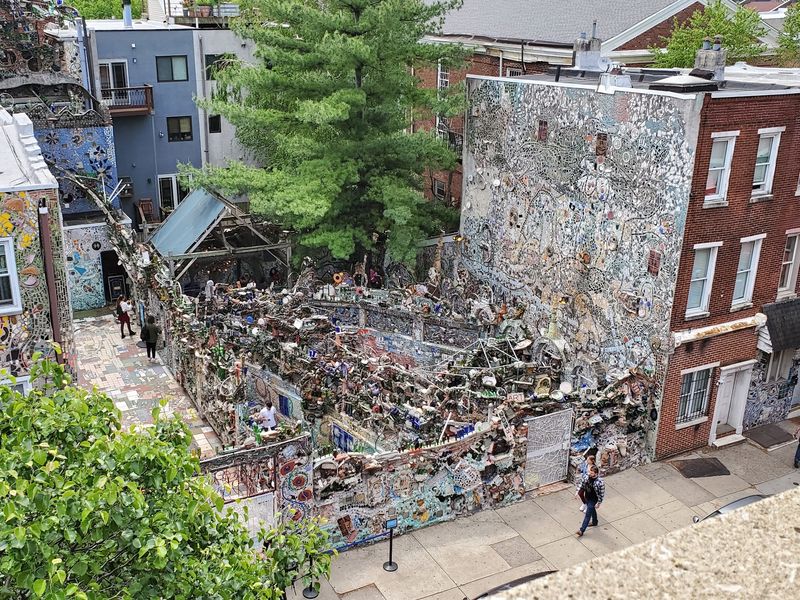
In 2004, this whole dazzling world nearly disappeared.
The Boston-based owners of the lots decided to sell as South Street property values climbed.
Their plan meant taking the artwork apart. For Zagar and his neighbors, that idea was heartbreaking.
Then the community showed up in a big way. Neighbors, lawyers, and art lovers jumped in to protect the creation.
That effort led to Philadelphia’s Magic Gardens becoming a nonprofit organization. Its job is to preserve and share Zagar’s work at the site and throughout the South Street area.
The site officially opened to the public as a museum in 2008. Not bad for a project that started on two neglected lots.
The backstory gives the visit extra weight. Every mirror shard you see survived a real chance of being hauled away.
It also connects to the Zagars’ longer story in the neighborhood. Isaiah and Julia moved to South Street in 1968 and helped spark what’s known as the South Street Renaissance.
They renovated rundown buildings and kept adding mosaics to walls. Julia’s folk art shop, Eyes Gallery, opened that same year and is still around today.
Folk Art From Around The World Hides In Plain Sight
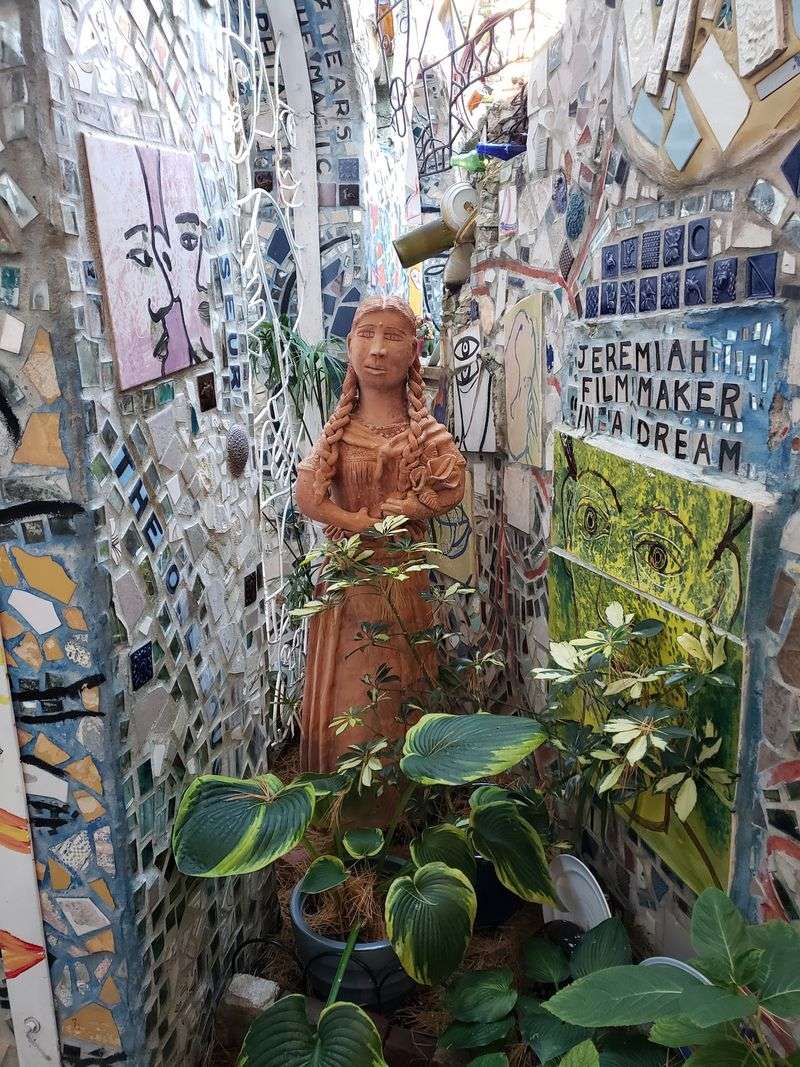
Long before South Street, Isaiah and Julia Zagar served as Peace Corps volunteers in Peru in the 1960s. That’s where they first connected with folk artists, and the love stuck.
Julia later stocked Eye’s Gallery with pieces from around the globe. When some of those treasures broke and couldn’t be sold, Isaiah found them a second career in his mosaics.
Honestly, that’s the best retirement plan a cracked pot could ask for. Instead of the trash, it ended up as part of a famous Pennsylvania landmark.
The collection leans heavily on Mexican folk art. That reflects decades of friendship and creative teamwork between the Zagars and artists there.
You’ll also find work from India, Peru, Ecuador, Morocco, Indonesia, and Guatemala. Some pieces are built right into the walls, while others are displayed throughout the space.
Spotting them adds a whole new layer to your visit. A figure that looks like decoration might have traveled thousands of miles to get here.
Keep an eye out for small sculptures nestled between tiles. They’re easy to miss when the mirrors are competing for your attention.
A Guided Tour Unlocks The Secret Mosaic Basement
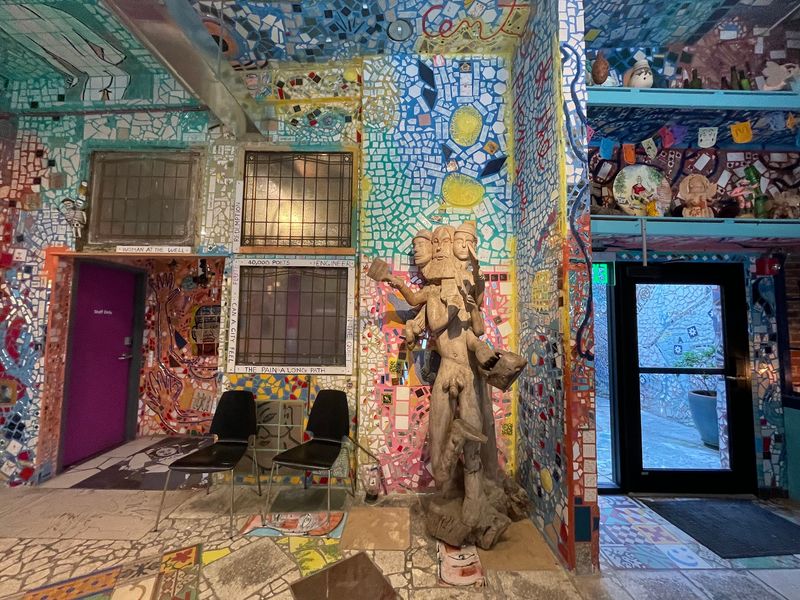
Self-guided wandering works fine, but a guided tour opens up something extra. The tours include the mosaicked basement, a space few people ever see.
Tours run about 75 minutes. They cover the outdoor sculpture garden, the indoor galleries, and public murals in the surrounding neighborhood.
That last part matters more than you’d think. Zagar’s mosaics spill out onto walls all around South Street, and a guide helps you connect the dots.
A good guide also helps decode the faces, symbols, and words packed into every wall. Without context, it’s easy to admire the sparkle and miss the story.
Booking tours ahead is recommended, although some tickets may be available at the door. Check the schedule online before you go, since spots can be limited.
If you love behind-the-scenes access, this is your move. A basement covered in mosaics is not something you stumble upon every day in Pennsylvania.
Fair warning, you’ll start judging every plain wall you pass afterward. Your own basement suddenly looks very beige.
Pair the tour with some free time afterward. You’ll want to revisit corners with fresh eyes once you know what you’re seeing.
After Dark, The Gardens Put On A Whole Different Show
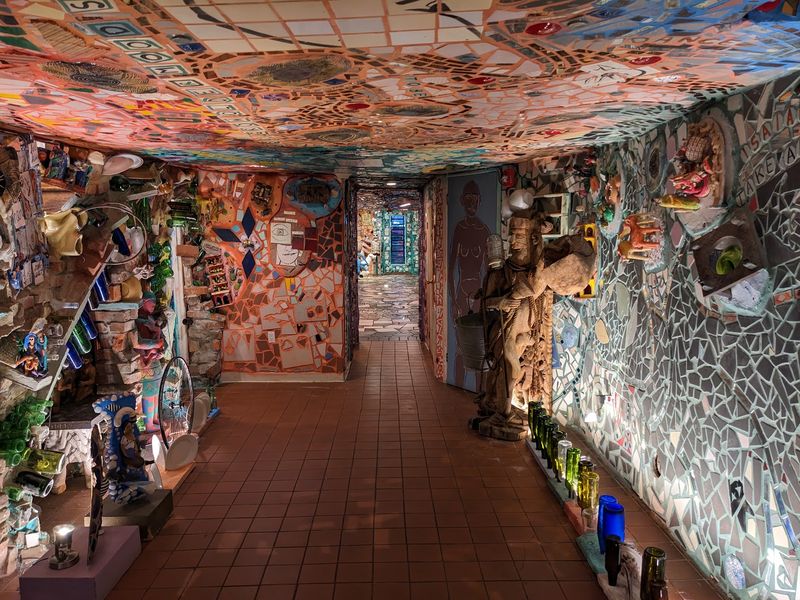
Monthly Twilight in the Gardens events open the space after regular hours from May through October.
Expect live music, art workshops, and the glow of colorful lights across the mosaics.
Mirrors plus colorful lights sounds like a winning combo to me. It’s a fresh way to see a place you might already know by daylight.
Families get their own treat with PECO Family Jams programs. These kid-friendly events aim to spark creativity in young artists.
Inside, two galleries host rotating exhibitions. They showcase artists from around the world, so something new may be on view each time you return.
The shows support values like originality and community. That fits a place that was literally saved by its neighbors.
Want to keep the creative streak going at home? Art kits for mosaic-themed projects are available, which is a sneaky way to fill a rainy weekend.
Event schedules change, so check the calendar before planning around a specific night. Popular programs can fill up, and timed tickets are the norm here.
Bottom line, the gardens are more than a one-time photo stop. Between evening events, family programs, and new exhibits, there’s always a reason to come back.
Book Ahead, Keep Your Hands Off, And Leave The Selfie Stick Home
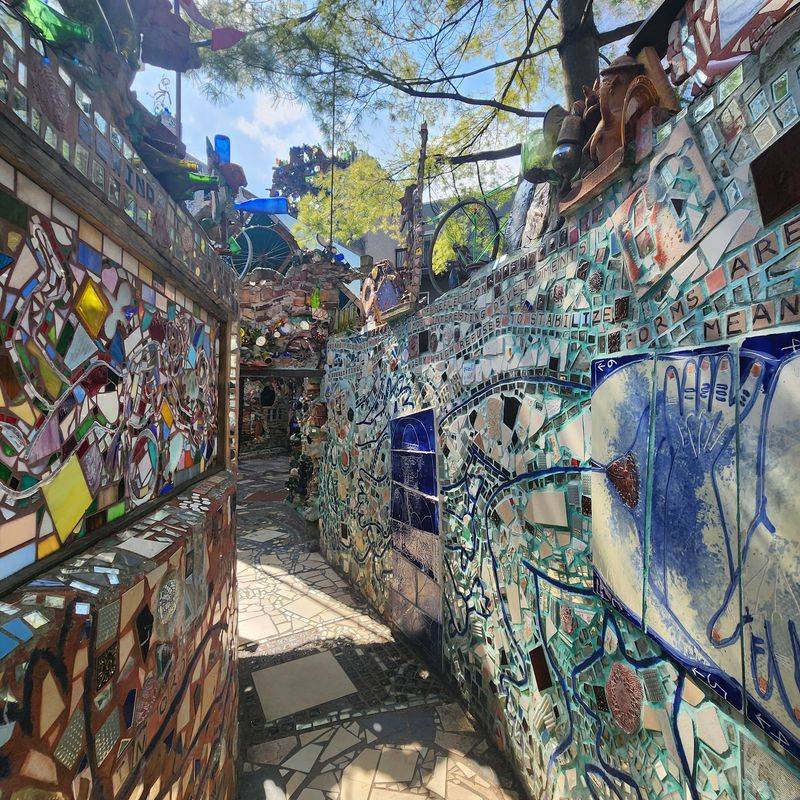
You’ll find the gardens at 1020 South St, Philadelphia, PA 19147, right along a busy shopping strip. Look for the mosaic-covered building, because subtle it is not.
Hours run from 11 a.m. to 6 p.m., Wednesday through Monday. Tuesdays are closed, so plan around that one.
General admission uses timed tickets, and visitors are strongly encouraged to book online in advance, including for kids.
Walk-up hopes can end in disappointment, so book early.
Touching or leaning on the artwork isn’t allowed. The pieces are fragile and one of a kind, and some tile and mirror edges are sharp.
Casual photos for personal use and social media are welcome. Tripods and selfie sticks are not, so your arms will have to do the work.
The outdoor garden has narrow paths and stairs. Wear shoes with good grip, especially if the weather has been damp.
Much of the art sits outside, so a pleasant day makes the visit more comfortable. Sunshine on all those mirrors doesn’t hurt the photos, either.
A gift shop is on site if you want a souvenir. Handmade items make a nicer memento than another fridge magnet.