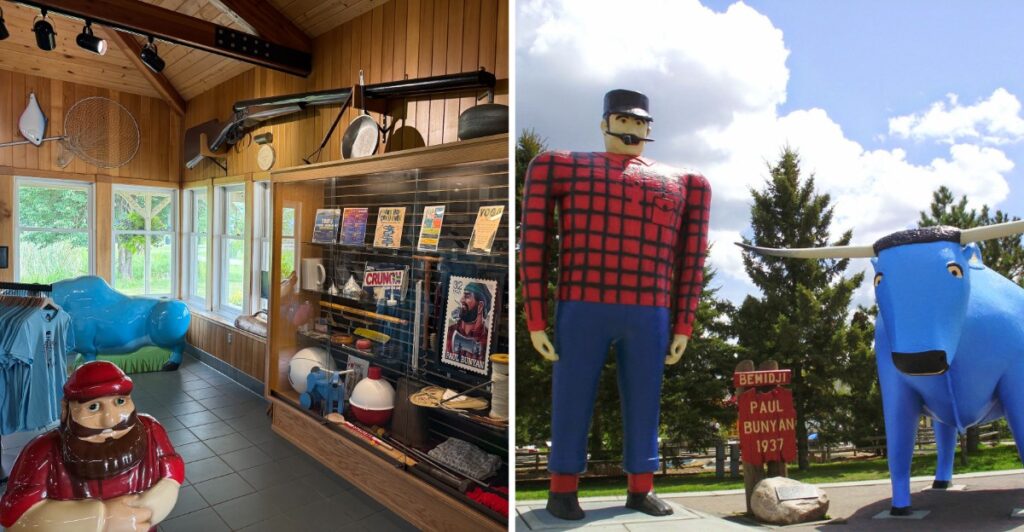
You are not driving past a giant lumberjack and a blue ox without at least slowing down.
Be serious.
These two have been part of the local landscape for decades, long enough to become far more than a roadside curiosity.
Minnesota gave them a lakeside home, and travelers have been stopping ever since.
The size gets you out of the car.
The backstory gives you a reason to linger.
There is a story behind why they are here, how the pair came together, and why one of them had a slightly more adventurous start than the other.
So yes, take the photo.
Then stick around long enough to find out what exactly you just posed beside.
Because giant blue oxen usually come with context.
Paul And Babe Arrived With A Winter Carnival
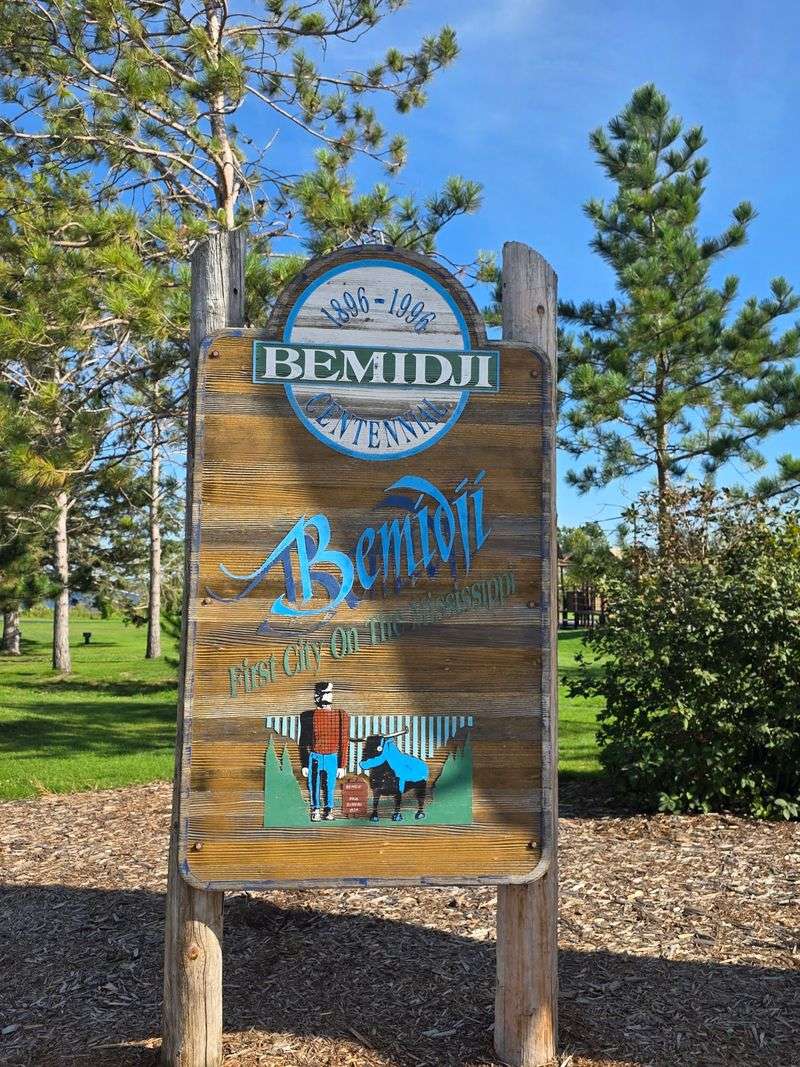
Bemidji’s giant Paul Bunyan and Babe the Blue Ox were created for a winter carnival that opened in January 1937.
Local civic groups and businesses had been looking for a way to promote winter recreation and bring attention to the city during the coldest part of the year. The carnival became the answer, and the statues gave it a centerpiece nobody was likely to miss.
Paul was designed by local builder Cyril M. Dickinson, while Jim Payton supervised the construction of Babe. Both were built by Bemidji residents rather than ordered from a distant manufacturer.
Both figures were built locally, giving Bemidji residents a direct role in creating the landmark from the beginning.
The carnival itself lasted only as an event, but the statues remained.
For a modern visitor, that makes the first look more interesting. The figures may feel playful, but they began as a serious tourism project during the 1930s.
If you arrive in winter, the original idea becomes easy to picture. Snow, frozen water, and a giant lumberjack still make a convincing combination.
Logging Folklore Gave The Pair Their Identity
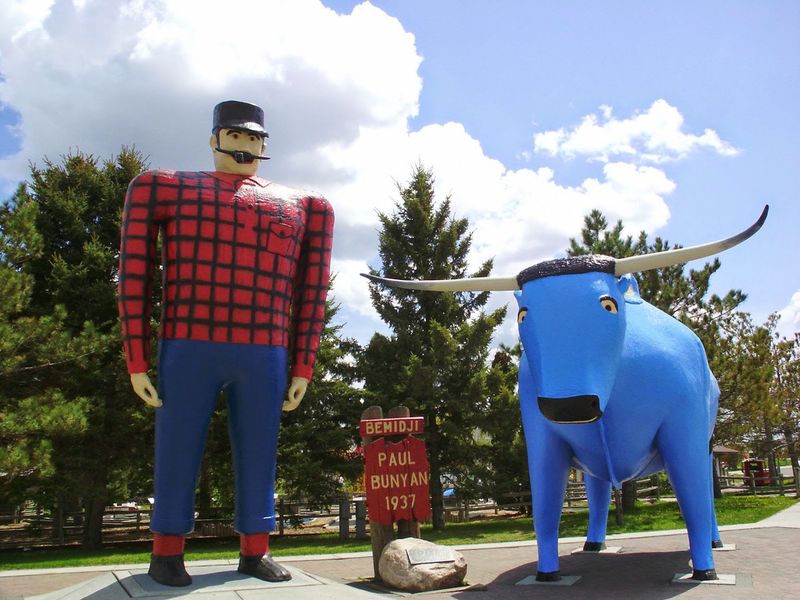
Paul Bunyan was already a familiar figure in American lumberjack folklore long before Bemidji built its statue.
Tall tales turned him into a larger-than-life logger capable of clearing forests, creating lakes, and handling jobs no ordinary crew could manage.
Babe the Blue Ox became his equally oversized companion, adding another layer of exaggeration to stories passed around lumber camps and later popularized in print.
Bemidji’s decision to use Paul made sense in a region shaped by logging. Northern Minnesota’s timber industry had played a major role in settlement and economic life, so a giant lumberjack could connect local history with a legend people already recognized.
The statue does not prove that Paul Bunyan belonged to one specific town. Folklore rarely stays that tidy. Different places have claimed connections to him, and the stories changed as they traveled.
Bemidji made its own connection especially visible.
At the lakeside site, documented logging history and larger-than-life folklore sit side by side.
If children are along, the tall tales can make the stop more entertaining. Pick one outrageous story and let them decide how seriously a giant lumberjack should be taken.
Paul Stands Eighteen Feet Tall
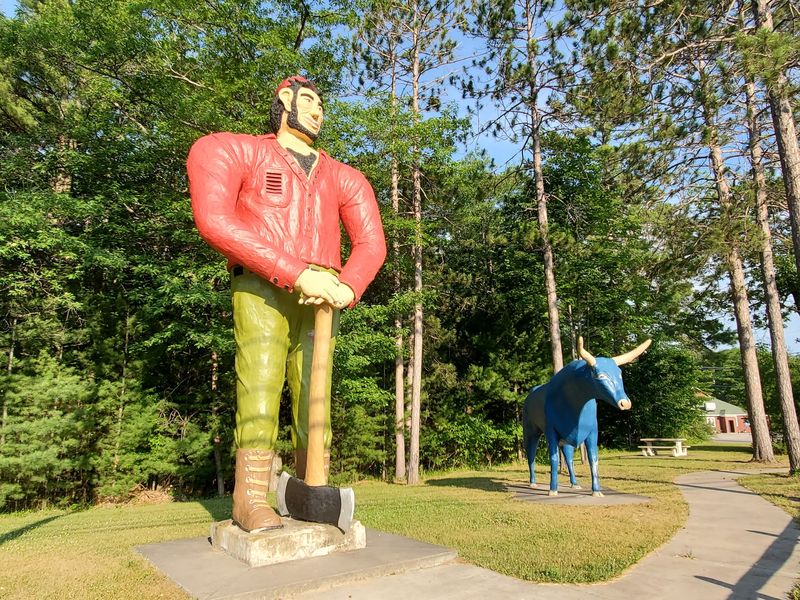
Paul Bunyan stands 18 feet high.
His construction required 737 man-hours, with a reinforced structure designed to withstand strong winds. Above the footings, Paul weighs about 2.5 tons. The reinforced base below him adds considerably more weight.
Workers created a wooden framework and shaped the figure with reinforcing bars, steel lath, and cement stucco. The process was substantial for what began as a winter carnival attraction.
Those numbers become easier to appreciate when you are standing near his boots.
Paul is large enough to dominate a photograph without being so enormous that the details disappear. His proportions, clothing, face, and stance are all easy to examine from ground level.
Step back if you want the lake and sky in the frame. Move closer if the goal is to emphasize the difference between an ordinary visitor and an 18-foot lumberjack.
The statue’s scale also says something about 1930s roadside promotion. Subtlety was not the plan.
Bemidji wanted travelers to notice, and the dimensions made sure they did.
Nearly nine decades later, you still have to tilt your head upward to meet Paul’s gaze.
Babe Spent His First Year On The Move
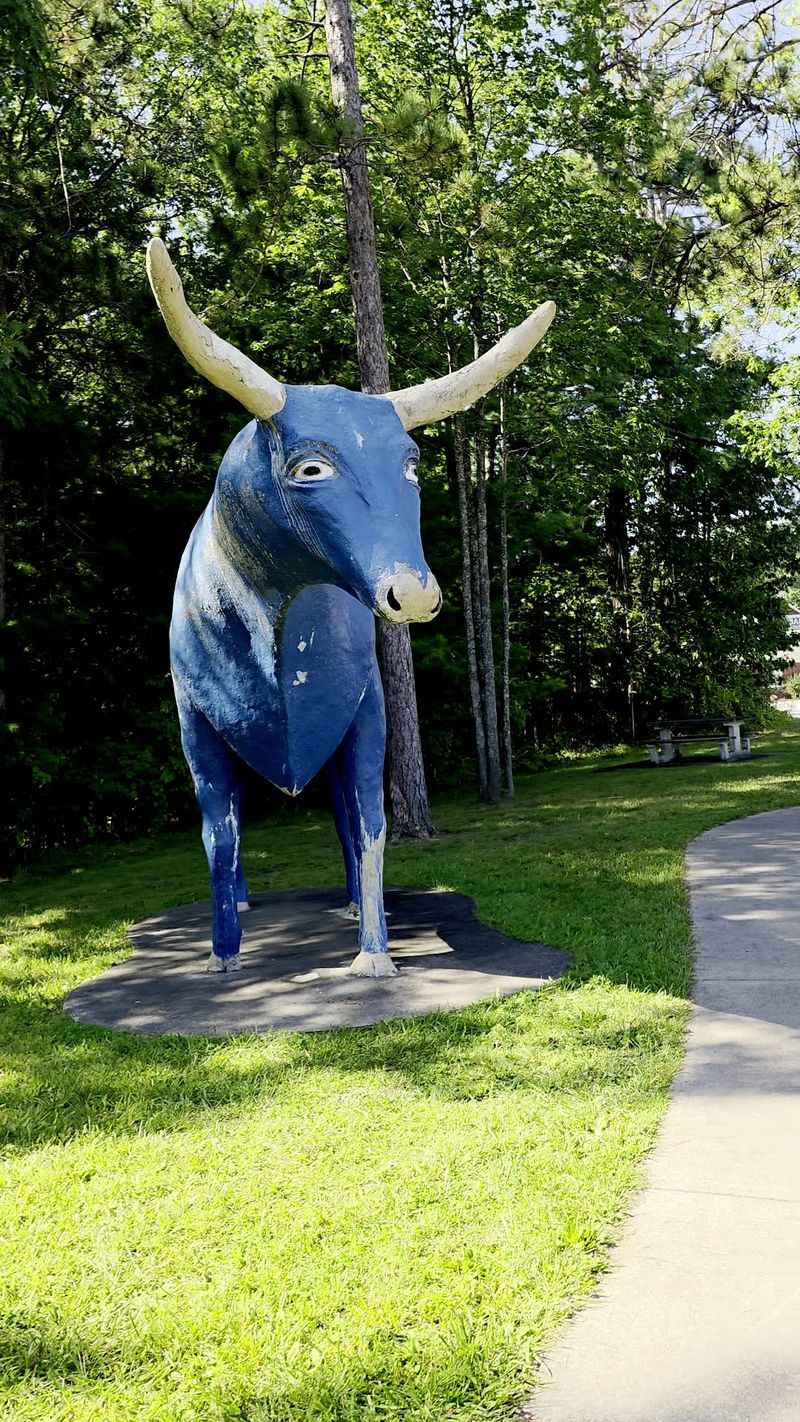
Paul settled into his lakeside position right away. Babe had a more mobile beginning.
The blue ox was constructed from a wooden framework covered with wire lath, padding, and canvas. Builders based the design on a large ox associated with a nearby logging camp, scaling the animal up to match Paul’s oversized world.
The statue was originally built so a vehicle could fit beneath it. Babe was mounted on a Model T Ford chassis and appeared in the 1937 Bemidji winter carnival.
The traveling ox did not stay within city limits.
Babe went to St. Paul for that city’s winter festival and later appeared at the state fair. The mobile setup turned the statue into a moving advertisement for Bemidji and its new roadside characters.
In 1938, Babe’s traveling days ended. The figure was removed from the chassis and installed permanently beside Paul.
That early chapter gives you something unexpected to picture when looking at the pair today. Babe seems completely rooted to the lakeshore now, but the original version was designed to roll through crowds.
Look closely at the size and shape of the ox, then imagine a 1930s automobile hidden underneath.
It is hard to think of many current tourism campaigns that could make the same entrance.
The Statues Earned National Historic Recognition
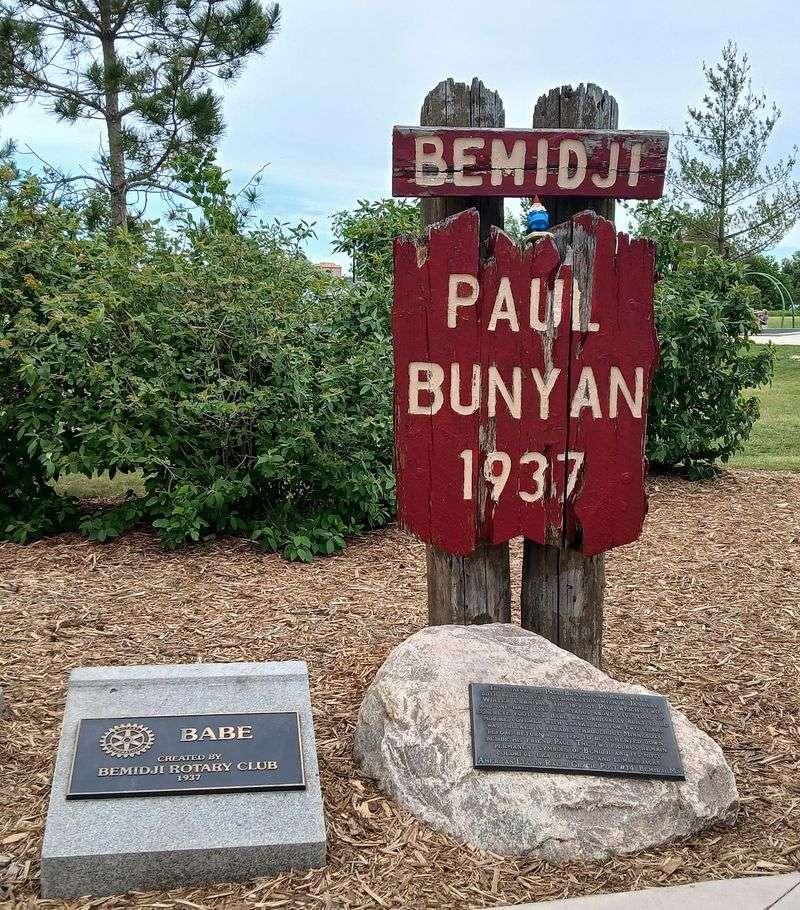
The carnival promotion quickly outgrew its original purpose.
Paul and Babe attracted attention beyond Bemidji and appeared in Life magazine soon after their debut. Their visibility helped establish the pair as an early example of the oversized roadside attractions that later became common along American highways.
That broader roadside history eventually brought formal recognition.
Paul Bunyan and Babe the Blue Ox were added to the National Register of Historic Places in March 1988. The listing identifies 1937 and 1938 as significant years and recognizes the figures for their role in tourism and recreation.
The designation is more meaningful than simply calling the statues old.
It places the pair within the history of American travel culture, when communities used bold roadside landmarks to convince motorists to stop, take a photograph, and remember a town.
Bemidji happened to get there early.
You can still stop for a photograph without digging into the history, then explore the background if curiosity takes over.
If you like places with a second layer, the National Register connection gives the visit more context.
What looks playful from the road is also a preserved piece of twentieth-century tourism history.
The Lakeside Stop Has More Than The Statues
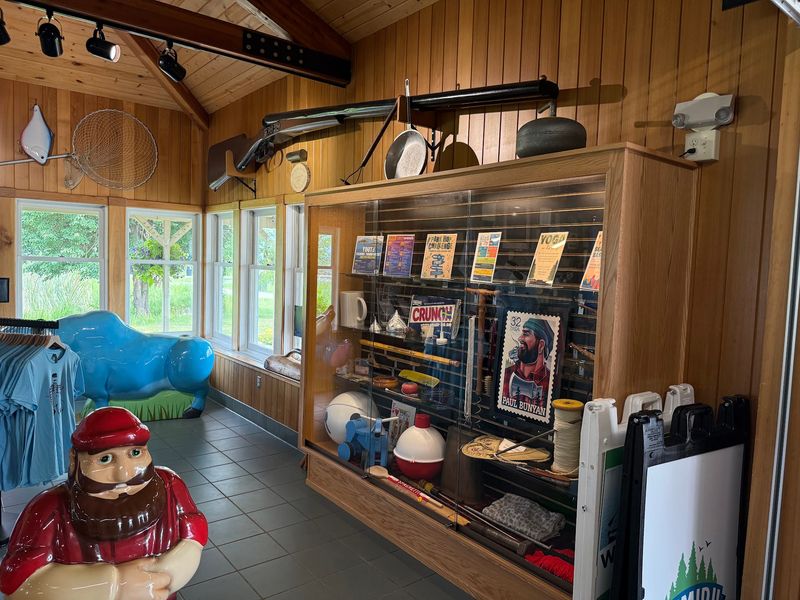
The Tourist Information Center beside Paul and Babe gives you an easy reason to stay longer than the photo requires.
Inside, displays include Paul Bunyan memorabilia and the Fireplace of States, a large fireplace constructed with 900 rocks gathered from every state in the country and every Canadian province.
That gives you something to explore when the weather is cold, rainy, or simply less pleasant than expected.
Outside, the Lake Bemidji shoreline adds another direction to the visit. You can stretch your legs, follow the nearby paths, or take a few minutes by the water before getting back on the road.
Downtown Bemidji is close enough that the statues can also serve as the starting point rather than the whole itinerary.
The visitor center is open year-round, although hours can change with the season. If going inside matters to your plans, checking the current schedule before arrival keeps the day simple.
The statues themselves do not require a complicated strategy. Walk up, take the photograph everyone came for, and then decide whether the lake, downtown, or the visitor center gets the next half hour.
That flexibility is part of the appeal. A landmark this recognizable does not demand a full afternoon to feel complete.
Generations Keep Coming Back To The Same Pair
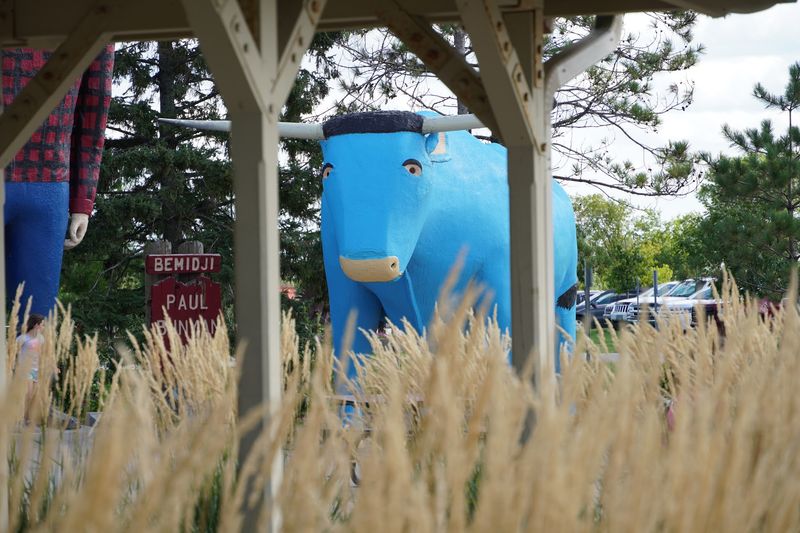
The lakeside setting has helped turn the statues into an easy tradition for families passing through northern Minnesota.
A grandparent can stand near the same Paul and Babe seen on a childhood trip. Parents can recreate old photographs with their own children. Travelers discovering the pair for the first time can join a ritual that began long before smartphones made roadside photos effortless.
The setting has changed around them, but the basic stop remains remarkably simple.
Paul still faces the road. Babe still stands beside him. The lake is still only steps away.
If you have an old family picture from Bemidji, bring it along and see how closely you can match the pose. If this is the first visit, take one that somebody else might bring back years from now.
That is the nice thing about a landmark built to get attention but kept around long enough to become part of family memory.
You can come for the giant statues, spend a little time by the water, and leave with a photograph that may matter more later than it does in the moment.
Paul and Babe will still be waiting at 300 Bemidji Ave N, Bemidji, MN 56601, ready for your next photo.